Health Education, Health Articles, Health Blog

Showing posts with label lake. Show all posts

A Wild Volvox

Seldom does a day pass when I fail to learn something new from the guests on my tour. Today, a pair of freshwater ecologists from Chicago taught me about the life of Lost and Found Lake.

A dragonfly's-eye view of Lost and Found Lake.

Our dragonflies live four to five years as nymphs, chomping on mosquito larvae and overwintering in lake-bottom muck. They molt from nine to twelve times before finally emerging as royal-blue, winged adults. They fly for one summer before dying in the frosts of fall.

Damselflies go through a similar process but spend only two to three years as nymphs, a stage in which they have three tails and long, wriggly body. We found dragonfly and damselfly nymphs when I scooped lake water into my frisbee. (Just one more reason why you should never leave home without one!)

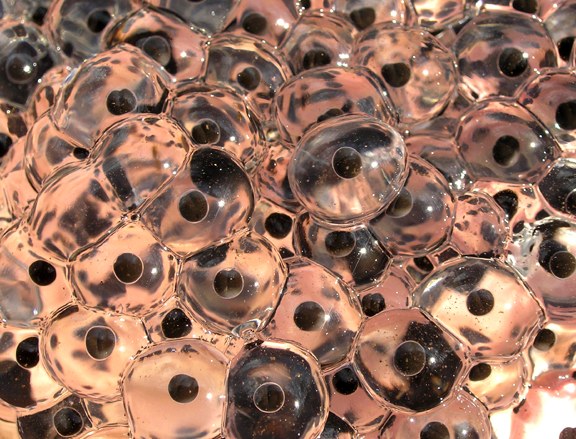
But the most incredible discovery of all came from the ecologists' daughter who scooped a firm, transparent goo blob from the lake. I'm used to unidentified blobs in the intertidal zone, but in freshwater I was out of my element.

Frog eggs? Nope, we have only one amphibian in Alaska (the wood frog, Lithobates sylvaticus) and its eggs look more like clear grapes with a black dot in the middle.

Snail eggs? Perhaps, though I've never seen a snail in this lake.

Then I looked closer. Thousands of tiny green dots were aligned within the blob, perfectly ordered like soldiers on the march. At the edges of the blob, where upper and lower surfaces overlapped, the dots gave a mossy sheen to the blob.

Could it be... Volvox? The spherical, chlorophytic protist from introductory bio lab?

The ecologists and I leaned in. "Look, it has five gas bubbles trapped inside!" one exclaimed. "I think it's respiring!" Oxygen building up inside was the final clue, and the blob was proclaimed to be Volvox.

A wild Volvox!

I sacrificed my water bottle for our new friend's transport. Back at the field station, we peered through a microscope to see the tiny green dots up close. They didn't look round, but rather like commas, and they jiggled like worms trapped in a force field.


Volvox is an important tool for biology education because it displays both sexual and asexual reproduction. Asexual reproduction is cooler: miniature, spherical daughter colonies form within the parent blob and are released into the world.

Scientists think Volvox switched from a single-celled organism to a communal enterprise about 200 million years ago, and research into that transition is providing clues about how the evolution of cooperation allowed our single-celled ancestors to become the plants and animals of modern times.

It always startles me to see laboratory species in the wild. The same thing happened with slime mold. In high school, I made mazes for slime mold using oats and Petri dishes, then filmed its decision-making with a time-lapse camera. Slime mold was recently featured in Nature for redefining intelligence! Now, on my daily hikes, I notice slime mold inching around the rotting logs of its home, the coastal temperate rainforest.

A banana-yellow slime mold seeks shade in the forest of Peterson Bay Field Station.

Watching slime mold and Volvox do their thing in the wild reminds me of the importance of intact ecosystems. Without old-growth rainforests and healthy lakes, scientists would never have encountered these model organisms that have led to dozens of laboratory-based discoveries and a better understanding of topics ranging from memory to cellular reproduction to our own evolution. 

Imagine how many more organisms are out there in unexplored regions of the Amazon, the Arctic, or the deep sea. Who knows what strange life form is going about its daily business of eating, competing, and reproducing, just waiting to be discovered next?
Share:

Smoked Salmon in an Unexpected Row Boat: Day Six on the Alaska Road Trip

Upon leaving Beaver Creek, we immediately came upon Canadian customs. “Alaska, here we come!” we thought, only to find that US customs were in another 30 kilometers. Which country lies in between? It’s unclear. After that minor hiccough, we did indeed cross the boundary into our own country. Finally!

Welcome to Alaska!

Our first business was to buy cheap gasoline: $3.00 per gallon instead of $1.30 per liter, you do the math. There, we met a mom and her young adult son who had driven all the way from Henryville, Indiana.

The telephone poles on the US side of the border were not doing well in the melting permafrost. Many were only feet from being totally submerged.

A roadside pond was packed with skittish ring-necked ducks, American wigeons, and mallards. They wouldn’t let us get within a half-mile; maybe this pond is open to duck-hunting?

Two ring-necked drakes and one duck.

An eager young ranger at the Tetlin National Wildlife Refuge was surprised at the direction we were headed. “Most visitors are headed south,” he told us. “Welcome to Alaska, ladies. You have the state to yourselves!” Jane spotted two distant trumpeter swans through the scope, and I read about the replica food cache that was used by early settlers and Native Alaskans to keep food and supplies safe from floods and rodents. According to the sign, frontier code stated that a stranger could break into any cache in an emergency, but was expected to fully replenish any supplies used.

We checked out a free audio tour, and an assertive lady verbally guided us through the next several hours of beautiful country. I think we stopped at every short hike the Refuge offered: Seaton Roadhouse, Hidden Lake, Dead Man Lake, and Lakeview Campground.

Seaton provided with a stunted black spruce forest, a posse of American robins, and two species of waterfowl: American wigeons and good ol’ mallards.

Seaton Roadhouse lake.

Two of the plentiful American wigeons.

Hidden Lake offered the best surprise of our day.

The boardwalk through stunted black spruce taiga.

Lowbush cranberry.

The 1.2 mile boardwalk through boreal forest brought us to a sparkling blue lake, a rack of red life-preservers, and a pair of flat-bottomed rowboats with handmade paddles (a 2x2 with a square slab of plywood nailed to the end).

Unexpected rowboats!

Handmade paddles.

We paddled in a hybrid rowboat/canoe style to the middle of the lake, where we ate a smoked-salmon picnic and watched rainbow trout leap from the water. A couple from Holland took out the other rowboat. They had visited the very same lake 10 years before and seen beavers from their rowboat, but today only an empty lodge remained.

Beavers abandon their lodges when the local supply of hardwood (willow and alder) saplings is depleted.

Dead Man Lake was home to a scoter, a duck we normally associate with the ocean, but which occasionally ventures inland in summer.

Lakeview Campground offered a photo blind, where we heard loud splashing near the shore. I thought it might be a bear, but mom was hoping for a moose or sage grouse. The culprit turned out to be a trio of mallards taking a raucous, splashy bath.

SPLASH!

Six adolescent ducklings is a feat to be proud of for mama mallard.

We made it to the city of Tok and ordered take-out at the suggested eatery, Fast Eddy’s.

Fast Eddy's in Tok, Alaska.

We pulled out of town at 5:30 pm, 120 miles down, 210 to go. Jane and I entertained ourselves with Milepost-Chocolate-Chip Trivia through Delta Junction and North Pole (a town suffused in candy-cane stripes). As we pulled into Fairbanks, we saw a moose and two calves nibbling grass by the highway. Our Best Western was thrilling for four reasons: a pool, a printer, free ice, and laundry – all of which we took full advantage of before hitting the most comfortable beds of the week!

End of day summary:
  • Day of road trip: 6
  • Start: Beaver Creek, Yukon Territory, Canada 
  • Miles traveled: 311 
  • Hours driven: 6 
  • Favorite bird sighting: ring-necked duck 
  • End: Fairbanks, Alaska, United States
Share:

The Fruit Barn, Dead Geese, and a Bobcat: We're Off to Big Sky!

Finally, at three on Friday afternoon, the car was packed. Amelia had finished her environmental methods paper, Anna had ordered us take-out sandwiches from Graze, Galen had found his cross-country ski boots, and I had arranged all my plants in the living room for a friend to water over spring break.

We were off!

Taylor Swift dominated our soundtrack as we drove out of Walla Walla, through rolling brown wheat fields with thin green shoots, and past the stench of the Wallula Paper Mill. We stopped at one of the famous eastern Washington fruit barns for salted caramel and peanut butter fudge, honeycrisp and pink lady apples, and a cultural experience.

Galen and Amelia show off our $16.95/pound fudge and the endless racks of jams, jellies, and fruit butters.

I sampled chocolate-covered mangoes and chili-spiced almonds. (The elderly man next to me declined the almonds, citing his "gringo palate.") A customer at the soda bar received a jumbo-sized Pepsi cup stuffed with ice cream, and two enormous scoops were balanced on top. My cashier asked if I'd like my apples rinsed -- to remove the pesticide residue, I assume. The parking lot was home to a herd of absurdly long-horned cattle.

The warehouse of chocolate candies and canned fruit products made me dizzy. I asked the young woman who cut my quarter-pound chunk of fudge if she ever had to throw away unsold chocolate. She told me, "Never! I've never seen a batch last more than a couple days." These fruit barns are a quirky phenomenon.

As darkness fell, we continued north into Ponderosa pine forest. We stopped at the Sinclair Dino gas station in the impossibly sleepy town of Mullan, Idaho where we met the friendly young cashier who let me roll out my sore leg muscles on the floor. We filled the tank, thanked him, and left -- only to return in three minutes for directions.

It was my turn to drive on the dark stretch of I-90 East over Lookout Pass, the border between Idaho and Montana. Just after we crossed the state line, a bobcat ran across the road in front of us! She was the size of a dog, but with the regular gait and dark brown fur of a cat. Luckily I braked in time to let her get across safely.

Photo credit: Linda Tanner, Creative Commons License.

"Did you see that?!" I yelled. Nobody had. I was thrilled to see my first bobcat, but I wish it had been in rather different circumstances!

We spent the night at a friend's house in Missoula, and continued our trek the next morning. We stopped for lunch (bison burger, oh boy!) at the Hummingbird Cafe in Butte, Montana.

Miniature collages by a local artist adorned the walls of the Hummingbird Cafe.

My favorite piece was "Rat and Roses." Maybe I'll make my own version next time I have a rat skull on hand.

The broken windows, falling-over retaining walls and abandoned buildings of Butte reminded me of certain neighborhoods in Ecuador. The looming, dusty brown hills with paths and words etched into them reminded me of Cusco, Peru.

Unplanned street art of Butte.

Before we left town, we had to stop at the infamous toxic lake, Berkeley Pit. This mine produced one third of America's copper from 1955 to 1982. We approached the Pit through a fake mine-shaft for tourists.


The lake holds 40 billion gallons of water. It looked huge from the surface, and became even more impressive when I realized the sloped sides got progressively steeper as they went down below the surface.


An infographic sign informed us, "The water has very high concentrations of copper, cadmium, cobalt, iron, manganese, and zinc." It also mentioned the concentration of arsenic and the water's stunningly acidic pH of 2.5.

Meanwhile, a reassuring voice over the loudspeaker reminded us about the water treatment facility that's being built to meet EPA regulations. The facility will treat seven million gallons of water per day and discharge "clean water" into Silver Bow Creek. The treatment plant is "designed to operate forever."

Another infographic noted that "even with the metals and the acid, the Pit supports life." Two species, to be exact: waterboatmen insects and an iron-digesting algae. I think the sign was trying to convince us that the Pit isn't all that toxic after all, but it made the opposite impression on me. Life is amazingly adaptable -- the fact that only two species manage to survive in the Pit persuades me of its extreme toxicity.

Back in the car, we listened to a fascinating Radiolab podcast about the Berkeley Pit. We learned about a flock of 340 snow geese that died on the water in the 1990s, the first green slimy life in the Pit discovered by two married chemists from Montana Tech, and an incredible cancer-curing yeast. You don't want to miss it. Check out the podcast here: Even the Worst Laid Plans?

Site of the proposed Pebble Mine in the Bristol Bay region of southwest Alaska.
Photo credit: Erin McKittrick, Creative Commons License.

The Berkeley Pit got me thinking about a different copper mine: the proposed Pebble Mine near Bristol Bay, Alaska. Pebble Mine is being contested by native groups, fisherman and environmentalists for its potential to destroy the world's largest remaining wild salmon run. If it goes through, Pebble Mine will likely be the largest open pit ever built in North America, dwarfing the Berkeley Pit and rivaling the Grand Canyon with its depth of nearly a mile.

After seeing the Berkeley Pit, learning about its toxic effects on ground and surface water, hearing of the untenable plan to treat its water "forever," and listening to the clearly deceitful message of environmental consciousness at the Pit viewing site, I am convinced that we should take action to prevent the Pebble Mine from being built.

By the mid-afternoon, we arrived at Anna's house in the gorgeous snowy mountains of Big Sky, Montana for a hot meal of potato-leek soup and blackberry cobbler. (Thank you Barbara!) Finally, we made it to Amelia and Galen's house where we received a warm welcome from Beth and John. I can't wait to strap some skis on my feet for the first time and get out into the lodgepole pines, Douglas firs and Engelmann spruces out the back door!
Share:

The Anhinghoo with an Exactlywattle?!