Health Education, Health Articles, Health Blog

Showing posts with label art. Show all posts

GRIZZLIES! Day Eight on the Alaska Road Trip

Today can be summed up in a word: GRIZZLIES!

Our day began at 8:00 am at the Denali National Park Visitor Center, where we picked up our pre-paid bus tickets to Eielson Visitor Center, located 66 miles into the park (an eight-hour round trip!) The road is paved on only the first fifteen miles, and this is the only stretch that people can drive in their own cars. After that, you’re stuck with the green “Explore Denali” shuttles, refurbished school buses.

The legendary green Denali school buses.

It’s a narrow, winding, dirt road, often next to steep cliffs with two school buses passing each other. We were glad to have left Prius back in the safety of her parking lot.

View of the river valley from a rest stop.

On the buses, we met several drivers – the delightfully chatty Marilyn, who advised us not to get our heads clawed off my bears because she “hates paperwork,” and the grumpy Dale, who taunted us by not stopping the bus next to wildlife until the bus riders were entirely silent – and made friends with other riders, including Maya and Rich from Nature Bridge, who were full of internship and fellowship advice for me.

Now to the good stuff: wildlife.

We saw seven caribou, including bulls with enormous antlers.

Unbelievable rack!!

The antlers are still in velvet.

I could barely lift them!

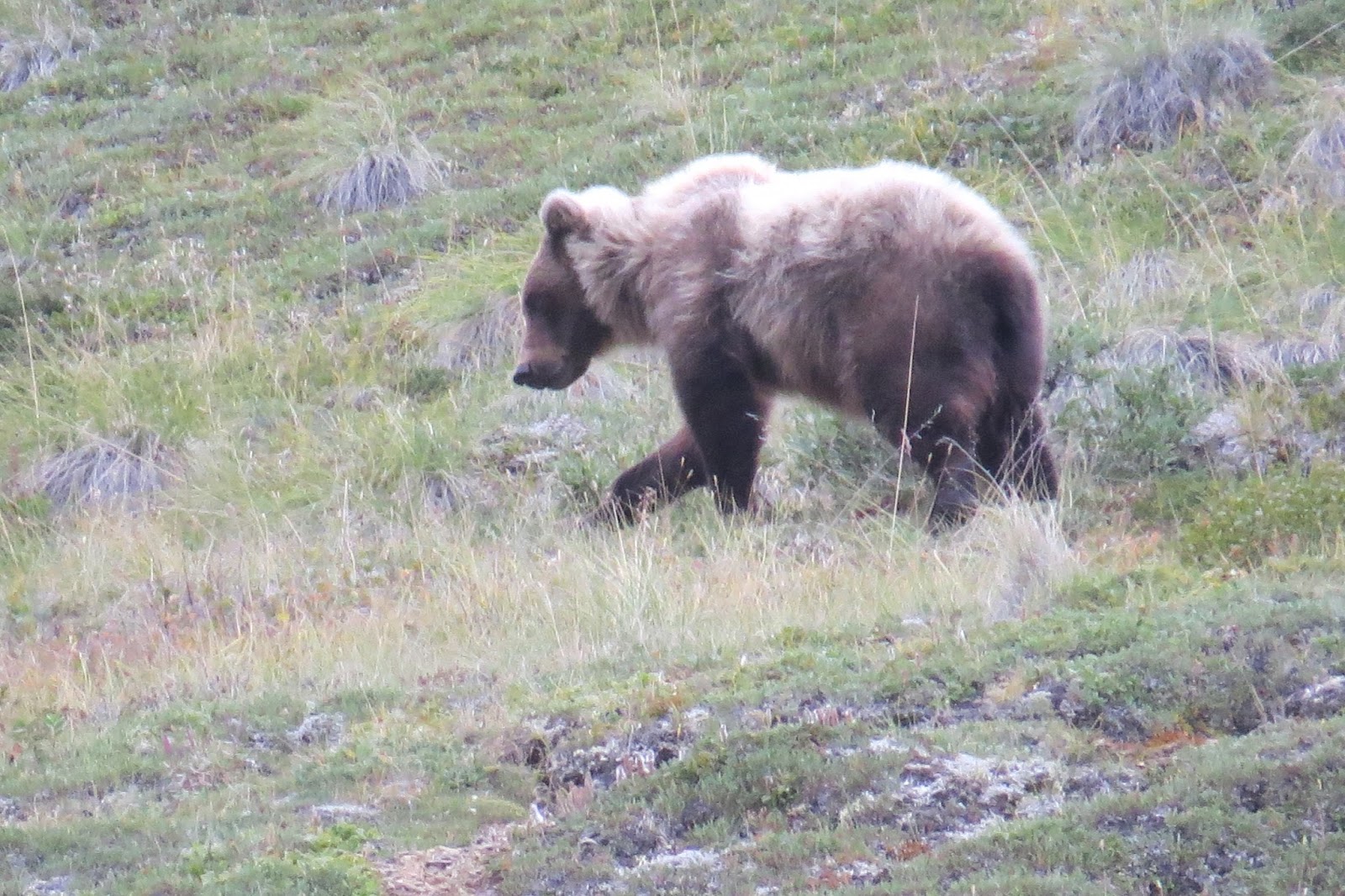
We counted six grizzly bears, walking below, sitting above, or snarfing blueberries. A sow and yearling cub ran along the road in front of our bus for ten minutes!

Just crossing the road.

Mmm... blueberries.

Check out those claws for digging!

Nice foot pad, dude.

Majestic grizzly.

Oh hey.

Got an itch here...

Ahh, that's better.

This is how far away many of the grizzlies actually were from the bus.

We spotted three groups of Dall sheep, adding up to maybe a dozen in total, but it’s hard to know for sure. These guys hang out so high on the rocky cliffs, they appeared as little white dots to us.

Two Dall sheep rams high on the mountain.

After four hours, we arrived at Eielson Visitor Center. The National Parks have an awesome program called Artists in Residence. To pay for her stay in a remote park cabin, the artist donates one piece of her artwork to the visitor center. We loved two of the pieces in particular.

This artist had the simple goal of capturing her favorite memories from her time spent in Denali: the green buses, the paw prints, the playful magpies, and the golden hill.

The epic quilt that took two years to sew! You know you're looking closely enough if you can see the mosquitoes.

This wasn't official artwork, but I loved the pressed wildflowers beneath the information desk.

We took an hour-long, ranger-guided hike on the Tundra Trail. Lichens, wildflowers, dwarf birch, and plentiful Arctic ground squirrels stole the show.

Arctic ground squirrel.

Tundra hike.

Tundra and Jane!

Tundra and Nina!

Birds included golden eagles, American kestrel, white-crowned sparrow, and our favorite of the day, Mystery Bird. Jane thinks it’s a northern waterthrush, while Nina is pulling for American pipit. No ranger could help us with this matter. To all those orntihologically-savvy readers, please help us out in the comments! What have we found? (Important clues: it was hopping around the gravel parking lot in the tundra, conspicuously bobbing its tail up and down.)

Mystery bird back...

Mystery bird front... (Click on the photo to zoom in.)

We caught a green bus heading back to the park entrance and hopped off at Savage River Bridge for the two-mile loop trail along the water. Alas, we saw no northern hawk owls, nor a willow ptarmigan, but we did sight a hoary marmot on its boulder and a vole crossing the trail. Best of all, we discovered the still-articulated knee joint of a moose calf under a bush by the river.

Dr. Jane demonstrates the ungulate hinge joint.

Back at the road, we flagged down yet another green bus (they’ll pick up anyone standing along the road) and added a cow moose to our list. She was browsing for greens. Eating seems to be the main activity up here in the northern summer.

We were on board for that! We headed back to the town of Healy to buy some… THAI FOOD! I’d been hankering for this mouth-watering meal from the orange food truck all day. The pad thai and green curry were DELICIOUS!

Alaskan twin!

At our new friend Maya’s suggestion, I set my alarm for 2:55 am and went outside to check for the glowing green northern lights. Not-so-much to my disappointment, the sky was overcast, so I snuggled back into my scrumptiously warm bed.

End of day summary:

  • Day of road trip: 8
  • Start: Healy, Alaska, United States
  • Miles traveled: 30 (Prius) + 132 (green school bus)
  • Hours driven: 8.5
  • Favorite bird sighting: Mystery Bird
  • End: Healy, Alaska, United States (thank goodness for our first night in the same place!)
Share:

The Fruit Barn, Dead Geese, and a Bobcat: We're Off to Big Sky!

Finally, at three on Friday afternoon, the car was packed. Amelia had finished her environmental methods paper, Anna had ordered us take-out sandwiches from Graze, Galen had found his cross-country ski boots, and I had arranged all my plants in the living room for a friend to water over spring break.

We were off!

Taylor Swift dominated our soundtrack as we drove out of Walla Walla, through rolling brown wheat fields with thin green shoots, and past the stench of the Wallula Paper Mill. We stopped at one of the famous eastern Washington fruit barns for salted caramel and peanut butter fudge, honeycrisp and pink lady apples, and a cultural experience.

Galen and Amelia show off our $16.95/pound fudge and the endless racks of jams, jellies, and fruit butters.

I sampled chocolate-covered mangoes and chili-spiced almonds. (The elderly man next to me declined the almonds, citing his "gringo palate.") A customer at the soda bar received a jumbo-sized Pepsi cup stuffed with ice cream, and two enormous scoops were balanced on top. My cashier asked if I'd like my apples rinsed -- to remove the pesticide residue, I assume. The parking lot was home to a herd of absurdly long-horned cattle.

The warehouse of chocolate candies and canned fruit products made me dizzy. I asked the young woman who cut my quarter-pound chunk of fudge if she ever had to throw away unsold chocolate. She told me, "Never! I've never seen a batch last more than a couple days." These fruit barns are a quirky phenomenon.

As darkness fell, we continued north into Ponderosa pine forest. We stopped at the Sinclair Dino gas station in the impossibly sleepy town of Mullan, Idaho where we met the friendly young cashier who let me roll out my sore leg muscles on the floor. We filled the tank, thanked him, and left -- only to return in three minutes for directions.

It was my turn to drive on the dark stretch of I-90 East over Lookout Pass, the border between Idaho and Montana. Just after we crossed the state line, a bobcat ran across the road in front of us! She was the size of a dog, but with the regular gait and dark brown fur of a cat. Luckily I braked in time to let her get across safely.

Photo credit: Linda Tanner, Creative Commons License.

"Did you see that?!" I yelled. Nobody had. I was thrilled to see my first bobcat, but I wish it had been in rather different circumstances!

We spent the night at a friend's house in Missoula, and continued our trek the next morning. We stopped for lunch (bison burger, oh boy!) at the Hummingbird Cafe in Butte, Montana.

Miniature collages by a local artist adorned the walls of the Hummingbird Cafe.

My favorite piece was "Rat and Roses." Maybe I'll make my own version next time I have a rat skull on hand.

The broken windows, falling-over retaining walls and abandoned buildings of Butte reminded me of certain neighborhoods in Ecuador. The looming, dusty brown hills with paths and words etched into them reminded me of Cusco, Peru.

Unplanned street art of Butte.

Before we left town, we had to stop at the infamous toxic lake, Berkeley Pit. This mine produced one third of America's copper from 1955 to 1982. We approached the Pit through a fake mine-shaft for tourists.


The lake holds 40 billion gallons of water. It looked huge from the surface, and became even more impressive when I realized the sloped sides got progressively steeper as they went down below the surface.


An infographic sign informed us, "The water has very high concentrations of copper, cadmium, cobalt, iron, manganese, and zinc." It also mentioned the concentration of arsenic and the water's stunningly acidic pH of 2.5.

Meanwhile, a reassuring voice over the loudspeaker reminded us about the water treatment facility that's being built to meet EPA regulations. The facility will treat seven million gallons of water per day and discharge "clean water" into Silver Bow Creek. The treatment plant is "designed to operate forever."

Another infographic noted that "even with the metals and the acid, the Pit supports life." Two species, to be exact: waterboatmen insects and an iron-digesting algae. I think the sign was trying to convince us that the Pit isn't all that toxic after all, but it made the opposite impression on me. Life is amazingly adaptable -- the fact that only two species manage to survive in the Pit persuades me of its extreme toxicity.

Back in the car, we listened to a fascinating Radiolab podcast about the Berkeley Pit. We learned about a flock of 340 snow geese that died on the water in the 1990s, the first green slimy life in the Pit discovered by two married chemists from Montana Tech, and an incredible cancer-curing yeast. You don't want to miss it. Check out the podcast here: Even the Worst Laid Plans?

Site of the proposed Pebble Mine in the Bristol Bay region of southwest Alaska.
Photo credit: Erin McKittrick, Creative Commons License.

The Berkeley Pit got me thinking about a different copper mine: the proposed Pebble Mine near Bristol Bay, Alaska. Pebble Mine is being contested by native groups, fisherman and environmentalists for its potential to destroy the world's largest remaining wild salmon run. If it goes through, Pebble Mine will likely be the largest open pit ever built in North America, dwarfing the Berkeley Pit and rivaling the Grand Canyon with its depth of nearly a mile.

After seeing the Berkeley Pit, learning about its toxic effects on ground and surface water, hearing of the untenable plan to treat its water "forever," and listening to the clearly deceitful message of environmental consciousness at the Pit viewing site, I am convinced that we should take action to prevent the Pebble Mine from being built.

By the mid-afternoon, we arrived at Anna's house in the gorgeous snowy mountains of Big Sky, Montana for a hot meal of potato-leek soup and blackberry cobbler. (Thank you Barbara!) Finally, we made it to Amelia and Galen's house where we received a warm welcome from Beth and John. I can't wait to strap some skis on my feet for the first time and get out into the lodgepole pines, Douglas firs and Engelmann spruces out the back door!
Share:

Blades of Sugarcane

Day 36: Monday, February 10th


This morning we packed up all the things that had spread out across our hotel room during our extended three-night stay. We stopped at two government-run research stations, IAPAR and Embrapa.

IAPAR (Instituto Agronomico de Parana) is a state-based (rather than federal) agricultural research agency. Instead of focusing on one commodity or type of farming, IAPAR works to develop sustainable farming techniques across the board. They were working on genetically modified strains of soybeans, biological pest control, shade-grown coffee techniques, and no-till farming, to name a few. We took a tractor ride around the research farm. The coolest part was watching latex drip from tapped rubber trees. Whoever discovered that?

Experimental coffee seedlings.

A new trial of shade-grown coffee under rubber trees.

A researcher shows us how latex sap is tappped from the trunk of a rubber tree.

The latex sap is poured into plastic flower pots, where it congeals into tough discs like this. These discs are sent to the factory for processing.

A red dirt road through experimental sugarcane fields.

In the afternoon we headed to Embrapa Soja, the soybean version of the federal agricultural research agency we visited a few days ago. (Earlier we visited the swine and poultry Embrapa.) We were joined by a group of older Canadian farmers who are also on an agricultural tour of Brazil. The Canadians’ attitudes and questions made me realize that I would have a very different perspective on this trip if I was of a different age.

We didn’t get to tour any of the Embrapa facilities, but the presentation raised some interesting points. One thing I find interesting if the Brazilian land conservation law which requires farmers in the cerrado biome to maintain at least 20% of their farmland in natural forest vegetation. (This requirement varies by biome, with Amazon land requiring a full 80% to be naturally forested.) Embrapa explained that since their research farm was already deforested, they were allowed to reforest the correct area of land 50 kilometers away from the property, as long as it was within the same biome.

This loophole made me think: wouldn’t it be better if every farmer were required to purchase and preserve an area of forest that equaled 20% of his farmland offsite, in a centralized location with other forest preserves? When we drive past farmland, I can look out the window of the bus and see the small, fragmented patches of forest dispersed among hectares of soybean and corn. These patches are a nice visual touch to the landscape, and I’m sure they house some wildlife, like frogs and birds. But they aren’t helping large mammals or raptors which require large ranges, and all the species they hold except birds are genetically isolated. So, I asked, why is the current law the way it is? Do these parcels help local water, soil, and air quality? Or was it simply too difficult to legislate and enforce offsite conservation zones?

I’ve found that I focus better when I’m doodling, so I drew a portrait of our presenter while taking notes.


Tonight we checked into a hotel with a tropical paradise pool. After a cheap, filling truckstop dinner of rice, beans, chicken, and a fried egg, we all headed to the pool for frisbee and drinks. I found two massive cane toads as a bonus!

Day 37: Tuesday, February 11th


Today we rode the bus home! Well, at least to Piracicaba, our home in Brazil.

We spent the morning at Zilor: Energy and Food, a sugar growing and processing company. We sat through some interesting (if slightly too-detailed) presentations, and then we got our wish. We frolicked through a sugar cane field! We chewed the sweet, fibrous cane fresh from the field, and waged sugar-cane battles. We galloped over the rows of straw and hid in the razor-sharp leaves. I had a sneezing attack (sugar cane is definitely in the grass family!) and took a photo with a working sugar-cane harvester. What fun!
  
Now that burning sugarcane is illegal in Brazil, the extra greenery is left in the field where it dries into hay. This hay is then baled and burned to generate electricity.

The farm implement of torture and death.

We saw all sort of machines in action! This truck was dumping chopped sugarcane stalks into another truck.

We got to watch a harvester in action. Usually, the cane would be taller than the harvester, but this year has been one of serious drought and low production.

This year's straw is raked into mounds for the baler to pick up.

The harvester!

Peek-a-boo! (This is where I realized my grass allergy applies to sugarcane.)

Look at me! Now I'm COUNTRY in all caps!

We could not resist a battle with blades of sugarcane.


Unfortunately, we couldn’t tour the inside of the processing plant since it’s currently the off-season, but we did take a bus tour. I was stunned by the massive equipment.

Since it is not harvesting season, the ethanol and sugar production were shut down. Only the boiler was running to produce electricity, which is sold to the utility companies.
 All of this mechanical infrastructure just to put those sweet crystals in our kitchens!

Here is a load of sugarcane straw bales being delivered to the boiler.

Here are the tanks which hold anhydrous ethanol.

The bus ride back to Piracicaba was long, as expected, but it was so much more pleasant than our overnight slog ten days ago. I dozed, listened to music, and managed to read a few chapters of Stephen King’s Different Seasons without getting too carsick. Everyone was running out of books to read, so we all swapped. I loved watching people get into their books. As a book lover myself, I always feel happy watching others read. It’s amazing what can happen when laptop batteries die!

Day 38: Wednesday, February 12th


Today can be described in one word: project. Although my group worked hard on our proposals and discussed our outline on the long trip, there just wasn’t time before today to get serious work done. So today, we got down to business!

We were glad that the morning class was just a study session, so we could get solidify our outline. For lunch, Erin and I walked to the cafeteria where I discovered my new favorite meal: buttery brown rice, cooked vegetables, and grilled chicken followed by a cup of frozen acai, banana slices, and strawberries.

In the afternoon, we worked at school until 6pm, when we stopped at Subway. They didn’t have flat bread, so I got a tangy combination of bacon, cheddar cheese, red wine vinegar, raw onions, and arugula on honey wheat bread. Then we sat in the hotel lobby and worked on our project until 1 in the morning, with just one break for frozen yogurt.

As we ran through the project and timed ourselves in the wee hours of the morning, I wished we had started this project earlier! But looking back, I knew we hadn’t had time. When I tried to work on the bus, I felt nauseated within minutes; we arrived late at night at several of our hotels; and the few hotels where we did have free time did not have reliable internet. So I just took the situation as an uncontrollable, to quote my ultimate frisbee coach, and made the best of the situation. We will meet tomorrow morning at 6am for a couple final run-throughs.

Day 39: Thursday, February 13th


Presentations day! I got up after four hours of sleep for a very early breakfast (apparently a little too early – although all the food was already laid out, a hotel worker let me know the breakfast was not open yet – my bad.) We ran through the PowerPoint a couple times, and like every last-minute group project, the presentation seemed to magically improve at the last minute to something better than respectable.

We watched three presentations and gave ours fourth. I most enjoyed the first presentation, which was about ethanol and the food vs. fuel debate. The presenters were great public speakers, and I’m very interested in biofuels. One thing I noticed during the presentation was the two members used the word “believe” and all three used the word “faith.” For example, one girl explained that whether you side with food (against ethanol) or fuel (for ethanol) depends on what you believe, since there is research supporting both sides. Later, another group member said he thinks ethanol will someday replace gasoline completely because he has faith in technology. I was a little disturbed by these statements, because I have been taught the “belief” and “faith” often denote a wish somebody has which is not entirely logically sound.

In the food vs. fuel debate, a person should still come to a conclusion based on the data. Just because there are scientists on both sides of the debate does not mean that a person can simply choose the side she likes more. In time, as more research is conducted and real-world consequences are observed, people will change their minds. One’s opinion should not be based on faith.

I was surprised when Shirota’s first question to the presenters focused on this exact detail, the use of the words “believe” and “faith” when discussing a scientific debate. Shirota, never one to hide his opinions, mentioned that this American habit of choosing what to believe when there is a sound scientific answer is a disgrace to the United States and to humanity. His examples included teaching intelligent design in schools and choosing not to get vaccinated. I know Shirota pissed off a lot of people in that class, but I was heartened by his logic and his candidness.

For lunch, I went to the cafeteria with Erin and repeated my New Favorite Meal. We watched the last few presentations. I just took a hot shower to untie the knots in my shoulders. In an hour I’ll go to the Farewell Dinner with my host sisters. It will be great to see them but sad to say goodbye! I can’t believe how soon we are leaving Brazil. It’s even harder to comprehend because even though I’m done with the presentation, my mind is not free. I have three internship applications due tomorrow, the day after, and three days after that! By then, I will be in Ecuador.

All I can say is that this adventure is far from over.
Share:

Popular Posts

Labels