Today we visited the neighbors on their vast property, Fazenda Colorado. In Brazil, a lot of land is owned by a few people. This fazenda, or cattle ranch, was a prime example. The red, sandy roads stretched for miles through pasture, forest, and rock outcroppings without ever leaving the property.
 |
| A red-legged seriema on Fazenda Colorado. These birds are three feet tall. They run like Big Bird, and they are always seen in pairs. I've never seen either partner without red lipstick. |
The land is owned by one man, Luiz, but he wasn't there today. His son (also Luiz) and a couple of family friends were visiting from Sao Paulo, where they live. It's about a 14-hour drive, so the families flew. Each family consisted of a mother, father, and two kids between the ages of five and eight. With all that land to roam, a swimming pool, a few palm trees, and the warm climate, it seemed like an ideal winter getaway.
 |
| Here is the ranch house where we stayed for a traditional and generous barbeque lunch. |
I learned that agriculture in Brazil is very profitable now, more so than medicine or most other careers, but the economy is unpredictable, so that might not be the case for long. Beef production is split into three stages: the breeding, the growing, and the slaughtering. This farm, Fazenda Colorado, is for breeding. There are 3,000 cattle on the land now, two-thirds adults and one-third calves. The owner has another farm a few hours away, Fazenda California, where the growing takes place.
 |
| Blue-and-yellow macaw. These large birds also travel in pairs, but sometimes they group together in noisy flocks. They always fly with purpose. |
Duca, Lygia, and I were invited over today so Duca could give Luiz and his friends a tour of their own farm. She has been given permission over the past years to do research on this land, so she knows it well.
 |
| Duca shoos white zebu cattle away from the road after opening one of a dozen gates. |
 |
| The "slipping monkey tree," or cumbara, is covered with rusty powder that poofs into a cloud when touched. I imagine its purpose is more to stop epiphytes from growing than monkeys from climbing. |
 |
| João, grandson of the owner, poses with a slipping monkey tree. |
The most incredible part of the farm is that it borders the Pantanal. To orient you in space: the Pantanal is the world's largest tropical wetland, covering 75,000 square miles smack-dab in the middle of South America. It is mostly contained in the Brazilian state of Mato Grosso do Sul (where I am), but the edges spill into Mato Grosso to the north, Bolivia to the west, and Paraguay to the south.
 |
| The lime-green blob is the Pantanal, world's largest tropical wetland. |
Pantanal is a geological wonder. Unlike most wetlands, it is neither a coastal estuary nor a permafrost marsh. It's a vast inland delta, essentially a low spot in the floor with no drain (an engineer's worst nightmare). Two-and-a-half million years ago, the continent simply sagged in the middle due to the same tectonic forces that are uplifting the Andes.
Rain falls. Rivers flow. Water collects at the bottom.
The Pantanal goes through enormous seasonal changes. In the wet season (January-March), up to 80% of the area floods. Cattle and wildlife huddle on the few emergent islands of forest. In the dry season (July-September), water evaporates until only a few puddles are left.
To the north and east, the Pantanal is surrounded by the
Serra de Maracaju, the Hills of Maracaju. These hills are coated in dry, semi-deciduous forest called Cerrado (pronounced "say-ha-doo.") Both Fazenda Colorado and Quinta do Sol are located in Cerrado.
Once we arrived at the edge of Fazenda Colorado, Lygia covered my eyes and made me walk blind. Then she removed her hand and told me to look. What I saw took my breath away.
 |
| A panoramic view of the Pantanal from the edge of the Cerrado. |
You can't tell from the photo, but I am standing on the edge of a sheer cliff, hundreds of feet above the Pantanal. Looking to my left and right, I could see the cliff extending out like the vertical edge of a vitória-régia, a Victorian water lily. The Pantanal itself was flat, spreading outward until the curvature of the earth hid it from my sight.
 |
| These are the Victorian water lilies that tempted me to come to Pantanal in the first place. It is fitting that the entire flat-bottomed pan of the Pantanal would resemble one of these iconic plants. Photo credit: Max Pixel. |
 |
| Seeing the Pantanal spread out beneath me was a moment of awe. |
From up here, I couldn't miss the amount of deforestation that has taken place in Pantanal for cattle pasture. The intermingling of yellow grass and dark-green forest looked pleasingly natural at first glance, but then I noticed the straight edges between the colors. These were lines drawn by humans.
 |
| After awe, it's time to refresh with terere, also known as yierba mate. Here, my friend Lygia shares it with the farm's manager and veterinarian, Alex. |
 |
| Terere drinking is a ritual. The ice-cold water is poured from a large jug (left) into a small, cow-horn cup with an embedded metal filter-straw (right). The bitter, caffeinated tea is drunk by everyone in a circle. Each person must pass the horn back to the pourer (the person with the cold-water jug) between every drink so she can refill it. If you are finished, just say, "Obrigada," or "Thank you," when you hand back the horn. |
 |
| Jatoba, a fruit that smells like stinky feet but tastes . . . okay. |
 |
| Eight-year-old Dora examines a jatoba pod under the branches of its tree. |
 |
| We hiked through the intact Cerrado forest to an amazing, hidden cave. |
 |
| A gaping rift in sandstone. |
 |
| Cave drawings inside. Duca says this cave was a temporary shelter for humans several thousand years ago. |
 |
| Spirals painted on another cave wall. Duca says this cave was a permanent dwelling. |
 |
| We had to be very, very quiet at the caves because the cliff faces were coated with quivering bees. |
 |
| Even worse, the cave entrances were guarded by a posse of black wasps. |
 |
| The wasps did not move. The looked languid and slow and deadly. I think they may have come straight out of the Hunger Games (any Katniss fans out there?) Then, one wasp started flying in loud circles. We got the hell out. |
 |
| The wasps made this palm-sized spider look like no big deal. |
 |
| A southern caracara. |
 |
| Burrowing owls were abundant in the cattle pastures. They live in holes and perch atop termite mounds and fence posts. |
 |
| A gray monjita. |
 |
| A chopi blackbird. These guys sang constantly around the house. |
 |
| A lineated woodpecker. I took out my binoculars to play with my five-year-old friend, João, and he promptly led me under a fence to show me this bird. You never know what a kidnergartener can teach you! |
 |
| A white-rumped monjita. |
 |
| An ordinary black vulture. |
 |
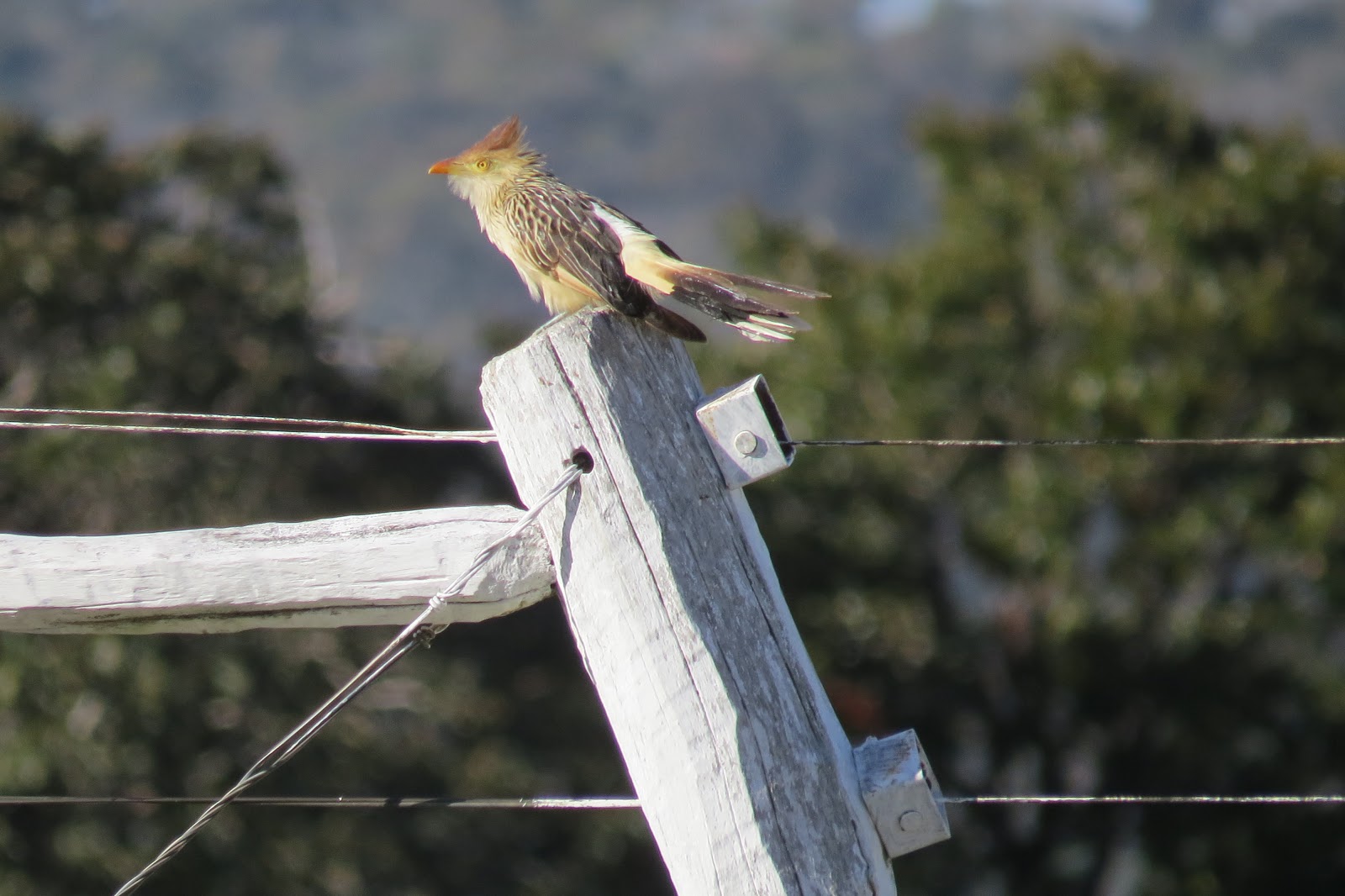
| A guira cuckoo. |
 |
| This guy looks like a regular roadside hawk to me. |
The grasslands yielded huge biodiversity to my temperate eyes, but I was sad to learn that this land was 95% forest when Luiz's family bought it 30 years ago. Luiz told me proudly how his family had cleared the trees and replaced them with African grass to pasture cattle. They plan to reduce the forest cover to 20%, the amount mandated by federal law to remain forested as a reserve.
 |
| Notice the rows of blackened branches in the background. This sandy land was recently cleared in a version of slash-and-burn agriculture. Now, it is vulnerable to erosion before the African grass seeds take hold. |
Luiz told me his family is aggressively transitioning the land from forest to pasture because they need to qualify for "production" status. Otherwise, their land is at risk for federal take-over under a controversial (and generally dysfunctional) agrarian reform program. The Brazilian government can seize large blocks of private, non-"production" land and redistribute them in 10-hectare parcels to landless citizens who camp out along the roads in wood-and-cardboard shacks.
While it seems obvious that Brazil needs to redistribute its wealth more evenly among the population, this land reform program is full of holes. For one, the landless recipients generally cannot sustain themselves by gardening 10 hectares of dry pasture, nor do they have farming skills; they sell the land as soon as they get the deed for a small sum. Furthermore, the law is apparently accelerating deforestation in the Cerrado and Pantanal, directly conflicting with environmental regulations that limit such activities.
 |
| Sausages, a small but strong cow-dog. |
 |
| In the afternoon, we rode nameless horses around a yard. The cattlemen live in houses on the property with their families. |
 |
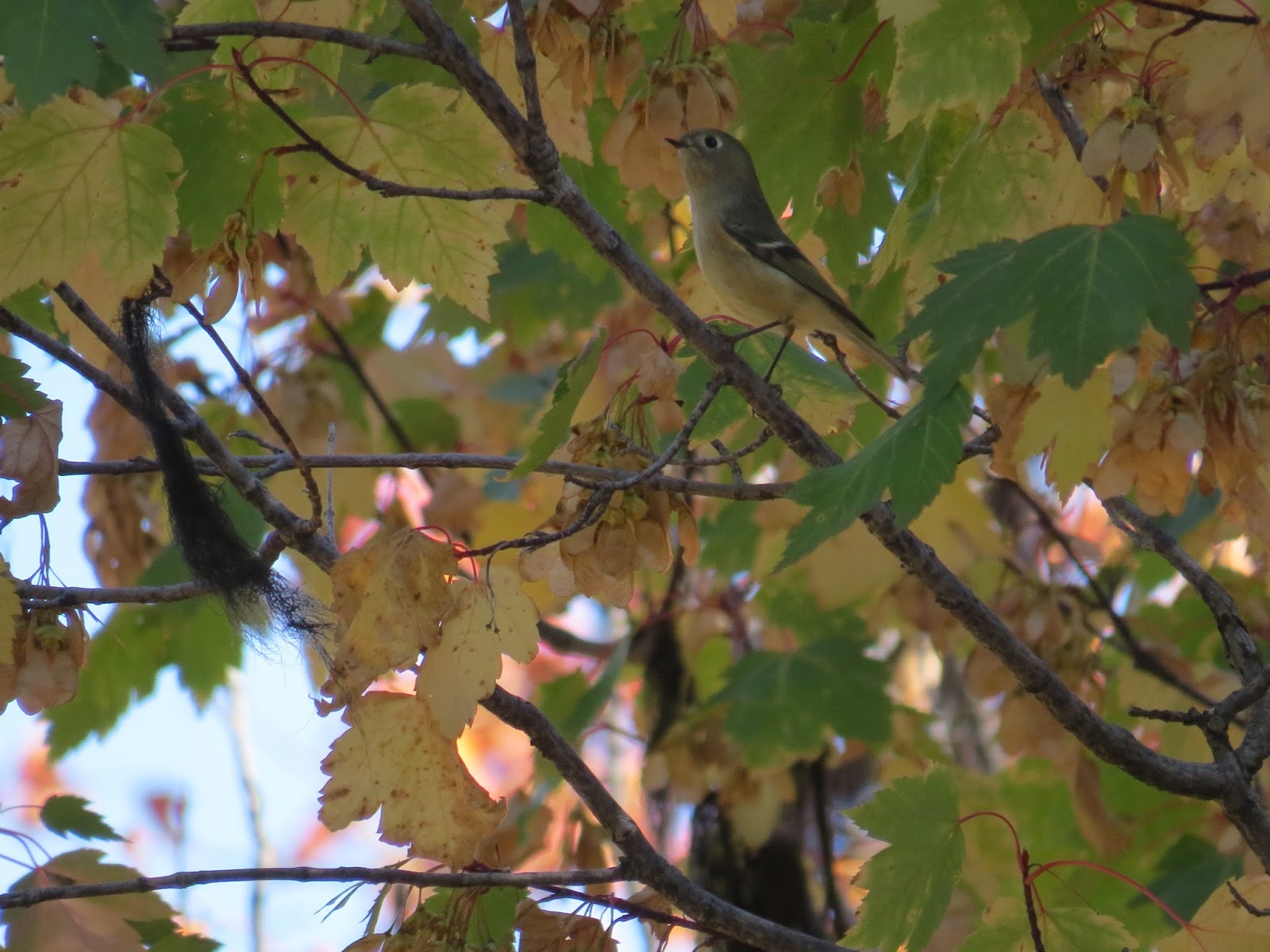
| I could not identify this bird. A tanager? Help? |
 |
| Picking oranges with Dora. They are verde mais doce, green but sweet. |
Dad's Daily Bug
 |
| A cave cricket. |
Mom's Daily Bird
 |
| A rhea, or ema in Portuguese. I appreciate the equally-tall cow in the background for scale. |