Health Education, Health Articles, Health Blog

Showing posts with label marine. Show all posts

On Being a Small Polyp in a Big Ocean

I was reading cross-legged on my bottom bunk when a tattooed man came into the room. It was 11:00 pm, and he was just getting in from a long day fighting for an Indonesian visa extension. So it goes when you stay in hostel dorm rooms. I liked this hostel because I could pay the dorm price but, owing to the volcano and record-low numbers of tourists, I usually had the room to myself. Not tonight.

My new roommate made the usual small talk. His name was Federico. He was a dive instructor on Gili, one of the tiny, sandy, dive-and-party islands between Bali and Lombok.

“Where are you from?” I asked, unable to place his vaguely European accent and deeply tanned skin.

“Argentina,” he answered.

That got me excited – probably more energetic than my roommate would have liked as the clock neared midnight – because I love any opportunity to practice Spanish. I explained that I had lived in Ecuador for a year. Here, the conversation took an eerie turn. After a bit of back-and-forth, we realized that we had both lived in the same country (Ecuador), in the same town (Puerto Lopez), in the spare room OF THE SAME HOUSE!!! (The house belongs to our mutual friend, Pablo.)

Federico, my Argentine roommate in a Balinese hostel, and I take an excited midnight selfie to send to our mutual friends in Ecuador as proof that the world is small.

Now we were old friends. I told Federico about my Watson project on coral reef disease.

"You simply have to meet Anuar Abdullah," Federico told me. "He is a guru of coral propagation. He's the Man. You'll see what I mean when you take his class. You just have to meet him."

I am always happier to take personal recommendations than find random connections over the internet, so I looked up this Anuar character the next day. I found his organization, Ocean Quest Global, and a pretty inspiring video about his life's mission. I messaged Anuar on Facebook and signed up for his coral propagation class, two months down the road on Gili.

Gili Trawangan is a tiny circle of sand in the ocean. Motors are prohibited, so bicycles and mini-horse taxis prevail. You can walk around the whole island in two-and-a-half hours.

My hostel bathroom on Gili was home to one of the largest cockroaches I've seen (Madagascar Giant Hissing Cockroaches notwithstanding.)

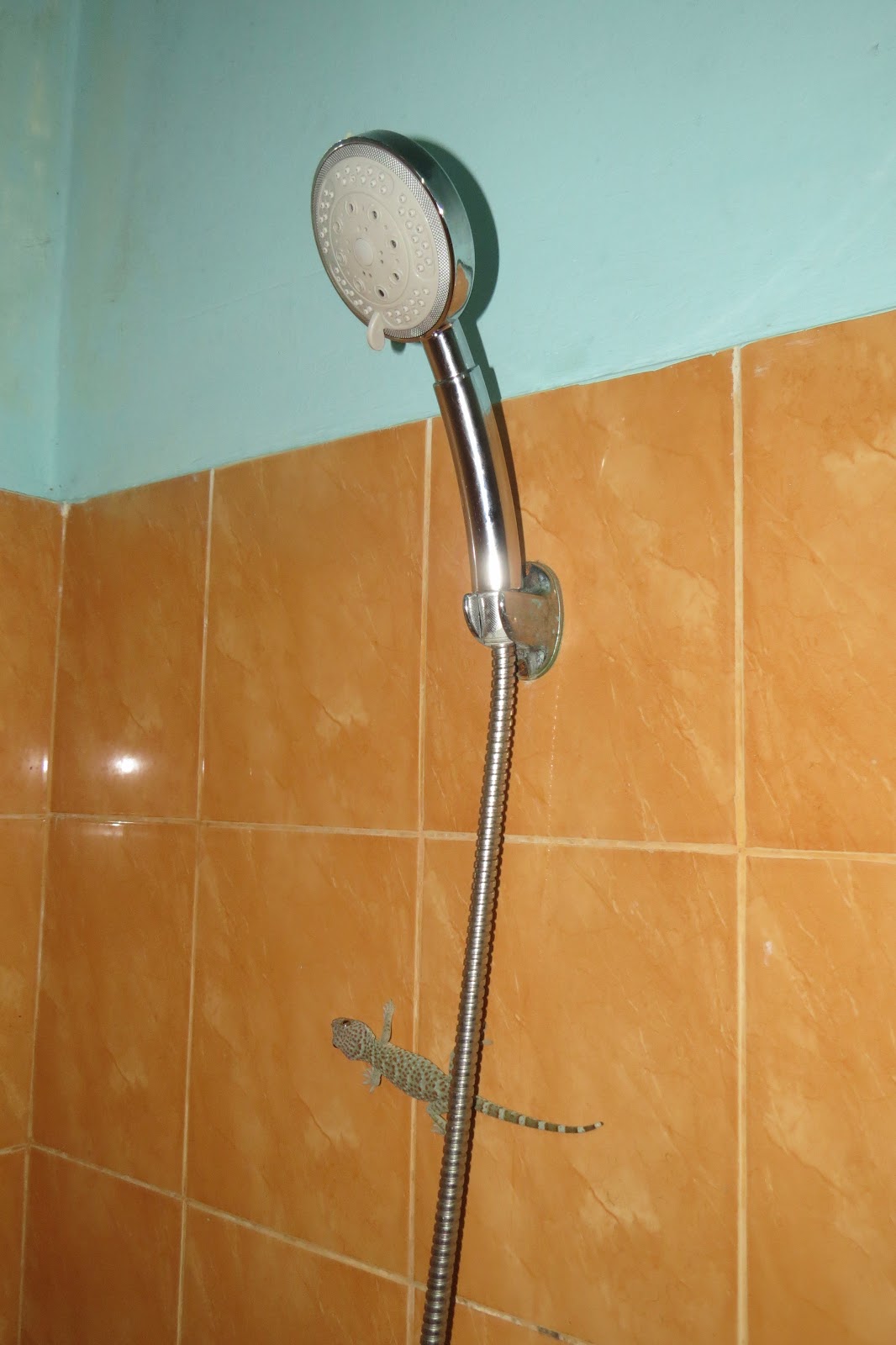
Luckily, the bathroom also came equipped with an enormous gecko!

A tokay gecko, Gekko gecko, to be exact. Look at that gorgeous red polka-dotting.

Fast forward. I've finished my work on Bali, moved to Malaysia for a month, returned to Bali, made my way by plane and van and boat to Gili... and here I was, ready to learn from the legendary Coral Man himself.

We met up for dinner, and immediately I was hit with the same impression as Federico: this was a person to know. Anuar didn't mess around.

"I just got back from a two-week research cruise through the Pacific," he told me. "Big things are happening there. Big things." His tone was intense but his volume soft. He had an intensity directed at no one. I got the sense he cared far more about what he was saying than about who he was talking to. "Big patches are DEAD. Gone. Nothing to regrow on. We need to stop playing around with conservation. This is too urgent."

Anuar teaches the first day of his coral propagation course in the upstairs restaurant of Trawangan Dive Shop on Gili.

Anuar's face is dark from the sun and lined from caring so deeply for another organism's life. Born in Malaysia, Anuar studied oceanography in the United States at Florida Institute of Technology before working in naval and tourism industries. Fifteen years ago he left it all behind. Coral has Anuar's entire heart, now that his two children are grown and his marriage has ended. The corners of Anuar's mouth are always pulled down in a slight frown, even when he's laughing. He has the worn expression of a soldier who's lost too many battles but who refuses to give up for love of his mission.

Sabine and I wait for a herd of lumbering brown cattle to cross the road as we walk across Gili for the sunset.

Then I met Anuar's counterpart, and she could not have contrasted more starkly. Sabine has a Swiss-French lilt to her English and corkscrew curls. Her smile, which she flashes often, spreads across her whole face. Over the following days, Sabine became my close friend. Over beach sunsets and gelato dinners, we learned we had much in common. We were both 23-year-olds (less than a month apart in age!) with a propensity to work on vacation and dream about fixing the world's problems.

Sabine met Anuar a few months ago as a dive student. On her gap year before starting occupational therapy school in Switzerland, she'd planned to see Southeast Asia, learn to dive, and follow wherever the path took her. Well, it took her straight into a full-time job volunteering as Anuar's assistant.

"I saw how much passion he had, and how disorganized his operation was, and I just had to help," she explained, almost as an excuse for why she was toiling away on a computer screen during this tropical vacation. Sabine sees organization as her greatest asset, and she certainly has the talent, but I'm not sure even a hard-working wonderwoman like Sabine can put decades of chaos into order.

The next day, I had a great surprise when I met the rest of my classmates. They were my coworkers from Reef Check and Coral Alliance in Bali, plus a few of the higher-up conservationists I'd never had a chance to meet! What luck. I got to spend three days picking their brains and talking marine-conservation over every lunch and dinner.

The Coral Team, from left to right: Chris, Nyoman Sugiarta, Jaya, Nyoman Swastika, me, Nikin.

Nyoman Sugiarta pulls on his wetsuit, always an unpleasant task, before we hit the water.

Anuar's paperwork and contact lists might be a rat's nest, but Anuar's coral propagation class lived up to its reputation. Anuar's goal is to replant corals all over the equatorial ocean, to give them a boost in the face of mounting stresses like rising temperatures, ocean acidification, plastic pollution, sewage runoff and destructive fishing techniques.

When it comes to coral propagation, I've always had one lingering doubt: if the coral has already died in a particular bay, why would replanting the same coral help? Won't it just die again, unless the root cause is addressed?

Anuar had a clear answer ready for me. "We only plant where we know the cause of the coral's original death," he explained. "So if it was killed by bomb fishing, and that's not happening anymore, for example, we will plant corals in that area."

Anuar shot and edited this video of our first day building a coral nursery on Gili Trawangan. The pile of rocks will be the nursery where corals grow from tiny fragments into large colonies, forming the broodstock for replanting the rest of the reef.


What about the bigger, global threats? I asked. What about rising temperatures and acidity? You can't stop those on the local level.

To that, Anuar explained that by planting corals, we are speeding up their recovery. We are allowing the reef to repopulate decades faster than it would without human intervention. By doing so, we are essentially accelerating evolution by natural selection.

Think of it this way: today, you have a full, healthy reef, 100%. Then a major storm hits and kills 90% of the reef. We use the remaining 10% to repopulate the reef. Already, by starting with the survivors, we have allowed natural selection to work; we have chosen the storm-resilient individuals to repopulate with. With our help, the reef recovers quickly, and in five years, it's full of healthy coral again. Then another disaster hits. This time, let's call it a heat wave that bleaches and kills 90% of the coral, again. Only 10% remains, and again, we replant from that stock. Now the corals have been selected to be both storm and heat resistant. Get it? It's far from perfect, but the idea is to give corals a chance to avoid extinction as they evolve to withstand their new, strange environment.

Human-induced climate change has accelerated the cycles of destruction for reefs, and without our help, corals wouldn't grow back quickly enough between major disasters to survive. But if we can also accelerate the cycles of regrowth, maybe we can give corals a chance to do what they've been doing so well for millions of years: evolve in response to changing oceans and survive.

Sabine and I watched this unreal sunset, but it left me with a deep melancholy. Maybe it was the techno dance music blaring on the beach, making me homesick for Sweets dance parties. Or maybe it was the heart swing for couples.

As I looked down the beach at the hordes of relaxed vacationers, I felt entirely alone. My heart and mind were too fiercely stuck on this urgent question, how to save our planet's corals? I'm glad I had Sabine at my side, or I might have imploded with the magnitude of the feeling.

That's the theory behind coral propagation in general. Anuar has some strongly-held and well-defended ideas about just how coral propagation should be done.

For one, he bans any use of plastic, concrete, or metal substrate. His experiments have shown than corals do much better when attached to aragonite stones, the porous, calcium-carbonate skeletons of long-dead corals. Plus, if you refuse to drop human-made junk in the ocean, you have done no harm in the event that you have to abandon a coral propagation project partway through (an unfortunately common occurrence).

Another of Anuar's unique gems is his glue system. He has a particular method of securing each type of coral to the rock. For hard corals, he suggests gluing the coral fragments to rock underwater using a combination of mineral gel and patented calcium-based catalyst. (If you don't have that, or if you're working on the surface, superglue will suffice.) For soft corals, pin the fragment into place with a pair of wooden toothpicks. For sea fans and sea whips, simply wedge the fragment into a crevice in the rock.

The third piece of Anuar's system is the nursery. Anuar discourages the "pluck and plant" method of cutting or gathering large chunks of healthy coral and gluing them to other parts of the reef. He says this method is haphazard, wasteful, and difficult to monitor. Instead, he recommends gathering only broken coral from the seafloor and cutting tiny pieces, about 1 cm long, and gluing each of those to its own rock in a centralized "nursery." Once the nursery matures, you can continually harvest those corals into tiny  pieces, which you then glue all over the wild reef you are trying to rehabilitate.

The turtle nursery on Gili is an example of a conservation strategy gone wrong. The turtles are often collected from their nests and put on display in this box-like tank to generate donations from tourists.

The baby turtles are too crowded, as you can tell from the scratches and bite marks on their shells and fins.
  
During the four days I was on Gili with Anuar and Sabine, my mind was working overdrive. I was inspired to have found a tool for conservation, since so many of my previous Watson projects have been merely attempts to study and understand the problems, not strategies for solving them. But was this the right tool? Would Anuar's coral nurseries prove scalable to the entire equatorial world? Did he have the necessary networking and organization to keep the momentum, or would the project fall apart once its charismatic founder retired?

Anuar and I pose with my certificate after I finished the course. I am now an official Coral Propagator.

Then the more existential questions set it. Is coral conservation the career I should pursue? What's the best way to make a difference in the world -- neat, published research from a university, or a messy underwater stab at growing things before they die forever? Yes, Anuar was right: the situation is urgent. The biosphere is unraveling. The oceans are emptying. The life is dying. But where does that leave me?

It was hard to say goodbye to Sabine, but I know we will both be working hard on whatever catches our hearts, and we can always commiserate about that from across the world.

For that, Sabine offered a trip to the gelato counter, and a bit of consolation. "Why do we always pretend we know everything?" she mused. "We don't control anything!" She told me about her worldview, which seems to center on sincere gratitude. From someone who is meticulous about filing and obsessive about doing good, the next piece of advice came as a surprise. "It's a wonderful thing to let things go," she told me. "Just let them really, really... go."

I was reminded of a poem Collin sent me back in September, when I was lonely in Brazil:

“Understory” by Mark Nepo

I’ve been watching stars
rely on the darkness they
resist. And fish struggle with
and against the current. And
hawks glide faster when their

wings don’t move.

Still I keep retelling what
happens till it comes out
the way I want.

We try so hard to be the
main character when it is
our point of view that
keeps us from the truth.

The sun has its story
that no curtain can stop.
It’s true. The only way beyond
the self is through it. The only
way to listen to what can never
be said is to quiet our need
to steer the plot.

When jarred by life, we might
unravel the story we tell ourselves
and discover the story we are in,
the one that keeps telling us.


I'm no expert at that process of letting go yet, but I accepted Sabine's reminder to stop analyzing everything for its lessons and just let the experience wash over me for a while. Without a chance encounter in a hostel and a stranger's advice, I never would have met Anuar or Sabine. I would not have glued my fingers to a baby coral by mistake. I would not have carried a laundry basket of stones across the bottom of the ocean or built Gili's first coral nursery from scratch. I wouldn't have felt the existential fear of being lonely when surrounded by dozens of laughing, drinking beachgoers, nor the nostalgic comfort of remembering that I'm always with myself, no matter who else I am with.

On the two-hour boat ride back to Bali, I was alone with the sun and the sea. Nothing was solved. The earth was still in biotic crisis. My graduate school plans were still nonexistent. The ideal career continued to elude me. But, for now, it all felt okay.

Share:

Reef Doctor: a Malagasy Model for Marine Healthcare

I walked barefoot on the sand littered with plastic bottles and fishing nets. To my left stretched a concrete wall, holding back past-their-prime hotels and half-finished houses from tumbling into the sea. To my right, the Mozambique Channel tickled the shore. Continental Africa lay beyond the horizon, but the curve of the earth had my eyes convinced this water might go on forever.

An outrigger canoe moored offshore from Ifaty Beach.

I’d been told to expect a forty-minute walk from my hostel in Mangily, a tourist town, to the Reef Doctor office in Ifaty, a sleepy fishing village. I can report that the timeline was optimistic. On the lower beach, I slurped through calf-deep quicksand. Higher up, I tiptoed across a gauntlet of razor-sharp crushed shells.

The fact that I stopped to photograph every shorebird probably didn't help my timeliness, either! This common ringed plover reminded me of a semipalmated plover with a stretched bill.

White-fronted plover. Another lifer, restricted to sub-Saharan Africa and Madagascar.

Ruddy turnstones in the wrack zone.

This shorebird (a black-bellied plover?) stands on a band of jagged coral bones, a remnant of Ranobe's old fringing reef that was gradually exposed over thousands of years by a shifting river delta. 

The whimbrel, a worldly traveller that breeds in the Arctic and migrates to South America, Africa, south Asia and Australia. (Sounds like a Watson year!)

A bit late and more than a bit sweaty, I arrived at Reef Doctor. It was hard to miss. The retaining wall on my left gave way to a compound of A-frame bungalows interspersed with salt-tolerant trees and hand-painted signs. A pile of rough boulders was labeled “Artificial Reef.” I assumed these rocks would become a future artificial reef, since they weren’t doing much to promote fish habitat up here on the sand. Two energetic volunteers sat cross-legged on the ground, painting an old wooden table with creosote.

The Reef Doctor campus was a beachfront village of yellow A-frames.

“Hi!” I called. “Is this Reef Doctor?”

“Yeah!” confirmed a cheery, tan woman.

“I’m looking for Seb,” I told her. I had been e-mailing with Reef Check’s director, Emma Gibbons, for weeks to set up this visit with the science officer, Sébastien Boudry.

“Oh sure. SEB!” the woman hollered. She motioned to a thatch-roofed bungalow. “I think he’s in there.”

Soon, Seb appeared to guide me through the workings of this coral-reef conservation nonprofit. He wore a long, messy bun of beach hair and a bandage on his left foot from a bang up with some rock or coral. A pair of metallic blue sunglasses rode on his head, and his flip-flops kicked up sand as we strolled to the science bungalow.

If it weren't for this colorful sign, I might not have recognized this particular bungalow as an "office."

Here, Seb’s surfer aura gave way to the data-minded, detail-oriented persona his job requires of him. "If current trends continue, the world's coral reefs are expected to be gone by 2050," he told me as he flipped through a PowerPoint of carbon-emission graphs. Seb offered me three hours of his time and answered my battery of questions about the fleet of volunteers he manages.

Seb Boudry, science officer for Reef Doctor.

"Yeah, the volunteers used to input their own data, but we had a few too many errors," he said wistfully. "So that’s all me, now." He swept his gaze over the stacks of penciled datasheets and tangle of cords leading to his laptop. The sun-tanned surfer vibe evaporated as I imagined Seb’s eyes turning red after hours of combing through numbers, checking for errors, transcribing thousands of digits from one page to another. So much for the glory of tropical marine biology.

The crooked whiteboard used to organize Reef Doctor's dizzying roster of conservation activities.

May I draw your attention to the lower left corner of the whiteboard, where the "coral disease" survey caught my eye. All coral conservation is about organismal health on some level -- bleaching is an example of non-infectious, environmentally-triggered disease. But what interests me most are the infections: the tangle of microbe and alga and coral that mirrors our own human struggle against pathogens.

Founded in 2002 by two British men, Reef Doctor has focused on improving the social and biological resilience of the Bay of Ranobe. Reef Doctor draws no arbitrary boundaries between social and ecological wellbeing. In this southwestern corner of Madagascar, the two meld into one enormous sea of urgency. To get a feeling for the socioeconomic state of Ranobe, check out this snazzy infographic:

Credit: Reef Doctor.

This photo, taken out the window of a taxi-brousse, shows the desperately dry Fiherenena River that runs between Toliara and Ifaty. You can see three women walking across the parched riverbed carrying loads on their heads, perhaps clothes to wash or mangoes to sell. This desert region is constantly in a drought, but the situation is becoming dire as deforestation, overfishing, and climate change threaten the last available options for subsistence.

Reef Doctor's major accomplishments include providing primary-school teachers for the community, implementing marine education in public schools, returning 1100 captured marine turtles to the wild through a tag-and-release program, creating a Women's Association to provide training in arts and crafts manufacture, and building a coral nursery to shelter young coral recruits until they are large enough to be transplanted into the reef.

While I was visiting, Reef Doctor was just finishing its three-year Darwin Grant to initiate seaweed and sea cucumber aquaculture in eight villages, providing an alternative livelihood to overfishing. Finally, and most significantly, Reef Doctor helped establish two of the first community-managed marine reserves in Madagascar, both here in Ranobe: Massif des Roses and Ankarajalita.

Seb scattered a handful of dead coral skeletons across the table to showcase Rabobe's marine diversity. Like any animal, corals can be classified by genus and species, but scientists often find it more convenient to describe the coral's morphology. Pictured here are a massive coral (left), a branching coral (top), and a mushroom coral (the circular one), among others.

Branching corals in the genus Acropora are one of the most important reef-builders in Ranobe.

As Seb spoke, the list of projects Reef Doctor juggles grew unwieldy in my memory. How can one organization tackle so many things at once? I came to understand that Reef Doctor is fueled by the two key ingredients: people and money.

The magic of the Reef Doctor system is that the labor not only pays for itself, it pays for everything else, too. Reef Doctor hosts a rotating casts of volunteers (working for 3-12 weeks) and interns (2-6 months) who pay for the privilege of helping conserve the world's third-largest coral reef. In return, the volunteers and interns can be trained in scuba diving and marine research techniques, and they live among an international group of like-minded folks on the breathtaking Mozambique Channel. Apparently, it's a fair trade, because there is never a shortage of eager workers. I was impressed to learn that 60% of Reef Doctor's budget is paid directly by volunteer fees, while the other 40% is furnished by donations and grants.

Seb pulled out these two giant snail shells. On the left is the bull-mouth helmet (Cypraecassis rufa). On the right is the smaller yet heavier triton (Charonia sp.) Both snails are severely over-harvested for the souvenir market. In the year and three months since he arrived at Reef Doctor, Seb has seen only two bull-mouthed helmets and one triton alive in the ocean, but he's seen bucketfuls of their empty shells in the market.

In the middle of our conversation, Seb had to run out for a staff meeting. Triton shell still in hand, out of breath from his steady stream of information, Seb apologized with one flip-flopped foot out the door. "I'm really sorry I just have to talk with the staff because I'm in charge of all the volunteers and interns and I need to get ready for their meeting tomorrow I'll be back in twenty!"

That's how I found myself alone in the Science Office. I felt like a child slinking off from my great-aunt's Christmas party into the recesses of her big, unfamiliar house. What might an unattended ecologist like me discover, poking around an office like this? The corner bookshelf drew me in like a magnet.

Reef Doctor's library consists of four boards in the corner stocked with books, printed journal articles, and a hefty portion of rat poop.

The books in front were well-used but in good condition: a field guide to reef fishes of the Indian Ocean, a manual of bleaching-survey methods. I dug deeper. One shelf, I discovered, had been claimed by a rat: the books' pages had been gnawed into powder, and a cozy-looking (yet thankfully empty) nest was squeezed into the corner. I found a yellow and brittle Nature Conservancy pamphlet featuring a quote from Darwin I'd never before heard:


Deep in a stack of French tomes, I unearthed another reference to our own and only Darwin. It was a 1976 volume by a University of Illinois geologist, its canvas cover engraved with gold lettering: The Coral Reef Problem. I read the introduction:

"It is of great philosophical interest to recall that Darwin's theory of coral reef formation was derived in a pure deductive fashion aboard the Beagle while sailing along the west coast of South America, before Darwin had ever seen a true coral reef... Through the middle of the nineteenth century the coral reef problem had a glamour about it."

A hidden gem in the bowels of the Reef Doctor library.

I was struck by the gulf in perception between this author, writing in 1976, and today's coral researchers. Forty years ago, the Coral Reef Problem was a delightfully puzzling question of how coral reefs are formed. Today, pondering the ancient origins of the reef feels like a reckless luxury when the corals' future is grimly predictable. Our new coral reef problem is this: how can we coax this "most extraordinary of natural structures" to survive past the year 2050?

That first statistic Seb had thrown out surfaced in my mind. If current trends continue, the world's coral reefs are expected to be gone by 2050. I started the mental calculations. By that time, I will be 55 years old. Will I have kids? If so, they'll be teenagers. Will they get to see a reef before it's too late? They'll have to learn scuba diving young... Where will we go to see the world's last reef, a scrap of corals taking their dying breaths? Will it be a secret lagoon, off limits to tourism? Will the cost for diving that last reef skyrocket, as demand increases and supply constricts to zero?

A bowl of salted reef fish for sale on the main street of Mangily. Can you find the threadfin butterflyfish, the moray head, and several species of snake eel? Reef Doctor has worked with local communities and the tourism industry to develop open and closed fishing seasons for vulnerable species, but enforcement is out of their hands. Only FIMIHARA (the local fishermen's association) and the chronically-underfunded Ministry of Fisheries have the power of enforcement. I was offered out-of-season lobster and octopus every day at lunch.

One night, we bought fried fish for dinner on the street. Haja and Mahery taught me how to make street food safe by asking the vendor to re-fry to fish in boiling oil right before handing it to us. The fish vendor wrapped our hot, greasy fish in the only paper available: reused pages from her child's homework.

Of course, my diving concerns are negligible compared to the burden carried by coastal communities who depend on reef-based fisheries. It's just my way of conceptualizing a massive global change that's happening too quickly to believe. 2050? One lifetime after that Illinois geologist scratched his head about Darwin's theory of coral accretion, his Coral Reef Problem will no longer be available for experimentation. Like the color of the dinosaurs or the reason why our fishy ancestors crawled from the sea, it will be a question for paleontologists, to be answered by fossils of things that have ceased to live.

An underwater probe that sends temperature data from the reef straight to Seb's computer. Corals expel their symbiotic algae and turn white (a process called bleaching) when they experience heat stress, typically when the water is 1 degree Celsius above average during the warmest months of the year.

Before I knew it, the staff meeting was over. Seb came back to find me as promised, and I jumped when I heard the door creak open. It's startling to be found when you're lost in a book. In our final minutes, I asked Seb how he maintains enthusiasm for his job as a reef doctor in the face of such a gloomy prognosis.

It was one of my first questions that gave Seb pause, if only for a moment.

"The 2050 thing, that's just a prediction," he started by clarifying. Three hours ago, Seb had asserted the 2050 expiration date with data-driven confidence. But that was Seb the Scientist. Now, I was speaking to a different persona, the conservationist, the coral-lover, the optimist whose hope is derived from within the scientist's margin of error. Yes, the data predicts that all the world's reefs will die by 2050 -- but what if the data are wrong? What if we can change the trend? What about that error bar?

"What I do," Seb continuted, "it try to slow it down, try to be positive. We know if nothing is done, it’s just going to die."

"Will this coral reef still be here, in Ranobe, in 2050?" I asked.

"I don't know. I hope yes," he said. "Maybe our generation will see the extinction of it, because it’s just going too fast.  But recently on the new reef, we saw the first humphead wrasse in ten years, so the water must still be clean enough for that. And the humpback whales are still coming. It means there is still some life, and it needs time to grow. That’s the problem, we haven’t given them time to grow. You never know what is going to happen."

Most of the Malagasy living in this region belong to the Vezo ethnic group. They are known for their perfected seafaring and fishing techniques which revolve around the pirogue, a wind-powered outrigger canoe similar to the ones that brought the first Indonesians to Madagascar 2,000 years ago. The sea is used for transportation because roads between villages can be rough or nonexistent. Here, a pirogue is weighted down with a load of tree trunks that will be used to construct houses.

Later in the afternoon, I spotted the same bundle of logs loaded onto a taxi-brousse.

A few days after talking with Seb, I went diving on the outer rim of Ranobe’s fringing reef. My dive instructor, Anne Furp, asked if I’m certified to dive deep.

"Yeah, I'm an Advanced Diver. I can go to 100 feet," I told her.

"Good," said Anne. "We only do deep dives here. Anything the fishermen can reach by freediving has already been destroyed."

Tip for backpackers on a budget: search thrift stores for tight athletic leggings and a long-sleeved swim-shirt. It's a lot cheaper than a wetsuit.

Knowing about my love for microbes, Anne pointed out a massive, lavender mound of Porites coral with white rings circling several of its pores. I don’t know what pathogen was causing those white rings, but I noted that coral disease does not discriminate among depths. We saw a scaly crocodile fish, a marbled grouper as long as I am tall, angelfish, moray eels, and (my personal favorite) a healthy sea star.

A few days after that, I went snorkeling in the shallow section of Massif des Roses, the first community-managed marine reserve established by Reef Doctor.

The sun was shining as a wind-powered pirogue carried Haja, Mahery and me to our snorkel site.

It was Haja and Mahery's first time snorkeling! They have studied Madagascar's terrestrial plants and animals all their lives, but never had they seen their ocean's algae, corals, or fishes.

The difference between the deep dive and the shallow snorkel was heartbreaking. In two hours, I swam above a seafloor that was half garden and half graveyard. Spiny black Diadema sea urchins clustered in crevices, and a school of dark fish flashed by. One Acropora showed the purple fluorescence of new growth at its tips, and a lime-green Porites photosynthesized under our masks. These live corals were surrounded by rubble, the skeletal remains of their dead kin. Seb’s prediction that coral reefs will go extinct in our lifetime appeared to be coming true in front of my mask. One of the healthiest patches in Ranobe, Massif des Roses, harbored life. Yet it was a ruin, an ecosystem drawing its last shaky breaths in the Intensive Care Unit of planet Earth.

Here is a GoPro video I made to document the condition of Massif des Roses and celebrate Haja and Mahery's inaugural snorkel.

Seb knows this bay will never be pristine, at least not for many generations. At best, Ranobe will become a fragmented habitat composed of a few hardy coral species, an artificial reef of boulders, and a rebar garden of transplanted coral recruits. Tourists will dive deep to glimpse the abundance of the past, while locals will scrape a living from the marine life that remains. Yet he, Emma, and all of Reef Doctor's staff and volunteers are moving toward something different, something alive.

Rather than forsake this seafloor as a lost cause, they embrace its knotted web of relationships: with scientists and fishermen, pirogues carrying away forests into houses, drier summers, drier winters, climate and weather and carbon dioxide, fried fish in torn pages of lined paper, stinging plankton and crumbling calcium carbonate.

The death within Ranobe is easy to see, but it is not complete. Life makes its way in this ruin: a school of snapper, a toothy eel, a jellyfish. The first humphead wrasse in ten years. Seb knows our survival is entangled with the survival of the reef. And for him, a sliver of uncertainty in his patient's prognosis is enough.

Share:

Second Quarterly Report: Halfway through the Watson

Here we are, six months into the Watson year and six more to go. Below is my second quarterly report, one of the few deliverables required of me by the Watson Foundation. In case you missed it, you can read the first quarterly report here. Thanks for following along!

Draped in a cape of strangler-fig roots.

Second Quarterly Report


Date: January 27, 2018
Countries you were in: Madagascar, Indonesia
Countries for next quarter: Indonesia, Malaysia
Current location: Sanur, Bali, Indonesia

Dear Watson Foundation,

Apa kabar? Hai from Indonesia! Today I’m writing from the raised wooden floor of a gazebo on the roof of my homestay in Sanur, Bali. I’m surrounded by a sea of red tiles and stone shrines, adorned each morning with foods, flowers, and incense offered in folded banana leaves. I hear two roosters locked in a crowing battle. I have no idea where they’re hiding.

A crab-eating macaque and his mossy stone cousin in the Ubud Sacred Monkey Forest.

My flooded street in Sanur after a night of thunderstorms.

Last I wrote, I was finishing my first month in Madagascar. The challenges of that country did not get easier with time, but I did come to value them more. These struggles ranged from flesh-ripping vines to my heavy sense of guilt because the people with whom I lived had so few resources while I have so many. The average daily wage in Madagascar is $0.70, but poverty cannot be captured in a number. A house in a typical village around Ranomafana has a dirt floor and a thatch roof, with an open fire for cooking and black soot for breathing, but poverty cannot be described by architecture. Everyone I met told me stories of sand fleas burrowing into their feet because shoes were not in the budget, but poverty cannot be understood through parasites. I am just beginning to grasp the roots and results of Malagasy poverty after living amidst it for three months, so I cannot presume to convey it in a paragraph, but perhaps this conversation will give a taste of our global economic dissonance.

A mud-walled and thatch-roofed house in the tavy hills outside Ambatovory.

My superheroine guide, Menja, and I were sitting in one of our rainforest camps beneath a leaky blue tarp, biding our time until the afternoon when we would set lemur traps.

Menja: “I hate the rain.”
Me: “I love the rain! At my home in Seattle, it rains all the time.”
Menja: “Well, that makes sense. Because you have a raincoat that doesn’t leak.”
Me: “Oh. Good point.”
Menja: “And you have rain pants that don’t leak either, right?”
Me: “Yeah.”
Menja: “And your house – does it have a roof that doesn’t leak?”
Me: “Yes, it does have that.”
Menja: “And outside – you have sidewalks? So it’s not too muddy to walk in the rain?”
Me: “Ah, yes, we have sidewalks. No mud trails.”
Menja: “And shoes?”
Me: “Yes, shoes too.”
Menja: “And you have a car? So when you need to go, you are not walking?”
Me: “Yes, we do.”
Menja: “And furniture.”
Me: “Huh?”
Menja: “In your house. You have furniture, yes? So you can sit down while it rains?”

I couldn’t think of a response to that. I’d never thought of the connection between a recliner and a rainstorm, but to Menja it was obvious. In her experience, rain means crouching for hours in a smoky, one-room house with no furniture. Not only does my house have chairs, but it also has windows with glass, a furnace to heat it, electricity to keep the lights on, books to read, and a computer with WiFi to occupy me. Rain in Madagascar bears no relation to rain in Seattle. The water may be the same, but our experiences of rain could not be more different.

Following Menja down a slick, clay trail in the rain to conduct sand-flea interviews.

To fill the daylight hours in our field camps, I began bringing colored pencils and offering drawing lessons to the village kids who hung around after lunch, hoping for leftovers. One day, while hosting a gaggle of children to draw bugs and leaves on pages torn from my notebook, I was overwhelmed by the knowledge that these children deserved an education they would never be offered. Most had dropped out after fifth grade because no matter how hard their parents worked, they’d never earn enough to pay school fees. The unfairness tied my stomach in knots. Right then, I decided I would raise money for Madaworks, a small nonprofit that funds high-school education for Malagasy girls. In a blog post titled “The Power of Pencils,” I asked my readers to donate, and within two weeks we had exceeded my $1200 goal. The Madaworks founder, Diane, then challenged me to raise tuition for a full, three-year education for both girls, a total of $3600. As I uploaded more stories and photos, donations flowed in from teammates, family members, and even strangers who’d come across my blog. Now, as I type, we are $20 away from our new goal. I have received praise for this effort, but I ask myself, why do I have the power to run a fundraiser in the first place? My resources––contacts in the United States, writing experience, a camera, internet access––all come to me as unearned gifts. I do not deserve praise compared to the Malagasy girls who will receive these scholarships: they have overcome far greater obstacles to achieve what I have been given for free.

The kids of Bevoahazo, engrossed in my bird book and their scientific drawings.

As a side project, I interviewed 58 households about the sand flea, a translucent white parasite the size of a pinhead that burrows into skin around the toenails for four to six weeks unless someone digs it out with a needle. Sand fleas live in humans, pigs, and dogs, and they are zoonotic, meaning they can switch from animals to humans. I’d never heard of sand fleas, so I was astounded to learn that 100% of villagers had been infected by this parasite, and 12% were actively hosting sand-fleas at the time of my interview. How could I have studied zoonotic disease for years and never heard of this parasite that infects millions or billions of people? I had wonderfully enlightening conversations with mothers about the health of their families, but the interviews weren’t always easy. One angry man told me he wanted nothing to do with my survey if I wasn’t going to give him medicine for his son’s feet, which left me feeling inadequate and sorry. I couldn’t provide medicine, because there is no medicine for sand fleas, but I did learn to offer small bags of salt, sugar and soap as compensation, and I taught each family how to sterilize their needles. Along with my lemur mentor, Dr. Zohdy, and climatologist Dr. Eronen, I submitted an abstract of our sand-flea research to the Planetary Health Alliance. If it’s accepted, I’ll present at the Annual Meeting in Edenborough, Scotland at the end of May. My hope is to incite more research and remedies for sand fleas by getting them added to the World Health Organization’s list of Neglected Tropical Diseases—yet my hope is tempered by the knowledge that all the diseases on this list will remain neglected until we, as a planetary community, devote far more resources to the injustice of poverty.

A female sand-flea, removed from my friend's finger with this needle. Photo credit: Cindy Capurso.

This foot had at least six sand-fleas embedded in it, making it hard for the child to walk and attend school.

On Christmas Day, my flight out of Antananarivo took me through the tiny island nation of Mauritius and the high-tech city-state of Singapore, whose airport includes a pool, movie theater, and butterfly garden. My final flight, to the Indonesian island of Bali, had plenty of room because Bali’s tourism has plummeted by 70% since its volcano, Mount Agung, began spewing ash in November.

Antananarivo from the air: a sprawling city surrounded by endless rice paddies.

Welcome to Mauritius, former home of the dodo. It must be the only country that is most famous for a species it forced into extinction.

Now what? My volunteer stint at Reef Check would not begin until mid-January, and I had no destination until then. After claiming my backpack, Marmelade, I spent a few hours trying in vain to meet other travelers and split a cab to anywhere. That’s when I met Francisca.

“Excuse me, are you looking for a ride?” I asked the petite woman swiping at her phone in frustration.

“Sure, I’m calling a GoJek,” she replied. She was a Portuguese civil engineer working in East Timor, I would soon learn, and she stops by Bali whenever she wants to go shopping or eat great sushi. Francisca took me to Kuta, the rowdy tourist town where backpackers converge to surf and party. The ride cost 13,000 rupiah – under $1.00 – and when we didn’t have exact change, the driver introduced me to Balinese generosity. “12,000 will be fine!” he said with a wide smile before driving away.

My second day in Kuta with two fast friends, Renne and Arlo.

That night, I met back up with Francisca for sushi (what else?) and checked into a capsule-bed hostel (it’s like sleeping in a very comfortable drawer). Once I got an internet SIM card and my new favorite apps, GoJek and MapsMe, I could navigate Bali as if it were my own city.

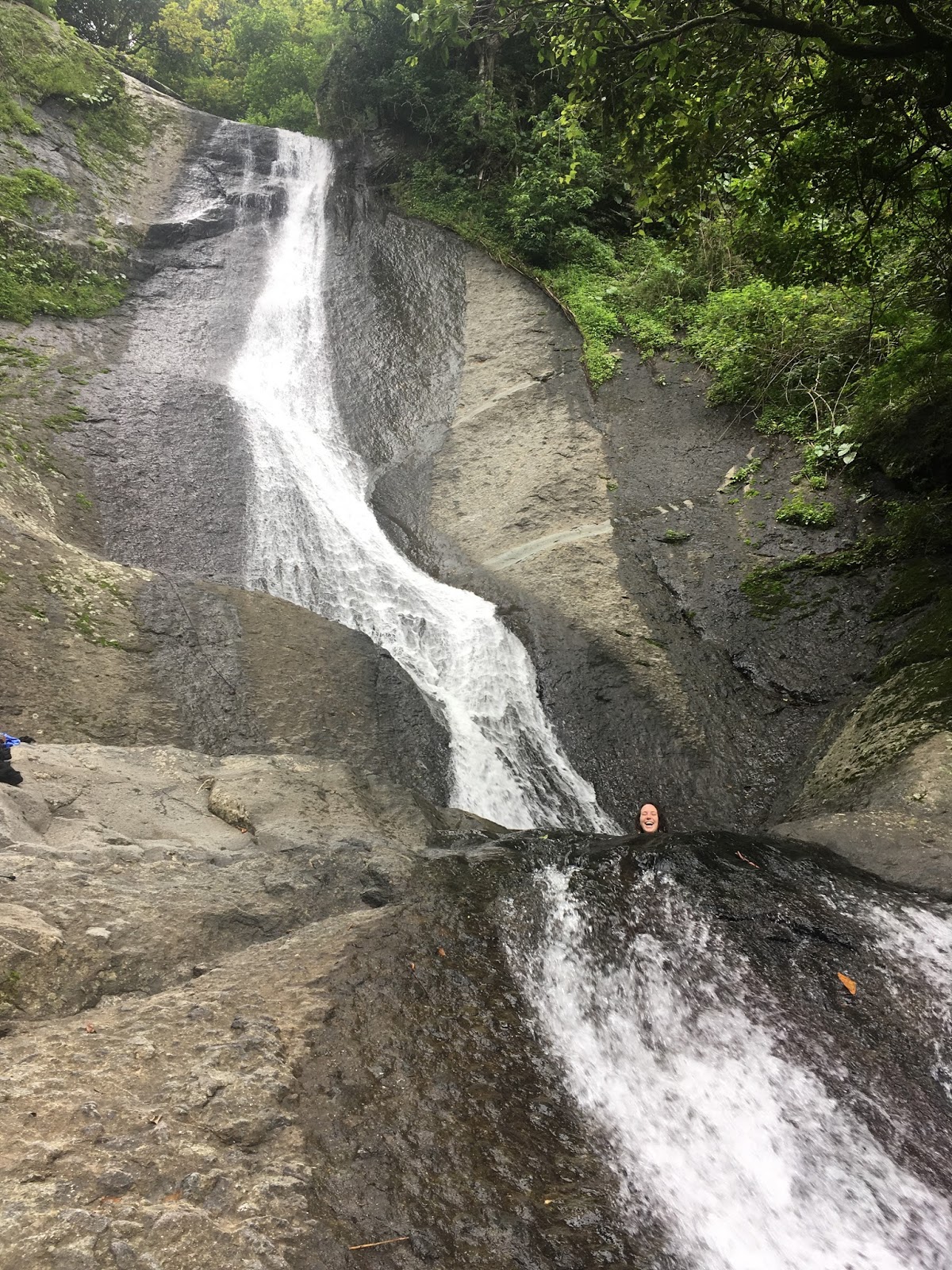
Can you spot my head? A secret waterfall flowing all the way down a mountain in West Bali.

Tracing Wallace's path to the ficus buttresses of Lombok.

I travelled from town to town, meeting new people and parting ways in a swirl of motion. I avoided eye contact with crab-eating macaques in the Ubud Sacred Monkey Forest, ate free banana pancakes at my favorite hostel, bargained for cheap sundresses in Kuta, and skinny-dipped in the Pacific Ocean to celebrate the first moments of 2018. In honor of Alfred Russel Wallace, I took a ferry from Bali to Lombok and whooped with excitement as we crossed Wallace’s Line. On Lombok, I examined giant millipedes, trekked to waterfalls, and read Wallace’s book, The Malay Archipelago, in the same steamy jungles where he wrote it.

Wallace would have loved to find this cicada...

... just down the trail from this cicada-mimicking moth. What notion about natural selection might it have inspired in his mind?

One afternoon, I hunched in a cramped bird-blind for an hour, sweat dripping off my nose and mosquitoes whining in my ears, as I waited for the green flash of an elegant pitta delivering insects to his chicks. I extended my Indonesian visa––a bureaucratic nightmare involving three visits to the Kantor Imigrasi––and became a certified rescue diver so I’ll be able to keep my fellow humans healthy while we examine the health of corals.

A stunning damselfly with translucent violet wings. (Any ideas, Thomas?)

I wonder if Wallace encountered quite as many giant millipedes as I did.

Late one Friday evening, I was bantering in a bar with a group of Balinese waiters, nursing my ginger tea, when I heard the word frisbee. Huh? “Did someone say frisbee?” I asked. It turned out that one of the waiters, a programmer named Sam, plays pick-up ultimate frisbee on Saturdays. So began my love affair with Bali Ultimate. I now attend three weekly pickup games in different corners of the island, and I’ve joined a team, UB7, for the Nusatara Cup at the end of March. While I can survive without ultimate, I am not thriving unless I can chase a frisbee down across a swampy field, gasp after sprints, and stay out at dinner past dark with teammates because we’re having too much fun to say goodbye.

Sunday pick-up ultimate in Canggu.

Black leggings? White socks? Or just a great day of mudtimate?

A week into January, I finally reported for duty at the Reef Check office. My role is to assist Sila, an earnest conservation biologist one year older than me, with the implementation of Reef Check’s new Climate Change Adaptation Program. For more than a decade, Reef Check has been partnering with local fishermen and divers from Tejakula, a sub-district on the northern coast, to collect data on coral health. Now, I’m working on curriculum to teach these local partners about the theory behind climate change and its impact on coral bleaching. I enjoy wrestling these abstract concepts into accessible terms, but I’m ready for my move away from the computer screen and into the Tejakula communities.

My first Tokay gecko, Gekko gecko, a species with which I've been obsessed since elementary school. You can't tell from the photo, but this lizard was a foot long, and clinging to a vertical mural like it was the ground!

A couple weeks ago, as a facilitator for the International Student Conference on Global Citizenship, I had the chance to take 40 undergraduate and graduate students snorkeling over a coral reef. Most of the participants were studying business or international relations. None were biologists, and many had never used a snorkel before. A few confident swimmers held their breath and dove to get eye-to-eye with massive blocks of Porites coral, finger-like Acropora, mushroom-shaped Fungia and delicate Gorgonian sea-fans. As we treaded in the choppy water, one student surfaced and, still catching his breath, called out to me, “Why are the corals bleaching?” It might have seemed an absurd moment for a scientific lesson, two bobbing heads hollering back and forth across the din of an ocean, but to me it was perfect. How many times had this man heard the sad tale of climate change in a lecture and tuned it out? Only here, as saltwater coated his tongue and the algae-cloaked corpses of dead corals swayed in his vision, did the question really matter. He wasn’t raising his hand to ask me why corals bleached because it was going to be on an exam. He hollered across the ocean because he couldn’t wait, because suddenly the survival of these calcium-and-jelly organisms was personal.

After snorkeling, we explored Taman Tirta Gangga, a Hindu temple known for its fountain of youth.

At the end of February, I’m heading to Malaysia with my boyfriend, Collin, to explore climate activism in Kuala Lumpur, marine life around Perhentian Kecil, and street food in Penang. I can’t wait to show him a little slice of my Watson life. Then, I’ll move to West Kalimantan on Indonesian Borneo to work with Health in Harmony, a ground-breaking nonprofit that protects orangutans’ rainforest habitat by providing healthcare to the surrounding communities. Already, the connections from this year are circling around to find me again. By coincidence, I met the Health in Harmony directors in Madagascar, and a conversation over rice and zebu blossomed into a partnership on Borneo.

Who did I meet at the Conference on Global Citizenship but Aimee Razafimanjary, a Master's student from Fianaratsoa, Madagascar! We couldn't stop laughing and speaking Malagasy amid the organic lettuce-fields of Bali.

My friends ask me if the year feels like it’s going by too fast. I tell them no. I have noticed these six months passing, and I know where the time has gone: to cat vaccines and hamburger nights, to waterfall baths and lemur lice, to colored-pencil art and coral funerals and sobbing confessions to the stars. I don’t feel like the year is going by too fast, but I can’t imagine it being over. Here’s to the next six months!

What is this, a leaf for GIANTS?

Sincerely,
Nina
Share:

Popular Posts

Labels