On May 27th, I explored Lake Ballard with my mother, Jane.
 |
| Jane birds Lake Ballard through a chain-link fence. |
If you're from Seattle, you might pause to wonder what I'm talking about. The house-boated Lake Union is well known, as are the duck-filled Green Lake and the bridge-spanned Lake Washington. But Lake Ballard? You've probably never heard of such a thing.
That's because Lake Ballard is actually a puddle of water that has collected in a huge empty lot at the intersection of NW 46th St and 15th Ave NW (better known as the Ballard Bridge). It sits across the street from Ballard Blocks Shopping Mall, home to Trader Joe's and LA Fitness, among others.
 |
| Lake Ballard contains multiple habitats: calm freshwater, concrete pads, and blackberry brambles. |
The concrete foundation has been growing a forest of Himalayan blackberries since its industrial buildings were torn down several years ago.
Online neighborhood forums have generated many complaints about this "wasted" space, with commenters referring to it as an "eyesore" and calling for rapid development.
One commenter wrote, "You mean that swimming pool? It's about time they did something with that. Boggles the mind how property owners can afford to just sit on land like that without doing anything. At least turn it into parking for boats and RVs to pick up some cash."
The capitalist spirit is alive and well in Ballard.
 |
| You never know what you might find in Lake Ballard -- perhaps a chair and a fire extinguisher. |
Seattle's bird-watching community has taken a different perspective, as have an impressive number of migrating shorebirds and urban resident species. Birders have dubbed the construction site "Lake Ballard." We frequent it with our binoculars, report sightings on the Tweeters listserv, and
submit eBird checklists. Highlights have included semipalmated plovers, least sandpipers, greater yellowlegs, spotted sandpipers, and solitary sandpipers.
 |
| Because it is fenced off from human trespassers and isolated from most predators, Lake Ballard is a safe haven for a duck to raise her family. |
 |
| I watched this mother mallard supervise six ducklings in the frothy waters. |
 |
| Here, a mallard and her duckling sleep behind a killdeer, the only shorebird we saw today. |
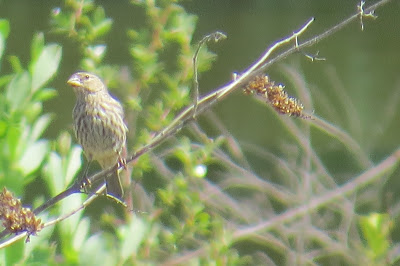 |
| A female house finch picks seeds from a pioneering shrub. |
Next to Lake Ballard runs one of Seattle's famous drawbridges, the Ballard Bridge. A host of streetwise birds make their homes here, in the traffic-rumbling shade.
 |
| Jane is framed between the Ballard Bridge and Lake Ballard. |
 |
| Pigeons are the most dependable sightings. |
 |
| European starlings live here, too. |
 |
| A native and intelligent American crow watched my mother and I with interest from a telephone wire. |
Most excitingly, a colony of cliff swallows have plastered their mud to the bridge's underside. Concrete cliffs suit them just fine.
 |
| This view is looking straight up at a hanging weed, fence-top pigeon perch, and cliff swallow nest below the bridge. |
 |
| Close-up of a cliff swallow's mud nest. |
 |
| Another nest with a white, blue, and orange head poking out. |
 |
| A cliff swallow makes adjustments to her corner abode. |
I have become fond of Lake Ballard and its avian inhabitants. To me, this empty lots holds several lessons:
1. Birds in Seattle are desperate for freshwater, and they need more aquatic and riparian habitat.
2. Nature is resilient, and it will fill in the weedy margins of capitalist development at any opportunity. We have the potential to coexist, humans and wildlife, in ecosystems that are contaminated and collaboratively built by all of us. (For more on this idea, I suggest reading
The Mushroom at the End of the World: On the Possibility of Life in Capitalist Ruins by Anna Tsing.)
3. Waste is never wasted. What a developer sees as a "waste of money" or a neighbor sees as a "waste of space" is a resource that will be used by marginalized populations, in this case birds and blackberries.
And with these lessons in mind, I am sad to share the news that Lake Ballard will soon be developed into
a grocery store, marine retail, and a restaurant. A big white board (formally known as Notice of Proposed Land Use Action) declares the lake's fate underneath graffiti of an incredulous fox. I picture a thought bubble over the spray-painted canine's head:
"Do we really need another grocery store across the street from Trader Joe's?"
 |
| A notice of Lake Ballard's impending demise, with commentary from a graffiti fox. |
Of course, Ballard is growing, and the stores will be frequented by customers happy for a source of high-end foods on which to spend their money. It's a capitalist dream to replace this wasteful swimming pool with economically productive businesses.
Yet, I imagine an alternative use for this land. What if Lake Ballard were immortalized into a small urban park? What if Ballard's residents worked together to demand that this vacant lot be turned into a freshwater oasis for shorebirds and waterfowl amid bustling concrete and air-conditioned gyms and grocery stores? My dream has been met with enthusiasm when I shared it with Trader Joe's clerks and shoppers, my only audience so far.
Resistance to development is not a stranger in this place. Across from Lake Ballard, wedged between Ross Dress for Less and LA Fitness, sits an odd and unexpected home. It's the house of the late
Edith Wilson Macefield, a Ballard legend who refused to sell her property for exorbitant offers. So, the Ballard Blocks Shopping Mall was built around her.
 |
| Edith Wilson Macefield's house tucked defiantly between behemoth units of Ballard Blocks Shopping Mall. |
Clearly, the birds are willing to call this ruin home. I would like to take a leaf out of Edith's book and defend this "waste" for the organisms who recognized its potential not as a generator of profit, but as a nursery for ducklings, a source of home-building mud, and a garden of seeds and berries. I would feel more at home in my city if I could visit Lake Ballard years from now, spend a few moments with its inhabitants, and remember that all of us -- all organisms -- are in this game of survival together.


