Health Education, Health Articles, Health Blog

Showing posts with label frisbee. Show all posts

Third Quarterly Report: Nine Wild Months of Watson

Holy moly, this deadline came up fast! Here's my third quarterly report for the Thomas J. Watson Foundation, one of the few requirements asked of fellows. If you like, you can revisit my first and second quarterly reports here. Without further ado...


Third Quarterly Report


Date: April 27, 2018
Countries you were in: Indonesia, Malaysia
Countries for next quarter: Indonesia, Malaysia, Scotland, England, Canada
Current location: Sukadana, West Kalimantan, Indonesia

Dear Watson Foundation,

I am sitting at a kitchen table inlaid with green and blue tiles, under a leaky thatch roof in the town of Sukadana, West Kalimantan, Indonesia. Water is billowing in through two windows and pooling in an aluminum pot. The splatter occasionally coats my laptop screen with mist. I know the storm is directly overhead because the thunder is almost simultaneous with blue-white flashes of lightning, and every clap sounds as loud as an old-growth tree crashing into the kitchen. I love these nightly tempests because they keep the rainforest steamy and damp. They also turn my yard into a mud puddle.

A Sukadana scene: concrete swiftlet house (the bird's salivary nests are a Chinese soup ingredient), drying coconuts, rainforested mountain and brewing storm.

Last I wrote, I was beginning my month with Reef Check on Bali. Although I did produce some documents – a fish identification guide, an infographic on Bali’s 2016 coral bleaching event – the work was unsatisfying. Many days, I arrived at the open-air office to find no tasks. I came to expect the phrase, “Why don’t you take the day off?” with disappointment that this organization was not utilizing my potential. On reflection, I realize most of the blame was my own. I should have invented tasks and been vocal about my strengths, respectfully reminding my supervisors that I can be an author, grant-writer and marine ecologist. Instead, I presented myself as disposable, and that led me to feel disposable.

I found this Cerulean kingfisher (Alcedo coerulescens) behind Bali's garbage dump on an unplanned day-off.

I also found this temple with walls of dirt and moss! If I were spiritual, this would be my place.

For my Reef Check capstone I joined a gathering of Pokwasmas, a fishermen’s cooperative in the village of Penuktukan, to present on reef resilience to climate change. I was honored to speak, but because I presented in English with no translation, only a handful of the audience understood. Since then I have learned to advocate for my language needs. Now when I present, I directly ask one bilingual person to translate for me, and I pause between each sentence to make sure my meaning gets across.

Shaumi, a marine science student from Udayana University, mops to prepare for the Pokwasmas meeting. Posters about marine conservation decorate the open-air room.

After the meeting, I spoke with Nyoman Sugiarta, a tourism-operator turned full-time conservationist. He pours concrete hexadomes for coral substrate and canoes the marine preserve to discourage poaching. On his forearm, an inky ecosystem of turtle, coral, fish and sea grass entwine the word “Conservation” in newspaper font.

Photo credit: Nyoman Sugiarta.

“Why do you feel strongly about coral conservation?” I asked Nyoman.

“I used to think corals were rocks,” he explained. “Then Reef Check came here and told us they were animals.” Nyoman became a diver and began paying attention to the strange, gelatinous lifeforms. “Now that I know they’re alive, there’s so much to learn! I can’t let them die.”

I was surprised that Nyoman’s explanation contained no economics. As an environmental biology student, my training often implied that wealthy Westerners can afford to conserve an ecosystem for beauty and curiosity, but subsistence resource-users conserve ecosystems for practical reasons, like increasing the harvest of fish. How quickly Nyoman dispelled that myth. Driven by his urge to learn, he traded his job for unpaid conservation and occasional scuba-dive guiding. Two summers ago, when I was a wilderness educator in Alaska, I tried to cultivate curiosity for slimy things: marine invertebrates, microbes, slime molds. In Nyoman I found an example of how powerful curiosity can be.

Corals and echinoderms I photographed in Indonesia.

In mid-February I moved to the Malaysian metropolis of Kuala Lumpur. My boyfriend Collin and I converged for a marvelous two weeks diving the corals of Perhentian Kecil, celebrating the end of Chinese New Year with 40,000 revelers in Penang, and visiting our friend Marra during her English-teaching Fulbright in Melaka. We tried to understand the threads that weave Malaysia’s tapestry of religions, genders, and races.

My three favorite postcards before I sent them: a street-art girl from Penang, public buses from Kuala Lumpur, and a stone plant from Melaka.

Once Collin left, I enjoyed the resources of a big city by touring One Health labs and giving a lecture at Monash University on “monsters and microbes.” I reunited with a great friend from high school, Nithya, who is loving her life as a solar-energy firmware engineer in Cambodia. Seeing Nithya’s drive and joy about her career got me thinking hard about my own. Compared to Nithya’s startup – young, efficient, impact-driven – my environmental nonprofits seemed ineffective and bureaucratic. I struggled to reconcile the fundamental difference between engineering, a building science, and ecology, a science of observation. Nithya had been trained to solve problems; I’d been trained to study them.

For her last night, Nithya and I tracked down the last cendol cart open in KL and enjoyed a midnight bowl of shaved ice, canned corn and green jelly (hold the durian, please).

With that mixture of inspiration and apprehension, I returned to Bali for Anuar Abdullah’s course in coral propagation. Anuar had an intense face, tan and deeply lined. His black T-shirt bore the skull-and-crossbones of Sea Shepherd, an organization of vegan pirates famous for sinking whalers. Coral gardening and piracy might seem like odd partners, but it makes sense: both groups have a take-no-prisoners attitude toward conservation. The first words out of Anuar’s mouth were, “Big things are happening. Corals are dead. We don’t have time to mess around. This is too urgent.” Anuar taught me details, like how many drops of superglue to use when attaching a fragment of Acropora to aragonite rock, but I was more interested to uncover why Anuar is successful (his fever-pitch drive to save the ecosystem he calls home) and why he is not more so (he works alone). I was daunted by Anuar’s stance that purely-academic careers are unethical in this critical moment of our planet’s health. Is a life of solitude and heartbreak the only way to fight for an ecosystem? I wondered.

We piled rocks to create an underwater nursery for coral fragments.

Before I left Bali, I met up with my ultimate frisbee team, UB7, for the tournament they host every year, the Nusantara Cup. Our team leader Alex invited me to be Spirit Captain, a uniquely-ultimate role that entails holding the team accountable for high integrity and leading a conversation after each game to discuss our opponent’s sportsmanship. I am proud to report that UB7 was the first Indonesian team in history to win the Nusantara Cup!

No mark!

The following morning had an inauspicious beginning. I was exhausted as only frisbee players will understand. My lungs burned, my hips flexors ached, the skin on my lower lip ballooned into painful blisters, and I wheezed with a nasty cold. The next ten hours in planes and cars were miserable. Little did I know, I was en route for the best month of my year.

ASRI staff jump on the beach, and I'm a bit late to the game.

That evening I arrived in Sukadana, a village nestled on the edge of Gunung Palung National Park in Kalimantan (Borneo), Indonesia. This lowland dipterocarp rainforest is home to 3,000 of the last Bornean orangutans. I’m volunteering here with Yayasan Alam Sehat Lestari (ASRI), roughly translating to Healthy Balanced Nature, a pathbreaking Planetary Health hospital with a mission to “save the rainforest with a stethoscope.” The model behind ASRI is simple: orangutans are expected to go extinct by 2050 due to habitat loss; most illegal loggers wish to stop but cannot because timber is their only source of cash for healthcare; to save orangutans, we need a human hospital.

A photo I took of a reforested orangutan corridor posted to the ASRI Instagram.

Over the past month, I have worked on education with Amad and Etty, communications with Oka, grant-writing with Monica, and reforestation with Dika. I’ve gotten to share a house and meals with ASRI’s founder, Kinari. All day I feel respected and productive. In the afternoons, the clinic staff becomes a riotously fun group of friends. We watch the sun set over the ocean, sip kelapa coklit susu (fresh coconuts filled with iced chocolate milk), watch horror films and play cards. I’ve taught the staff to bake chocolate-chip cookies and buttercream cupcakes. They've taught me to speak Bahasa Indonesia and slow down my pace. I leave tomorrow, but on no account am I ready to bid this place goodbye.

One day I baked Tollhouse cookies for the ASRI staff. It's a family recipe, the first one I learned as a kid, and Natalia asked me to write it for her. On my last morning, she pulled out a tupper of fresh-baked Tollhouse cookies! They tasted just like home.

Kelapa coklit susu on the beach.

For the past few years, I've been seeking an interdisciplinary lens through which to approach my work, one that embraces complexity. The Anthropocene Epoch demands a reckoning with entanglement; we will not find success by inspecting any one element in isolation. Initially, I titled my Watson project "One Health" because that movement -- the intersection of human, veterinary and environmental medicine -- seemed like a good stab at integration. But here at ASRI, I’ve learned that I identify even more with "Planetary Health," the recognition that solutions for human and ecological health must be integrated. ASRI does not draw a line between trees and bodies. It delivers babies, provides dental checkups, plants rainforest saplings, and buys back chainsaws from loggers to facilitate a regenerative economic spiral. With this lens, I have a new goal for my PhD. I want to identify and implement win-win solutions in which human health problems are addressed by restoring ecosystems.

A logger revs his chainsaw one last time. Today, he will sell it to ASRI's Chainsaw Buyback program in exchange for a micro-loan and training to launch a small business.

Working at ASRI is emotionally exhausting in the best way. Every day, I find myself revising my place in conservation and developing hope that real change is possible. Since 2007, ASRI has recorded an 89% decrease in logging households and a 25,000 hectare increase in forest cover. The end of illegal logging in Gunung Palung National Park is within reach.

An organic farmer, recently trained by ASRI, takes fastidious care of his black-pepper trellises. With tools like homemade compost and crop rotation, farmers can move away from slash-and-burn agriculture.

In Brazil, I learned how humans, pets and wildlife are connected by disease across a rapidly-changing landscape. In Madagascar, I probed that connection to find out whether forest fragmentation directly contributes to zoonotic spillover of viruses. Now, in Indonesia, I am seeing how the upward spiral of integrated human and ecological restoration really works to create health.

My housemate Bella, a medical student from Jakarta, tests out Marmelade (my backpack). She didn't believe all my things would fit inside.

Though I’m still in denial about leaving Sukadana, I will fly tomorrow to Tanjung Puting National Park to witness rehabilitated orangutans in their wild habitat. I then cross to Malaysian Borneo for two weeks of coral propagation and one of hornbill research. At the Planetary Health Alliance Annual Meeting in Scotland, I’ll present on Malagasy sand-flea season and climate change. I have tickets to visit a bird observatory on a northern Scottish isle and the London School of Hygiene and Tropical Medicine. In mid-June, I helicopter in to the most extreme leg of my Watson journey, the Arctic. In lieu of my original plan to visit anthrax-infested caribou carcasses in Russia (which is now on the do-not-travel list), I will volunteer with Dr. Emily Jenkins to test Arctic foxes and mosquitoes for emerging pathogens at Karrak Lake, a remote outpost in Nunavut, Canada.

Amad stole my camera and captured this candid moment. I am lost somewhere deep in thoughts.

I can’t decide if I’ve learned more about myself or the world these past nine months. I suppose it hardly matters. As I prepare to leave Asia for three Western nations, I’m starting to sense the Torschlusspanik (an excellent German term for “the panic one feels as gates are closing or an end is nearing”), but I can hardly imagine August as an ending. Every day, the world feels larger and richer with beginnings than before.

Love,
Nina
Share:

Spirit: from Balinese Frisbee to a Bornean Hospital

It was the end of one era, and not quite the beginning of the next. After my coral propagation class on Gili Trawangan, I dove into a strangely familiar netherworld that transcends time and space. I'm talking about ultimate frisbee.

Tuesday Beach Ultimate the week before I left Bali for Malaysia. That's me kissing Ari on the cheek!

After a midnight coincidence in a Balinese bar, in which I overheard the word "frisbee" and procured a ride the next morning on the back of someone's motorbike to a game of pick-up ultimate, I was hooked. I played as often as I could, from windy beach-litter-clean-up/frisbee combos to high-level mini games to mandatory practice each Sunday. Yes, I managed to try out for a competitive team, UB7, within my first week. The captain, Alex, convinced me to come back to Bali after my month in Malaysia to play on UB7 at the international tournament, Nusantara Cup.

Alex (front) and I set in a team circle during a Sunday practice.

Warming up before practice in my Balinese neighborhood, Sanur.

I made new friends, both Indonesians and ex-pats, on the field. Sweating and diving and nursing grass-cuts over dinner is, universally, the fastest way I have found to make friends. But frisbee also brought old friends to me, even as I lived in relative isolation here in an archipelago of Southeast Asia.

Ari Lozano was my high-school Fryz teammate and my got-your-back-no-matter-what co-captain for our college team, the Whitman Sweets. She swung by Bali to visit me after winning gold with the USA Under-24 Worlds Team in Australia (GO ARI!!!) We played plenty of pickup and dabbled in scuba diving, Ari's newest hobby.

For the Nusantara Cup, I convinced two more Fryz to visit! Here's Jessie Thoreson, one of the ladies who inspired me to play frisbee in sixth grade, and has continued to inspire me ever since. She brought her guitar and leftie backhand, and it was like no time had passed.

Unreal! Here I am with Jessie and Henry Phan (and my Balinese teammate Naja photo-bombing), another of my lifelong friends and inspirations. Henry was one of the first men to take me seriously as an athlete, and he was the same intentional, kind baller I knew in middle school. Fryz will be my family always.

The tournament was a huge success. I got back from Gili the night before, and Alex asked if I would be his spirit captain. That's a uniquely-frisbee leadership role involving sportsmanship, integrity, and positivity. It was my job to greet the other team's spirit captain before each game, shake hands, and ask if there was any particular aspect of their spirit on which they were working. After the game, I led our team in a consensus effort to rank our opponents' spirit in five categories: communication, physical contact, positivity, knowledge of the rules, and fair-mindedness. I was honored to be trusted by the team in this leadership role, as well as my informal contributions to team strategy, even though I was a transient through Bali. These people gave me a home in the middle of my Watson year, and for that I am deeply grateful.

I got to cut and handle this weekend, what a treat.

Throwing or faking? We'll never know.

As a bonus, we won the tournament! Our win marked the first time a Balinese team has ever won a tournament on its home island. In the finals, we beat my personal favorite team: Learning To Fly, all the way from Bangalore, India. After, I traded with one of the men for his orange jersey.

Our final photo with our second-place opponents, Learning to Fly.

The day after the tournament, I was physically exhausted, sunburned to the point of peeling, and hacking with an asthmatic cold. By 3:00 in the afternoon, Jessie and I couldn't stay away. We hopped on motorbikes and headed out to one last hurrah of pick-up ultimate in Bali. There, we found a dozen similarly-addicted frisbee players, all in various stages of injury from the preceding days, all smiling ear-to-ear because we were tossing a plastic disc once more. This sport is an addiction, a home around the world, a lasting family. I'll miss you, UB7, but know that we will meet again one of these days.

The frisbee players can't stop! Here's post-tournament pick-up.

And with that, I said goodbye to Bali. A sixteen-hour day of travel took me across several islands and channels to Java, Pontianak, Ketapang, and finally my destination of Sukadana, a rural town on Indonesian Borneo.

I must be here!

Fun fact, the island of Borneo is roughly the same size as Madagascar, but it contains three countries: parts of Indonesia and Malaysia, and the entirety of Brunei. The island is known as Borneo in Malaysian and English, but Kalimantan in Bahasa Indonesia. It's home to most of the world's remaining orangutans and hornbills, and also to some of the fastest rates of deforestation for oil-palm plantations.

Oil palms neatly criss-cross Borneo from my airplane window.

The reason for my trip to Borneo lies with an organization known as Health in Harmony. I was referred to this nonprofit by a friend of my mother's, and fate brought it all together. I'd been emailing with Health in Harmony's Director of International Partnerships, Amy, when she told me she'd be out of touch for a few weeks. Why? A scouting trip to Madagascar. At the time, I myself was living in Madagascar. Who shows up in the bedroom next to mine? None other than Amy! I spent a dinner and then some grilling the patient and knowledgeable woman about her groundbreaking work in One Health conservation. That interaction led me here, to become a monthlong conservation and education volunteer at Health in Harmony's pilot site in Borneo.

The story of Health in Harmony is very compelling. It all started when Dr. Kinari Webb, a young orangutan researcher straight out of Reed College, spent a year doing fieldwork in Borneo. She realized, as many ecologists do, that studying her beloved primates was not going to save them. She was horrified to realize that the apes might go extinct within her lifetime. She saw the illegal logging, spoke with local communities, and actually listened to what they had to say. This process, called "radical listening," taught Dr. Webb that in order to save orangutans, she would need to become a medical doctor and provide healthcare so the people living around the national park wouldn't be forced to log for their lives.

Really, Dr. Webb explains it all much better than I do. I highly recommend watching her TED Talk:


The next morning, I felt like I was dreaming as I walked through the spacious, white, outdoor halls of Alam Sehat Lestari, or ASRI, the hospital Dr. Webb founded. The hospital's rear boundary butts up against Gunung Palung National Park, one of the largest remaining tracts of Bornean orangutan habitat.

This triptych from the hospital's wall depicts an ASRI reforestation project in the degraded, marginal lands of the National Park. I'm interested to see the progress with my own eyes.

The orangutan poster is a popular destination for patients to take selfies.

A planetary health vibe permeates the hospital. This sign translates to, "Let's guard them now. Someday, they will take care of our grandchildren."

I spent my first afternoon acquainting myself with Sukadana, my home for the month of April. I am living in a breezy house once occupied by Dr. Webb herself. The roof is half thatch and half corrugated-metal. Insects, rats, and cats enter at will, but the mosquito net over my bed keeps the worst at bay. My only complaint are the twitchy yellow wasps that live in two nests daubed to our kitchen's rafters. These curious buggers buzz against my net all night, and they often wander right through the seams of the net into my personal space. It's unnerving to hear the buzzing get closer, then stop, and suddenly feel the tickle of a wasp's feet across my arm in the dark. I've killed a dozen between sturdy books so far. Maybe, if I keep at it, I'll get them all!

The central monument of Sukadana is this space-age salute to durian. Could anything be more Indonesian?

I parked my bicycle for a quick tour of the outdoor market, specializing in fish and vegetables.

The long, toothy, saltwater eels caught my eye (and nose.) I asked if I could take a photo with them, remembering how such requests to photograph without purchasing were met with angry glares in Madagascar. Not so here!
 
Not only did the fish mongers welcome my photography, they all requested selfies with me and their fish.

Here are just two of our fish-selfie album.

The marine-invertebrate-monger was not to be outshone. Here he displays a prawn and a slipper lobster.

In this highly Islamic town, you would be silly to direct anyone in relation to "the mosque," because there seem to be mosques on every block. But if you were to mention the "big mosque," there could be no doubt about the direction you meant to indicate. This glorious white structure looms above the horizon in a powerful silhouette. Its call to prayer can be heard echoing through the streets five times a day -- including right now, as I type. It's lucky I am a sound sleeper, because my poor housemate is awoken every morning at 5:00 am by the sacred Arabic songs coming through the loudspeaker.

The Big Mosque.

Already, Sukadana feels like a home. I don't have the ready-made community of a frisbee team, but the ASRI staff have the same loving camaraderie. I've heard there is an avid Zumba community, a swimming pool for Saturdays, and an early-morning bike crew, so I won't be lacking for exercise. Maybe I'll be able to teach my coworkers to throw a disc, too, and start a frisbee club. I imagine our name would have a nice ring to it: Sukadana Spirit, a team for ecosystem health.
Share:

Frisbee Love is Universal

Day 7: Sunday, January 12th


The bus ride was great! I wish I could have looked out the window at the scenery, but sleep was too wonderful.

We arrived at our Sunday destination, a dingy waterpark called Parque Aventurah, at 10:30am. Everyone erupted with a chaotic jumble of questions. “Are we getting back on the bus before rafting?” “Can we take our bags into the park?” “How big are the lockers?” “Is the zipline free?” “Does someone have extra sunscreen?”

We had about an hour before our rafting trip, but due to the confusion we didn’t do much. I didn’t want to swim because I didn’t know if I’d have a chance to reapply sunscreen. Plus, the sky was overcast. I wish I’d taken out my camera and found some birds! Instead, I played on a decrepit see-saw and lollygagged by the pool

Then it was time for rafting. I hoped the trip would be better than my first rafting experience in Eastern Washington, when my lifejacket had been so tight I’d felt like I was suffocating the whole time.

We gathered on a grassy hill and donned moldy-smelling life jackets and colorful plastic helmets. I was in the yellow-helmet group with five other AZP students. We filed onto the rusty metal bus we had avoided earlier in the parking lot. I heard grumbles all around, but I was excited to finally experience the sensations of the world. We’ve spent the past week driving around the state of São Paulo in a cushy, air-conditioned charter bus with chilled water and drink holders. Today, I sat on a high, flat-backed aluminum bench and hung by head out the wide-open window. I felt every bump in the road and every fleck of dust in my eyes. I smelled oncoming rain and cow manure. I heard tweeting birds as we whizzed by trees and streams. That bus ride was the first time I felt alive all week.

By the time we arrived at the end of the dirt road, angry dark storm-clouds had gathered. We heard distant rumbling thunder. “In the States, we wouldn’t be allowed to step onto a soccer field in this weather,” I mused to a classmate.

“This is Brazil, baby!” he replied, grinning. Brazil it was.

The river rafting was my first encounter with Brazilian forest. I’m living in the country that contains over half of the world’s remaining tropical forest, and I hadn’t seen a wild patch of trees yet! We carried our paddles down a rickety flight of wooden steps to the muddy water. Tropical bushes with glossy, heart-shaped leaves draped over the water’s surface. Palms and other evergreens crowded the banks. We loaded the boats and practiced obeying basic Portuguese commands. My favorite was, “Piso!” for “Get down on the floor of the raft because we’re going over a waterfall!”

We drifted down the river for what felt like hours. We passed over occasional rapids and four true waterfalls, but most of the trip was smooth and calm. At one point, the banks were composed of steep, slick, solid black rock. I wondered about the geology. Was this riverbed the result of a volcanic eruption? I also grew curious about the trees. Was this a primary forest? Or had the surrounding pastures once encroached all the way to the river? Was the river now a protected park? Did it provide enough habitat to sustain many animal species? I knew that if I’d been on my Ecuador program, we would have been discussing these topics for the whole ride.

When we got back to the water park we were soaked. I felt much freer, and had a great time chasing friends up and down the water slide. We got creative: head first down the slide, five at a time, climbing back up through the water… Finally a park official wandered over and clarified the rules (all of which we had broken), but by then we were ready to hit the showers anyway.

I got out my camera to photograph the many songbirds and vultures I’d noticed around the park, but I only got the chance to take one photo before we had to leave!

At least it was a cool shot – this bird was bringing nesting material to its mud-cave.

Back in the plush, reclining seats of our bus, I couldn’t resist another nap, but I noticed a few things out the window: fields of sugarcane and plantations of eucalyptus, oranges, and pines.
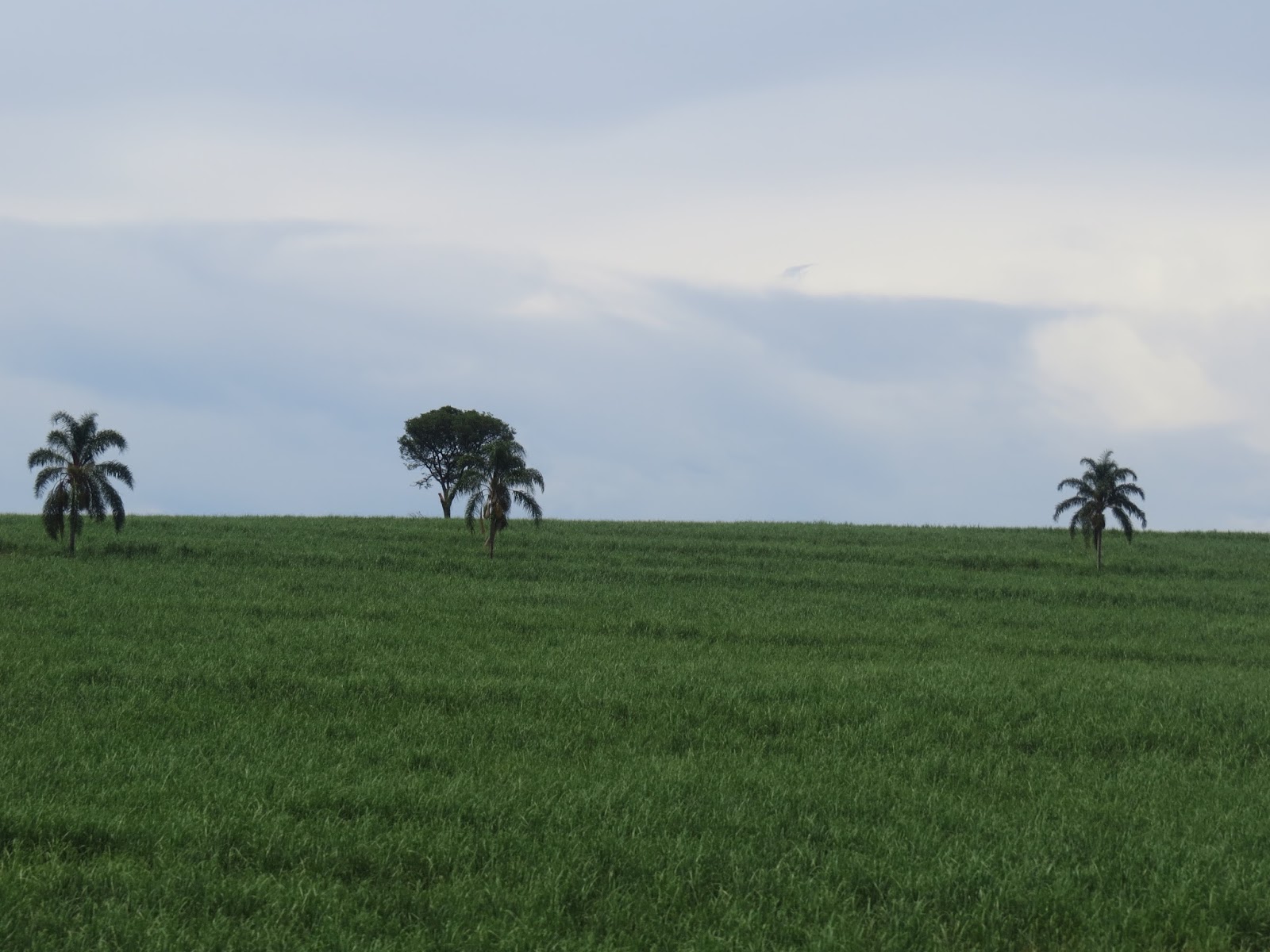
Tropical palms dot a massive sugarcane field.

A patch of eucalyptus trees stands alone.

Our "small" city looks pretty large from this angle!

Welcome home!

I don't know how well they show up in this photo, but a hundred black vultures were circling above the city!

We finally got a free evening, hooray! I caught up on some bird analysis from my photos, updated my blog, e-mailed my family, and started a scholarship application. I even had time for a short neighborhood run with Holden and Christine. For dinner I split a hamburger with Rachael at a new sandwich shop. The burgers came in three sizes so we went for the grande, but when the plate came we realized we were each going to get a larger-than-edible meal. My half-burger was bigger than any hamburger I’ve ever seen!

I got ready for bed early, feeling refreshed from a day out of the classroom. I hung my wet clothes to dry, showered, brushed my teeth, and snuggled into bed wearing PJs. The clock read 10:30pm. Finally, I was going to get that early night!

I just wanted to finish my bird blog first. Then my boyfriend got on Facebook and we talked for the first time in way too long. My roommate was still journaling when I finally turned out my light at 1am. I am incapable of going to bed early. MUST TRY AGAIN TOMORROW.

Day 8: Monday, January 13th


Today was our last day of Brazilian history/economics with Professor Pedro, and it was the first day we got to choose our own lunch restaurants. People scattered, but Erin, Sejal and I decided to tag along with Juliana to a Japanese restaurant. Since there were only four of us, we got to ride in Juliana’s car!

Riding in a car doesn’t sound that exciting, but sitting shotgun in the hot, humid air with loud Brazilian music blaring and the window down was incredible. I felt like I was in a movie montage about the perfect high-school summer.

We all ordered sushi. Most of the menu items were seaweed cones, to be eaten like a burrito. Juliana and Erin got Philadelphia cones, which looked delicious. Sejal got a “simple salmon cone,” and I got salmon rolls like the ones in the States. Sejal’s looked great – absolutely packed with chunks of sake, raw salmon. I ordered green tea and got a can of sweetened diet tea – tasty, but not what I was expecting. I wasn’t full after my rolls so I ordered a simple salmon cone like Sejal’s. It was about four parts salmon to one part rice, amazing value but not the ideal ratio! It cost around $5.00. I managed to eat almost my whole cone, but had to leave some perfectly good salmon sashimi on my plate. Next time I want to go with three friends who love salmon so we can split the simple salmon cone with lots of extra rice.

As we walked back to Juliana’s car, the stormy skies which had been swirling all day reached a breaking point. Lightning and thunder cracked at the same time and palm trees whipped back and forth. We started driving down the road and noticed giant sheets of paper flying off the roof of a skyscraper. As the sheets got closer, I heard a weird metallic banging and realized they were huge sheets of tin! It was a thrilling moment until the light turned green and we drove out of harm’s way.

Suddenly the rain began. I hung my head out the window and let the water soak my hair. The rain was POUNDING! The gutters flooded and the windshield was obscured under a waterfall. We barely made it to school, where Juliana advised us to wait in the car. I was too excited and ended up dancing around in the rain. When I got back to the classroom, it looked like I had showered in my clothes. I pretty much had.

In the afternoon we began our second class which, it turns out, is also about Brazilian history and economics. We went through the same historical events, including Prince Henry the Navigator. I felt like it was a waste of time to revisit the same topics again, but at least this time they were in chronological order and were much easier to keep straight. Our new professor has a good sense of humor.

After class, we all followed Juliana on a round-about route to our planned soccer game against some Brazilian students. Most of us had been wearing our athletic clothes all day. I was so excited to get outside that I couldn’t keep still. I wanted to be goalie and dive in the grass. I also had a disc packed in case people wanted to play pick-up ultimate after the game.

We were all thoroughly disappointed when we realized that due to the afternoon rain, we would be playing in a gym. Nooooooo! I warmed up by tossing my disc with Erin. We had tons of fun before the game even started. I goal-kept a shutout game, then switched to forward and assisted a few goals. Pure luck, but it felt great to run around and be competitive.

Then a Brazilian girl pointed to my disc. “You want to play?” I asked. I’m sure my whole face lit up. A crew of eight of us – half Ohio, half Brazil – left the gym for a soccer field out back. We threw the disc in a circle, everyone cheering everyone else. These students had never played ultimate before, but they automatically embodied Spirit of the Game.

Through a mixture of Spanish, English, and Portuguese, I explained how to play ultimate and we all enthusiastically battled in a game to ten. I was so impressed by the effort, heart, and humor of everyone involved. People who had never thrown a disc tried hucks and got Ds. When the sun set, we were all sad to go home and immediately made plans to connect over Facebook and reconvene next week. “Every day!” cheered one of the women.

Our incredible frisbee crew!

“Can I keep the frisbee?” she asked in cautious English.

“Of course!” I replied. The disc had gotten cracked during the game, and I had another one in my suitcase.

We all signed the disc before we parted ways. “I’ll hang this on my wall,” the woman told me happily. “And I’ll keep you all in my heart!” We finally left after a group hug. Frisbee love is universal. <3
Share:

Popular Posts

Labels