Health Education, Health Articles, Health Blog

Showing posts with label Walla Walla. Show all posts

Why Two Whitman Seniors Returned to 9th Grade

It was spring of my senior year in college, and there was just one more class I needed to take before I graduated: 9th-grade biology.

Every Tuesday, my fellow nature-nerd Eva and I volunteered in a Wa-Hi classroom. You can watch our interview with the Walla Walla Public School District here, and read below for the whole story.


When you live in Walla Walla, the name "Wa-Hi" rolls off the tongue. It's short for Walla Walla High School, one of two (along with Lincoln High) in the Walla Walla Public School District. That's about all I knew until January, when I got to Whitman for my senior spring.

During my three years at Whitman, I'd been wanting to get more involved in community service, but there never seemed to be time. I volunteered in small ways: I brought Whitman's crested gecko and rock python to bilingual elementary-school classrooms and did yard work for the elderly on Martin Luther King, Jr. day. Then I got an e-mail from our Science Outreach Coordinator asking for volunteers in a Wa-Hi 9th-grade biology classroom. I signed up for one hour a week on Tuesdays. My friend Eva signed up for the same time so we could carpool and work together.

The Wa-Hi campus.
Photo credit: Breanna Baltrusch.

When we got to Wa-Hi, I was amazed to see a barn full of sheep. In high school, I would have given anything for the chance to attend a rural school with an Future Farmers of America (FFA) program. And here I was, living ten minutes from an FFA school! I wish I'd gotten involved on my first day in Walla Walla, maybe volunteering with the FFA kids or a local 4-H club.

The campus is spread out between green, grassy commons and bisected by a restored section of Yellowhawk Creek. Eva and I signed in at the main office and walked through a maze of outdoor hallways to find Ms. Burt's classroom.

The Wa-Hi hallways are outdoors.
Photo credit: The Whitman Wire.

Mary Burt is one of those teachers students feel lucky to have. Even though these 9th graders were not always thrilled to spend their 7th period learning about cells and forest ecology, they were always happy to see Ms. Burt. She has a sense of humor that keeps her classroom's attention through laughter instead of discipline.

Here I am in the classroom with Eva, my volunteer partner, and Ms. Burt, the 9th-grade biology teacher.

I loved working with Wa-Hi students. I would have liked to invest more than one hour a week, but even so, I got to know the students' names and personalities. That's the great thing about high schoolers -- they'll tell you exactly what they're thinking. When a student would tell me, "No, I'm not going to do the work; this is boring and I hate it," I took her at her word. I remember feeling trapped by worksheets and standardized curriculum.

I tried to make every interaction about the student first, asking how he was doing and building a human-to-human relationship instead of just a teacher-to-student one. Second, I tried to bring in curiosity.

"Science is not about memorizing things, it's about asking questions," I told one student. "So if you don't know the answers about cells, why don't you write a list of questions?" Then, we'd pick which question sparked the most curiosity, and I'd help the student pursue the answer to that question instead of the ones on the worksheet.

Some students were motivated by drawing, so I encouraged them to draw their work. Others were distracted by YouTube during class, so we found relevant videos as inspirations for project topics. One student was making a scene by drinking a Dr. Pepper instead of working, so I asked him to explain the day's concept, diffusion, in terms of soda. His improvised explanation was so good, I used it with other students for the rest of the class.

The barriers to success in this classroom were high. It was the last period of the day; the honors and Advanced Placement students had been separated into other classrooms; and I imagine Ms. Burt would have loved to have a full-time assistant rather than a couple of volunteers a week. There were simply not enough resources to allow for the creative, engaging education these students deserve.

This semester, I was a teaching assistant for a Whitman course, Plant Identification Laboratory. Spending Tuesdays at Wa-Hi and Thursdays in a Whitman lab, I was amazed and disappointed by the enormous gap between the two classrooms.

Picture Wa-Hi: the desks were mismatched and graffitied. They barely fit inside the small classroom. There are no paid assistants, only once-a-week volunteers. The students were responsible for stacking the chairs each Tuesday so the custodian could mop, and Ms. Burt was responsible for keeping the blackboard clean. There are about 1700 students, and the student-faculty ratio is 19:1.

Now picture Whitman: the students are spread out across five rows of pristine laboratory benches, with extra space in the back for projects. The microscopes and stools are upgraded regularly. There are two paid teaching assistants (me and my friend Lia). We can leave the blackboard messy with chalk because the custodian will take care of it. There are about 1500 students, and the student-faculty ratio is 8:1.

I made up a name for this divide: the Classroom Privilege Gap. Obviously, a private college and a public high school are not parallel institutions, but this gap also exists among high schools, rural or urban, private or public, north-end or south-end. Working in these two classrooms each week was a reminder of how unfair and damaging this gap is.

Behold the Whitman classroom, replete with 45 microscopes and carefully arranged plant samples.

The weekly lab is planned by our professor, Heidi (right), set up by two paid teaching assistants (Lia and me), and supported by the biology department staff. Compare that to Ms. Burt's five-days-a-week Wa-Hi biology class, run entirely by Ms. Burt and a couple volunteers.

Teachers like Ms. Burt need more support, and students like the Wa-Hi 9th-graders deserve better school infrastructure. There's no easy solution, but adequately funding public schools is a place to start. Only 2-3% of the federal budget goes to education, and the Trump administration's budget called for a $9.2 billion (or 13.5% cut) to education spending. We can do better.

Edit: My friend and relentless activist for justice, Annie Want, just sent me this NPR article about why funding in public schools is so unequal across America. Did you know that school funding depends on local property taxes? And that in 1973, the Supreme Court decided in a 5-4 decision that the U.S. Constitution guarantees no right to equal funding for education? And that by doing so, the Court negated the intention of the famous Brown v. Board of Education decision to provide equal and integrated public education to all children, regardless of race or economic means? If any of this is news to you, as it was to me, read that article! Seriously.

As Chief Justice Earl Warren wrote in Brown v. Board of Education:

"It is doubtful that any child may reasonably be expected to succeed in life if he is denied the opportunity of an education. Such an opportunity, where the state has undertaken to provide it, is a right which must be made available to all on equal terms."

Finally, I'll leave you with this sign I read every Tuesday in the Wa-Hi office:

I love this sign. It doesn't require you to believe that you are special or perfect or amazingly talented; it just reminds you to do what you can with what you have.

What can you do? Call your representatives. Volunteer in public schools. Vote for administrations and taxes that support education. If you have more ideas about getting involved, leave them in the comments. I'd love to hear from you.
Share:

Owl Babies

2016 began with owls. On New Year’s Day, I journeyed north through a light snowstorm to Skagit with a group of friends known as Bird Nerds Birding Club. (I met its founder, Courtney, while volunteering for Seattle Audubon’s Christmas Bird Count. Birding is the best way to make friends!)

Bird Nerds take on the Skagit.

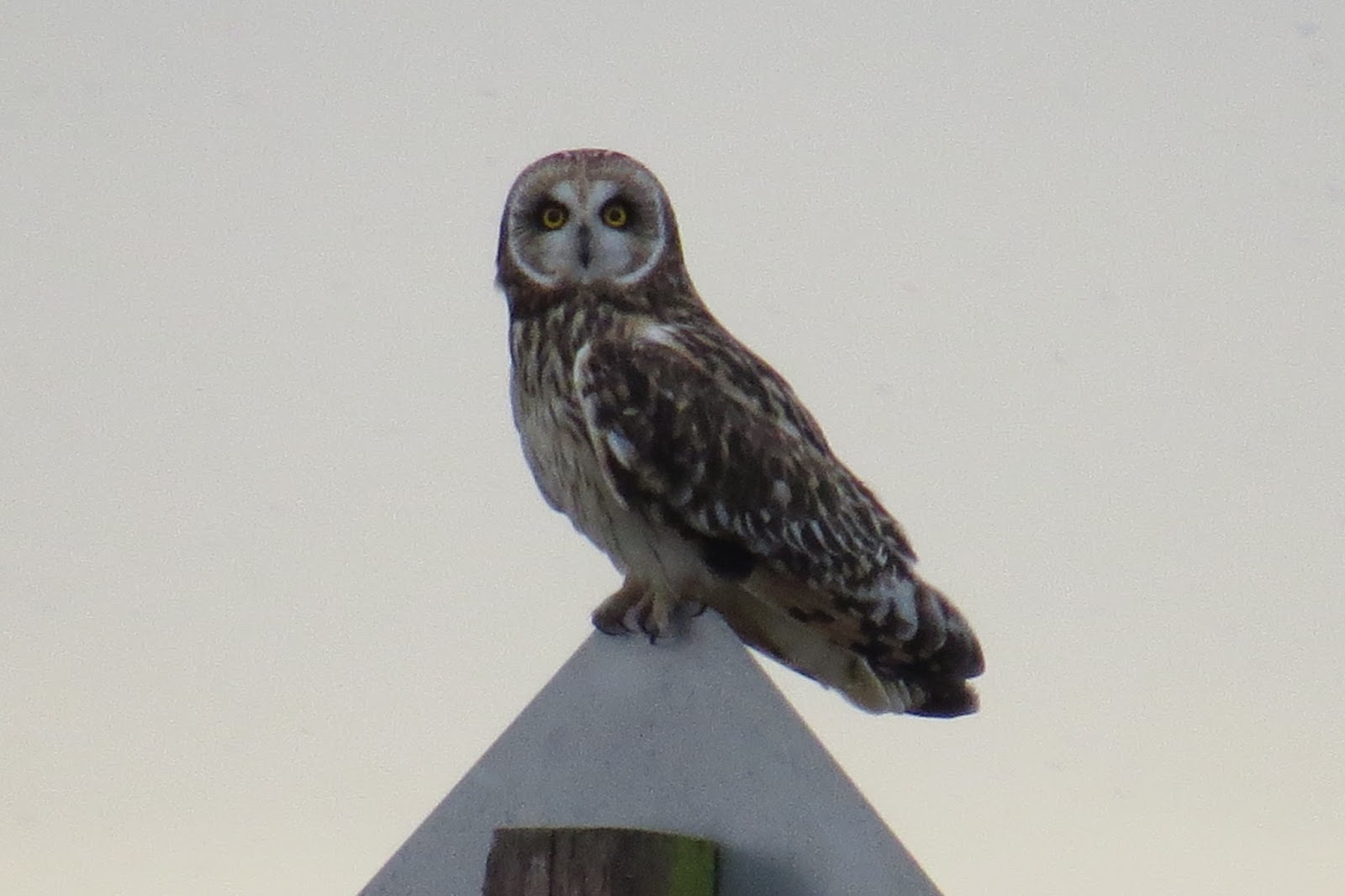
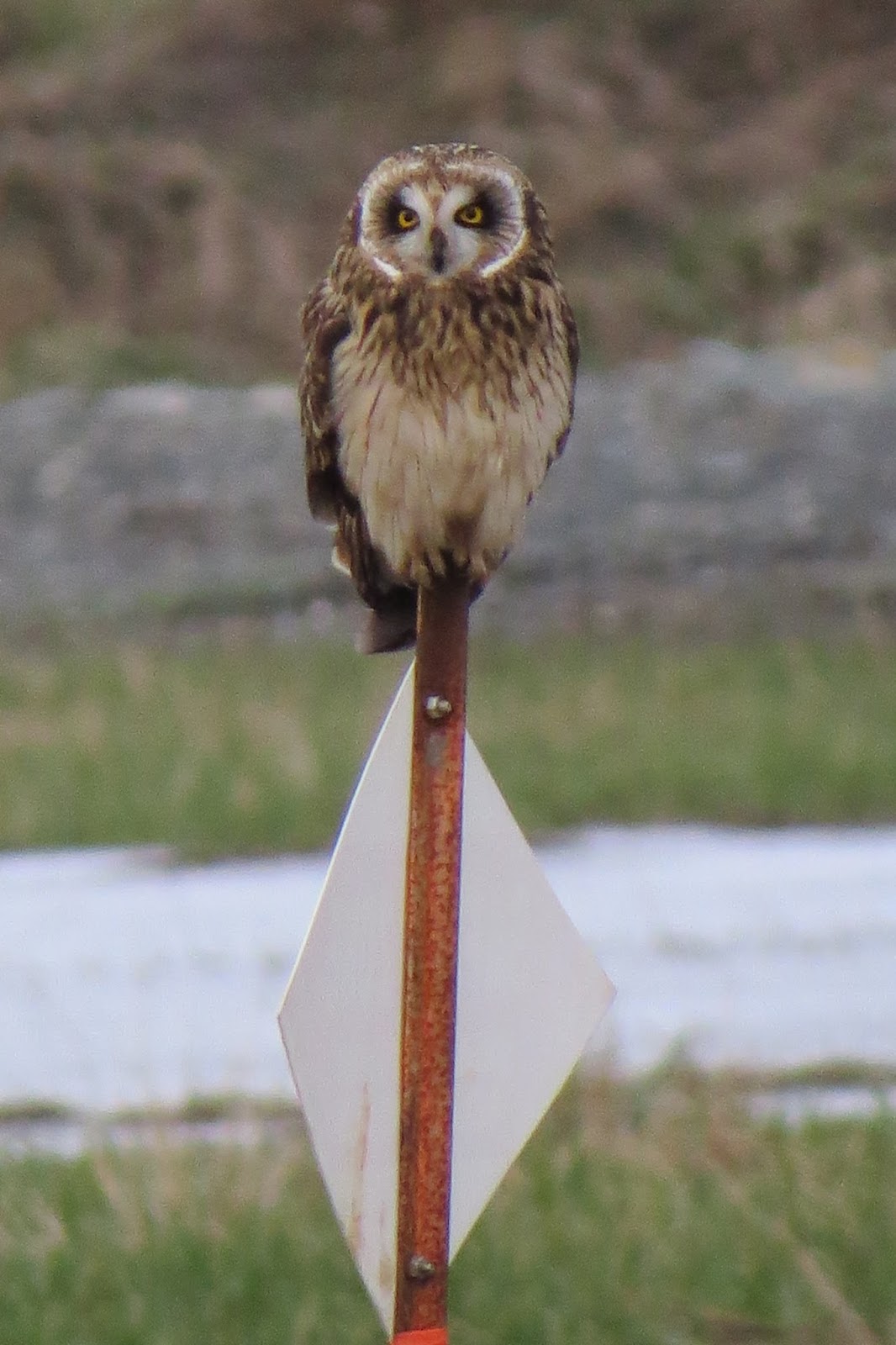
Washington State is home to fifteen species of owl, and I was lucky enough to see three of them this winter and spring. Our first stop: short-eared owls, Asio flammeus.

The dark eye shadow is quite a statement.

She liked to perch on the caution sign.

Look at that dished face for funneling the skitter-sounds of rodents into her short ears.

These owls were a lifer for me. I soon learned to recognize their distinctive flight, long-winged and loping like a butterfly’s.

Sibley's Guide describes their flight as "floppier" and "erratic."


In this neck of the woods, the short-eared owls fly by day, and they convene a following of dedicated photographers. When the owls weren’t nearby, I enjoyed watching scattered huddles of men and women in full camouflage attire, their telephoto lenses propped on sturdy tripods and transported in jogging strollers.

Can you spot the photographers?


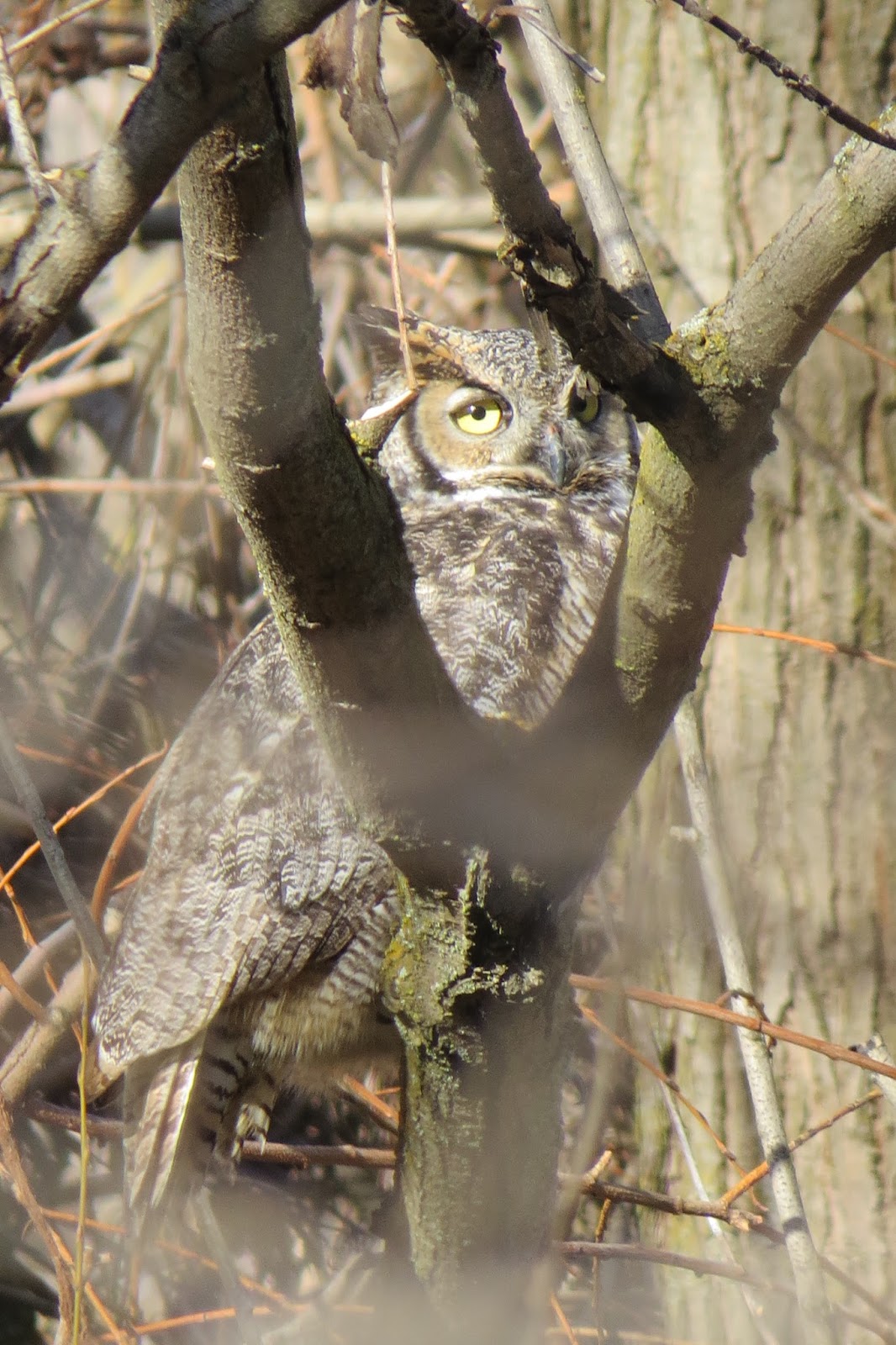
A month later, I returned to college in Walla Walla and invited Margo, Lizzie, and Molly Moo Moo to join me for a lap of Bennington Lake. Birders come in two categories – Sitters and Flitters – and this crew of budding ornithologists earned the first title with their patience. After we heard a single hoot, they took up posts off-trail for five, ten, twenty minutes until finally Margo spotted the owl. We stalked closer and watched the resident pair of great-horned owls watch us.

The great-horned owl, Bubo virginianus, is the most widespread owl in America.

Hello yellow eyes.

The baby owls thought. All owls think a lot.

"I think she's gone hunting," said Sarah.

"To get us our food," said Percy.

"I want my mummy!" said Bill.

If you know what’s up, you’ll recognize this conversation between three great-horned owl branchers from the wonderful children’s book, Owl Babies, by Martin Waddell.

Last week, near Bennington Lake, I got to meet Sarah and Percy. Bill was probably snuggling with his Owl Mother somewhere. I was on an excursion with my advisor, Tim, and several professors and classmates on Reading Day. (That’s the day between the last day of classes and the first day of finals, and it’s best spent doing anything but studying.)

An owlet basks in the sun on the parking-lot cliff.

This brancher eyed us from ten feet away.

Two hours later, she was still at her post.

You again?

Get outta here!

It’s been an incredible spring for owls. A few days later, I returned to the same lake with Thomas for a mid-finals birding break. After listening for yellow warblers in the willows, we heard a raspy cough from high within a cottonwood – it was Sarah and Percy, begging for food from their good old ma!

Sarah and Percy in a black cottonwood.

Before our eyes, an adult great-horned owl delivered a writhing gopher snake to one of the owlets.


I’ll let the video speak for itself.


Only a few minutes later, she returned with a second snake, but the first owlet (who I’m certain at this point was Sarah) begged more convincingly and snagged that snake, too. The second owlet, Percy, hunched dejectedly in the rain while Mom took a break.

Sarah polishes off her second snake in ten minutes.

“Geez, Mom, can’t you tell us apart? I’m hungry over here!” whined Percy.

As if that sighting wasn’t enough, on the last day on finals, I received a phone call from my friend Joe.

“Check your texts! I sent you a photo,” Joe instructed. “I found a bird for you to ID!”

The photo showed a puffy western screech owl, Megascops kennicottii, nestled in the knot of an oak.

“She’s right here on my street,” said Joe. “Come see!” Through the phone, I could hear the porpoise-like laugh of the owl.

Could you imagine a better owl hole?

It seems like the owl's coated in bark, or the tree in feathers.

Thomas and I went to find her, and there she was, her ruffled feathers blending with the rough bark. She eyed us with sleepy disinterest.


Maybe she was waiting to deliver a letter… or just hunt a mouse.
Share:

Why Natural History Matters

I wrote the following essay to apply for the Arthur G. Rempel Scholarship in Natural History. Dr. Rempel was an emeritus professor of biology at Whitman College for 40 years and a founding member of the Blue Mountain Audubon Society. I’m honored to be the recipient of his scholarship, especially because the members of the Blue Mountain Audubon Society welcomed me to Walla Walla and became some of my first friends when I transferred to Whitman. (Remember the singing elk and brown skippers from the October Hawk Watch?) As always, I’d love to hear your thoughts in the comments.

-Nina

Novice and seasoned birders scan for waterfowl on a trip I lead each semester for the Outdoor Program.
Photo credit: Margo Heffron.

It’s raining on the Science Building as I type. Earlier, the sky was blanketed by a layer of stratus which thickened and darkened and then started to sputter. The first droplets hit pavement as I googled the definition of “natural history,” unaware and distracted, but now I look up and see the cloud has evolved into nimbostratus, overflowing with precipitation. Smashed raindrops streak the window like strings of pearls, and Ankeny glows the color of hydrated chlorophyll. There, a crow swoops sideways over Maxey! Where’s she headed? Will she preen the moisture off her feathers from a perch in the gingko behind Anderson or the pine next to Cordiner? Does she have a nest? I want to run outside and smell the rain.

Crows mob a red-tailed hawk at Juanita Bay.

Tom Fleischner, author of Natural History and the Spiral of Offering, defines natural history as “a practice of intentional focused attentiveness and receptivity to the more-than-human world, guided by honesty and accuracy.” These words remind me of a meeting I facilitated to discuss concerns about the future directions of an environmental club of which I was president. Leaders, members and officers all arrived with the same intention, to help our club be the best it could be, but tempers rose as our leader interrupted the members’ stories, corrected their factual errors, and spoke for more minutes than she listened. One club member stormed out; another broke down crying. After the meeting I considered what went wrong, and it all came down to listening. The same nouns that define natural history – attentiveness and receptivity, honesty and accuracy – are also the ingredients for a productive conversation. I suppose this shouldn’t come as a surprise. After all, natural history is a conversation between human and nature.

Photographing a grazing Nene at Kilauea Lighthouse, Kauai.
Photo credit: Russ Finley.


Outside, the rain has eased. The sky looks brighter to the south; I wonder if the sun is in that part of the sky. Two droplets coalesce on the pane and slither down under the guidance of gravity. The chestnut’s leaves look new and small, a lighter shade of green than I’m used to.

Margo focuses on a sparrow near Bennington Lake.

Natural history matters because it is an attempt at honest listening. Experiments, despite the insights they provide, cannot match the honesty of pure observation. A hypothesis is limited by the imagination of the researcher, and it reduces the likelihood of stumbling onto a truth we didn’t even think to suspect. Natural history is exploration without hypotheses. It requires vulnerability, because we risk discovering something we weren’t looking for, and humility, because we cannot be proven right. It challenges us to stop talking, guessing, analyzing, presenting, submitting, performing… for long enough to stand still. Watch. Listen. In doing so, we broaden our understanding of what exists.

Is it a plant or fungus on this path to Mount Rainier? Hard to tell.
Photo credit: Amelia Bishop.


Natural history often involves undirected recording of observations, and these records have proven essential to progress in biology. The sketches that filled Darwin’s journals fueled his insight into natural selection. My own photographs of blue-morph green frogs and Galápagos penguins, taken to capture moments of unexpected beauty, became useful when submitted to monitoring projects. Last year, as I investigated the tide-pools of Carkeek Beach, I stumbled upon the diseased sea stars that would become my research subjects, and a note I scribbled on my dive slate about a sea turtle’s tumor led to a presentation on fibropapillomatosis. None of these discoveries, large or small, would have been possible without venturing into the forest or under the waves with no goal but an honest and accurate perception of our surroundings.

Diving Leon Dormido off San Cristobal Island, Galapagos, Ecuador.
Photo credit: Joselo Ballesteros.

A passing green turtle, Chelonia mydas.

Conservation, like biology, depends on natural history. My descendants will inherit a world shaped by the interactions of billions of generations of archaea, bacteria, and eukaryotes who came before. One organism, Homo sapiens, exerts influence over most of those interactions. Natural history gives us the best chance of unraveling what makes nature tick and what she requires to thrive. No Petri dish microcosm experiment will tell us what the Olympic Rain Forest needs to be whole; no ecosystem services spreadsheet will calculate the value of an intact prairie.

Exploring the Hoh Rain Forest with a group of out-of-town NOAA interns.

Sam explores the Mineral Creek Falls on the Hoh River Trail.

Turn over mossy logs under the falls and you may find... a salamander!
Perhaps the endemic Olympic torrent salamander, Rhyacotriton olympicus?

But what if conservation comes up short? I’m not alone in my prediction that over the next century, species will go extinct, ecosystems will fragment, and biodiversity will plummet at the hands of my own kind. Has natural history failed?

When I’m tempted to despair over the sixth mass extinction, the natural historian in me takes a step back from judgement and desire to simply observe. Invasive species become migrants, extinctions become open niches setting the stage for the next great diversification event… the Post-Anthropocene Explosion? Each day of our lives is a conversation with nature, and we learn only when we keep quiet for long enough to listen. The most wonderful conversations never go in the direction I expect.

I was not expecting to see bison on my way home from college!
Photo credit: Janine Walker or Paige Soper.

It’s not raining any more. A hundred tiny insects of various kinds are stuck dead in a cobweb plastered to the upper left corner of the window pane. I notice a Douglas fir’s branches tipped with orange buds, and there seems to be a slight breeze through the needles. I wonder how it sounds?

A spring peeper moment.


Share:

Do You Know Your Wheat Farmer?

Do you know your wheat farmer? Or any wheat farmer, for that matter?

I do! Last weekend I met Dwelley, a life-long Palouse farmer who harvests about 1500 acres of wheat per year (and, incidentally, who majored in philosophy at Whitman College.)

Dwelley gives us a history of the farm using two huge framed photos from the farm's past.

Although the field trip was billed as "Ride a Combine!" we actually learned about much more than equipment.

Though the combine WAS pretty cool!

For example, I knew the Palouse was full of "winter wheat" but I never knew what that meant.

It means the wheat crop is planted in September or October and sprouts in the fall. The delicate green shoots have to hang out under the freezing snow all winter! The wheat develops a sturdy root system until it can finally photosynthesize and grow above-ground all spring and summer. It's harvested in July and August and BAM -- planting season again.

Sophie examines the inside of the combine, which sorts the wheat from the chaff. Literally.

Wheat is not the only crop planted on Dwelley's farm: he rotates his fields with peas, garbanzo beans and alfalfa to replenish nitrogen in the soil and break up disease cycles.

Seed peas from a past harvest.

We spent a lot of time talking about disease challenges facing wheat farmers. Pathogens come in many forms (and colors), from the Midwestern mosaic virus which turns whole patches of wheat yellow to stripe rust, a fungus that coats the wheat in vivid orange.

Water and weeds are also difficult issues to reckon with. Dwelley discussed the trade-off between center-pivot irrigation and dry-land farming. And while no-till farming does decrease erosion and (eventually) increase organic matter in the soil, it sometimes results in the need for more herbicides like Round-Up to control weeds.


Dwelley demonstrates the blower which spreads the straw back onto the field to dry.

We love tractors!

Examining a combine from the top down.

Dwelley talked about the type of wheat he wants to provide and the soft, flavorful, high-quality bread he hopes it will become. 

It was wonderful to hear Dwelley's down-to-earth views on topics that effect his crops, land and livelihood. As consumers, we often hold lofty ideals about sustainable farming and how food ought to be, but it's important to realize that farmers are as concerned about the long-term sustainability of their farms as we are (and probably more so).

The decisions Dwelley and other farmers make are incredibly complex. Every new variety of wheat Dwelley tries is a risk; each day he withholds expensive fungicide during an outbreak of stripe rust is a gamble. Even as we admired Dwelley's lush green alfalfa field, Dwelley expressed his doubts. "This field is highly acidic," he told us. "If I'd realized how unsuited alfalfa is for acidic soil, I probably wouldn't have planted it!"

The essential farm "junk yard" with Dwelley's acidic alfalfa field in the background.

Every decision Dwelley makes is based on economics, risk management, experience, and intuition about what's best for the land, the crop, the product and the consumer. In a perfect world, Dwelley would love to grow wheat without Round-Up, fungicides, insecticides, irrigation, tilling or any other risky technology, but that's not realistic.

As consumers, let's expand our discussion to include the reality of agriculture: that every calorie is eeked from the ground with a precise combination of technologies and a whole lot of elbow grease. Let's talk about agriculture not as a binary between industrial monoculture and sustainable organic production, but as the fluid art and science it truly is. Let's ask: what is the ideal balance between Round-Up and tillage? What breeding techniques can we use to improve dry-land varieties, thereby reducing the need for irrigation? How can we use genetically modified organisms to improve the safety and sustainability of agriculture?

These questions are actively being asked by farmers and scientists right now, not only by organic producers and food activists, but within the context of mainstream agriculture as well.

So what can you do? Go out and meet a wheat farmer!

And don't forget to climb a tractor... The view's great from up here.
Share:

Popular Posts

Labels