Five years of college.
One year in Ohio.
One semester in Galapagos, where this blog was born.
One semester split among Brazil, Peru, and mainland Ecuador.
One semester camping in the Intermountain West.
Two and a half years in Walla Walla, Washington.
Walla Walla was the place I called home for longest since leaving high school, and saying goodbye was the opposite of easy. Luckily, I got to spend three days after graduation with my adoptive family and ultimate frisbee team, the Sweets, in the eastern Cascades.
I felt strange and out-of-place in the luxury golf resort, Suncadia, but as soon as I wandered past the mowed green turf I found myself immersed in a dry Ponderosa pine forest filled with deer, lichen, wildflowers, and songbirds.
 |
| Ponderosa pine thrive on the "sunny side" of the Cascades. |
 |
| Oregon grape in bloom. |
 |
| Oregon grape flowers are elegantly layered and butter-yellow. |
 |
| My first Nashville warbler! He was wearing a red cap, grey hood, and yellow belly. |
 |
| Chocolate lily, Fritillaria affinis. |
As I sat on a log to observe the Nashville warbler mine a shrub's catkins for their nutritious seeds, I was startled to find a chocolate lily. These flowers are rare. Their underground bulbs, resembling clumps of rice, are eaten by several Coast Salish tribes. I was so excited to photograph this flower from below, I was lying motionless on my belly for several minutes, and when I sat up I saw two well-dressed joggers staring at me.
"Oh my god, we thought you were a dead body!" the man gasped.
"Just looking at a flower," I told them. "Want to see a chocolate lily?"
"Umm, that's okay," he replied. They glanced at each other and jogged quickly away.
For the moment, this forest is still filled with rare beauty on the margins between golf greens and second homes with four-gar garages, but this ecosystem is nowhere near intact. Yesterday, I saw several new concrete foundations being poured for new mansions within this gated community. Only a few tall Ponderosas stood between existing houses.
I had to ask myself, what is the appeal of living or vacationing in a place like this? If the point is to live in a dry montane forest, then the appeal has been nullified by the density of homes and roads. (And why live in a forest if you don't even stop to notice the chocolate lilies?) I think the real appeal is exclusivity. Suncadia is known for being expensive and luxurious. To own a home here is a symbol of wealth. I imagine the wealthiest residents will soon move to a more remote, forested enclave as Suncadia becomes too suburban and accessible, and deforestation will continue to reduce chocolate lily and western toad habitat in the Cascades.
 |
| Look at the chocolate lily's gorgeous brown-and-green, mottled petals and six pollen-laden stamen. |
 |
| Arrowleaf balsamroot, a sign of springtime in eastern Washington. |
 |
| Wolf lichen, Letharia vulpina, is neon green-yellow because of its vulpinic acid, a toxin once used to poison wolves. It belongs to the family Parmeliaceae. |
 |
| Deer scat. |
 |
| A very young sapling growing from a nurse-log. |
 |
| A chipping sparrow in a Douglas fir. |
 |
| A few Sweets around our magical, self-igniting fire pit. |
 |
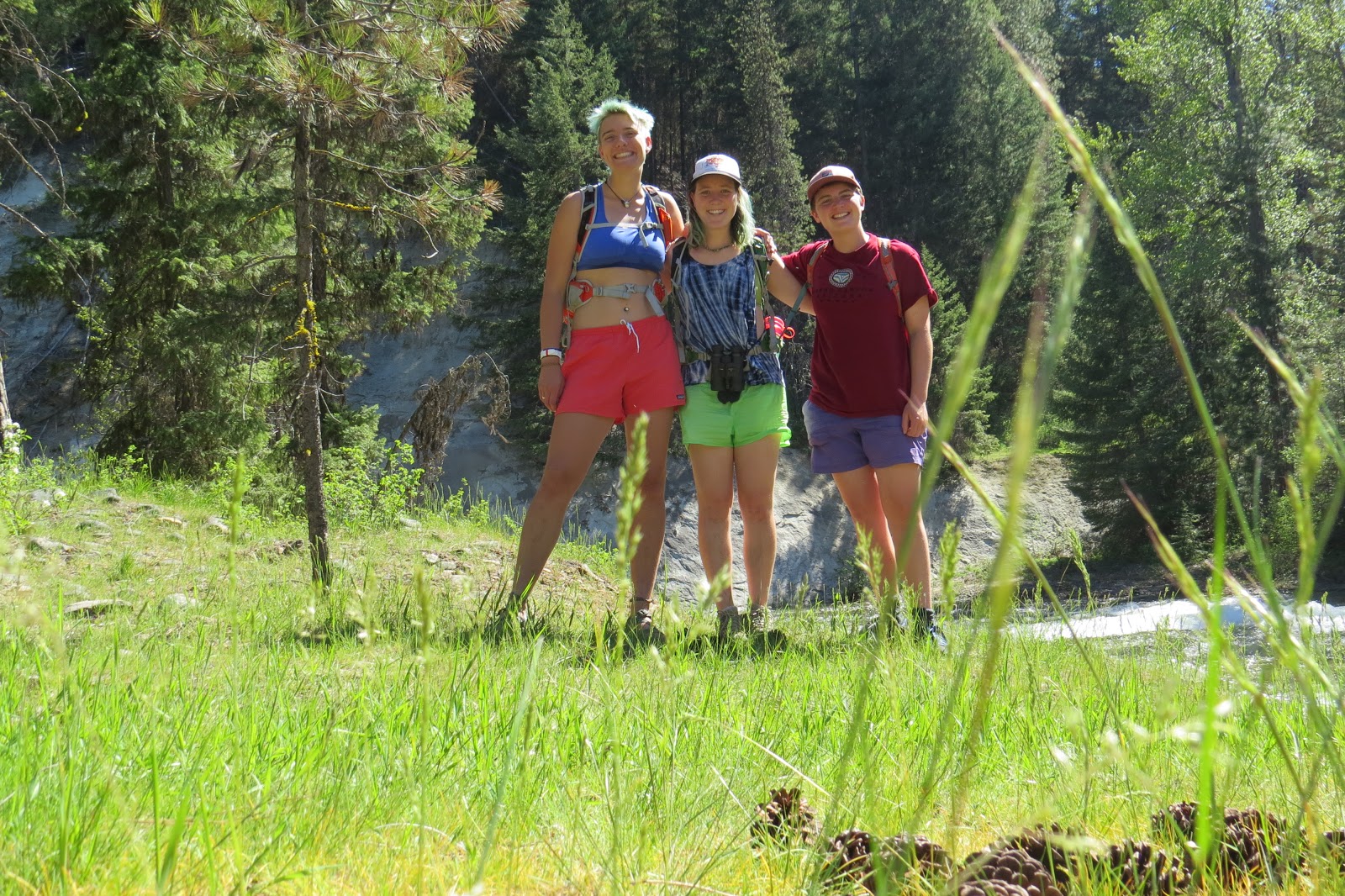
| On our second day, I set out for a hike with Kevin and Hardy in the Teanaway Community Forest, along the West Fork Teanaway River. |
 |
| Brown-eyed sunshine, Vulpicida canadensis. This bright yellow lichen also belongs to the family Parmeliaceae, but it differs from wolf lichen due to its brown ascocarps (sexual reproductive structures) and the texture of its thallus (the main, leafy body of the lichen.) |
 | | We went skinny-dipping in a shallow pool of the river (after this photo.) |
|
 |
| A baby western toad, Anaxyrus boreas, was swimming in our shallow pool -- or rather, we were swimming in hers. |
On our third and final day, we packed into cars with all our gear from the past one to four years of living in Walla Walla. Before we headed over the Pass to our various homes, I persuaded my teammates to stop for a picnic lunch at the Northern Pacific Railroad Ponds in Cle Elum, a birding hotspot. There, I talked with another woman from Seattle, a novice birder who was exploring the area for the first time. We saw a mallard with ducklings and many species of swallows over the water.
Though I never wanted to say goodbye to Whitman, college, or the Sweets, these few days were a good transition from the bubble of school to the wide world beyond -- the birds and trees and waterways I can turn to when I don't have daily practices, weekend tournaments, dance parties, sprint workouts, weight lifting, potluck meetings, and pick-up games on Ankeny to bring me joy. At least I know I will find ultimate to play wherever I go next... and something tells me I'll be watching goofy Snapchats from my Sweets for a long time to come.
 |
| Kaitie holds a round, moss-lined nest we found on the ground. It must have blown down from a tree in the wind. |