And it's especially concerning when you learn that barely any Spiny Forest is left. The pressures of cattle and goats, plus logging for charcoal, has nearly caused the extinction of an entire ecosystem. Only 3% of remaining Spiny Forest vegetation is protected. I visited two tiny protected areas, Reniala Nature Reserve and Parc Mosa, located near the Mangily Village and Ifaty Beach. Reniala, the larger of the two parks, protects fewer than 60 hectares of land.
 |
| Octopus trees are cut and planted in rows to make living fences. The spiny walls don't actually keep goats from crossing, but they demarcate property lines. |
The landscape here is dominated by four strange trees. The first one I notice is the octopus tree,
Didierea madagascariensis. The name in Malagasy is
sono, pronounded "shoo-noo." Its entire subfamily, Didiereoideae, is endemic to Madagascar.
 |
| An octopus tree in bloom. Notice how the white blossoms grow directly from the trunk, among the spines and leaves. |
 |
| A frilly whitish lichen also filled in between the spines on some octopus trees. |
The second tree to catch my eye was silver thicket,
Euphorbia stenoclada. This spiky, fleshy, leafless, dusty-green plant looks like a torture device. Our guide called it "zebu food" because, believe it or not, it's a major food item for the humped cattle that call the Spiny Forest home. The actual name is Malagasy is
famata. |
| This Euphorbia tree is known as silver thicket or "zebu food." |
 |
| To save water, silver thicket photosynthesizes with its blue-green bark and grows no leaves. |
 |
| The insides are filled with a goopy white latex that can blind you if it gets in your eyes. |
The third plant to capture my attention was the elephant's foot, Pachypodium geayi, or vontake in Malagasy.
 |
| The elephant's foot name must come from the leathery gray bark and stout diameter. The stunted, high-altitude specimens look even more like a pachyderm's podium. |
 |
| A close-up of this tree's alien-looking leaves sprouting in tufts from pudgy branches. If you recall the spiny tree growing in front of my South African hotel, I think it must have been a mainland species of elephant's foot. |
And then there are the baobabs, the fantastical beings that drew me to the Spiny Forest. Strangely enough, these giant, bottle-shaped trees belong to Malvaceae, the mallow family. There are nine species of baobab in the world: two in Africa, one in Australia, and six on Madagascar. The species I encountered here in Mangily was the fony baobab, Adansonia rubrostipa.
 |
| Baobabs are sometimes called bottle trees, and this individual gives you a pretty good reason why. |
 |
| The local species, the fony baobab, is known for peely red bark. |
 |
| Peely bark is often a defense against epiphytes, but this silvery lichen still managed to get a hold on a few of the more ancient baobabs. |
 |
| Many of the baobabs in Reniala Nature Reserve were named. This one was called the "climbing baobab" because you can clearly see the scars left by sap and fruit harvesters who cut a ladder right into the trunk. Reniala has protected these baobabs since it opened in 2001, but some of these trees are over a thousand years old. One baobab has felt the hands and machetes of many generations of humans. |
 |
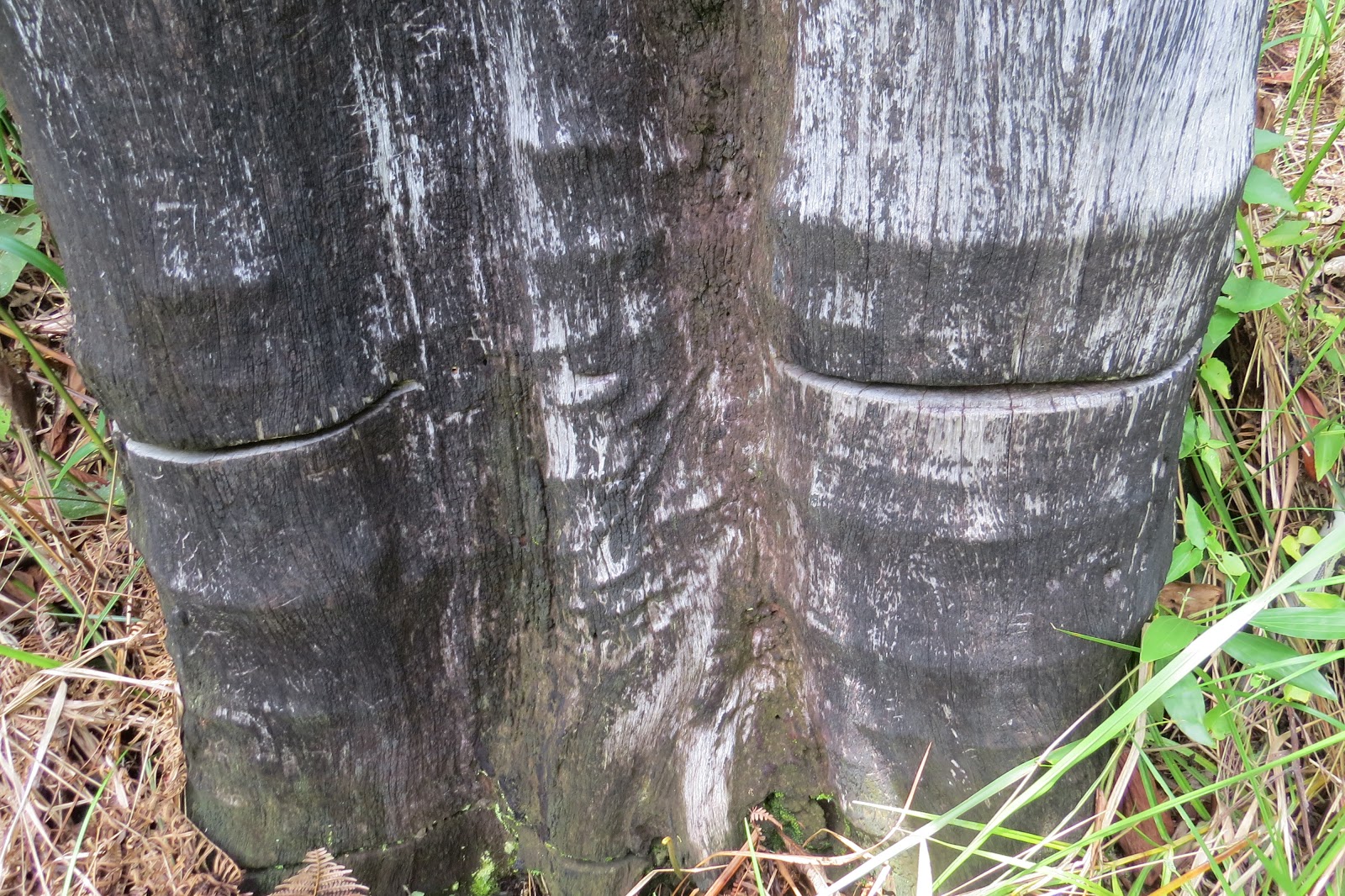
| Notice the rectangle of bark missing from this baobab's trunk. Before the park was established (and outside the park to this day) cattle ranchers use the wet, pulpy insides of baobabs to provide water for their zebu cattle in times of extreme drought. When practiced carefully, the baobab can survive the wound. |
 |
| This double-trunked tree was called the "lovers' baobab" because one half seems to by hugging the other. |
 |
| Can you tell why this one's called "rhinoceros baobab"? |
 |
| Check out the tip of the branch! |
 |
| This baobab split into two trunks near the top, beautifully illuminated by the setting sun. |
 |
| The heavy, velvety fruits looked like Christmas baubles hanging from this leafless baobab. |
 |
| A close-up of the baobab fruit. |
 |
| This tree was described as Madagascar's thickest baobab with a 12.5 meter diameter. My guide estimated its age between 1,000 and 1,200 years. I was dumbfounded. This very organism, with all the consciousness and memory and worldy opinions a tree can have, has lived for more than a millenium. What a blip am I, this fast-moving, warm-blooded, impatient mammal scurrying at its foot. |
 |
| Trying to comprehend Baobab Time. |
 |
| Baobabs grow incredibly slowly. This twiggy sapling is five years old, nurtured and watered by the Reniala staff, so you can see why it's important to protect the towering ancients that still live. |
Many other plants of the Spiny Forest deserve mention, but I won't bore you with a complete botanical catalog. I'll just point out two more species that gave me pause.
 |
| Here, Mahery knocks on the trunk of a farafatsy or "false baobab," Givotia madagascariensis. The wood is incredibly light, like balsam, and it's used to make parts of traditional outrigger fishing canoes. You can tell it apart from a true baobab (the reddish tree on the right) because a farafatsy trunk gets narrow at the base, while a baobab's is thick all the way to the ground. |
 |
| I couldn't find the name of this tree, but I was mesmerized by its familiar maple-shaped leaves fluttering in the breeze -- utterly incongruous with its smooth, bulging trunk and branches that reminded me of nothing form home. |
Parc Mosa and Reniala Nature Reserve are essentially an island of Spiny Forest within a sea of bare sand, goat-grazed rubble, and the packed dirt of villages. It's not large enough to support the megafauna, like diurnal lemurs, but it does provide habitat for many gorgeous reptiles, birds and invertebrates.
 |
| The only diurnal lemurs in Reniala are these captive ring-tailed lemurs, Lemur catta, rescued from poachers and markets. They are nursed back to health here until they're ready for release back into the wild elsewhere. |
 |
| A Standing's day gecko, Phelsuma standingi, on the wall. The juvenile has this epic zebra stripes, and the adult fades to dusty blue. I grew up visiting the Standing's day gecko at the Woodland Park Zoo in Seattle, and that's one of the many reasons I knew I wanted to visit Madagascar one day. |
 |
| I found this big-headed, ground-dwelling gecko hiding under the bathroom waste-basket in our beach hostel! I still don't know the species, but it might be an ocelot gecko, Paroedura pictus? Stay tuned for updates once I post a photo to iNaturalist.org. |
 |
| A night-bark gecko, also known as a giant Madagascan velvet gecko, Blaesodactylus sakalava, hiding in the crevice of a split baobab trunk during the daytime. |
 |
| This is a three-eyed lizard, Chalarodon madagascariensis. The black spot on the back of its head is called the parietal eye. It's an extension of the pineal gland of the brain, and it can sense light and dark! |
 |
| This three-eyed lizard found a caterpillar to eat. |
 |
| A warty chameleon, Furcifur verrucosus, pretending to be a bumpy branch. |
 |
| The spiny-tailed iguana, also called Merrem's Madagascar swift, Oplurus cyclurus, is famous for having a tail shaped like a spruce cone. |
 |
| Like most Malagasy wildlife, this Mahafaly sand snake, Mimophis mahafalensis, was tame and slow. The science journalist David Quammen advises against using the word "tame" because it implies that humans have habituated the animals to our presence, which is not the case. Really, these animals evolved in isolation from humans, so they have a reduced innate fear. Quammen suggests the term "ecologically naive" for Madagascar's wildlife. |
 |
| A headshot of the Mahafaly sand snake's sand-patterened scales. |
 |
| A spider tortoise, Pyxis arachnoides, ambles beneath the spiny tangle of branches. These little guys left the sand criss-crossed with their foot-dragging tracks. |
 |
| These tortoises are wild, but you can pick them up without any trouble. It's no wonder they are critically endangered due to illegal collection for the pet trade. |
 |
| A Madagascar hissing cockroach, Gromphadorhina portentosa, sidles up the bark of a baobab at night. I was excited to see this insect in the wild because last week, my aunt Martha sent me an article about these critters in the Seattle Times. As a kid, I saw these cockroaches at the zoo and dreamed of meeting them in the wild. When I pet this one on the back, it let out a hiss and scurried into a crack in the bark. |
 |
| An orb-weaver hangs in her web above the path. I know you can't tell from the photo, but this spider was huge, larger than my outstretched hand and fingers. |
 |
| The shell of a deceased snail. It's hard to imagine how a mollusk survives in this desert. |
 |
| A Madagascar green pigeon! A bird with feathers the color of moss, what could be cooler? |
 |
| Either a common jery or a stripe-throated jery... can anyone help me out? |
 |
| A female Sakalava weaver, named for the Sakalava people who live along the western coast. The male weaver is a brilliant yellow. |
 |
| This baobab is surrounded by a thatch roof, but even more interestingly, notice the big clump of sticks and grass hanging off the right side. That's a colonial nest of Sakalava weavers! |
 |
| Madagascar fody on top of an octopus tree. This little red bird is the bane of rice farmers, who hang colorful batiks in their paddies to keep this bird from destroying the crop. |
 |
| A subdesert tetraka singing from the top of an octopus tree. This species is endemic to the Spiny Forest. |
 |
| A sickle-billed vanga sits on its nest. This bird's crazy beak reminds me of the red-billed scythebill I saw in Brazil. |
 |
| A long-tailed ground-roller, one of two dream birds I really hoped to see here in the Spiny Forest. How lucky to catch a glimpse of one as it darted across the sand like a road-runner! |
 |
| The two birds I sketched in the rainforest with Josia, dreaming of the Spiny Forest: subdesert mesite (top) and long-tailed ground-roller. |
 |
| A male Madagascar cuckoo-hawk. This bird is common around Ranomafana, but my guide told me it's a rare to see one in the Spiny Forest in December. Most individuals migrate away in spring (which are the months of September, October and November in the southern hemisphere!) |
 |
| A crested drongo. The Malagasy name, railovy, means "king." As you can see, octopus trees were the prime singing spots. |
 |
| A Madagascar sparrow-hawk, looking haggard because it was being mobbed by two crested drongos. Despite the fact that these birds are strange endemics found only on Madagascar, the scene looked just like a red-tailed hawk being mobbed by a pair of crows in my Seattle backyard. |
 |
| A Madagascar bulbul sings next to a baobab fruit. Its song reminded me of an American robin's. |
 |
| The Madagascar cuckoo is known as kakafo in Malagasy. Its eerie four-syllable song, "ka-ka-KA-fooo," echoed around the edges of our rainforest camps from sunrise to sunset, but I never laid eyes on the bird itself until I got to the Spiny Forest. |
 |
| A male Souimanga sunbird glitters with teal iridesence in the sunlight. This species fills the niche of absent hummingbirds, hoving over flowers and drinking nectar. |
 |
| A hawk-billed vanga keeps watch over its mate and nest. The diverse members of the vanga family, Vangidae, in Madagascar are an example of adaptive radiation that rivals the Galapagos finches or Hawaiian honeycreepers. |
 |
| Here is the hawk-billed vanga's nest, carefully wedged in one of those precious baobab forks. (Most baobabs have a single, enormous trunk, but sometimes the trunk splits into two or even three.) You can see two hungry chicks peeking out here, but there are three in total. |
 |
| A male Madagascar paradise flycatcher keeps the eggs warm in a teacup-sized nest perched at knee-height in Reniala Nature Reserve. |
 |
| A crested coua flashes us a view of its bare turquoise-and-lavendar face. |
Here is an excerpt from my journal that I hope will convey some of the magic of this place:
My favorite moment of the early-morning bird tour through Parc Mosa was around 8:00 am. It started to rain. I had heard that it never rains here in the Spiny Forest, but it does, in the most peculiar way. Fat, heavy drops spatter down from a single puffy cloud way overhead, gray in the center and white on the fringes. The blue sky and hot sun are present during the rain. You might even be standing in direct sunlight as the rain hits you, if there is a breeze to blow the raindrops sideways in their descent.
We had one main guide and two spotters, all teenaged sons of Mosa, the park's curmudgeonly owner. Apparently, a spotter on the far side of the park spotted something cool and communicated that to his brother, our guide (through a whistle, whoop, or text message? I couldn't tell.) Our guide started speed walking and motioning us to follow him. He soon broke into a run, his flip-flops smacking the red sand, bone dry but for a few spots where the raindrops has struck. I started running after him. We twisted and turned on the network of trails--more like openings widened by goat traffic--to avoid running into spiny octopus trees or getting tangled in Euphorbia "zebu food." I was out of breath, scratched on my bare arms, clinging to my camera in one hand (to keep it from swinging) and my wide-brimmed straw hat in the other (to keep it from flying off). The rain picked up. While running, I clutched the camera to my chest and my straw hat over it to provide temporary protection from the water. Looking back over my shoulder, I could see that my friends had fallen behind or decided not to run. I wasn't worried they would get lost, because there was another guide back there with them, but I hoped they wouldn't feel like I'd left them behind. As we kept running for minutes and my throat burned, it crossed my mind that this might be a rehearsed trick at the end of every bird walk to earn tips from awed and exhausted tourists. If so, the thrill of the chase and the smoothness of the execution were worth it. (Yes, I tipped extra.)
Finally, we arrived at the bird, of which I'd started to doubt the existence. It was a subdesert mesite, one of my two target dream-birds I'd sketched the week before in my journal with Josia. The bird was brown with a long, fray-tipped tail. It hunched uneasily on the branch of a Euphorb tree, raindrops beading on its back. I prayed that my friends would get here in time to see it. They did. The mesite hung around until everyone got a chance for a photo, and then it hopped away into the brambles. Maybe it was in on the tip-earning scheme, too.
 |
| The target of our rainstorm sprint, a subdesert mesite! |
If there is no place like home, there is
really no place like the home of baobabs and elephant's feet, octopus trees and silver thicket. This ancient, patient, razor-sharp landscape has been the single most alien ecosystem I've encountered on my Watson year. I didn't have the time or tools to meet the microbes of the Spiny Forest, but I am certain that an equally interesting ecosystem thrives here at the bacterial scale.
Think about this. If you are astounded by the number of human generations a thousand-year-old tree has witnessed (as I am), just imagine the number of microbial generations---and the amount of evolution---that have come and gone amid the velvet-ball fruits and flaky-red bark of a single baobab.