Health Education, Health Articles, Health Blog

Showing posts with label waterfowl. Show all posts

Lake Ballard: A Lively Capitalist Ruin

On May 27th, I explored Lake Ballard with my mother, Jane.

Jane birds Lake Ballard through a chain-link fence.

If you're from Seattle, you might pause to wonder what I'm talking about. The house-boated Lake Union is well known, as are the duck-filled Green Lake and the bridge-spanned Lake Washington. But Lake Ballard? You've probably never heard of such a thing.

That's because Lake Ballard is actually a puddle of water that has collected in a huge empty lot at the intersection of NW 46th St and 15th Ave NW (better known as the Ballard Bridge). It sits across the street from Ballard Blocks Shopping Mall, home to Trader Joe's and LA Fitness, among others.

Lake Ballard contains multiple habitats: calm freshwater, concrete pads, and blackberry brambles.

The concrete foundation has been growing a forest of Himalayan blackberries since its industrial buildings were torn down several years ago. Online neighborhood forums have generated many complaints about this "wasted" space, with commenters referring to it as an "eyesore" and calling for rapid development.

One commenter wrote, "You mean that swimming pool? It's about time they did something with that. Boggles the mind how property owners can afford to just sit on land like that without doing anything. At least turn it into parking for boats and RVs to pick up some cash."

The capitalist spirit is alive and well in Ballard.

You never know what you might find in Lake Ballard -- perhaps a chair and a fire extinguisher.

Seattle's bird-watching community has taken a different perspective, as have an impressive number of migrating shorebirds and urban resident species. Birders have dubbed the construction site "Lake Ballard." We frequent it with our binoculars, report sightings on the Tweeters listserv, and submit eBird checklists. Highlights have included semipalmated plovers, least sandpipers, greater yellowlegs, spotted sandpipers, and solitary sandpipers.

Because it is fenced off from human trespassers and isolated from most predators, Lake Ballard is a safe haven for a duck to raise her family.

I watched this mother mallard supervise six ducklings in the frothy waters.

Here, a mallard and her duckling sleep behind a killdeer, the only shorebird we saw today.

A female house finch picks seeds from a pioneering shrub.

Next to Lake Ballard runs one of Seattle's famous drawbridges, the Ballard Bridge. A host of streetwise birds make their homes here, in the traffic-rumbling shade.

Jane is framed between the Ballard Bridge and Lake Ballard.

Pigeons are the most dependable sightings.

European starlings live here, too.

A native and intelligent American crow watched my mother and I with interest from a telephone wire.

Most excitingly, a colony of cliff swallows have plastered their mud to the bridge's underside. Concrete cliffs suit them just fine.

This view is looking straight up at a hanging weed, fence-top pigeon perch, and cliff swallow nest below the bridge.

Close-up of a cliff swallow's mud nest.

Another nest with a white, blue, and orange head poking out.

A cliff swallow makes adjustments to her corner abode.

I have become fond of Lake Ballard and its avian inhabitants. To me, this empty lots holds several lessons:

1. Birds in Seattle are desperate for freshwater, and they need more aquatic and riparian habitat.

2. Nature is resilient, and it will fill in the weedy margins of capitalist development at any opportunity. We have the potential to coexist, humans and wildlife, in ecosystems that are contaminated and collaboratively built by all of us. (For more on this idea, I suggest reading The Mushroom at the End of the World: On the Possibility of Life in Capitalist Ruins by Anna Tsing.)

3. Waste is never wasted. What a developer sees as a "waste of money" or a neighbor sees as a "waste of space" is a resource that will be used by marginalized populations, in this case birds and blackberries.

And with these lessons in mind, I am sad to share the news that Lake Ballard will soon be developed into a grocery store, marine retail, and a restaurant. A big white board (formally known as Notice of Proposed Land Use Action) declares the lake's fate underneath graffiti of an incredulous fox. I picture a thought bubble over the spray-painted canine's head:

"Do we really need another grocery store across the street from Trader Joe's?"

A notice of Lake Ballard's impending demise, with commentary from a graffiti fox.

Of course, Ballard is growing, and the stores will be frequented by customers happy for a source of high-end foods on which to spend their money. It's a capitalist dream to replace this wasteful swimming pool with economically productive businesses.

Yet, I imagine an alternative use for this land. What if Lake Ballard were immortalized into a small urban park? What if Ballard's residents worked together to demand that this vacant lot be turned into a freshwater oasis for shorebirds and waterfowl amid bustling concrete and air-conditioned gyms and grocery stores? My dream has been met with enthusiasm when I shared it with Trader Joe's clerks and shoppers, my only audience so far.

Resistance to development is not a stranger in this place. Across from Lake Ballard, wedged between Ross Dress for Less and LA Fitness, sits an odd and unexpected home. It's the house of the late Edith Wilson Macefield, a Ballard legend who refused to sell her property for exorbitant offers. So, the Ballard Blocks Shopping Mall was built around her.

Edith Wilson Macefield's house tucked defiantly between behemoth units of Ballard Blocks Shopping Mall.

Clearly, the birds are willing to call this ruin home. I would like to take a leaf out of Edith's book and defend this "waste" for the organisms who recognized its potential not as a generator of profit, but as a nursery for ducklings, a source of home-building mud, and a garden of seeds and berries. I would feel more at home in my city if I could visit Lake Ballard years from now, spend a few moments with its inhabitants, and remember that all of us -- all organisms -- are in this game of survival together.
Share:

Triplet Eaglets, Twin Colts and Septuplet Ducklets

In case you haven't heard, spring is the season for babies.

Here at Peterson Bay Field Station, a pair of bald eagles is accomplishing an incredible feat: they are raising triplets!

The broken crown of a seaside spruce makes an ideal platform.


I'm taking photos every day to mark their progress. To the eagle experts out there: any idea how old these chicks might be?

On the Lost and Found Lake Loop Trail, which winds through a mile-and-a-half of Lutz spruce forest, I found the sign of an American robin's reproduction: the cracked shells of two sky-blue eggs.

Cracked sky.

Shell fragments.

A proud mom or a heartbroken orphaner?

I don't know if the eggs hatched or were pilfered by raven or raccoon.

On my day off here in Homer, I circumnavigated Beluga Slough through questionable tides, estuarine mud, and private property.

Kenai Mountains in the background.

Kachemak Bay on the horizon.

I ducked behind the tree line to read a chapter of Aldo Leopold's A Sand County Almanac on somebody's hand-hewn log bench. Seven northern shovelers flew in as soon as I was out of sight.

Pendulous bills make for good shoveling.

I've never seen such an enormous hoof print. Moose were probably watching me follow their trail.

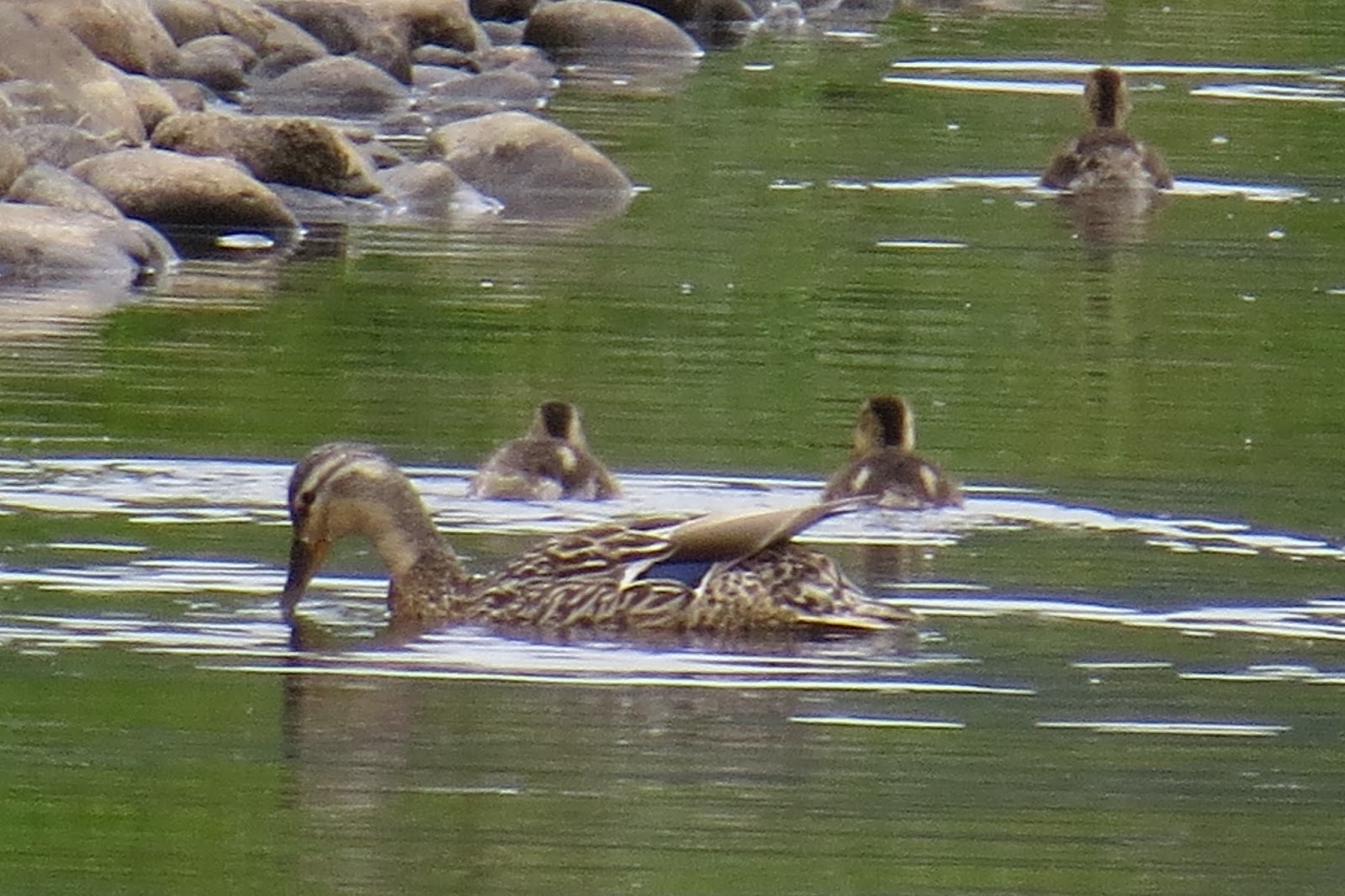
Further along, I discovered septuplet ducklets. Their species eluded me at first. Mallards have orange bills; green-winged teal have dark faces; gadwalls aren't common here.

What nice eyeliner you have. I always go for down-turned wings, too.

Is that a peek of blue speculum I spy?

But with enough patience and photographs, I got a look at her blue speculum, and I believe she is simply a dark-billed mallard mama.

Ahh, blue indeed!

On my walk home, I got a much closer view of a mother mallard with only two ducklings. She had a dark bill and a brilliant blue speculum, confirming my identification.


And her duckling took an adorable bath while practicing her dabbling! I wonder how even their down is waterproof?


A baby duck is a duckling (or ducklet, with poetic license). A baby eagle's an eaglet. What do you call a baby crane? Take a gander. (No, a gander is a male goose!)

I'll give you this one. A baby crane is called a colt!


Watching them gambol through the grass makes clear the resemblance between filly and fowl. I couldn't get too close to the pair of colts this morning, but you can see their yellow fluff nudging mom or dad for food.
Share:

X Marks the Spot: Day Twelve on the Alaska Road Trip

Back on the road, our first stop was the tiny post office of Moose Pass, an itty-bitty town, where I mailed off my paperwork (printed nearly a week earlier in Fairbanks, a hazard of being in rural Alaska) and bought postcard stamps.

Better late than never (sorry Olivia!)

We backtracked past Anchorage and paused at the world’s-slowest-diner, Kava’s Pancake House, for second breakfast. My meal included three massive reindeer sausages; I saved one in a piece of buttered toast for dinner.

A great birding spot, Reflection Lake, materialized within the boundaries of Palmer Hay Flats State Game Refuge. We saw a black-capped chickadee gleaning spiders from twigs, reinforcing our earlier sighting of boreal chickadees.

This black-capped chickadee had less rufous on its sides and more white on its cheeks than did the boreal chickadees of earlier in the week.

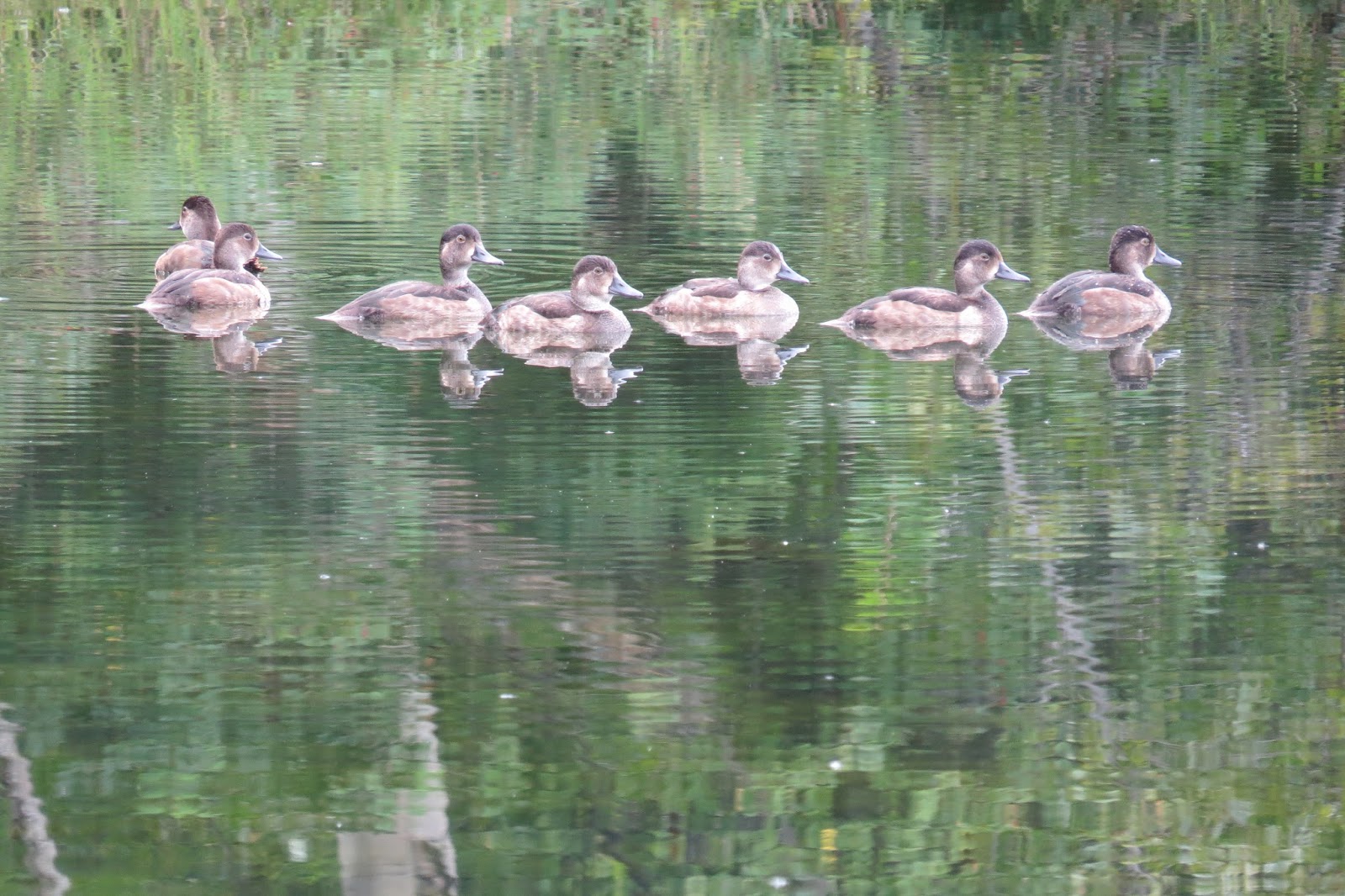
Mama ring-necked duck with a big clutch of teenagers.

In the lake, a red-necked grebe and his baby caught fish.

Necky and Stripey.

Goofy and Hatty.

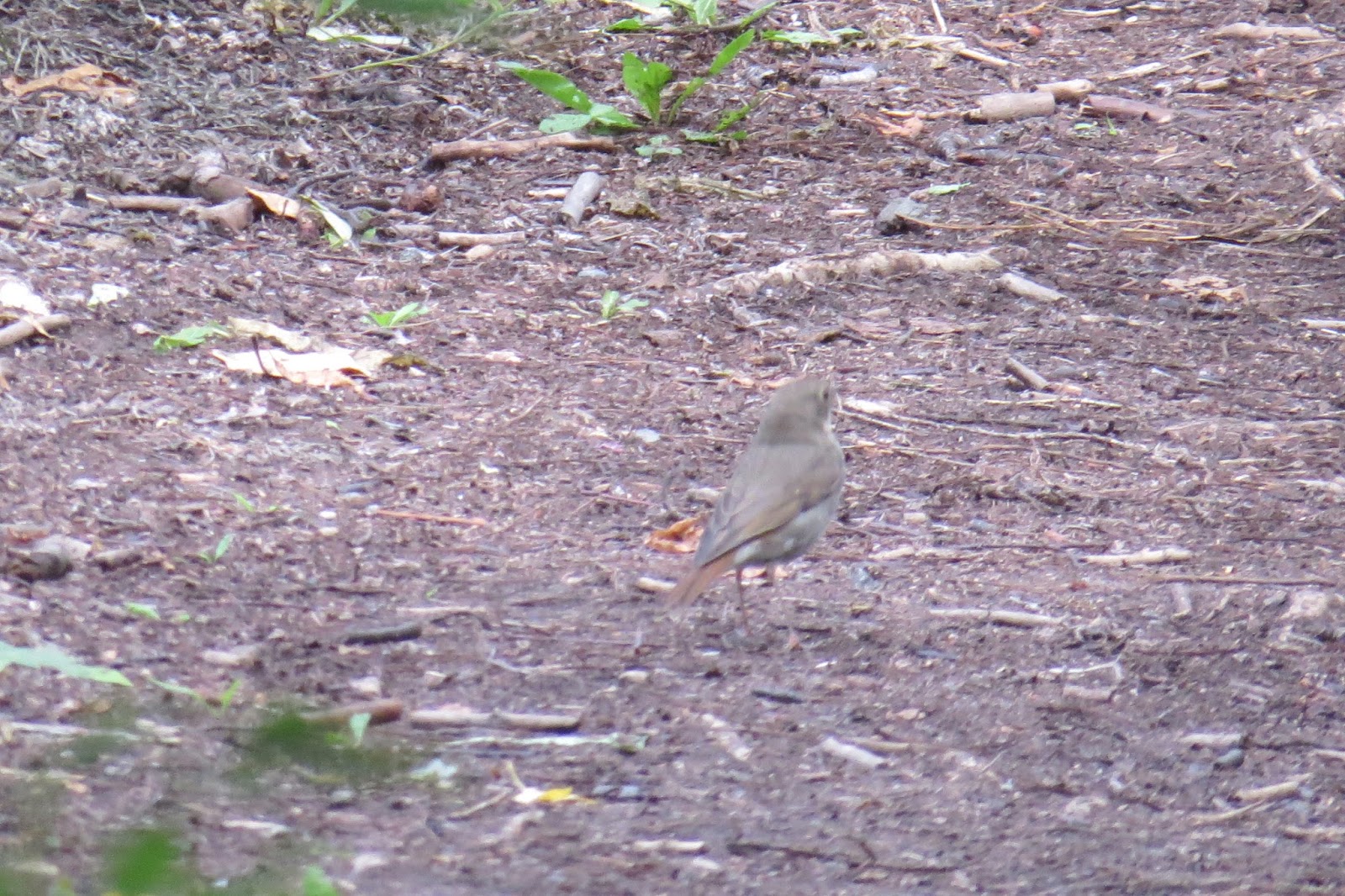
A hermit thrush hopped in the open ahead on the path! (Birders: are we interpreting those rusty tail feathers and spotty chest correctly? Swainson's and gray-cheeked thrushes live here too.)

Hermit thrush exhibit A.

Hermit thrush exhibit B.

Best of all, we finally found our icterid lifer, the rusty blackbird!

A male rusty blackbird is a striking bandit-masked critter!

“That’s our bird-of-the-day!” we cheered, but little did we know what was coming next…

As we climbed the pass between Anchorage and Tok, we ascended back into our beloved boreal forest biome. I thought we had left the stunted black spruce behind, but now, as we retreated into the interior, we were back among them!

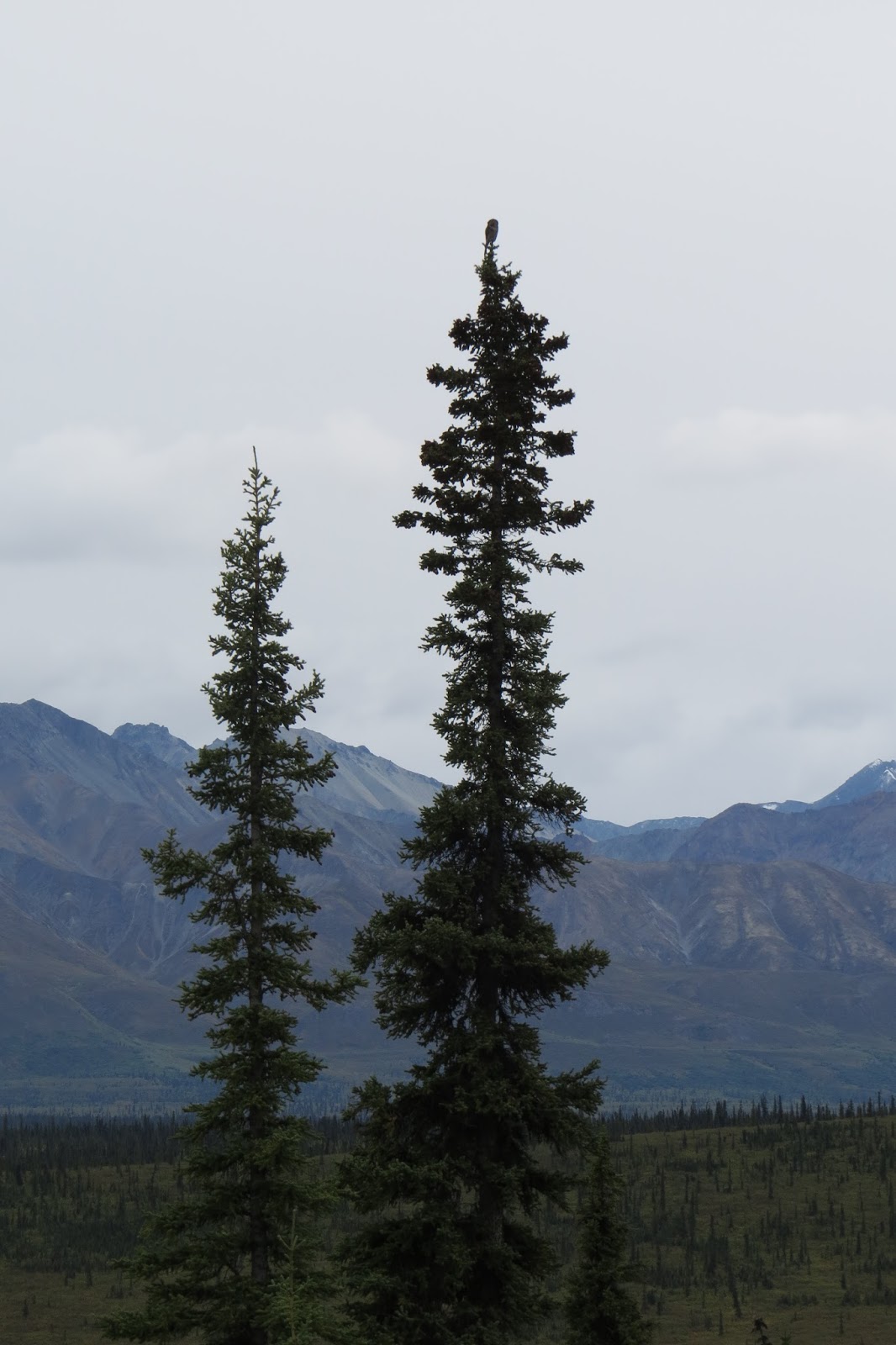
“Let’s keep scanning the treetops for northern hawk-owls,” Jane suggested, an activity we had given up days prior. Futile though I expected it to be, I began to scan the trees. A minute later – there was an owl!

Jane pulled a U-turn and photographed the quizzical little owl like crazy. His long, off-center tail and stripes give him a little-kid-in-pajamas look. What a guy.

Long tail, stripey chest, don't care.

Alone atop his very own spruce.

It was a boomer day for raptors. Shortly after the hawk-owl, a real hawk emerged!

Hey, hawks like spruce trees, too!

We think he's a juvenile red-tailed hawk from the stripes on his wings and tail. Thoughts?

We stopped at roadside ponds for waterfowl, meeting several other travelers along the way.

Non-breeding-plumage buffleheads in a roadside pond.

Canvasbacks and an interloping wigeon.

This lone trumpeter swan was one of the few we saw without a mate.

“Excuse me, are you a birder?” asked a woman at a rest stop. “I could tell because of your binocular harness. X marks the spot!” (She was referring to the criss-crossed straps on Jane’s back.)

We checked into the Golden Bear Motel in Tok, and then moseyed out to the lobby for tea and hot water. Two, then three, crusty local dudes told us lore of the 85-degrees-below Tok winters.

“Scientists say if you are running in the nude at that temperature, you’ll die as quickly as if you were runnin’ through fire!” one of them told us. Most of the winter isn’t that bad, they assured us. The air is so still, ten inches of powder can pile up on each telephone wire, and the sun is often shining on the crunchy white snow.

“Sure, it’s dark,” one man conceded.

“Yeah, you watch the sun come up, and hover for a couple hours, and go back down,” another added.

“But the twilight lasts forever!” said the first. “Not like Hawaii. I was there once and when the sun set, BAM, it was night. I was like, what the hell? Where’s the twilight? Nah, Tok’s not so bad.”

We all nodded and sipped our tea.

Tok, Alaska - it ain't so bad.

End of day summary:
  • Day of road trip: 12 
  • Start: Seward, Alaska, United States 
  • Miles traveled: 442 
  • Hours driven: 8.5 
  • Favorite bird sighting: northern hawk-owl 
  • End: Tok, Alaska, United States
    Share:

    Boardwalk Birds and Baklava: Day Ten on the Alaska Road Trip

    I’ll keep it simple today: it kept raining. As we packed up in Healy, left Denali National Park behind, drove past glorious mountain ranges utterly obscured by clouds, and arrived four-and-a-half hours later in Anchorage… it kept raining!

    Our respite came at Potter Marsh, a wetland just south of Anchorage that was created when the railroad berm blocked the flow of creeks, and freshwater backed up.

    The sun was shining at Potter Marsh.

    The signs touted the “accidental wetland” and the unusual fact that industrial development actually created wildlife habitat for once, but most of the signs failed to mention the estuary that was here before. It may not have been so full of birds, but estuaries are critical habitats for different critters, like juvenile fishes and invertebrates. Basically, we have to remember you can’t get something for nothing, and every habitat is valuable.

    Anyway, back to pretty birds. We saw waterfowl with feathers of many colors: red-necked grebes, northern shovelers, northern pintails,  mallards, American wigeons, green-winged teals, and scaups.

    Red-necked grebe.
      
    Red-necked grebe juvenile.

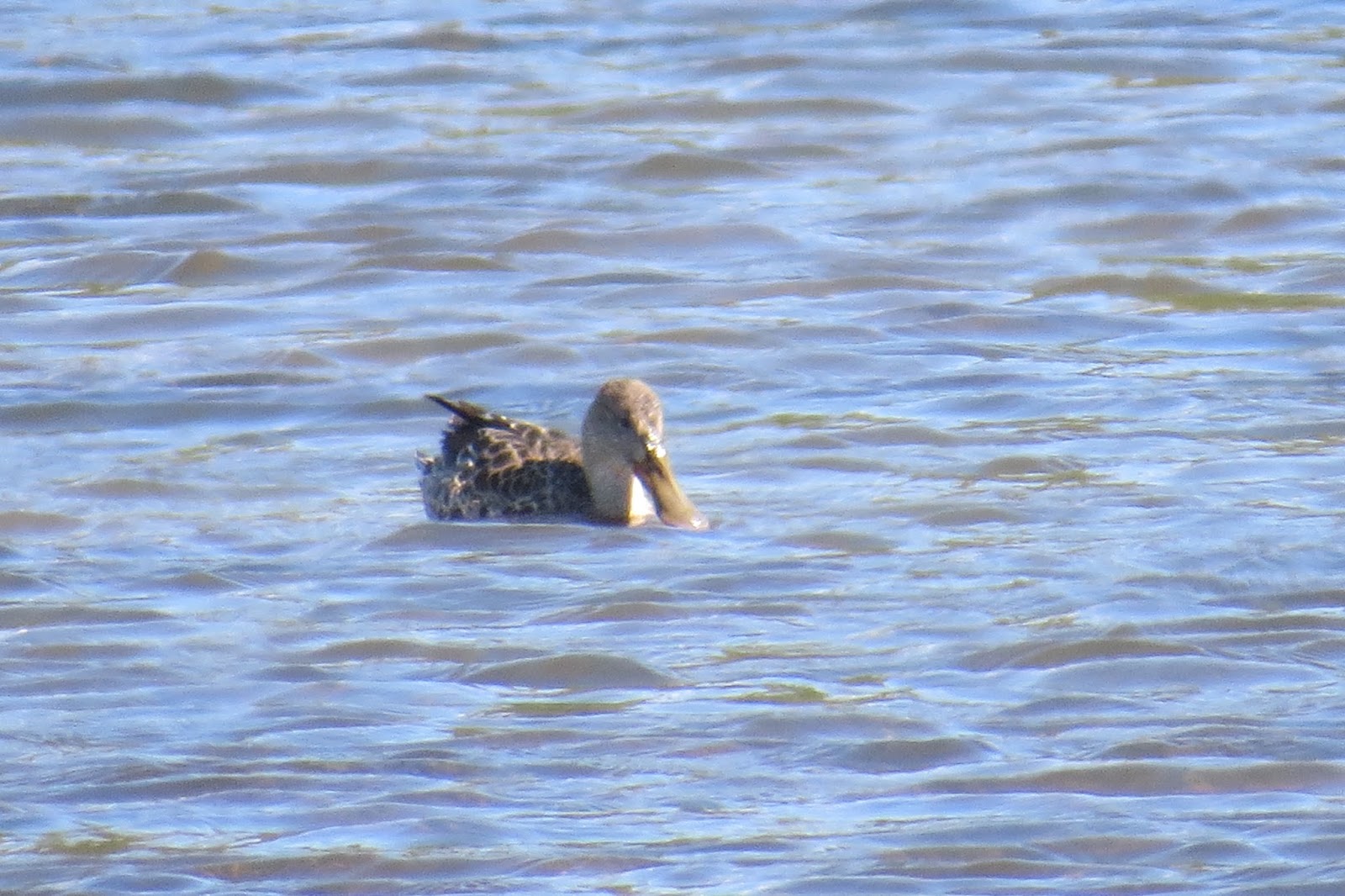
    Northern shoveler (what a pendulous bill!)

    Northern pintail (ballerina neck).

    A plain old mallard flaunts her blue speculum.

    Two American wigeons with their rocker black-tipped blue bills.

    A green-winged teal nestled in the reeds.

    We were convinced of this ID when she let her green wing peek out.

    For the shorebirds, we are under the impression (ornithologist readers, correct us if we’re deluded) that both greater and lesser yellowlegs were mucking around in the same pool.

    These two looked like greater yellowlegs.

    This one, on a nearby shore, looked like a lesser.

    She fanned her wings for us, but we still weren't sure about her lesser-ness!

    And two more yellowlegs in a different pond... greaters?

    My favorite spot was a Wilson’s snipe teetering in the weeds of a muddy tributary under the boardwalk!

    A Wilson's snipe is an elusive bird.

    We also saw black-capped chickadees swinging around a willow, a herring gull (?) munching on gunk, a flock of Canada geese, a red-necked grebe with her stripey-faced chick, and a laughing belted kingfisher.

    Pink legs, black wing tips, and a red spot on the lower mandible = Herring gull? (But why no streaks on the back of the neck?)

    I was amazed to see a large number of salmon braving the culverts of this estuary-turned-wetlands to reach their ancestral spawning creeks.

    The salmon were coming in through culverts to spawn.

    Can any salmon scientists out there identify the species?

    The boardwalk was funded by the Highway Commission as a safety measure because so many cars of birders were stopping along the narrow highway to watch the ducks in Potter Marsh. The highway people tried building precarious gravel pullouts near the ponds and posting warning signs, but the problem continued, so they finally gave in and built the birders a boardwalk. Hooray!

    We continued our drive around scenic Turnagain Arm, the shallow extension of Cook Inlet between Anchorage and the Kenai Peninsula.

    Turnagain Arm.

    The tide was out, and we watched the waves break over miles of sandbars and mudflats. A bald eagle perched on an exposed piece of driftwood. Black-billed magpies danced around the parking lots.

    A bald eagle on mud-flat driftwood.

    Of note is the ghost forest of Sitka spruce snags around the abandoned town of Portage. An earthquake hit this coastline in 1964, and this shard of land dropped between six and twelve feet in an instant. All that remains of the town were a rusty truck and the wood of a half-sunken building.

    The dead Sitka spruce where saltwater inundated the forest during a massive earthquake.

    Our accommodations down in Seward had character. We stayed in a ground-floor apartment at the Taroka Inn, complete with two TVs, kitchenette, back door to an alley, and enthusiastic proprietor who gave us coupons.

    I took a run tonight through town. I love Seward! The waterfront real-estate is all taken up by tent and RV-campsites. I ran past many campers with beach bonfires, and I watched a sea otter rolling and preening in the frigid saltwater. (I think I got too close, and he disappeared for a bit. The campers glared at me. I had to run away. Oops.) The buildings are coated with technicolor murals. My favorite: “Remembering Exit Glacier.” The impact of climate change is already felt heavily in Alaska.

    "Remembering Exit Glacier."

    My mom and I ate baklava at a picnic table of a closed-for-the-night café after dusk. The sun set early behind the steep forested hills of Seward, a town nestled between water and mountains.

    End of day summary:
    • Day of road trip: 10 
    • Start: Healy, Alaska, United States 
    • Miles traveled: 373 
    • Hours driven: 7 
    • Favorite bird sighting: Wilson’s snipe 
    • End: Seward, Alaska, United States
      Share:

      Popular Posts

      Labels