Health Education, Health Articles, Health Blog

Showing posts with label Mato Grosso do Sul. Show all posts

Outbreaks, Couch Surfing, and a Glowing Green Church

It was one of those perfect coincidences. I was reading a post on Names Across Nations (seriously, what a blog) in which the author, a previous Watson Fellow, stumbles across a university in her German host-city with an onomastics department. A whole department dedicated to her niche topic, the study of names and naming, and she didn't even plan it! Naturally, she meets with a professor there, and they have a three-hour conversation fueled by their mutual delight that someone else in the world is obsessed with names.

I thought to myself, I should really try to meet with some professors at the Universidade Federal do Mato Grosso do Sul (UFMS) before I leave. So, I Googled “zoonotic disease UFMS” and e-mailed the first five names for which I found contact information: three veterinarians, an ecologist, and a medical doctor. One of these professors replied saying, “I’ll be at a zoonosis conference on the exact days you’re in town. Why don’t we just meet there?”

Talk about luck! The conference was called DIERN: Doenças Infecciosas, Emergentes, Reemergentes, e Negligenciadas. Scientific language tends to be easy to understand in Portuguese because, like in English, its words stem from Latin. The conference’s name is a cognate: Infectious, Emerging, Reemerging, and Neglected Diseases.

A poster for DIERN, the Central-Eastern Conference on Infectious, Emerging, Reemerging, and Neglected Diseases. (Don't be confused by the dates; this must be a poster from last year.)

I read the conference program with glee, sent a Facebook message to everyone I knew from Campo Grande asking for a couch to sleep on, and bought a bus ticket to the city. The one thing I failed to do was actually register for the conference. I was waiting until the last day in case my plans fell through. (It’s a tricky gamble, this waiting game. Last month I paid ahead for a 5K race in Campo Grande, and then I had to skip it because I got invited to trap marsupials.) This time, my gamble did not pay off. When I finally tried to register, a red warning streaked across the screen: “registrations closed, conference full.” Gulp. Luckily, the conference organizers responded sympathetically to my pleading e-mail and welcomed me to attend anyway.

Marmelade, my champion backpack supplied by my champion North Face employee.

On Saturday morning, I stuffed Marmalade (my turquoise backpack) to bursting, said a tearful farewell to Lygia and Duca, and spent the day vaccinating cats and dogs against rabies in the town of Corguinho (more on that later). Then I took an evening bus into Campo Grande, a city of a million people and the capital of this cattle state.

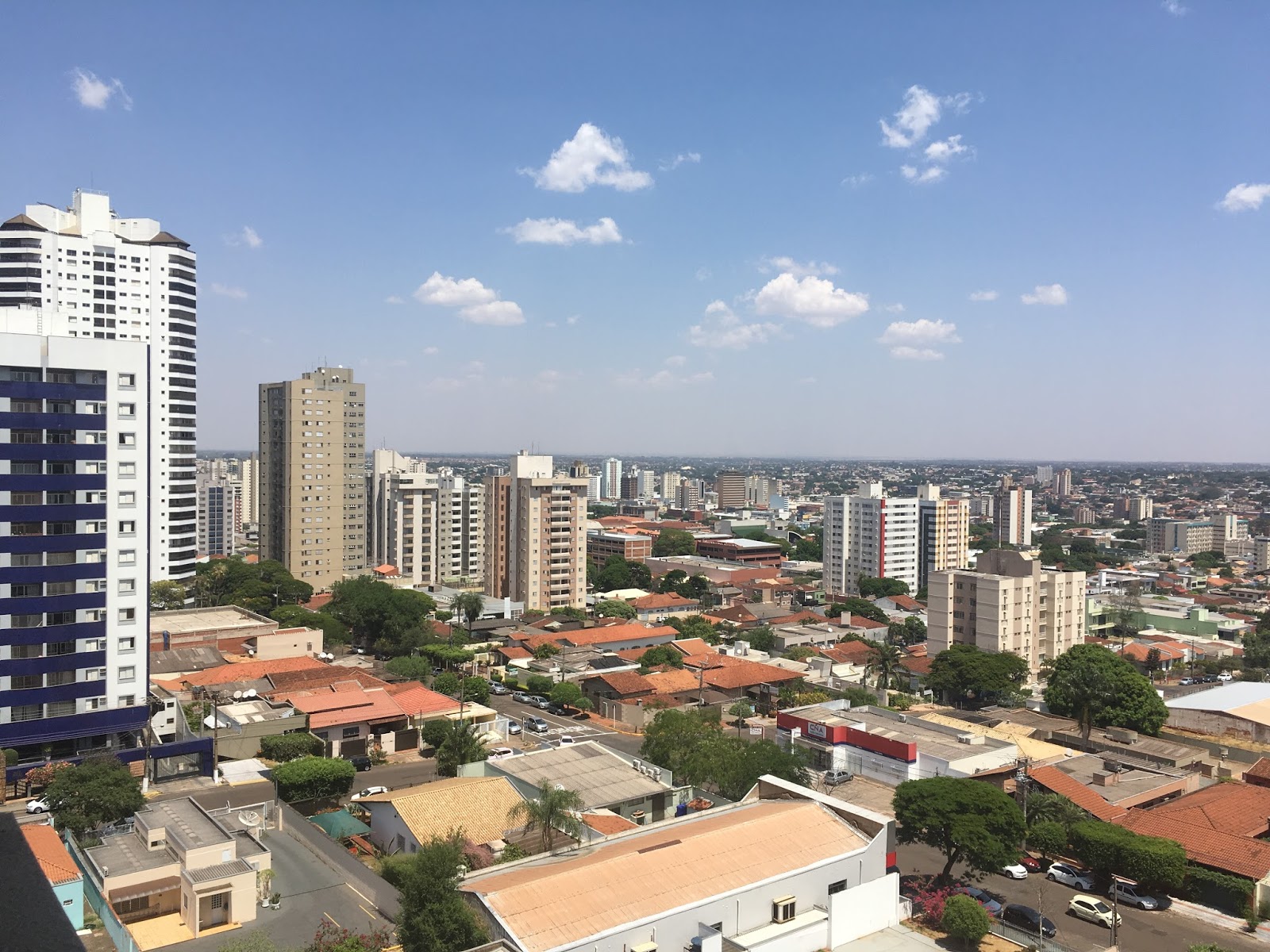
Campo Grande from a skyscaper apartment.

I stayed the first night on the couch of my friend Renata. She was very enthusiastic about the Theo’s dark chocolate bars I gave her. Brazil exports cacao but, ironically, even “dark chocolate” here is mostly sugar and milk, so 70% cacao Theo’s bars from my neighborhood of Seattle are precious.

Dark chocolate from Fremont!

Here, Renata holds a rehabilitated roadside hawk as part of the falconry class she took me to last month.

The next morning, I took an Uber to Faculdade Medica (FAMED), the university’s medical school. My driver was a little confused when his map took him through a gate, down a cobblestone road, through a narrow dirt alleyway sprouting plants, and into a parking lot surrounded by walls of rusty sheet-metal. We had arrived at FAMED!

I had signed up for an all-day mini-course called, “Investigacãos de Surtos,” investigations of outbreaks. First we defined an outbreak: a higher-than-normal incidence of a certain disease over restricted space and time. Not to be confused with endemic disease (always present in a given zone), an epidemic (widespread in space and/or time), or a pandemic (affecting multiple countries or continents).

The four outbreak professors: Dr. Larissa, Dr. Adriana Lucena, Dr. Liana Blume, and Dr. Marcelo Wada.

I was excited to realize that epidemiology is detective work. (In fourth grade, I was obsessed with solving mysteries. After reading Harriett the Spy, I founded the American Mystery Association, drafted bylaws in which “a good attitude” was mandatory, and established the headquarters in my treehouse. The AMA charged 10 cents per mystery. Bonus: if I didn’t crack your case, you didn’t pay.)

Epidemiological mysteries are far more tantalizing than the kind I tackled, which usually involved finding lost household objects. In the world of disease, the mystery asks: what is the source of disease, and how can we stop it? Outbreaks involve three kinds of clue: people, place, and time. When epidemiologists catch wind of an outbreak, usually though a medical center’s report to the federal Ministerio de Saude (Ministry of Health), they scramble to collect their equipment and get to the field, wherever the outbreak is occurring.

Dr. Marcello explains how this map of cases in a Toxoplasmosis outbreak allowed the epidemeologists to locate the source at a water reservoir.

They start with the first clue, people, by tracking down every possible patient. Which people are getting sick? How many? Then then move to place by plotting cases on a map. The highest density of cases is the focal point, the probable source. Finally, they use a tool called an “epidemic curve” to understand time. For most diseases, we know the minimum and maximum incubation time (the shortest or longest time it can take a person to get sick after being exposed to a pathogen). By counting backward from the first and last cases of the outbreak, scientists can determine the period of time in which the disease’s source was infectious.

My attempt to estimate the time period during which an outbreak started, using an epidemic curve.

I imagine that many epidemiological mysteries are never solved, but we went through a couple case studies where the pathogen’s source was traced to a single batch of oranges at a Luau or the water reservoir of a town. In each case, the epidemiologists recommended public health actions to prevent a recurrence. How satisfying!

Outbreak students 2017!

When the mini-course ended, my day’s adventures had only just begun. I didn’t have any way to get from FAMED to the house of Giovana, a friend of Renata’s who’d agreed to host me for the next three nights. Without a SIM card or WiFi, I couldn’t call an Uber, nor could I walk three kilometers with all my earthly possessions on my back. So I asked around, and I found a friendly medical-student volunteer who agreed to give me a ride.

While I waited for him to finish cleaning, I talked with medical students and learned how different the higher-education systems are in Brazil and the United States. Here, high-schoolers take a national exam to determine which professions and universities they are qualified to enter. Many students then select the highest-ranked profession and school available to them. Theoretically, this system encourages a meritocracy by providing free college to any citizen who earns it, regardless of wealth. In reality, wealthy high-schoolers from private schools take most of the spots. The Brazilian system sounds rigid and status-driven to me, but I can’t say the United States does it any better. Another difference is that medicine is an undergraduate program in Brazil. Some of these students will be doctors by the age of 22!

Then my driver was ready, so I told him my address and we lurched through Campo Grande, his car dying at every stop sign. “It just started doing this today!” he told me, exasperated. He dropped me on the curb, restarted his poor car, and sputtered away.

I looked around to assess my situation: an iron fence, a locked gate, and curtained windows. It was after dark. I was an hour earlier than I’d told Giovana to expect me, and she obviously was not home. Across the street, a glowing green church had just started to attract people, so I walked over and asked if it was a public service. The man at the door gave me a puzzled look, but eventually I ascertained that I could attend. Turns out, it was Sunday! I sat myself down in a center pew, hiking boots dangling from Marmelade, DIERN name-tag around my neck.

The Catholic service was, in a word, Brazilian. The woman in charge had a black page-boy haircut and a microphone turned all the way up. We began by crowding outside to welcome Nossa Senhora Aparecida, the patron Mary of Brazil, who is always (in my experience) a statue wearing a long cloak. We danced and sang her onto the stage. It’s unclear if she was a new statue, or if this happens every week.

The service lasted for an hour-and-a-half of standing and kneeling, a music video, eruptions of applause, some scolding to open the word of God as often as we open our cell phones, and golden chalices. There was a ritual involving fire, holy water, and a Bible being fed to each in turn. There was singing, holding hands, and crossing across the head and shoulders.

According to one of the songs (which was in Portuguese, so take my translation with a grain of salt), Nossa Senhora Aparecida was a statue discovered in a certain Brazilian river by fishermen 300 years ago. Her name literally means “Our Lady Who Appeared.” She’s one of many worldwide “appearances of Mary” and the only official black Mary. The best parts of the service were sudden outbursts when the otherwise soft-spoken leader would blast into the microphone, “Let’s make some noise for NOSSA SENHORA APARECIDA!!!!” and we would all cheer like crazy for the statue.

After, I was approached by curious congregants. One asked, “Are you Brazilian?” but clearly knew the answer already. Another asked, “Were you at DIERN today?” Turns out, she works at the Ministry of Health with one of my classmates from the Outbreaks course. An elderly woman didn’t say anything, she just petted my hair and face and smiled at me.

Giovana greets the same  hawk Renata was holding above. I met Giovana at this falconry class, and then she let me stay at her house a month later. You never know when falconry classmate will reappaer in your life!

Giovana holds the roadside hawk.

I wove through the crowd and crossed the street. Giovana’s lights welcomed me through her window, a relief. I was ready for bed.
Share:

Marsupial Trapping in Bonito

If I told you I spent eight days in the forest capturing nocturnal marsupials, where would you think I was working? Probably Australia, the land of marsupials, where eutherian mammals (those that use placentas to transfer nutrients to a growing fetus) never arrived. But Australia is not the only place marsupials call home.

The small-mammal-trapping team, from left to right: Cyntia, Mariane, me, and Gabriel.

Brazil is home to many marsupial species, and I got to meet two of them as a volunteer with Cyntia Cavalcante Santos's small-mammal-trapping team. Cyntia is finishing data collection for her PhD. Her field work consists of spending a week at a time in the dry, tick-infested forests and sunny, cattle-infested pastures near Bonito, where the native ecosystem is a combination of Mata Atlantica (Atlantic forest) and Cerrado (tropical savannah).

Her plan is to complete six transects in each of eighteen locations, and she walks every transect four times: once to set out traps, and three times to check what hapless little mammals were attracted by the smell of juicy fruit overnight. She wakes at four in the morning and starts bushwhacking before sunrise. Did I mention she also walks a kilometer along each transect to collect scat and photograph tracks in the dirt?

If you do the math, that adds up to... a lot of sweat! And a lot of sweat bees to drink it.

While we prepared traps at the truck, we were covered in so many sweat bees, we could barely breath without snorting one up the nostril. These little guys tickle, and they are not fun to respire, but they neither sting nor bite.

I was lucky to accompany Cyntia on her fifteenth transect, along with two first-year college students from Dourados, Mariane and Gabriel. We walked the transects and set up two kinds of live trap: open-mesh Tomahawks on the ground, and folding metal Shermans on tree branches. We baited each trap with a fragrant chunk of pineapple or banana, then left them in place overnight in hopes that a nocturnal mammal would be lured inside.

Mariane models one of our Sherman traps for arboreal mammals.

Cyntia's goal is to understand how human land-use is affecting the habitats and ranges of mammals in the Cerrado. Here, native vegetation is being converted to cattle pasture at an alarming rate. I've seen it happen before my eyes. Primary forest is logged and burned. The remaining wood is gathered into piles to continue drying, so it can be burned later. The bare red dirt is plowed and planted with braquiária (Brachiaria brizantha), an African grass used for cattle pasture.

Real-time deforestation near Bonito. Notice the piles of burned wood, the plowed red dirt, and the intact forest on background hills.

After the ground is plowed, ranchers create uniform berms of dirt to prevent rain from eroding their land downhill into the creeks and rivers. These raised stripes can be seen years later, once grass has filled in the pasture. This tactic can be viewed as dedication to "the environment" because is preserves topsoil and reduces sediment pollution in rivers, but retaining soil is not the same as retaining species. Compared to primary forest, the difference is slim between a pasture, a pasture with berms, and an asphalt parking lot -- at least in terms of biodiversity. That's how it seems to me, anyway. Cyntia's research will tell us how pastures and cornfields really compare to forest.

Erosion-control berms give the pasture a striped appearance.

A male rhea stands alone in corn stubble, booming out low-frequency calls in front of a tragically-small forest fragment.

Not only are cattle the proximal cause of deforestation... these horned zebus are also a formidable obstacle to scientists walking through pasture!

Cyntia documents the vegetation of a mountainous "open" transect, a euphemism for steep-sloped pasture. A cow mopes in the distance.

Another effect of cattle on land: hummocks! Shoutout to Collin's thesis.

Sun rises over rolling green hills, the landscape we evolved to love in African savannas and now transplant onto every continent (at least, according to the evolutionary hypothesis of environmental aesthetics.)

We didn't capture any mammals our first day, in the pasture or the forest, but there was still much to be learned from the landscape, and many challenges to overcome.

Cyntia points out a young manduvi, the species of tree where endangered hyacinth macaws make 90% of their nests. The macaws nest in cavities excavated by woodpeckers in old-growth trees, at least fifty years of age. You can imagine how forest fragmentation quickly breaks down this evolved interdependence among species.

The ripe fruit of manduvi.

A saprophytic plant, nearly identical to the northern groundcone I saw last summer in the temperate rainforest of Alaska. I have no idea what this plant is, though, because the groundcone genus (Boschniakia) lives only in western North America.

Cyntia poses with native bamboo. We played music on the stems, hard as wood and hollow as a straw. Each stem was a different diameter and emitted its own note.

One morning, I was renewing the fruit-bait in the traps by myself when I noticed that a swarm of black ants had taken over one of the Shermans. The ants moved slowly, almost leisurely, along the branch. They were huge, but not the gargantuan size of a bullet ant. Their black color was matte, not shiny, and their limbs seemed substantial, as if the ants were molded plastic instead of chitin exoskeleton. Each of their faces was covered by a flat shield, from under which glowed a ruby-red light. If ever I have encountered alien robots, these were them.

The ants milled around the trap with confidence, but no hurry.

I watched, entranced. When two ants encountered one another, they paused for an intimate greeting of entwined antennae. I assumed the ants had been attracted by fruit, but when I finally looked inside the trap, the pineapple chunk was intact and abandoned. The ants didn't like pineapple. So why were they here?

A rubber-band-chewer hard at work.

Upon closer inspection, I realized that many of the ants were intently chewing the rubber bands I'd used to attach the Sherman trap to its branch. "Can they digest rubber?" I wondered. The ants reminded me of municipal road-workers, called out after a windstorm to rapidly clear the streets of downed trees. Later, Cyntia told me my analogy was spot-on. These ants "own" specific trees in the forest, and they guard them jealously from epiphytes, bee hives, leaf-eating insects and, apparently, small-mammal traps. The ants were actively removing our trap.

I marvelled at their intelligence. Surely they had never encountered rubber bands or metal before -- how did they know to focus on chewing the rubber bands? One patrol ant must have encountered the out-of-place object and called for backup. I imagine the crew biting on all parts of the trap and scratching their antennae about what to do. Finally one ant bites the rubber and finds it softer. How did that ant communicate its discovery to the rest? Did they argue before they settled on the band-chewing plan? How did they organize into band-chewers and sentries? What messages do they send through entwined antennae, invisible pheromones, or vibrations?

In my excitement to photograph the ants, I accidently bumped into the trap. I jumped back, expecting the ants to swarm with speed and anger, but they did the opposite. They became absolutely stationary. Now, the illuson that they were plastic ant toys became inescapable. I waited for them to resume their walking, greeting, and chewing, but after five minutes I gave up and walked away from the red-eyed robots, frozen in place as if time itself had stopped.

Unfortunately for me, time had not stopped, and I had to run to finish baiting the rest of my traps!


Another highlight of the trapping project was getting to meet the people whose land we were surveying. As I explained in my recent post, Vale do Bugio: Tourism as a Tool to Protect Private Ecosystems, most Brazilian land outside of the Amazon is private. That can be tricky for researchers who seek to understand ecosystem-wide phenomena. It means that mammalogists must be both expert scientists and expert socializers.

Cyntia began each day by greeting the landowners, explaining her project, offering a glossy Wildlife Conservation Society magazine about Cerrado research, and making small talk about just about everything.

We spent over an hour meeting Seu Claudio, an elderly farmer whose five children have grown and moved away. His brown skin wrinkled around his eyes, his arms were strong and lean, and his smile alternated between teeth and gaps. His eyes spilled tears when he told us that his wife, Donna Maria Rosa, had passed away one year and five months before. He pointed out the blackboard on his front porch where he had written a voltage equation for the electric fence and a note to his late wife: "PARABENS!! PELO SEU DIA DAS MAES," happy Mother's Day. His loneliness, loss and love were plain to feel.

Claudio accompanied us on our hot, dusty hike up his thorny mountain to set out the traps. The next day, I noticed that his blackboard had been updated to include our four names at the bottom: "Gabriel - Nina - Dr. Cyntia - Mariane." He filled us an enormous bag with lemons from his garden and thanked us for the magazine, which he'd read cover-to-cover the night before.


Making social connections with private landowners can be a burden to scientists in Brazil, drawing down precious hours for fieldwork and data analysis. But I also see an enormous value in these relationships forged between academics and farmers. Conversations foster compassion and curiosity. Maybe these human connections will help keep the country from polarizing. Production, subsistence and livelihood need not be antagonists of biodiversity, conservation and science. All humans need both food and a functioning biosphere to survive.

Over the next week, we managed to capture six marsupials of two species, from both forest and pasture landscapes. One was the catita (gray short-tailed opossum, Monodelphis domestica).

Why leave the trap when it feels so safe?

She acted just like my sister's pet mouse, Cleo, when we brought her home to her new cage.

The second was cuíca-graciosa (agile gracile opossum, Gracilinanus agilis), an arboreal marsupial with a curly tail, thick black eye makeup, and translucent ears.

Here, Cyntia weighs the cuica in a plastic bag. She will also measure its limbs, collect its ectoparasites, and preserve its feces in alcohol.

"Look, Mom, I can fly!"

When we released the mammals back into the forest, they often took a few minutes to leave the trap.

I was amazed at how they sniffed, explored, and observed their surroundings just like a pet mouse or a human. I've never spent much time around small mammals, preferring reptiles, fish, and birds, but it was heart-warming to notice the similarities between me and my cousins.

True to its arboreal nature, the cuica shot straight up the first acuri palm it came to.

And then it watched us. 

As a tangent, check out the Wikipedia page for this species and see if you recognize the photos! When I checked Wikipedia to find this species's English name, I realized the page had no photo. Always a joy to contribute to the world of free-use online media!

Cyntia photographs the hoof-print of a deer.

Small mammals aren't Cyntia's only interest. She wants to know how all mammals are using Cerrado landscapes, but those pesky jaguar and peccary don't fit inside Tomahawks, so Cyntia uses a different kind of trap: cameras.

After a week of small-mammal trapping, I volunteered to stay behind with a soon-to-be-Master's-student, Renata. Along with Almir, the university driver, we collected fifteen motion-triggered cameras set out a month earlier. As you might expect, half the cameras faced cornfields and pastures, while the other half were nestled among native acuri palms and bamboo stands.

It was a marathon day, and we only paused for soupy tuna sandwiches at three in the afternoon. The sun was setting, we had fourteen cameras in the truck, and we were feeling good, until...

"What's that buzzing?" asked Renata as we got near the fifteenth camera. Yup, small wasps called marimbondas had built a hive in the camera box. Renata tried whacking the box to get the wasps to leave, but that trick only works with ants and mice. These wasps got angry. They swarmed out and stung Renata on the knuckle.

Plan B: get Almir! I remembered back to my high-school bee-keeping days, when we used smoke to calm the bees before stealing their honey. What could we use to make smoke? I suggested paper, but Almir had bigger ideas. He found a can of air freshener in the truck, and he improvised a blow-torch by lighting the scented aerosol on fire with a cigarette lighter.

Almir wields a flower-scented blow torch.

He didn't calm the wasps with smoke. He incinerated them with flames.

Renata looks on from a safe distance as dusk sets in.

It did the trick. Once enough wasps were vaporized, we stuffed the camera in a feed-sack and tied a tight knot. Back at the lab, Renata threw the whole buzzing mess in the freezer. An hour later, we opened it up to find sluggish (but very alive) wasps and a papery apartment complex filled with larvae and honey.

The marimbondas had built a veritable city in our camera. I was sad to destroy it.

As if the poor camera had not been through enough, we doused the hive in insecticide and pried out the hexagonal architecture with a butter knife. Finally, the camera was liberated. We expect many photos of... wasps.

Renata, victorious with insecticide in hand, after a long day.

Me, exhausted with butter knives in hands, after a very long and wonderful week.


Best of luck on your doctorate, Cyntia! Thanks for including me in your science!

Dad's Daily Bug

This flying red beetle chews on the leaves of acuri palms, leaving jagged topiaries in the woods.

Mom's Daily Bird

A social flycatcher on a termite mound. Not to be confused with the lesser kiskadee, great kiskadee, or boat-billed flycatcher, which all have similar patterns but different sizes of bill!
Share:

How to Make Rapadura, a Sugarcane Sweet

The sweet smell of boiling sugar permeated the air when Lygia and I arrived at the towering bamboo that marked our first stop, a chacara or small farm.

This was where I would conduct my first wildlife-disease interview. I was nervous. What if my Portuguese was unintelligible? Would any of my questions be offensive or too personal? Would the farmer object to my audio recorder, the consent form, or even speaking with me?

The chacara's owner was too busy to talk with us, and we soon discovered why. He was cooking rapadura (pronounced hah-puh-doo-ruh) out back!

The first step to cooking rapadura is juicing the sugar cane.

We were invited to try swirling glassfuls of fresh sugar-cane juice, a flavor at once sticky, sweet, green, and plant-like.

Two wide, metal kettles held the boiling brown liquid.

The fresh juice is then boiled down to a thick, bubbling syrup over open flames. The process reminded me of my cousins' Vermont sugarbush, where they tap maple trees for sap and boil the clear fluid into maple syrup.

Lygia is a rapadurera in the making!

When the right consistency is reached, the men poured the caramel-colored liquid into a wooden trough.

It's hot, heavy, sticky work to pour molten sugar!

Here, one of the confectioners spreads the rapadura to cool in a wooden trough for just the right amount of time. Then, roasted peanuts are mixed in.

This beautiful wooden frame is put together like a set of Lincoln Logs. The peanut-sugar slurry is poured in.

When the bricks of candy are cool, the wooden frame is removed.

The bricks are stood on end to finish hardening.

Voila, more sucrose than anyone should reasonably consume in a lifetime!

We bought two bricks, and we've put them to creative use. Brown sugar is hard to come by here in Taboco, so we substituted grated rapadura in my recipes for Tollhouse chocolate-chip cookies and Sloppy Joe's. The slight peanut flavor is a bonus.

And, amid the saccharine operation, I did manage to conduct my first interview with a young woman who lives on the chacara. She was expecting her second child, and we even managed a simple conversation about her kids. The day was sweet from start to finish.

Mom's Daily Bird


Rufescent tiger heron. Socó-boi. Tigrisoma lineatum. This bird posed in the dirt road just before sunset as we finished a long day of fruit-surveys near Bonito. Alexine, the peccary researcher, told me, "We don't stop for birds! Only peccaries!" but this rule was relaxed for such a magestic fowl.

Dad's Daily Bug


This nocturnal insect crawled around the patio at high-speed. A member of the family Gryllotalpidae, it's called a paquinha or mole-cricket.
Share:

Popular Posts

Labels