Health Education, Health Articles, Health Blog

Showing posts with label plants. Show all posts

Rainforest's Rebirth

Heat rises from the wet ground and pulses down through black shade cloth. I can feel thermal energy surrounding me in waves. Welcome to the tropics.

Meranti saplings.

I am standing in ASRI’s lokasi reboisasi, the reforestation nursery. Black plastic pouches, known as polybags, stand in rows like toy soldiers. Each is filled with a measure of native loam, scooped from the forest floor, and a single sapling. The soil here is fine-grained, rolling into a ball between my fingers like playdough. It’s not ideal for plants because it holds water like a sponge and, when dry, forms a rock-hard barrier to roots, but it’s what these trees evolved for, so it’s what they grow in. After all, this nursery is not preparing saplings for an easy, domestic life in a garden. These saplings have a destiny: they will become the rainforest.

Native loam rolls into a ball like playdough.

We arrived to the Laman Satong nursery after an hour of swerving around potholes and bumping over stones in the dirt road. I’m here with three capable guides. Ihsan is ASRI’s Reforestation Coordinator. Juliansyah is the Nursery Manager. And Dika is the new Director of Conservation Programs. He’s in the process of defending a PhD in tree population genetics from Copenhagen University, and he arrived at ASRI one day before I did.

Ihsan tends his flock.

Dika scrutinizes the baby trees.

Here at the nursery, we are standing on a plot of ground donated free-of-charge by the Catholic Church. The surrounding land was forested until the year 2000, when private timber companies cut the trees and left grassland. Usually, timber leases are meant to follow a 35-year rotation, in which the first plots to be cut will have regrown with native trees in time for the next round of logging. Unfortunately, Dika explains to me, these rotation requirements are often violated. The company will simply log the entire lease at once, sell the timber, and abandon the land, which is then sold into palm-oil plantations. That’s what happened to most of the private land around the nursery.

ASRI's Laman Satong reforestation nursery.

Yayasan means "Foundation." Alam Sehat Lestari translates to "Sustainable Healthy Nature."

Alam Sehat Lestari is abbreviated as "ASRI," itself an Indonesian word expressing the fresh, green beauty of flourishing nature.

Then, lacking a source of legal timber, loggers were compelled to illegally move their activities inside the boundaries of Gunung Palung National Park. Across the road, I can see the degraded margin of the park. That’s the area ASRI aims to restore.

This widening road is the border of Gunung Palung National Park.

On the private-land side, three men build a house next to a small rubber plantation.

First, Ihsan shows us around the nursery. Some of the saplings were provided by patients as payment for their medical or dental care. This noncash payment system is a cornerstone of ASRI’s commitment to providing affordable healthcare.

This list, posted at the cashier's desk, displays the cash value of each species of rainforest-tree sapling when provided as payment for medical services. Notice the top two, belian (ironwood) and meranti, both pictured below.

The rest of the saplings were collected, with permission, from intact areas of the National Park where a natural seedbank still exists. The collection puts only a minor strain on the forest’s regeneration ability, because the vast majority of saplings never survive to adulthood. Competition for sunlight and attacks by herbivores and disease would weed out most of these baby trees if they were left in the forest, whereas the relative safety of the nursery allows almost all to survive. Someday, the team might switch to gathering seeds instead of saplings to further reduce impact on the forest and stress of transplantation, but coaxing seeds to germinate is not easy. For now, the nursery staff lets the forest give birth to saplings. Learning how to germinate tropical hardwood seeds will be a task for another day.

Ihsan shows off a belian (ironwood) sapling.

From above, the nursery almost looks like a forest floor.

Dika plucks a leaf from one of the robust display trees. “See that line of pores along the central vein?” he asks, pointing tenderly to the leaf’s underside. “That tells us the species, Shorea leprosula. This genus is a big complex and you need to look closely to tell them apart.” What Dika calls Shorea leprosula, everyone here knows as meranti. The nursery is also home to uba, a hardwood timber favorite, and belian, the famous ironwood. Then there are the fruit trees: sweet cempadak, gas-leaky durian, bitter jenkol and patai.

Dika points out pores on the underside of a meranti leaf.

I weigh a heavy belian (ironwood) seed in my hand.

Ihsan tells me the saplings don’t struggle against many diseases, but ants have a habit of making their nests in the polybags and occasionally stripping young leaves. Because they’re transplanted right before the rainy season, the saplings don’t require watering. The hardest part of running the nursery is, Ihsan tells me without hesitation, “Weeding!” A stiff grass erupts from any patch of soil left untended, smothering the slow-growing trees. “When the tree is taller than the weeds, then it is safe,” Ihsan explains. I imagine that day comes as a relief for the nursery manager, like the feeling a nervous parent gets while watching her child walk across the stage at high-school graduation. The journey isn’t over, but at least the aggressive grass has been outgrown.

Moss coats a logged stump in the reforestation plot.

ASRI has reforested 22.5 hectares so far at this site. I ask Ihsan how many hectares he’s aiming for. He looks puzzled. “Our goal?” he asks. “There are many open areas. Our goal is to plant them all.”

Black shade-cloth protects the tender saplings from direct sunlight.

My straw hat bumps against the shade-cloth roof as I stand from the sprout I've been examining. I may be average height in America, but here, I’m just a bit too tall. We walk out to the parking lot, where water vapor is steaming from puddles. A turquoise butterfly slowly folds its pointed wings with black, scalloped edges like a pair of 1950s cat-eye glasses. A small orange butterfly shows off bauble-tipped antennae, like a Martian, and a pale yellow one rests on a sapling. It’s time to explore the new forest.

The purple blossoms of cengkodok (Melastoma sp.) reminded me of Washington's native azaleas.

A tengkawan planted in 2015. This tree can bring $5,000 per cubic meter of timber.

Within five minutes, a cloud of mosquitoes has descended. They seem to ignore Ihsan and Juliansyah, but Dika and I are going crazy. We roll down our sleeves and spray on deet. We're passing through a semi-wild orchard of jackfruit and durian when an enormous stump confronts us. Two chainsaw slices indicate how this rainforest giant, a thousand-year-old ironwood, met its death. “Normally this tree can put out new sprouts from the stump,” Dika explains. “It’s very resilient.” He runs his fingers over the blackened bark. “But not this time. It was burned for charcoal, so it died all the way down.”

A thousand-year-old belian (ironwood) stump.

A chainsaw delivered the first blow; fire finished it off.

A lanky, teenage belian (ironwood) sprouts from a stump that was cut but not burned.

The first saplings were transplanted here in 2009, and more are being added every year. The forest is a teenager now. It still sports those awkward sunny patches of grass and lingering invaders, like guava and acacia, but there’s light at the end of the tunnel.

Dika models Bellucia pentamera, an invasive weed with wide, sun-gobbling leaves.

Jackfruit (Artocarpus heterophyllus) hangs from a transplanted fruit tree.

For an eerie instant, this log makes me feel like I am home in the Hoh Rainforest of Washington State.

Ihsan places his hand on the flaky, reddish bark of an acacia. “You’re probably wondering how this big tree got here,” he tells me, giving me more credit for my observations than I deserve. “It’s not old, just fast growing. An acacia from Australia. Non-native. But we won’t cut it down. We let these trees provide shade for the saplings, and they’ll die within forty years. Fast to grow, fast to die. But the native trees will live for a thousand years or more.” This long-view logic makes sense to me. Why cut a tree when you could let time do the work for you?

Two fast-growing acacias, introduced from Australia.

Back at the nursery, I open my lunch: rice, chicken liver, and eggplant curry folded into a cone of waxy brown paper.


We packed our lunches at a warung (cafe) this morning. 

Juliansyah points to a mural of black squares labeled with indecipherable numbers and X’s. It’s a map, he explains. Each square is a reforestation plot, twenty meters on a side. The X’s are controls, left to their own devices with no saplings added. Through careful monitoring, ASRI is finding an answer to the question on my mind: does all this effort – collecting saplings, tending the nursery – make the forest come back faster than it would if mother nature were left to her own devices? Does reforestation make a difference?

Juliansyah explains the number-and-X map.

Before I lose my chance, I ask Ihsan about the boxes labeled X. “The control plots?” he asks. “They’re sunny and grassy. Just ferns.”

Ferns and sunshine dominate a control plot.

Today, at least, I have learned that nine years of dirt under the fingernails makes the difference between a cool, moist canopy of teenage forest and a sunny meadow. For orangutans, hornbills, and all the rainforest organisms of Borneo, that’s a difference worth noticing.

Ihsan walks beneath the canopy of a rainforest reborn.
Share:

Vale do Bugio: Tourism as a Tool to Protect Private Ecosystems

Our weekend visit to Vale do Bugio, Valley of the Howler Monkeys, didn't yield any non-human primates. But it did get me thinking about ecotourism, the difference between private and public ecosystems, and bloated dead bats.

It all started when Duca, Lygia and I loaded into the rusty truck and bumped down two hours of red-dirt roads to arrive here at Vale do Bugio.

One reason we'd come here was because, as Duca told us, "The place is gorgeous!" The second reason was practical. Duca and Lygia were hoping to strike up a partnership with the landowner to use this primary-forest reserve as a tourism destination.

This sign, if you couldn't tell, says, "Vale do Bugio," meaning "Valley of the Howler Monkeys." We didn't see any howlers, but we did see some potential infrastructure improvements!

As a comparison, here is the well-signed entrance to Taboco, the small town near Quinta do Sol (the forest reserve where I live).

Duca and Lygia are on a mission to bring ecotourism to Taboco. Ecotourism is one of the conservation strategies championed by the Wildlife Conservation Society. When practiced by the community, with local guides and homestays, tourism provides a source of income that consumes fewer natural resources than, say, cattle ranching, the most common occupation in this region.

Ecotourism also helps build a conservation ethic by increasing the value placed on intact ecosystems by local communities. When customers will pay to see birds in the primary forest, that forest becomes more to the landowner than a waste of space where pasture could be. When tourists stay at a farm in hopes of sighting an ocelot, the farm's owner has a good reason not to shoot that ocelot, even if it does steal chickens from time to time.

An aside: during my interviews with farmers, I have heard families complain of chicken-stealing ocelots, duck-killing foxes, dog-strangling anaconda, garden-wrecking tapir, and chick-grabbing hawks. These wild species become less of an economic burden when they "pay their way" and provide an additional source of income through tourists.

The private driveway to Vale do Bugio could also use some work. Our truck lurched over high berms and listed sideways in eroded tracks. We decided that tourist groups would walk up the driveway as an introductory hike, while an intrepid driver crawled behind them in the four-wheel-drive vehicle.

Ecotourism opens the door for environmental education. Already, as outreach coordinator for WCS, Duca has spoken with dozens of families about lower-impact farming methods, non-lethal techniques for managing wildlife damage (such as electric fences to keep tapir out of manioc fields), and skills to help community-members guide tourists on hikes and host them as overnight guests.

Vale do Bugio has a few simple accommodations already in place, like this stand-alone bedroom, but it will take a huge amount of work if Duca and Lygia decide to turn the place into an ecotourism attraction. Signs, road grading, trail maintenance, handrails, maps, bedding, kitchen and bathroom improvements, and potable water are all on the list. 

During my time in Brazil, I have been struck at how precious little public land exists here. Magnificent waterfalls, towering cliffs, expansive views, ancient cave drawings, old-growth forest, and endangered-species habitat lie entirely within fenced, private land. Only a handful of state and national parks dot the massive expanse of Cerrado.

Lygia blows on a dandelion while we tour the property. I told her to make a wish, but she has a different legend for dandelions. If you blow all the seeds off in one breath, it means you're going to get married.

What's wrong with a lack of public land?

For one, nature on private land inaccessible to nearly everyone: city-dwellers, foreigners, scientists, and anyone without the means to own rural property.

For another, private nature is vulnerable to the whims of a single owner. I don't mean to imply that ecosystems on public land are secure: cattle grazing on Bureau of Land Management desert, logging in US National Forests, damming of the Colorado River, mining uranium near the Grand Canyon, and harvesting solar energy at Ivanpah are enough to dissuade me of that optimistic notion. Yet public lands are accountable to a large and slow-moving bureaucracy, with at least some measure of public input and transparency. An ecosystem on private land, on the other hand, can be extinguished overnight without making any headlines (or should I say, any Facebook statuses.)

Lygia found this grasshopper with short, sassy antennae.

Now, there is one saving grace for the semi-deciduous forests of the Cerrado. By federal law, Brazil mandates that a minimum of 20% of every parcel of land in this region must be covered by forest. Some landowners, like Duca, choose to retain nearly 100% of their land in forest cover. The more ambitious cattlemen tend to deforest right down to the 20% limit. The leftover fragments of forest are called reservas, reserves. There is some political push to have the law eliminated. From the other side, Duca and other local scientists have lobbied the government to increase the reserve percentage to 100%, effectively outlawing further deforestation in the Cerrado. Unsurprisingly, neither side has made headway, and the limit remains 20%.

Duca and Lygia cross a creek to begin hiking the Trilha da Fenda, the Gap Trail. You'll see why it's called that in a moment.

Community-based ecotourism is Duca and Lygia's vision for opening the Cerrado to the world, and opening the minds of local landowners to conservation.

Last week, Lygia was invited to a private meeting with the mayor of Corguinho (arranged over a piece of beef at the Lasso Club Party, where else?) about making the municipality more inviting for tourism. Her pitch was so successful, she was then invited to discuss benefits and needs with the state tourism secretary in the capital, Campo Grande. These things move slowly, and only thanks to a lot of hard work by everyone involved, but it seems that Duca and Lygia may be making history here in this corner of the Cerrado -- for both wild organisms and human livelihoods.

Enticing botanical oddities lined the steep, slippery path. Unfortunately, a handrail did not. (But now, thanks to Lygia's lobbying, a plan is in the works.)

Enough abstract scheming. Let me take you to the Fenda, the Gap, the most magical slot-canyon I have ever experienced. (And if you know slot canyons, you know they are a magical bunch.)
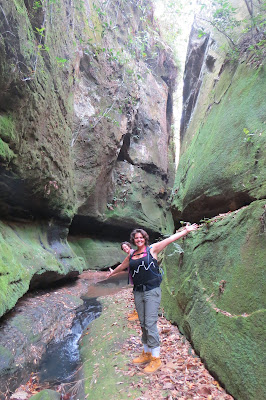
The stunning, moss-coated slot canyon at the end of the trail.

From my journal entry:

Saturday, August 5, 2017. This morning we hiked along a clear mountain stream that led us back into a water-carved, sandstone canyon. The walls glistened with eerie moss, all the way up. I estimate 50 feet. In the spirit of Humboldt, I eyeballed some measurements. It took 18 seconds for a fluttering leaf to fall from the top edge of the canyon to the bottom, and only 2 seconds for a fat droplet of rain.

The canyon soon stooped underwater. We swam up to our necks, scrambled over boulders, and noted the odor of bat droppings. "The stream begins in a cave full of bat poop," Duca told us. "Don't drink the water!" As if I was tempted? 

The canyon floor soon dipped underwater, but that didn't stop us.

Then Lygia, who was leading us, came sloshing back and whooping in fear. "A very, very, very, very, very, very--" a very what? we thought as she yelled --"very, very, very, big, big, big SNAKE!" (I realized in this moment the advantage of Portuguese, a language in which the noun comes before the adjective.) We craned our necks around a bend in the canyon to see a massive rattlesnake curled on a cool, damp rock. Unlike Lygia, the snake was calm. She didn't rattle or raise her head. I estimate she was 4.5 feet long and 4 inches in diameter. Needless to say, we turned back. There is something about being wedged deep in a slot that makes fooling with a venomous snake even less appealing than usual.

As we swam back with some urgency, Lygia noticed a decomposing lump on the rock ledge. "Is this a dead bat?" she asked. I peered at the bloated ball and confirmed. I'd noticed similar lumps and suspected they might be carcasses, but in the dim light I'd dismissed them as leaves. Now that I paid closer attention, I counted seven dead bats in all. Some were bleached skeletons, discernable by the five slender bones fanning outward to support a long-gone wing. Others were bloated and floating bodies. We were all grossed out, knowing bats carry such lovely zoonoses as ebola, rabies, nipah, and hendra.

We rinsed off in the clean stream at the trailhead and applied Purell to our open cuts. Not exactly Biohazard Level 3, but it was all we could do before a picnic lunch in the bed of the truck.

Back at the truck, we hung most of our clothes on branches to dry out while we ate a picnic lunch of oranges, sweet rolls, white cheese, and the ubiquitous terere (communal yerba-mate tea with ice water).

A tatu, or armadillo, eyed us warily from the roadside grass. The creature is a ball of armor with legs.

For a ball of armor, it sure has a cute face!

Mom's Daily Bird


White woodpecker. Pica-pay-branco. Notice that sky-blue eye in the yellow face patch. If you think animals don't make art, consider the plumage of a male bird, meticulously crafted over millennia by the aesthetic tastes of females.

Dad's Daily Bug


It's a fly! It's a moth! It's a wrought-iron window pane with antennae! (Honestly, I have no idea what it is. But it's pretty, and it landed on Duca's hat.)
Share:

Why Two Whitman Seniors Returned to 9th Grade

It was spring of my senior year in college, and there was just one more class I needed to take before I graduated: 9th-grade biology.

Every Tuesday, my fellow nature-nerd Eva and I volunteered in a Wa-Hi classroom. You can watch our interview with the Walla Walla Public School District here, and read below for the whole story.


When you live in Walla Walla, the name "Wa-Hi" rolls off the tongue. It's short for Walla Walla High School, one of two (along with Lincoln High) in the Walla Walla Public School District. That's about all I knew until January, when I got to Whitman for my senior spring.

During my three years at Whitman, I'd been wanting to get more involved in community service, but there never seemed to be time. I volunteered in small ways: I brought Whitman's crested gecko and rock python to bilingual elementary-school classrooms and did yard work for the elderly on Martin Luther King, Jr. day. Then I got an e-mail from our Science Outreach Coordinator asking for volunteers in a Wa-Hi 9th-grade biology classroom. I signed up for one hour a week on Tuesdays. My friend Eva signed up for the same time so we could carpool and work together.

The Wa-Hi campus.
Photo credit: Breanna Baltrusch.

When we got to Wa-Hi, I was amazed to see a barn full of sheep. In high school, I would have given anything for the chance to attend a rural school with an Future Farmers of America (FFA) program. And here I was, living ten minutes from an FFA school! I wish I'd gotten involved on my first day in Walla Walla, maybe volunteering with the FFA kids or a local 4-H club.

The campus is spread out between green, grassy commons and bisected by a restored section of Yellowhawk Creek. Eva and I signed in at the main office and walked through a maze of outdoor hallways to find Ms. Burt's classroom.

The Wa-Hi hallways are outdoors.
Photo credit: The Whitman Wire.

Mary Burt is one of those teachers students feel lucky to have. Even though these 9th graders were not always thrilled to spend their 7th period learning about cells and forest ecology, they were always happy to see Ms. Burt. She has a sense of humor that keeps her classroom's attention through laughter instead of discipline.

Here I am in the classroom with Eva, my volunteer partner, and Ms. Burt, the 9th-grade biology teacher.

I loved working with Wa-Hi students. I would have liked to invest more than one hour a week, but even so, I got to know the students' names and personalities. That's the great thing about high schoolers -- they'll tell you exactly what they're thinking. When a student would tell me, "No, I'm not going to do the work; this is boring and I hate it," I took her at her word. I remember feeling trapped by worksheets and standardized curriculum.

I tried to make every interaction about the student first, asking how he was doing and building a human-to-human relationship instead of just a teacher-to-student one. Second, I tried to bring in curiosity.

"Science is not about memorizing things, it's about asking questions," I told one student. "So if you don't know the answers about cells, why don't you write a list of questions?" Then, we'd pick which question sparked the most curiosity, and I'd help the student pursue the answer to that question instead of the ones on the worksheet.

Some students were motivated by drawing, so I encouraged them to draw their work. Others were distracted by YouTube during class, so we found relevant videos as inspirations for project topics. One student was making a scene by drinking a Dr. Pepper instead of working, so I asked him to explain the day's concept, diffusion, in terms of soda. His improvised explanation was so good, I used it with other students for the rest of the class.

The barriers to success in this classroom were high. It was the last period of the day; the honors and Advanced Placement students had been separated into other classrooms; and I imagine Ms. Burt would have loved to have a full-time assistant rather than a couple of volunteers a week. There were simply not enough resources to allow for the creative, engaging education these students deserve.

This semester, I was a teaching assistant for a Whitman course, Plant Identification Laboratory. Spending Tuesdays at Wa-Hi and Thursdays in a Whitman lab, I was amazed and disappointed by the enormous gap between the two classrooms.

Picture Wa-Hi: the desks were mismatched and graffitied. They barely fit inside the small classroom. There are no paid assistants, only once-a-week volunteers. The students were responsible for stacking the chairs each Tuesday so the custodian could mop, and Ms. Burt was responsible for keeping the blackboard clean. There are about 1700 students, and the student-faculty ratio is 19:1.

Now picture Whitman: the students are spread out across five rows of pristine laboratory benches, with extra space in the back for projects. The microscopes and stools are upgraded regularly. There are two paid teaching assistants (me and my friend Lia). We can leave the blackboard messy with chalk because the custodian will take care of it. There are about 1500 students, and the student-faculty ratio is 8:1.

I made up a name for this divide: the Classroom Privilege Gap. Obviously, a private college and a public high school are not parallel institutions, but this gap also exists among high schools, rural or urban, private or public, north-end or south-end. Working in these two classrooms each week was a reminder of how unfair and damaging this gap is.

Behold the Whitman classroom, replete with 45 microscopes and carefully arranged plant samples.

The weekly lab is planned by our professor, Heidi (right), set up by two paid teaching assistants (Lia and me), and supported by the biology department staff. Compare that to Ms. Burt's five-days-a-week Wa-Hi biology class, run entirely by Ms. Burt and a couple volunteers.

Teachers like Ms. Burt need more support, and students like the Wa-Hi 9th-graders deserve better school infrastructure. There's no easy solution, but adequately funding public schools is a place to start. Only 2-3% of the federal budget goes to education, and the Trump administration's budget called for a $9.2 billion (or 13.5% cut) to education spending. We can do better.

Edit: My friend and relentless activist for justice, Annie Want, just sent me this NPR article about why funding in public schools is so unequal across America. Did you know that school funding depends on local property taxes? And that in 1973, the Supreme Court decided in a 5-4 decision that the U.S. Constitution guarantees no right to equal funding for education? And that by doing so, the Court negated the intention of the famous Brown v. Board of Education decision to provide equal and integrated public education to all children, regardless of race or economic means? If any of this is news to you, as it was to me, read that article! Seriously.

As Chief Justice Earl Warren wrote in Brown v. Board of Education:

"It is doubtful that any child may reasonably be expected to succeed in life if he is denied the opportunity of an education. Such an opportunity, where the state has undertaken to provide it, is a right which must be made available to all on equal terms."

Finally, I'll leave you with this sign I read every Tuesday in the Wa-Hi office:

I love this sign. It doesn't require you to believe that you are special or perfect or amazingly talented; it just reminds you to do what you can with what you have.

What can you do? Call your representatives. Volunteer in public schools. Vote for administrations and taxes that support education. If you have more ideas about getting involved, leave them in the comments. I'd love to hear from you.
Share:

Popular Posts

Labels