Health Education, Health Articles, Health Blog

Showing posts with label Piracicaba. Show all posts

Sleepy Tree Hugger

Day 19: Friday, January 24th


We experienced our first class with Shirota today. It was awful.

Just kidding! I wasn’t sure what the class would be like – or how many beers would be promised for correct answers – but I was right in predicting that it would be a lot more engaging than our last classes. I had to fight the urge to sleep only once, and that was due to my lack of sleep, not the class itself. We talked about environmental issues, like Amazon deforestation and Piracicaba River pollution, which made a lot of people in the class happy (especially after the disappointing end of our last class.)

Early on, Shirota asked, “Nina, I have a hectare of Amazon rainforest. I can preserve it or cut it. What should I do?” Of course, the real answer depends on a lot of things, but I decided to give Shirota the answer he wanted. I said, “Preserve it.” Shirota shook his head and explained that tree huggers act through feelings, but it is better to act through thinking. The right answer would be, “It depends.” During our discussion, Shirota admitted that in an ideal world we should save the entire Amazon, but we can’t and won’t.

I understand Shirota’s position because of course, everything depends. If cutting that hectare of rainforest would save my mother’s life, I would do it in a moment.

Shirota’s description of tree huggers reminded me of a different debate in which environmentalists tend to use their hearts instead of their heads: nuclear energy. Given climate change and the current state of renewable fuels, I think we should give nuclear a chance, but lots of people (who Shirota would probably call tree huggers) refuse to think about the issue rationally.

With that in mind, I am happy to discuss Amazon deforestation. Obviously deforestation is going to happen, and we should work on policy and education which results in as much forest being saved as possible. If half of the pristine Amazon is saved forever, as Shirota suggested at Rabobank, I would be very happy because I think that’s truthfully an optimistic goal. My only disagreement with Shirota’s attitude is one I brought up in class: shifting baseline, the idea that each generation sees the current state of nature as close to the original, and accepts that conserving half of what is left is sufficient. Obviously, over several generations, the shifting baseline process results in nearly no conservation at all.

If, by cutting down half the Amazon Rainforest today, we were able to guarantee that the other half would be saved forever – well, I might agree to it. But the fact is, if we cut down half today, the people of the next generation will want to cut down half of what remains during their lifetimes too, and on and on. For this reason, I support the effort to preserve everything that is left. From a global and historical perspective, there isn’t much pristine nature left already.

After class, Shirota gave his feedback on our project proposals. His advice: “You can do whichever one you want.” We decided to work on Amazon deforestation, since all our ideas, including cattle and immigration, can be included within it. We will have to talk as a group to decide what the scope of our presentation will be. I hope we have time to work on it during the long trip!

We got out of class early so we would be ready for our homestay families to pick us up at 7:00pm. Debora and a friend took me straight to a barbeque in a frat house. We had beef and crusty rolls, and I had fun practicing Portuguese and English with all the guests. I was so dead tired that I started to nod off at the party, and someone offered me a bed which I gladly accepted. I slept for a solid three hours before Debora took me home and tucked me into my real bed. I was sorry I had fallen asleep during the party, but Debora understood, and I felt much better after the nap. I hope I catch up on a lot of sleep this weekend!
Share:

We Study, We Eat, We Walk Around

Day 15: Monday, January 20th


Today was our first day of classes with Professor Fernando Peres. We began with a discussion of geography and biomes. I wish we could have spent the next three days talking about the Amazon, cerrado, pantanal and mata Atlantica ecosystems!

The discussion turned toward economics and world population. At break, John and I got into a great discussion about the Malthusian Crisis and overpopulation, and a whole bunch of people joined in. We asked each other, will we be able to curb our population voluntarily before we hit a crisis, or will we keep reproducing until a disaster like the plague, climate change, or famine takes us out?

The debate continued at the lunch buffet, and then after class as we walked to the basketball and volleyball courts. It was exhausting to play defense in the humid heat!

I showered, ate frozen yogurt with delicious coconut/condensed milk topping for dinner, and set to work on my homework. (It was our first day with homework!)

I really needed to wash clothes in the sink, but around 10:30 at night Erin, Sejal and I got hungry and headed to McDonald’s for second dinner. We snuck out of the hotel, giggling and hoping nobody saw us, but at McDonald’s we ran into AJ! I got to try that McDonald’s hamburger I’d been thinking about since our tour of the Food Town factory. It was a bit of a struggle to order – I ordered for Erin and asked for a sweet tea. The woman nodded and handed me a coke… I tried to order a grilled chicken wrap for tomorrow’s lunch and one of the items said “Mostarda,” and then “grill” in tiny letters, I ordered the Mostarda and got a crispy (not grilled) chicken wrap with mustard. It will make for a good lunch tomorrow anyway.
                                                                         
When we got back to the lobby, we got sidetracked watching John’s philosophical YouTube videos. Then we showed each other our favorite music videos and funny talking animals. I loved how easy it was to goof off and laugh! I won’t have any clean clothes tomorrow… worth it.

Day 16: Tuesday, January 21st


People got very heated today during class over the distinction between farms as a way of life and farms as a business. I wasn’t sure what people were arguing over, as Devon said partway through the debate. I think it would be interesting to delve deeper into these discussions instead of hurrying through them. It helped a lot to have read a homework piece, because people were more engaged. I think we should replace an hour of lecture time with an hour of personal work each day.

For lunch, I ate yesterday’s Mostarda wrap, but it was not enough food. By the end of the day, I was seriously hangry – shaky and weak with an oncoming headache. From now on, I’m going out to buy lunch, even though I might miss a bit of studying time.

After class, I walked straight to dinner like a zombie. I drank a suco de maracuyá quickly for some glucose, and felt much better after a pizza dinner. We chose two flavors – pepperoni and franga (chicken) stroganoff. The stroganoff was covered in catupiry (that thick white cream cheese) and little potato chip strips. It was very heavy.

I got back in time to work on my Hollings essay and get to bed by midnight. I am missing out on a lot by not going to the pool or playing cards, because I need that little bit of free time to work.

When we got back to the hotel, Erin and Sejal both lay down to take naps. Erin didn’t wake up until the next morning! I guess we’re all a little short on sleep.

Day 17: Wednesday, January 22nd


Today was our last class with Professor Fernando Peres. On our first day, Professor Peres has explained the five main topics for the course and taken a poll about which we were most interested in. The fifth topic, the environment (specifically environmental constraints of agricultural development and environmental problems caused by increased crop and livestock production), won by a wide margin. I was excited to focus on this popular topic, but unfortunately we ran out of time to even start on this topic. Taking a poll of interest was a good idea – but what is the point if we didn’t adjust the class accordingly?

Even though we missed out on the environment, we took some fascinating notes on something called the Lorentz Curve which shows the income disparity for a country or a certain industry. This curve is a visual, mathematical way to visualize the income gap. It was also fun to take colorful notes using Microsoft Word.

The bottom graph shows the income distribution of various industries in Brazil. The yellow line shows the best distribution (farmers) and the purple line shows the worst (public servants). 

After school, Devon and I walked to the ATM, but his card didn’t work and apparently I didn’t have mine. ATM fail! I was riding the struggle bus all day, and it was only compounded when I got back to the hotel late to find that everyone else had stopped for Subway sandwiches on the way home. Now hot, hungry, and frustrated, I elicited AJ’s sympathy and ate 6 inches of his teriyaki chicken Subway. It was the perfect meal – I still owe him for that! I need to start keeping some healthy snacks in the room.

When it got dark, Erin, Sejal, AJ and a small group headed out to a tropical bar near campus called Manga Rosa. I stayed in and worked on my Hollings application. Can’t wait for that to be over!
Share:

Hyundais and Hamburgers - to São Paulo We Go!

Day 9: Tuesday, January 14th


Since our free time is so precious here, Erin, Sejal and I decided to pack our own lunches from the breakfast buffet. “Next time, be a little less conspicuous!” Dr. Pfister advised us. I guess packing three sandwiches in a plastic bag and putting them in your backpack isn’t very subtle.

The lunches didn’t turn out that great. I chose a sweet, crumbly bread and greasy, sliced sausages with caramelized onions. It was a soggy mess by lunchtime! We were eating on the benches out front when Logan and I noticed an industrious trail of ants carrying away dropped chunks of bread. We spent a long time observing those little insects – the tiny workers and larger soldiers, and the way several ants cooperated on slightly larger pieces of food. We experimented by placing a piece of bread outside of the ants’ line to see how long it would take them to find it, but we didn’t hang around long enough to find out.

This evening we had our last Portuguese class. I was sad about that, but most people were celebrating. We learned the words to a popular Brazilian song called Águas de Março. I’ve heard this song a couple times now and I really like it! By the end of the class, we were singing along with the song’s catchy YouTube video.

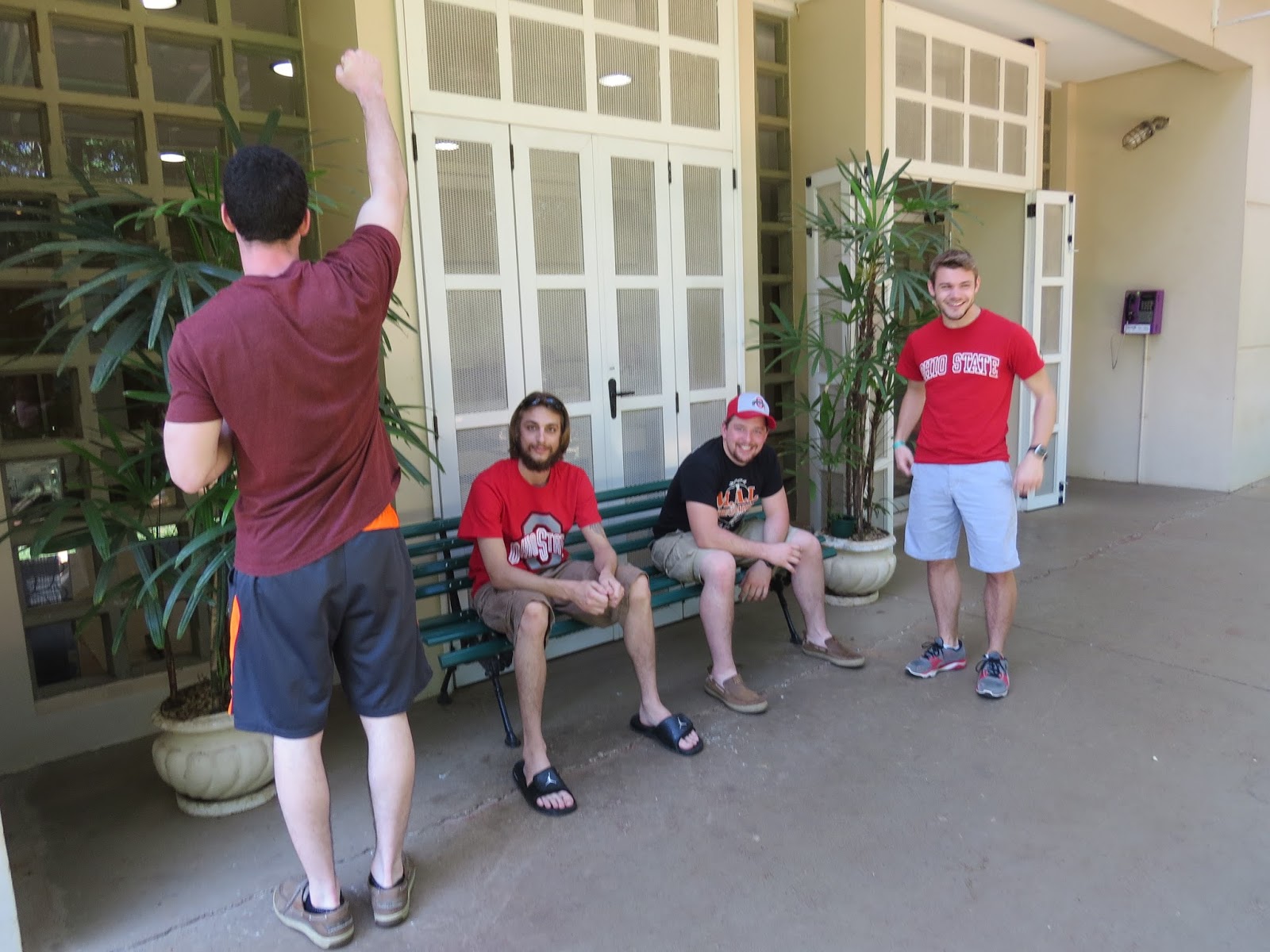
I’m sure everyone’s journal will contain a detailed description of Enrique’s barbecue! The night began as a friendly get-together between the Ohio State and Mizzou students, but it quickly escalated into a drunken shit show, pardon my French. The house was just like fraternity house, complete with panties strung above the doorway and a naked female mannequin who had been remodeled to include to baby-bottle nipples over her breasts for guys to drink beers through. Not my style.

I tried to make conversation with the Mizzou kids I had spent the day with a week earlier, but people were either disinterested or too drunk. I abandoned the effort and had fun dancing to pop and country on the sticky, beer-coated floor.

Mizzou guys started breaking glasses, bleeding all over the kitchen, and passing out in the living room. Shirota decided we had drunk enough and proclaimed, “The bar is closed!” A huge tropical storm hit and began dumping down rain. We were kicked out of the party before midnight!

The march through the downpour was epic. The sober people joined together to get the inebriated folks home. When we finally arrived at the hotel, we counted off to see if we all made it home, and someone was missing. “I lost John!” shouted Gabby, running into the hotel lobby in her flip flops. Apparently, John had run off in the rainy night.

My first priority was getting my own roommates safely in bed, but once that was over I headed back to the lobby to see if I could help. I was sent out in a search party, and within minutes John was discovered down the street, passed out and soaked. Finally, I changed out of my wet dress and hit the sack!

Day 10: Wednesday, January 15th


Tour day! I wasn’t particularly interested in the Hyundai Factory, but it was better than another eight hours in class.

The giant complex of buildings was surrounded by parking lots full of Hyundai cars.

We were forbidden to take photos. Before the tour, a Hyundai woman came onto the bus and stuck little red stickers over all our cellphone cameras.

Hand over your phones!

Custom Hyundai "anti-click" stickers for both front and back iPhone cameras.

The coolest part of the tour was seeing the twelve-armed, high-speed, totally automated welding robots. As I watched the metal arms whir around the bodies of half-formed cars, it was clear this system was superior to human workers who would need to be trained and could be injured in the process of welding.

I’m not sure why we toured the Hyundai factory. It didn’t have anything to do with agriculture, and I think the day could have been better spent at a grain or beef farm, or perhaps an orange or sugarcane plantation. My friends and I were very tired, so we played mind games to keep ourselves awake during the tour. We tried to count the number of times the word “Hyundai” was said, but we lost count.

After the Hyundai tour, we went back to Coplacana, the coop I had visited with the Missouri group. I thought my second time at the coop might get boring, but my experience was completely different with Ohio State students. After the short video, we spent an hour asking questions in the auditorium. People wanted to know everything from the history of sugarcane growing to the specific packaging requirements of organic soybeans to the controversies surrounding genetically modified organisms in Brazil.

I asked the questions that had nagged me earlier and I learned lots. For example, Brazil has a progressive new law which requires farmers to wash out their pesticide containers three times and return them for recycling at an official facility. The goal is to avoid chemical runoff into streams and soils, but I didn’t understand why a farmer washing the container would help. I pictured a farmer holding a garden hose, cleaning out the pesticide jug three times in his front yard. Shirota politely explained that the washing takes place when the pesticide is used: when the farmer dilutes the chemical with the appropriate amount of water into the bulk tank, he simply swirls water in the jug at least three times. Ohhhhhhhh.

I also learned more about sugarcane processing. Until this year, sugarcane was burned in the field before harvest to reduce the work for harvesters. As of 2014, burning is banned by law, so most farmers are switching to mechanical harvest. Interestingly, sugar mills have capitalized on the new law by accepting all parts of the plant – the papery green leaves in addition to the sugary cane. The cane is squeezed for sugar; the leftover mash is used to produce ethanol; and the green leaves are burned to produce electricity. Sugar mills have always burned leftover plant material to fill their own electricity needs, but now – with the extra green matter and improved efficiency – mills are producing surplus energy which they sell back to the utility companies. There are always tradeoffs to new techniques, but it seems like an environmentally positive adjustment to harness the energy from burning sugarcane leaves rather than setting fire to them in the field.

We toured the facilities and ate lunch at Coplacana. We were then scheduled for a tour of a biodiesel factory and a dairy processing plant, but some accident meant those tours were cancelled. We got back to the hotel at 2pm for an entire afternoon of free time! We were elated.

We played intense games of frisbee and Marco Polo in the suspiciously unchlorinated swimming pool. I split a filet mignon with Erin at a new restaurant, which we call The Suckling Monkey, and retired to my room for homework. As usual, I was in bed by 10pm but asleep closer to 1am. It’s hopeless.

Day 11: Thursday, January 16th


Today was our last day of class before our trip to the city of São Paulo. Erin, Sejal, AJ, and I decided to save time by grabbing lunch at the ESALQ cafeteria. We ordered a variety of fried foods from the display case – little tear-drop shaped chicken dumplings called coxinha (pronounced co-sheen-ya) and round balls labeled “hamburger.” Unfortunately, all the foods contained a thick layer of this smooth, liquidy, white cream-cheese called catupiry. We felt more than a little queasy after that meal.

Tonight my first objective was packing for the São Paulo trip and taking my extra bag down to Dr. Pfister’s room for safe-keeping. Everyone headed down to the lobby to play cards, which sounded like a ton of fun, but I decided to stay in my room to work on my Hollings Scholarship application. This is one of those applications that I’ve been putting off for months (it’s due on January 31), and now that I’m here in Brazil with next to no free time, it’s really starting to stress me out.

Of course, once I was in my room, I found more important things to do than start my essay: skyping with my mom. It was great to hear updates from home, and in the end my mom gave me the encouragement I needed to sit down and start outlining my essay. I had hoped to get to bed earlier than the card-players, but Erin and Sejal made it back to the room while I was still on Skype and we all got to bed late, as usual – but at least I was feeling inspired rather than hopeless about my application.

Tonight was the first time I missed a social event to work. I felt bad about skipping out, since you’re only in Brazil once and you gotta experience everything you can! Hopefully, I’ll become more efficient with my time in the future so I won’t have to skip anything else. No more Facebook breaks! (Yeah right.)

Day 12: Friday, January 17th


Up and out early, headed for São Paulo! I slept well on the bus, but I was still severely sleepy when we pulled up at Food Town. Have you heard of Food Town? It’s an enormous meat processing complex which produces foods for many companies, the most notable being McDonald’s. This particular Food Town supplies the hamburgers, buns, and breaded chicken for Brazilian and Middle Eastern McDonald’s restaurants.

This tour was the most interesting one so far. I loved getting a peek into the reality of factory farming and industrial food production. The organic movement is vocally opposed to this system of food production, yet this system feeds the vast majority of people in America and much of the world.

Before we entered the factory, we were told to remove all makeup and nail polish. We were given white full-body suits, moon boots, gloves, and hair nets (and beard nets, if applicable). We disinfected our boots in a high-tech sudsing device, and finally were permitted to enter.

We shivered through freezer and refrigerator rooms, learning about the ratio of fresh-to-frozen meat which is used to perfect the consistency of the hamburger patties. We peered into vats of beef and watched shiny metal machines pop out five perfect patties every second. I had one of those epiphany moments when I watched one little patty travel all the way down the line into a sealed box, and realized that one day soon, that patty will be served on a bun and eaten somewhere in Brazil or the Middle East. Weird.

Here are my observations about the pros and cons of Food Town.

Cons: The food production was incredibly impersonal and the scale was massive. The workers in the factory acted like machines, spending all day on one repetitive task, and that cannot be fun.

Pros: Extraordinary attention was paid to food safety, probably more than would be paid in a smaller, independent operation. The system was extremely efficient, and produced an immense amount of food cheaply and quickly.

At the outlet of the patty-making machine, every now and then a malformed or double patty would pop out. These patties were automatically dumped into a cardboard box. “What happens to those patties?” I asked.

“Those go into pet food,” replied our tour guide. Nothing goes to waste!

I thought it was funny how McDonald’s and Burger King, along with twenty or so competing restaurants, use the exact same machines to make their burgers. According to our tour guide, the restaurants have completely different (and secret) recipes for their products, but how different can they really be? No wonder I can’t tell the difference between fast food chains.

After the tour, we spent almost an hour asking questions about everything from the fast food industry in Brazil to the feedlot versus grass-fed systems of raising cattle. I loved seeing how the tour sparked each person’s curiosity in a different way. It showed how every field of agriculture culminates in food production.

After the tour, we headed into the real city.

Our first glimpse of São Paulo.

An impressive spiderweb suspension bridge.

We ate lunch at a fancy downtown mall, and then spent the afternoon at Rabobank. I was not looking forward to the bank, but it defied my expectations and I found the presentations quite interesting – if a bit too long.

We entertained ourselves with fruit juice, hot pão de queijo (cheese bread balls), and...

making origami Harry Potter and friend!

Rabobank is a multinational bank, based in Holland and with branches in the US and Brazil, which focuses entirely on agriculture. Because it specializes, Rabobank attracts the very best farming customers. They have strict criteria to make sure their clients are successful, full-time, large-scale farmers. We learned that Rabobank’s richest customer is one of Brazil’s giant soybean barons. He farms a million acres and is worth three billion dollars!

The bank's meeting room was lined with fancy trophies and awards.

I loved how the trophies were all agriculture themed.

Here's a glass chicken!

This award was neat because it shows both the US and Brazil.

There's a capsule of seeds included in this award. I wonder what will happen if they sprout?

After a quick break at the hotel to unpack, we were back on the road headed to a bakery for dinner. I fell asleep, per usual, and when I woke up I felt as though I had been asleep for an hour. One of those weird things were time is warped while you sleep, I thought. It took me a while to realize that I actually had slept for an hour – we had gotten stuck in the atrocious São Paulo traffic!

For dinner I ordered picanha, a popular Brazilian cut of beef which would be called “rump cap” in the United States. We hurried through our meal so we could make it to Samba School.

It had been a whirlwind day, and none of us knew what was going on by now. We followed Juliana onto the bus, off the bus, and through the pitch-dark streets of Brazil. We passed slums and high-rises, wondering: Is this safe? Where are we? What are we doing?

Suddenly we heard pounding drums and the rise and fall of human voices. We rounded a corner and came upon a massive parade of costumed, singing, dancing Brazilians in the street! We clapped in time and watched as women spun around in pepperoni-pizza hoop skirts. Near the end of the parade, we were absorbed into the parade and suddenly we were jumping around in time with the music. All the Brazilians were singing a song on repeat, but we just attempted to mimic the frantic steps of samba.

I don’t know how long we sambaed down the streets. We were sweaty, exhausted, and extremely happy by the time we reached the warehouse at the end of the route. One of the samba instructors who had been helping us had enjoyed my energetic samba so much he bought me a beer, which I passed on to my happy friends. In the warehouse, we took photos wearing extravagant Carnival costumes and got some impromptu samba lessons from the locals. The instructor pulled Collin into the center of the circle and taught him some fancy moves, then pulled me in to be Collin’s partner. Pretty soon, we were all partnered up and twirling around in a sweaty mob.

The parade reminded me of my hometown’s crazy, colorful Solstice Parade, but the big difference was that this samba parade was just practice. I’m sad we’ll be missing the real deal, Carnival, in March!
Share:

Frisbee Love is Universal

Day 7: Sunday, January 12th


The bus ride was great! I wish I could have looked out the window at the scenery, but sleep was too wonderful.

We arrived at our Sunday destination, a dingy waterpark called Parque Aventurah, at 10:30am. Everyone erupted with a chaotic jumble of questions. “Are we getting back on the bus before rafting?” “Can we take our bags into the park?” “How big are the lockers?” “Is the zipline free?” “Does someone have extra sunscreen?”

We had about an hour before our rafting trip, but due to the confusion we didn’t do much. I didn’t want to swim because I didn’t know if I’d have a chance to reapply sunscreen. Plus, the sky was overcast. I wish I’d taken out my camera and found some birds! Instead, I played on a decrepit see-saw and lollygagged by the pool

Then it was time for rafting. I hoped the trip would be better than my first rafting experience in Eastern Washington, when my lifejacket had been so tight I’d felt like I was suffocating the whole time.

We gathered on a grassy hill and donned moldy-smelling life jackets and colorful plastic helmets. I was in the yellow-helmet group with five other AZP students. We filed onto the rusty metal bus we had avoided earlier in the parking lot. I heard grumbles all around, but I was excited to finally experience the sensations of the world. We’ve spent the past week driving around the state of São Paulo in a cushy, air-conditioned charter bus with chilled water and drink holders. Today, I sat on a high, flat-backed aluminum bench and hung by head out the wide-open window. I felt every bump in the road and every fleck of dust in my eyes. I smelled oncoming rain and cow manure. I heard tweeting birds as we whizzed by trees and streams. That bus ride was the first time I felt alive all week.

By the time we arrived at the end of the dirt road, angry dark storm-clouds had gathered. We heard distant rumbling thunder. “In the States, we wouldn’t be allowed to step onto a soccer field in this weather,” I mused to a classmate.

“This is Brazil, baby!” he replied, grinning. Brazil it was.

The river rafting was my first encounter with Brazilian forest. I’m living in the country that contains over half of the world’s remaining tropical forest, and I hadn’t seen a wild patch of trees yet! We carried our paddles down a rickety flight of wooden steps to the muddy water. Tropical bushes with glossy, heart-shaped leaves draped over the water’s surface. Palms and other evergreens crowded the banks. We loaded the boats and practiced obeying basic Portuguese commands. My favorite was, “Piso!” for “Get down on the floor of the raft because we’re going over a waterfall!”

We drifted down the river for what felt like hours. We passed over occasional rapids and four true waterfalls, but most of the trip was smooth and calm. At one point, the banks were composed of steep, slick, solid black rock. I wondered about the geology. Was this riverbed the result of a volcanic eruption? I also grew curious about the trees. Was this a primary forest? Or had the surrounding pastures once encroached all the way to the river? Was the river now a protected park? Did it provide enough habitat to sustain many animal species? I knew that if I’d been on my Ecuador program, we would have been discussing these topics for the whole ride.

When we got back to the water park we were soaked. I felt much freer, and had a great time chasing friends up and down the water slide. We got creative: head first down the slide, five at a time, climbing back up through the water… Finally a park official wandered over and clarified the rules (all of which we had broken), but by then we were ready to hit the showers anyway.

I got out my camera to photograph the many songbirds and vultures I’d noticed around the park, but I only got the chance to take one photo before we had to leave!

At least it was a cool shot – this bird was bringing nesting material to its mud-cave.

Back in the plush, reclining seats of our bus, I couldn’t resist another nap, but I noticed a few things out the window: fields of sugarcane and plantations of eucalyptus, oranges, and pines.

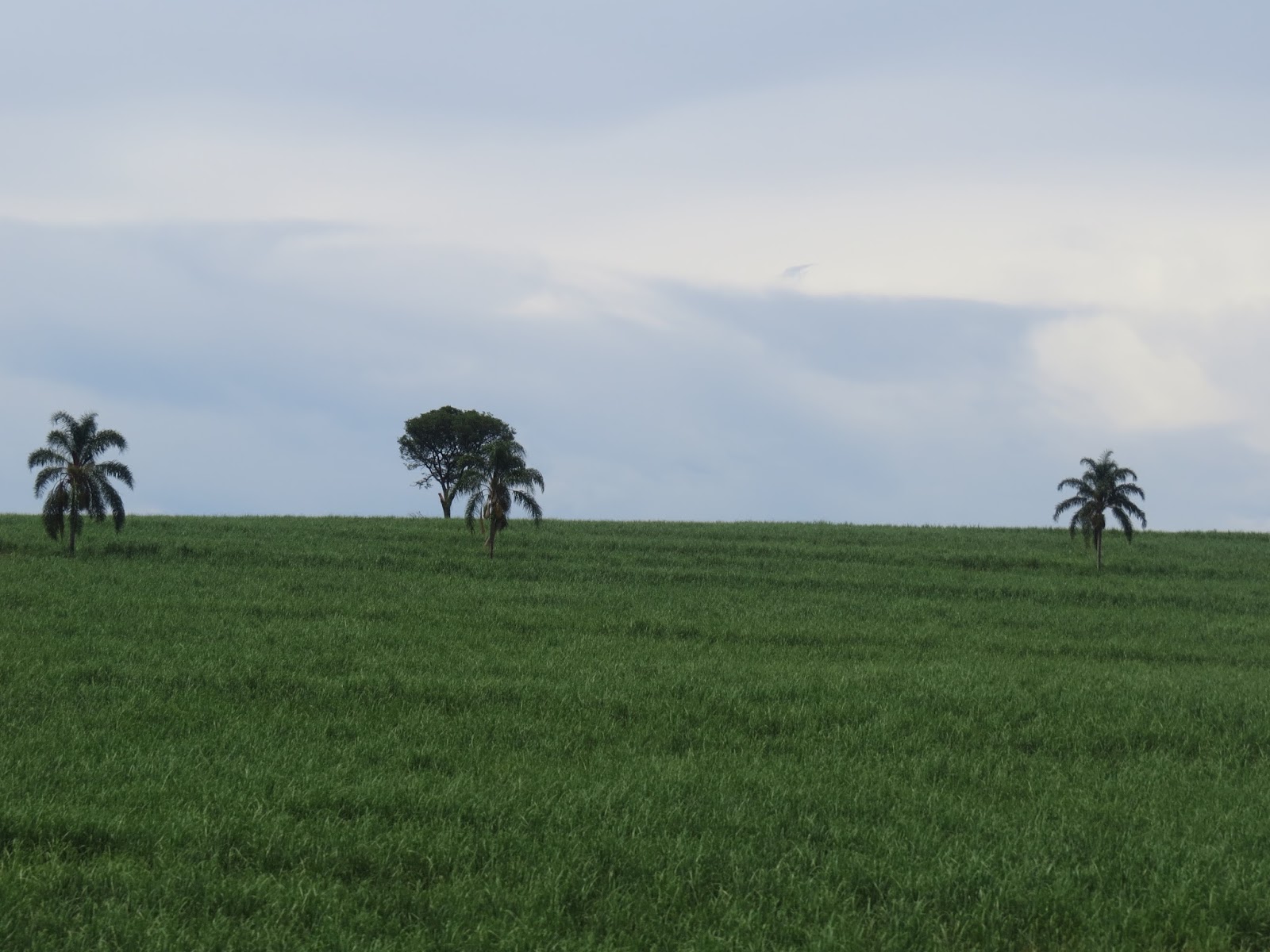
Tropical palms dot a massive sugarcane field.

A patch of eucalyptus trees stands alone.

Our "small" city looks pretty large from this angle!

Welcome home!

I don't know how well they show up in this photo, but a hundred black vultures were circling above the city!

We finally got a free evening, hooray! I caught up on some bird analysis from my photos, updated my blog, e-mailed my family, and started a scholarship application. I even had time for a short neighborhood run with Holden and Christine. For dinner I split a hamburger with Rachael at a new sandwich shop. The burgers came in three sizes so we went for the grande, but when the plate came we realized we were each going to get a larger-than-edible meal. My half-burger was bigger than any hamburger I’ve ever seen!

I got ready for bed early, feeling refreshed from a day out of the classroom. I hung my wet clothes to dry, showered, brushed my teeth, and snuggled into bed wearing PJs. The clock read 10:30pm. Finally, I was going to get that early night!

I just wanted to finish my bird blog first. Then my boyfriend got on Facebook and we talked for the first time in way too long. My roommate was still journaling when I finally turned out my light at 1am. I am incapable of going to bed early. MUST TRY AGAIN TOMORROW.

Day 8: Monday, January 13th


Today was our last day of Brazilian history/economics with Professor Pedro, and it was the first day we got to choose our own lunch restaurants. People scattered, but Erin, Sejal and I decided to tag along with Juliana to a Japanese restaurant. Since there were only four of us, we got to ride in Juliana’s car!

Riding in a car doesn’t sound that exciting, but sitting shotgun in the hot, humid air with loud Brazilian music blaring and the window down was incredible. I felt like I was in a movie montage about the perfect high-school summer.

We all ordered sushi. Most of the menu items were seaweed cones, to be eaten like a burrito. Juliana and Erin got Philadelphia cones, which looked delicious. Sejal got a “simple salmon cone,” and I got salmon rolls like the ones in the States. Sejal’s looked great – absolutely packed with chunks of sake, raw salmon. I ordered green tea and got a can of sweetened diet tea – tasty, but not what I was expecting. I wasn’t full after my rolls so I ordered a simple salmon cone like Sejal’s. It was about four parts salmon to one part rice, amazing value but not the ideal ratio! It cost around $5.00. I managed to eat almost my whole cone, but had to leave some perfectly good salmon sashimi on my plate. Next time I want to go with three friends who love salmon so we can split the simple salmon cone with lots of extra rice.

As we walked back to Juliana’s car, the stormy skies which had been swirling all day reached a breaking point. Lightning and thunder cracked at the same time and palm trees whipped back and forth. We started driving down the road and noticed giant sheets of paper flying off the roof of a skyscraper. As the sheets got closer, I heard a weird metallic banging and realized they were huge sheets of tin! It was a thrilling moment until the light turned green and we drove out of harm’s way.

Suddenly the rain began. I hung my head out the window and let the water soak my hair. The rain was POUNDING! The gutters flooded and the windshield was obscured under a waterfall. We barely made it to school, where Juliana advised us to wait in the car. I was too excited and ended up dancing around in the rain. When I got back to the classroom, it looked like I had showered in my clothes. I pretty much had.

In the afternoon we began our second class which, it turns out, is also about Brazilian history and economics. We went through the same historical events, including Prince Henry the Navigator. I felt like it was a waste of time to revisit the same topics again, but at least this time they were in chronological order and were much easier to keep straight. Our new professor has a good sense of humor.

After class, we all followed Juliana on a round-about route to our planned soccer game against some Brazilian students. Most of us had been wearing our athletic clothes all day. I was so excited to get outside that I couldn’t keep still. I wanted to be goalie and dive in the grass. I also had a disc packed in case people wanted to play pick-up ultimate after the game.

We were all thoroughly disappointed when we realized that due to the afternoon rain, we would be playing in a gym. Nooooooo! I warmed up by tossing my disc with Erin. We had tons of fun before the game even started. I goal-kept a shutout game, then switched to forward and assisted a few goals. Pure luck, but it felt great to run around and be competitive.

Then a Brazilian girl pointed to my disc. “You want to play?” I asked. I’m sure my whole face lit up. A crew of eight of us – half Ohio, half Brazil – left the gym for a soccer field out back. We threw the disc in a circle, everyone cheering everyone else. These students had never played ultimate before, but they automatically embodied Spirit of the Game.

Through a mixture of Spanish, English, and Portuguese, I explained how to play ultimate and we all enthusiastically battled in a game to ten. I was so impressed by the effort, heart, and humor of everyone involved. People who had never thrown a disc tried hucks and got Ds. When the sun set, we were all sad to go home and immediately made plans to connect over Facebook and reconvene next week. “Every day!” cheered one of the women.

Our incredible frisbee crew!

“Can I keep the frisbee?” she asked in cautious English.

“Of course!” I replied. The disc had gotten cracked during the game, and I had another one in my suitcase.

We all signed the disc before we parted ways. “I’ll hang this on my wall,” the woman told me happily. “And I’ll keep you all in my heart!” We finally left after a group hug. Frisbee love is universal. <3
Share:

Those Aren't Squirrels!

Here are two more daily journal recaps for your enjoyment. The series began here if you want to start from the beginning. Divirta-se!

Day 5: Friday, January 10th

Second day of classes! We spent a solid six hours on Brazilian economic history. We watched two episodes of Jared Diamond’s Guns, Germs, and Steeland discussed events through the 1800s. Taking computer notes was a great improvement over writing by hand, and I started to accept our unchronological order. It was still a challenge to stay awake, especially during the movies.

Those movies are killer. Photo credit Erin Homerosky.
Lunch took place at yet another por kilo buffet. During our coffee break, I tossed my frisbee with AJ and Juliana, our wonderful Brazilian guide and life-saver. Tossing a frisbee was one of the best experiences I’ve had in Brazil so far! Gotta do that more often!

Survival Portuguese Class #2 focused on food, and that came in handy at Piracaçaí, the new restaurant we tried for dinner. The restaurant was açaí berry themed. Have you heard of that purple, antioxidant-rich berry? Chocolate covered açai, açai smoothies… Well Brazilians are even more crazy about it than Americans. Luckily there were no berries in my tuna sandwich.

Now I’m back in the hotel room, trying and failing (yet again) at sleeping early. When Shirota took us through the schedule today, I realized how little free time we are going to have for the next six weeks! Nearly every moment is scheduled, and the mornings are early. We only have twelve days of classes, which is pretty incredible when you consider twelve days out of an entire semester. On the other hand, the classes are eight hours each day with the same professor in the same classroom. It’s only our second day, but if I could give two pieces of feedback about the AZP Brazil trip, they would be these:

  • Downtime. It’s impossible to pack everything about a country into a six-week trip, so I understand why we're so busy. However, I’ve realized that my brain stops processing and appreciating new experiences when it doesn’t have downtime. For me, this involves going through photos, writing down the birds I see each day, and reading books. With eight-hour classes, group meals, this daily journal, and preparation for our hour-long group presentation, I’m not getting enough sleep, and definitely not enough downtime. I haven’t had time to walk the campus or explore Piracicaba. I feel the experience would be improved if classes were two hours shorter each day but took up a couple extra days.

    Chilling outside during a precious break.

  • Experiential learning. Looking ahead, I see a ton of experiential learning in the itinerary. Tours of a sugarcane processing plant, T-shirt factory, McDonald’s bun factory, dairy farm, Iguaçu Falls, and much more. I also see twelve days of solid classroom time, and the two classes I have experienced so far haven’t been as inspiring as I’d hoped. I would love for the classroom and experiential learning to be more integrated. During my last semester in Ecuador, we spent three hours per day in the classroom, and the rest of the day exploring the city, snorkeling, hiking, or touring. I never tired of either classroom or experiential learning, since each one reenergized me for the other. Classroom time allowed me to build background knowledge before field trips or clarify points after. Field trips inspired me to ask questions and build a deeper understanding through books and classes. For example, a trip to a church or museum would tie in well with our current lectures about Portuguese colonialism, and I bet our tour of the dairy farm would be even better if we could spend a couple hours reflecting on it with an animal sciences professor.

      The classroom where we live.
    I don't like to give constructive criticism without a positive side, so here are my two favorite things about the program so far:

    • The trip is in Brazil instead of a comfortable, English-speaking European country
    • The trip is six weeks long, far more valuable than Mizzou’s ten-day trip.
    Definitely not an English-speaking country!
    Now for that early night! Well, midnight is better than 1:30am, at least. It’s a goal in progress. Boa noite!

    Day 6: Saturday, January 11th

    Finally, the weekend! Oh, never mind. We have class on Saturday. Sad face.

    On a positive note, MONKEYS!

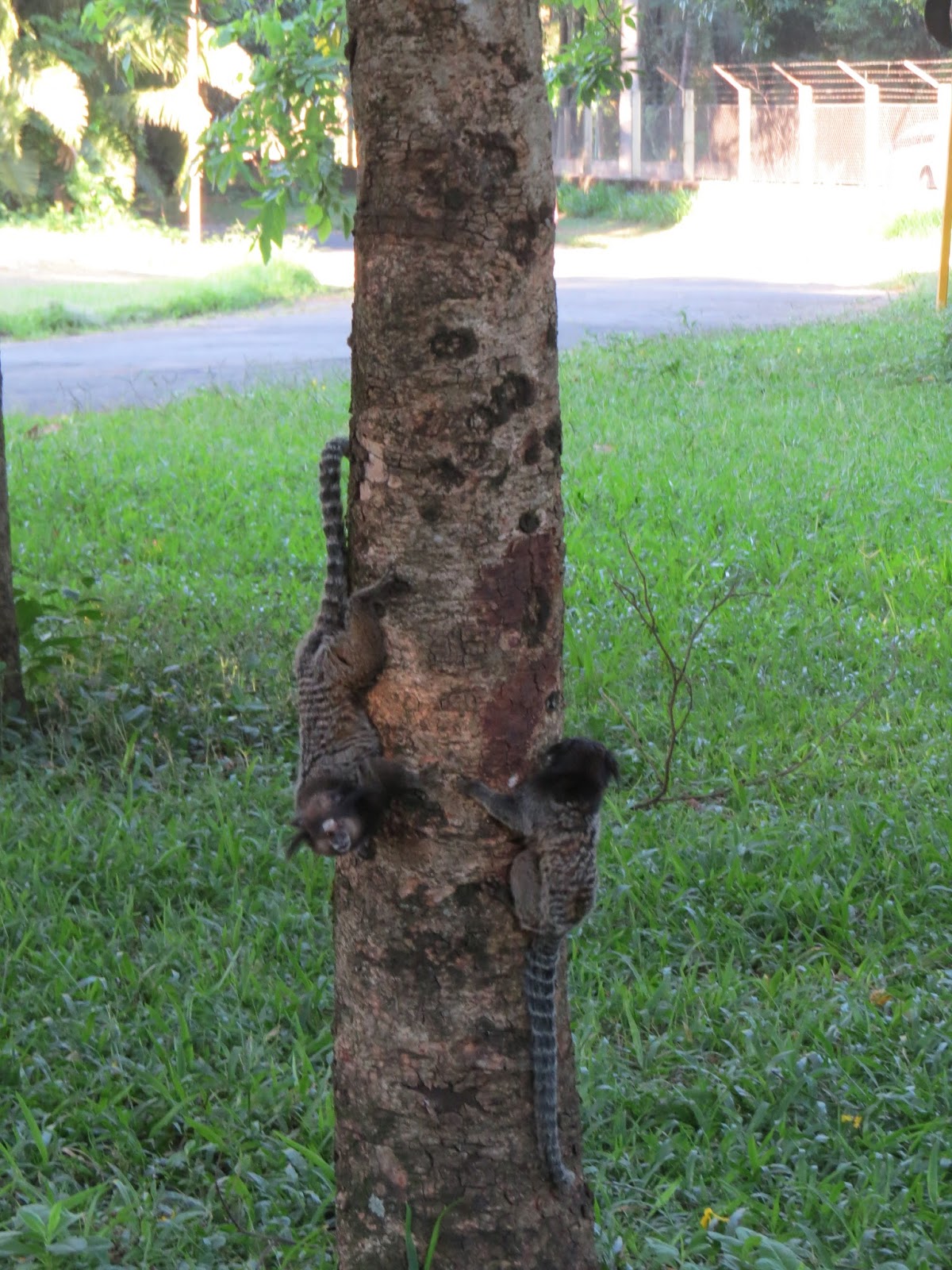
    As we walked through the gated entrance to campus, I noticed these strange squirrels on a tree... But they definitely weren't squirrels!

    We didn’t seem to worry them at all.
    There were seven little black-tufted-ear marmosets (Callithrix kuhlii) spread across two trees. (Thanks Mom for that ID!) One monkey scrambled down to the ground and nibbled on a piece of fruit. The guards leave apples and bananas out for the monkeys sometimes.