Here we are, six months into the Watson year and six more to go. Below is my second quarterly report, one of the few deliverables required of me by the Watson Foundation. In case you missed it, you can read the first quarterly report
. Thanks for following along!
Menja: “Well, that makes sense. Because you have a raincoat that doesn’t leak.”
Me: “Oh. Good point.”
Menja: “And you have rain pants that don’t leak either, right?”
Me: “Yeah.”
Menja: “And your house – does it have a roof that doesn’t leak?”
Me: “Yes, it does have that.”
Menja: “And outside – you have sidewalks? So it’s not too muddy to walk in the rain?”
Me: “Ah, yes, we have sidewalks. No mud trails.”
Menja: “And shoes?”
Me: “Yes, shoes too.”
Menja: “And you have a car? So when you need to go, you are not walking?”
Me: “Yes, we do.”
Menja: “And furniture.”
Me: “Huh?”
Menja: “In your house. You have furniture, yes? So you can sit down while it rains?”
I couldn’t think of a response to that. I’d never thought of the connection between a recliner and a rainstorm, but to Menja it was obvious. In her experience, rain means crouching for hours in a smoky, one-room house with no furniture. Not only does my house have chairs, but it also has windows with glass, a furnace to heat it, electricity to keep the lights on, books to read, and a computer with WiFi to occupy me. Rain in Madagascar bears no relation to rain in Seattle. The water may be the same, but our experiences of rain could not be more different.
 |
| Following Menja down a slick, clay trail in the rain to conduct sand-flea interviews. |
To fill the daylight hours in our field camps, I began bringing colored pencils and offering drawing lessons to the village kids who hung around after lunch, hoping for leftovers. One day, while hosting a gaggle of children to draw bugs and leaves on pages torn from my notebook, I was overwhelmed by the knowledge that these children deserved an education they would never be offered. Most had dropped out after fifth grade because no matter how hard their parents worked, they’d never earn enough to pay school fees. The unfairness tied my stomach in knots. Right then, I decided I would raise money for Madaworks, a small nonprofit that funds high-school education for Malagasy girls. In a blog post titled “The Power of Pencils,” I asked my readers to donate, and within two weeks we had exceeded my $1200 goal. The Madaworks founder, Diane, then challenged me to raise tuition for a full, three-year education for both girls, a total of $3600. As I uploaded more stories and photos, donations flowed in from teammates, family members, and even strangers who’d come across my blog. Now, as I type, we are $20 away from our new goal. I have received praise for this effort, but I ask myself, why do I have the power to run a fundraiser in the first place? My resources––contacts in the United States, writing experience, a camera, internet access––all come to me as unearned gifts. I do not deserve praise compared to the Malagasy girls who will receive these scholarships: they have overcome far greater obstacles to achieve what I have been given for free.
 |
| The kids of Bevoahazo, engrossed in my bird book and their scientific drawings. |
As a side project, I interviewed 58 households about the sand flea, a translucent white parasite the size of a pinhead that burrows into skin around the toenails for four to six weeks unless someone digs it out with a needle. Sand fleas live in humans, pigs, and dogs, and they are zoonotic, meaning they can switch from animals to humans. I’d never heard of sand fleas, so I was astounded to learn that 100% of villagers had been infected by this parasite, and 12% were actively hosting sand-fleas at the time of my interview. How could I have studied zoonotic disease for years and never heard of this parasite that infects millions or billions of people? I had wonderfully enlightening conversations with mothers about the health of their families, but the interviews weren’t always easy. One angry man told me he wanted nothing to do with my survey if I wasn’t going to give him medicine for his son’s feet, which left me feeling inadequate and sorry. I couldn’t provide medicine, because there is no medicine for sand fleas, but I did learn to offer small bags of salt, sugar and soap as compensation, and I taught each family how to sterilize their needles. Along with my lemur mentor, Dr. Zohdy, and climatologist Dr. Eronen, I submitted an abstract of our sand-flea research to the Planetary Health Alliance. If it’s accepted, I’ll present at the Annual Meeting in Edenborough, Scotland at the end of May. My hope is to incite more research and remedies for sand fleas by getting them added to the World Health Organization’s list of Neglected Tropical Diseases—yet my hope is tempered by the knowledge that all the diseases on this list will remain neglected until we, as a planetary community, devote far more resources to the injustice of poverty.
 |
| A female sand-flea, removed from my friend's finger with this needle. Photo credit: Cindy Capurso. |
 |
| This foot had at least six sand-fleas embedded in it, making it hard for the child to walk and attend school. |
On Christmas Day, my flight out of Antananarivo took me through the tiny island nation of Mauritius and the high-tech city-state of Singapore, whose airport includes a pool, movie theater, and butterfly garden. My final flight, to the Indonesian island of Bali, had plenty of room because Bali’s tourism has plummeted by 70% since its volcano, Mount Agung, began spewing ash in November.
 |
| Antananarivo from the air: a sprawling city surrounded by endless rice paddies. |
 |
| Welcome to Mauritius, former home of the dodo. It must be the only country that is most famous for a species it forced into extinction. |
Now what? My volunteer stint at Reef Check would not begin until mid-January, and I had no destination until then. After claiming my backpack, Marmelade, I spent a few hours trying in vain to meet other travelers and split a cab to anywhere. That’s when I met Francisca.
“Excuse me, are you looking for a ride?” I asked the petite woman swiping at her phone in frustration.
“Sure, I’m calling a GoJek,” she replied. She was a Portuguese civil engineer working in East Timor, I would soon learn, and she stops by Bali whenever she wants to go shopping or eat great sushi. Francisca took me to Kuta, the rowdy tourist town where backpackers converge to surf and party. The ride cost 13,000 rupiah – under $1.00 – and when we didn’t have exact change, the driver introduced me to Balinese generosity. “12,000 will be fine!” he said with a wide smile before driving away.
 |
| My second day in Kuta with two fast friends, Renne and Arlo. |
That night, I met back up with Francisca for sushi (what else?) and checked into a capsule-bed hostel (it’s like sleeping in a very comfortable drawer). Once I got an internet SIM card and my new favorite apps, GoJek and MapsMe, I could navigate Bali as if it were my own city.
 |
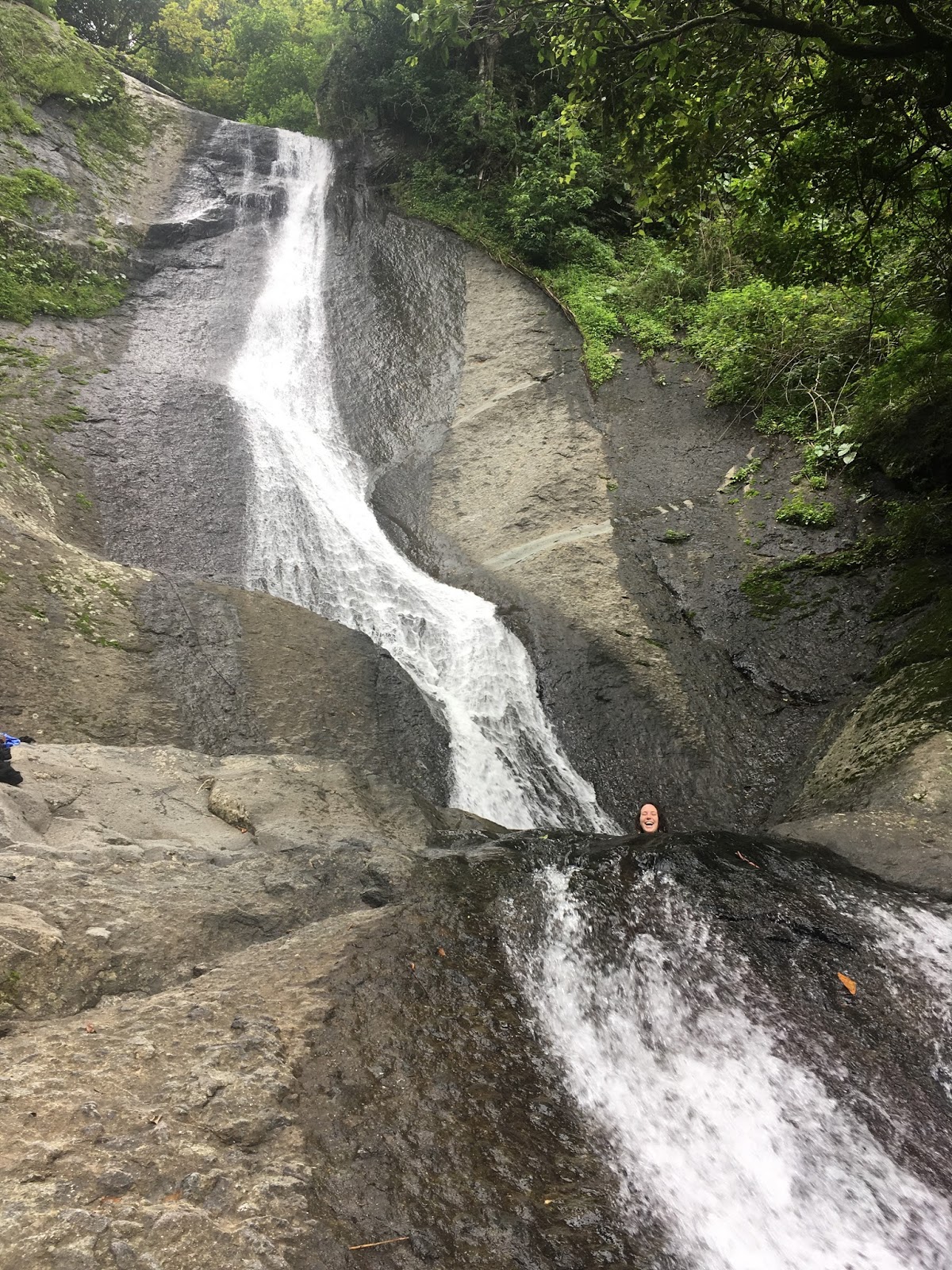
| Can you spot my head? A secret waterfall flowing all the way down a mountain in West Bali. |
 |
| Tracing Wallace's path to the ficus buttresses of Lombok. |
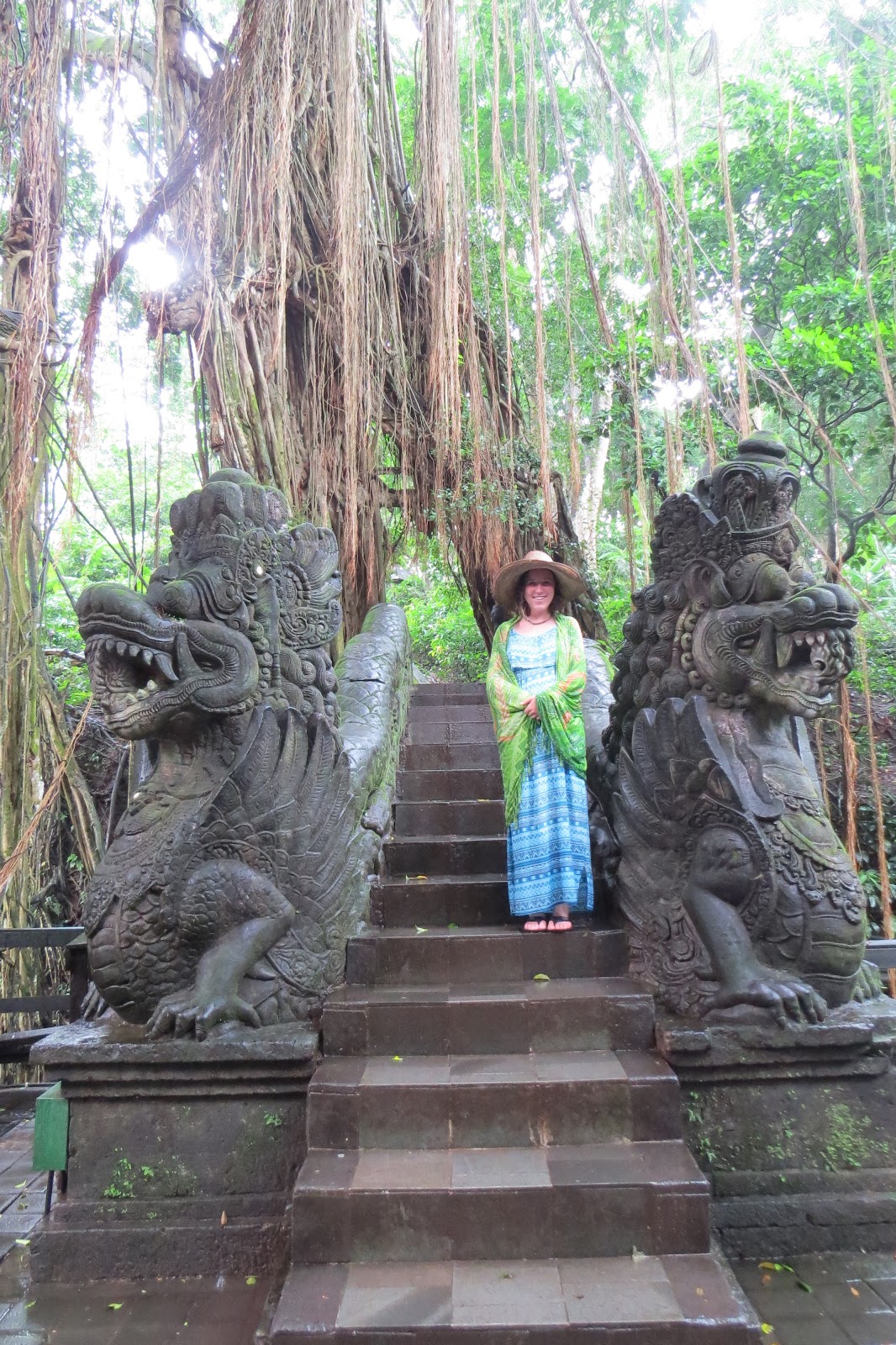
I travelled from town to town, meeting new people and parting ways in a swirl of motion. I avoided eye contact with crab-eating macaques in the Ubud Sacred Monkey Forest, ate free banana pancakes at my favorite hostel, bargained for cheap sundresses in Kuta, and skinny-dipped in the Pacific Ocean to celebrate the first moments of 2018. In honor of Alfred Russel Wallace, I took a ferry from Bali to Lombok and whooped with excitement as we crossed Wallace’s Line. On Lombok, I examined giant millipedes, trekked to waterfalls, and read Wallace’s book,
The Malay Archipelago, in the same steamy jungles where he wrote it.
 |
| Wallace would have loved to find this cicada... |
 |
| ... just down the trail from this cicada-mimicking moth. What notion about natural selection might it have inspired in his mind? |
One afternoon, I hunched in a cramped bird-blind for an hour, sweat dripping off my nose and mosquitoes whining in my ears, as I waited for the green flash of an elegant pitta delivering insects to his chicks. I extended my Indonesian visa––a bureaucratic nightmare involving three visits to the Kantor Imigrasi––and became a certified rescue diver so I’ll be able to keep my fellow humans healthy while we examine the health of corals.
 |
| A stunning damselfly with translucent violet wings. (Any ideas, Thomas?) |
 |
| I wonder if Wallace encountered quite as many giant millipedes as I did. |
Late one Friday evening, I was bantering in a bar with a group of Balinese waiters, nursing my ginger tea, when I heard the word frisbee. Huh? “Did someone say frisbee?” I asked. It turned out that one of the waiters, a programmer named Sam, plays pick-up ultimate frisbee on Saturdays. So began my love affair with Bali Ultimate. I now attend three weekly pickup games in different corners of the island, and I’ve joined a team, UB7, for the Nusatara Cup at the end of March. While I can survive without ultimate, I am not thriving unless I can chase a frisbee down across a swampy field, gasp after sprints, and stay out at dinner past dark with teammates because we’re having too much fun to say goodbye.
 |
| Sunday pick-up ultimate in Canggu. |
 |
| Black leggings? White socks? Or just a great day of mudtimate? |
A week into January, I finally reported for duty at the Reef Check office. My role is to assist Sila, an earnest conservation biologist one year older than me, with the implementation of Reef Check’s new Climate Change Adaptation Program. For more than a decade, Reef Check has been partnering with local fishermen and divers from Tejakula, a sub-district on the northern coast, to collect data on coral health. Now, I’m working on curriculum to teach these local partners about the theory behind climate change and its impact on coral bleaching. I enjoy wrestling these abstract concepts into accessible terms, but I’m ready for my move away from the computer screen and into the Tejakula communities.
 |
| My first Tokay gecko, Gekko gecko, a species with which I've been obsessed since elementary school. You can't tell from the photo, but this lizard was a foot long, and clinging to a vertical mural like it was the ground! |
A couple weeks ago, as a facilitator for the International Student Conference on Global Citizenship, I had the chance to take 40 undergraduate and graduate students snorkeling over a coral reef. Most of the participants were studying business or international relations. None were biologists, and many had never used a snorkel before. A few confident swimmers held their breath and dove to get eye-to-eye with massive blocks of
Porites coral, finger-like
Acropora, mushroom-shaped
Fungia and delicate Gorgonian sea-fans. As we treaded in the choppy water, one student surfaced and, still catching his breath, called out to me, “Why are the corals bleaching?” It might have seemed an absurd moment for a scientific lesson, two bobbing heads hollering back and forth across the din of an ocean, but to me it was perfect. How many times had this man heard the sad tale of climate change in a lecture and tuned it out? Only here, as saltwater coated his tongue and the algae-cloaked corpses of dead corals swayed in his vision, did the question really matter. He wasn’t raising his hand to ask me why corals bleached because it was going to be on an exam. He hollered across the ocean because he couldn’t wait, because suddenly the survival of these calcium-and-jelly organisms was personal.
 |
| After snorkeling, we explored Taman Tirta Gangga, a Hindu temple known for its fountain of youth. |
At the end of February, I’m heading to Malaysia with my boyfriend, Collin, to explore climate activism in Kuala Lumpur, marine life around Perhentian Kecil, and street food in Penang. I can’t wait to show him a little slice of my Watson life. Then, I’ll move to West Kalimantan on Indonesian Borneo to work with Health in Harmony, a ground-breaking nonprofit that protects orangutans’ rainforest habitat by providing healthcare to the surrounding communities. Already, the connections from this year are circling around to find me again. By coincidence, I met the Health in Harmony directors in Madagascar, and a conversation over rice and zebu blossomed into a partnership on Borneo.
 |
| Who did I meet at the Conference on Global Citizenship but Aimee Razafimanjary, a Master's student from Fianaratsoa, Madagascar! We couldn't stop laughing and speaking Malagasy amid the organic lettuce-fields of Bali. |
My friends ask me if the year feels like it’s going by too fast. I tell them no. I have noticed these six months passing, and I know where the time has gone: to cat vaccines and hamburger nights, to waterfall baths and lemur lice, to colored-pencil art and coral funerals and sobbing confessions to the stars. I don’t feel like the year is going by too fast, but I can’t imagine it being over. Here’s to the next six months!
 |
| What is this, a leaf for GIANTS? |
Sincerely,
Nina