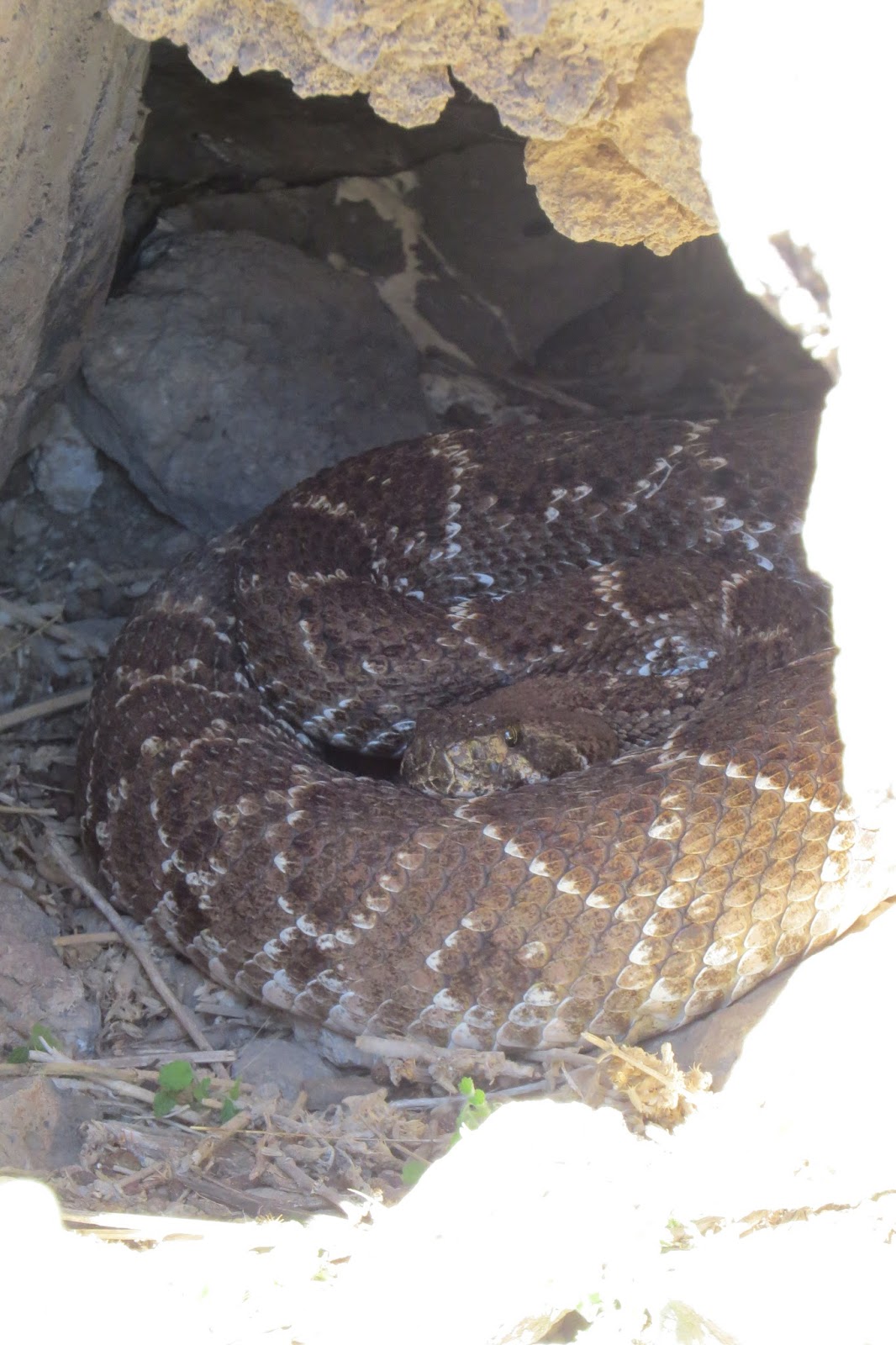
When people think Florida, they think alligators. The Everglades are home to a lot more reptile and amphibian species than just alligators -- but we'll start with the gators anyway, because they really are so cool!
The American Alligator
The first alligator we saw was swimming through the Wakodahatchee storm-water runoff ponds. His eyes looked like a submarine periscope.
That gator grin!
This elderly alligator needs a pair of dentures. I wonder how many white-tailed deer, Burmese pythons, and fellow gators his teeth are lodged in.
I used my camera to get an up-close look at this alligator's eyeball and was surprised to see that it was crawling with little red ants! (Can you see them?)
Alligator skin looks like an armored tank.
The paw of a resting dragon?
The alligators were tame and sleepy! Here my dad shows how close we could get without disturbing them.
Baby alligators are tiny. This one was resting on a lily pad!
For scale, those tiny green dots on this baby's back are duckweed.

An alligator, a tri-colored heron, and an expanse of sawgrass: the Everglades in one photograph.
|
Alligators seem lazy all day, but they're just storing their energy to hunt by night. This alligator was one of a dozen patrolling the pond at Anhinga Trail after dark.
The American Crocodile
Let's not forget that American alligators aren't the only crocodilian in the Everglades: there are also American crocodiles! Unlike alligators, crocs are endangered. They are more tolerant of saltwater, larger, and paler in color.
The best way to tell apart a gator and a croc is the teeth. It's hard to miss the exposed daggers of a crocodile smile.
Turtles
Dozens of turtle species call Florida home. Here's a sign I saw on our first day denoting four common species in the Everglades: Florida cooter, Florida red-bellied turtle, red-eared slider, and Florida softshell.
You can tell this guy is a Florida red-bellied turtle (Pseudemys nelsoni) even without seeing the red on his plastron (the lower shell). You just have to notice the two cusps on his upper beak (they look like vampire fangs!)
Here's another turtle, probably a Florida red-belly, sunning herself on the bank of a canal.
Watch for 13 seconds as one Florida soft-shell chases another and even takes a bite!
Lizards
We found this green anole (Anolis carolinensis) perched on a perfectly-matched green leaf in the middle of a sawgrass and spike rush prairie (which is actually a waterlogged marsh), many feet away form the nearest tree island.
There's his leaf, right in the middle. I wonder if he stays there all the time?
He let us get close enough to admire his intricate head scales.
Here my dad is photographing our patient green anole.
The invasive brown anole (Anolis sagrei) is more common, larger, and more aggressive than the native green anole. Here's a brown anole with a nice yellow pattern.
Here's a large mature male brown anole, sunning himself and his manly crest.
Now this is an interesting lizard: the Little Bahama Curly-Tailed Lizard (Leiocephalus carinatus armouri). They're abundant on the sidewalks and parking lots of West Palm Beach and Everglades City. The whole time I mistook them to be eastern fence lizards with oddly curly tails (to keep off the hot pavement?) but no, they're a species endemic to the Bahamas and introduced to West Palm, Florida in 1935 to rid the sugarcane crop of pests. Aren't they cute?
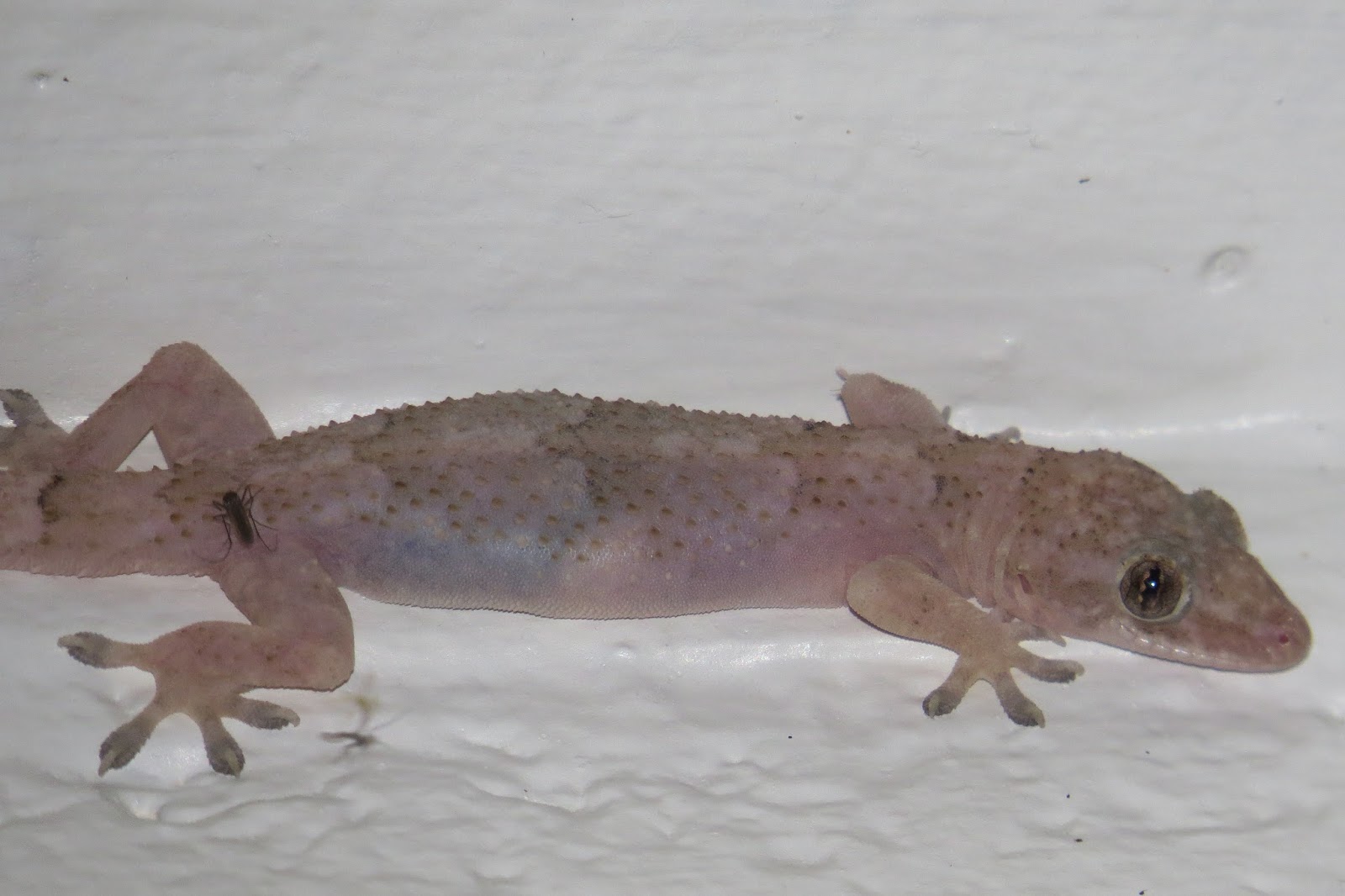
Another introduced species, the Mediterranean house gecko (Hemidactylus turcicus), was common on building walls at night. Do you notice a special guest in this photo? Incredibly, the gecko turned and ATE THE MOSQUITO OFF HIS OWN BACK just seconds after I took this photo!
Snakes
Sadly, the only snake I saw was long dead.
My dad got a nice video of a thin, brown vine snake, though!
Update: thanks to Mike VanValen of the one and only iNaturalist.com (see my rave below), we have now identified this snake as a
peninsula ribbon snake,
Thamnophis sauritus ssp. sackenii.
Frogs
Nighttime is frog time, and our first frog was this HUGE, invasive Cuban treefrog (Osteopilus septentrionalis) crawling through the grass. My mom noticed his eyes reflecting the flashlight beam in the grass -- good spotting Mom!
Another Cuban treefrog, this one much smaller and with a dark brown splotchy pattern.
I want to digress for a moment here and draw attention to
my favorite website of all time, iNaturalist. This website allows people from all over the world to upload photos and descriptions of the life forms they observe -- plants, animals, fungi, you name it. If community members agree with the identification of the species, the data becomes "research grade" and can be used to catalog the world's vast, poorly understood, and fast-disappearing biodiversity.
The neatest feature of iNaturlaist is the "ID Please" section, where I post photos of the species I can't identify. I posted this photo (which I had originally captioned as "mystery frog" and thanks for a response from
Paul, a professional herpetologist with an iNaturalist profile, I can now share with you that this frog is indeed another Cuban treefrog!
A rather dry green treefrog (Hyla cinerea) clinging to the side of a big white metal box at the Flamingo Visitors' Center.
Now, no post about the frogs of Florida would be complete without a salute to this evil bird, the loggerhead shrike (Lanius ludovicianus). Shrikes are carnivorous, cunning predators. They catch their prey -- insects, birds, lizards, even small mammals -- and store it for later on sharp twigs and barbed wire fences. My mom and I had never seen a loggerhead shrike, so when we noticed this black-masked bird sitting atop a barbed-wire (!) fence, we pulled over and got out to explore. We scoured the barbed-wire for food caches and found....
Impaled frogs!!!
Skewered right through the throat!
Three different frogs!
I wonder what the loggerhead shrike did before barbed-wire fences??