If you've taken a biology class, you've probably learned about (and forgotten) a man named Alfred Russel Wallace. But even if you've never taken a science class in your life, you've heard of (and remembered) a man named Charles Darwin. Seriously, just look up at my blog banner. I've spent the past six years "tracing Darwin's path" and writing about it on this blog, titled Natural Selections in his honor. Well, I think it's time I traced Wallace's path for a moment instead.
Here I am holding an original 1859 first-edition of Darwin's On the Origin of Species in the basement archives of the Whitman College library.
Wallace was born in Wales, the seventh of nine children, when Darwin was a teenager. Unlike Darwin, he grew up poor, and he had to drop out of school at the age of 14 to work, but he didn't give up on education. He became an avid beetle collector and kept up on the latest scientific happenings by reading the original literature as it was published (goals!) One of the unsolved mysteries in natural philosophy (as science was called back in the day) was the origin of species. Where do new life forms come from? Wallace became obsessed with this question. An intentional, focused guy, he found a career that would let him explore nature and puzzle over this question full-time. At the age of 25, Wallace boarded a ship for Brazil to begin his professional life as a collector of valuable specimens: big butterflies, colorful birds, pressed plants. He then shipped these preserved organisms back to England where they were sold to wealthy private collectors.
Here I am holding my overpriced, paperback copy of Wallace's The Malay Archipelago, bought in a bougie Kuta bookstore and read in the jungles of Bali and Lombok, where I like to imagine Wallace hiked before I did.
Brazil didn't treat Wallace well. During his four years there, his brother (who had come to join him) died of Yellow Fever, and his crates full of specimens burned up in a ship fire that nearly drowned Wallace himself. Incredibly, Wallace tried again. His next destination was Southeast Asia, and here he found his greatest successes. During a malarial fever, he penned an article about the origin of species, which turned out to be the very same Theory of Natural Selection that Darwin was working on. The two men were co-authors on the first published paper, but Darwin gets most of the credit in hindsight because of his powerful book, On the Origin of Species.
Today, Wallace is most famous as "the father of island biogeography," a field that concerns itself with understanding the distributions of organisms across islands (and the ever-increasing fragments of habitat that exist on mainlands.) While collecting in Indonesia, Wallace noticed a peculiar thing. The islands closer to mainland Asia were home to one set of fauna, while the islands closer to Australia were home to another. Curiously, the transition was not gradual. As he pinned butterflies and skinned birds, Wallace made a startling discovery: the change occured on an invisible line between the small, nextdoor islands of Bali and Lombok.
Wallace's original map showing his revolutionary line, not yet named in his honor. Credit: Wikimedia Commons.
This invisible divider has been named Wallace's Line. It can be traced diagonally through the islands of Indonesia and Malaysia, separating them into biogeographical zones labeled "Indo-Malayan Region" and "Austro-Malayan Region." I couldn't pass up a chance to cross the line myself. What could be more human than to flaunt the limitations of the natural world by travelling from the land of primates into that of marsupials? The biogeographer Jared Diamond wrote, "Our ancestors may have crossed from apehood to humanity as they crossed Wallace's Line." Surrounded by divers headed for Gili Trawangan, honeymooners aiming for Gili Air, and surfers bound for Lombok, I boarded the ferry with an imaginary line as my destination.
Wallace's line is just an imperfect approximation of the real world. But I liked to think I crossed it right... here!
Once on Lombok, I couldn't just turn around and come home. I wanted to see this differet faunal assemblage for myself. So I hired local birdwatching guide, Saleh Amin, known to everyone as Ale, for one long day. Join us!
Collared kingfisher.
Another collared kingfisher. Isn't it funny how kingfishers always seem to be named for a circular accessory? In North America we have the belted kingfisher; in South America we add the ringed kingfisher; and now on Lombok I've seen the collared kingfisher. What's next, the braceleted kingfisher?
Ale picked me up at 5:30 am at my sketchy Sengiggi hostel, the confusingly-named Borneo Homestay, where I had been sleeping on a thin mat on the roof for $5 a night. (At least I wasn't in one of the beds downstairs, which turned out to be infested with bed bugs.) Since I was alone, I rode on the back of his motorcycle for a slightly-discounted $145 tour. We headed straight for the other side of the island. After two hours of wind in my eyes and knee pain from clinging to the back of his scooter, I wished I'd sprung for the $185 car version. Oh well.
White-shouldered triller female.
On the way, I opened a greasy cardboard box and ate my breakfast, which I'd asked the hostel guard to buy for me the night before. It was Milk and Cheese Mooncake, a spongy, sweet, pungent pastry with a smooth, brown surface and a honeycombed, yellow interior. I felt a cold coming on, morphing from yesterday's sore throat to today's asthma. Part of me wished I had stayed in bed, or should I say, on my sleeping mat.
Blue-tailed bee eater. Strikingly similar to the olive bee eater from Madagascar.
Our first stop (finally) was Gunung Tunak, a provincial park on the southeast coast of Lombok. We arrived around 7:30 am. There, we were greeted by Dennis Wahyudi (known as Wahyu), his wife, and his kindergarten-aged son. This three-person family shared a motorbike and followed us down the potholed dirt road for our tour. Wahyu and Ale were both skilled photographers, lugging enormous telephoto lenses and tripods all day. When we reached the sea, we scrambled up a grassy hillside to a raised wooden platform under a roof -- the Indonesian picnic table.
The picnic platform where we cooked gourmet ramen for a morning snack.
A grassy hillside and tidal lagoon in view from our picnic platform.
Snacks abounded. We started off with sickly sweet pancakes, sugary black tea, and mie, a less-soupy and more-flavorful version of Top Ramen cooked over a camp stove.
Zebra finches. These birds make popular and prolific pets. The preschool where I worked in eighth grade had a cage of zebra finches. The females laid fertile eggs every day, and the teacher was constantly trying to find homes for the glut of babies.
Pacific swallow. Looks similar to our barn swallows back home, but without the blue chest bar and long forked tail.
Ale is a 32-year-old birder and naturalist with an undergraduate degree in biology. He's taken the last nine years to figure out his next step. Now, he thinks he's found it: a Master's of Protected Area Governance and Management offered in Queensland or Tasmania, which will enable him to help Lombok run its parks better. Ale hopes to become a government minister so he'll have power to protect Lombok's ecosystems.
Ale and I pose on the sea cliffs of Gunung Tunak Provincial Park.
"All the research and knowledge in the world doesn't help," Ale told me, "if the government doesn't make good policies to support conservation." I was inspired to see such a knowledgeable naturalist motivated by management. No matter how much Ale loves basic ecology or bird photography, he will not let these passions distract him from finding applied solutions to the urgent needs of conservation.
Olive-backed sunbird.
Lemon-bellied white-eye.
I saw with my own eyes why Lombok's parks need Ale. At the entrance to Gunung Tunak lies a brand new butterfly garden, a grassy parkland studded with a few trees and divided by a pleasantly curvy concrete path. Two rows of windmills glitter in the sun, and a red-and-blue sign proudly claims, "Cooperation of the Korean Government." Lacking are the butterflies. The project lost momentum before the pollinator-attracting shrubs and flowers were planted.
The new butterfly garden, with windmills and grass in place of old-growth forest.
"That's where I found the elegant pitta nest," Ale told me, pointing to a bit of grass. "Right there." Two years ago, this so-called garden was dense, healthy, old-growth forest. "I told them not to cut it," Ale continues. I don't hear an edge in his polite tone, but underneath his words lie a smoldering frustration and desperate hope to save what remains of Lombok's forests. "That's why I need to get my Master's and manage these parks." For the ecosystems, there's no one I'd rather see in charge than Ale.
Lombok spangled drongo. While technically categorized as a subspecies of Wallacean drongo (Dicrurus densus vicinus), found throughout Indonesia, this bird also shows some characteristics of the spangled drongo (D. bracteatus), native to Australia. That's why birders like Ale have given it its own common name, the Lombok spangled drongo, and hope to describe the species with a Latin name soon.
Pale-headed munia. I love the munias, a group of thick-billed seedeaters. The pale-headed munia is the most common, and one of the most beautiful in my opinion. I love its silver hood.
Scaly-breasted munia. This bird's intricate "scales" arise because each rounded feather is outlined in black.
Black-faced munia. We originally identified this bird as the more-common Javan munia. Over lunch, we looked through our photos and, noticing the penciled belly, realized we had seen a flock of three black-faced munias instead!
Five-colored munia. The highlight of our day. I was trying to identify these munias -- red head, pure white breast -- but they didn't fit any of the categories. Ale got a look and let out a whoop. They were five-colored munias, a bird so close to extinction on Lombok that Ale hadn't seen one since 2016. And here we were, watching a flock of five of them chatter and peck seeds at the seaside!
The sea cliffs were so high, we couldn't hear the splash when we threw stones over the edge.
Pure turquoise water. We watched white-tailed tropicbirds fly across the cliff faces, but they were too far away for my camera to capture.
Wahyu had a smartphone by Xiaomi, "the Apple of China." The phone has a neat trick of blurring the background to imitate the focus of an old-fashioned camera.
I asked if the grassy hillsides were like that naturally, or if the native vegetation had been removed. Ale said the grass was native, but then I encountered these cow pies, and I'm sure bovine grazing has an effect. One thing that never changes, no matter where I go in the world: there are always cows.
Arctic warbler.
Yellow-vented bulbul. The most common bird on Bali. In the mornings, I watch these street-smart birds dine from the Hindu offerings outside my bedroom window.
Since 2012, Ale has been writing a Bahasa Indonesia guide to the birds of Lombok and Sumbawa (the neighboring island to the east). The book, illustrated with his own photographs, contains 80% of the 297 bird species recorded on these two islands. Ale tried to get the Department of Natural Resources to sponsor its publication, but he had to decline their offer, which would have left him with almost none of the profits from his six-year-long labor of love. I think the Department lost a big opportunity to attract naturalists to their island, but I know Ale will find another way to publish.
Red-chested flowerpecker. The female doesn't have the red chest...
... but she does have a nice red rump!
Long-tailed shrike. An evil bird, just like the loggerhead shrike I photographed in Florida.
When I told Ale that I was on Lombok to trace the footsteps of Alfred Russel Wallace, he gave me a funny look. "You know Wallace, don't you?" I asked.
Ale smiled. "Alfred Russel, of course. I am actually narrating a documentary about his servant, Ali, who worked with him for seven years." Sure enough, when I got back to my rooftop hostel, I found Ali mentioned in my copy of The Malay Archipelago. Ali was a fifteen-year-old boy when he joined Wallace's team, and he proved instrumental to the voyage.
Wallace wrote, "When I was at Sarawak in 1855 I engaged a Malay boy named Ali as a personal servant, and also to help me to learn the Malay language by the necessity of constant communication with him. He was attentive and clean, and could cook very well. He soon learnt to shoot birds, to skin them properly, and latterly even to put up the skins very neatly. Of course he was a good boatman, as are all Malays, and in all the difficulties or dangers of our journeys he was quite undisturbed and ready to do anything required of him."
When Wallace returned to England in 1862, Ali took his name out of respect, to become Ali Wallace. Here I was thinking Wallace was overshadowed in the history books, when really I should've been giving due credit to Ali!
Pied bushchat female.
Lesser frigatebird.
Pied fantail. Ale and Wahyu called this bird to a particular bamboo clearing, where it posed and sang and fanned its tail for us.
Later, after Ale and I left for lunch, Wahyu tracked down its nest and got some glorious shots. For my part, I'm content with this one, showing a territorial bird searching in vain for a rival to fight.
After Gunung Tunak, we crossed back over Lombok to the west side. On the way, we saw two little-brown-jobs called cisticolas. We also paid for parking at Lombok International Airport so we could explore the lake and weed-fields on its outskirts. We dipped on the cerulean kingfisher, a tiny bird of shimmering turquoise plumage, but we did find a few airport birds.
Zitting cisticola. This wide-ranging species is found from Africa to Europe to Asia.
Golden-headed cisticola. Of the 50 cisticola species, only two are not found on Africa. This one, the golden-headed, is found from India to Australia. And the other, the Madagascan cisticola -- well, you can guess where that one is found! No, I did not see one.
A lesser coucal after a rainstorm at the airport. This bird looked identical to the Malagasy coucal, which I saw both in the wild and tied up before being slaughtered for dinner. Ale told me that coucals are notorious for hiding inside bushes, even when they sing. (Most birds perch up high to put on concerts.) The only thing that reliably draws coucals out of the shrubbery is rain: once they get wet, the ruffled birds need to dry out their wet feathers. Thinking back to Madagascar, that explains why all my photos of coucals show disheveled, damp birds after storms!
Common myna. This species, native to continental Asia, is considered by the IUCN to be one of the world's most invasive species. I've never been to mainland Asia, but I have been surrounded by mynas in South Florida, South Africa, Madagascar and Lombok.
Eurasian tree sparrow. Another invasive making its home in the airport. At first I though this bird was the ubiquitous house sparrow, but look at that black cheek-spot, and you'll see that it's a close relative, the Eurasian tree sparrow. Without house sparrows as competition, these tree sparrows take on the aggressive, urban role on Bali and Lombok.
For the second half of our journey, we arrived at Kerandangan Nature Reserve just outside Sengiggi. I'd been here yesterday for a lovely forest hike to two waterfalls. I'd seen kera hitam (the Javan lutung, Trachipithecus auratus, a black monkey of the colobus family) and kera bali ekor panjang (the crab-eating macaque, Macaca fascicularis, the same kind I saw in the Ubud Sacred Monkey Forest.) I'd photographed giant millipedes and explored the smooth rock-chutes polished by flowing water. Today, none of that was on the agenda. We had two missions.
A derelict sign at the otherwise well-maintained Kerandangan Nature Reserve, advertising "wild watching."
Our first mission was the sought-after paok laus (elegant pitta, Pitta elegans). Ale found this bird a week ago by watching an adult pitta carry more worms than it could eat deep into the forest. He then spent days searching for the nest. Usually pittas nest in a meter off the ground in bushes, but this one was tricky. Ale finally found the nest wedged high above his head in the crook of a dead tree. Photographers come to Lombok from all over the world to capture an image of the elegant pitta, not only because of its beautiful green and red colors, but also because there is a fierce competition among Southeast Asian photographers to get a picture of each of the world's 43 pitta species. The current record by one photographer is 37.
I watched while Wahyu and Ale set up a tall, narrow tent made of camouflage-print fabric. The back was wide open, and the front contained one horizontal slit. It was a single-occupancy bird blind. Ale invited me to sit on his folding stool and hold a walkie-talkie. He'd be waiting out of sight. I sat in there for over an hour, mosquitoes pricking my neck, sweat trickling off my nose, sleep creeping in, eyes pressed up to the slit.
My view from the bird blind.
Ale and Wahyu piped in occasionally over the radio. "Do you see any pitta?" came the crackly whisper.
"Not yet," I replied. As if I would've watched the thing without telling them!
"We wait!" they encouraged me. I was impressed by their patience. Personally, I was ready to accept that pittas live wonderful, happy, undocumented lives and get out of there, but I couldn't disappoint my devoted guides.
My miserable hour in the bird blind.
Suddenly, there was a flicker at the snag. A flash of feathers, a green rump, yes! It was the elegant pitta!
The elusive elegant pitta spent half a minute at his next, delivering a mouthful of insects to his chicks.
The thrill of that moment more than compensated for the sweaty, buggy hour in the blind. I was glad that Ale and Wahyu had encouraged me not to give up.
I also shot this short video. It shows the elegant pitta feeding its chicks (from behind). At the end, when the pitta flies away, you can get a look at the nest itself.
Usually, my policy is to observe and enjoy an organism before trying to get a photo. I know I miss a lot of pictures this way, but I would rather have an experience than a trophy. Isn't that what Google Images are for, after all? In this case, however, out of respect for the Singaporean competitors who fly all the way to Lombok for this one shot, I prioritized the photo. And it felt wrong. I spent only a few seconds actually seeing this bird, this father feeding his adolescent offspring in Wallace's jungle. The rest of the time, I saw him on the viewfinder screen of my camera. I felt like I was watching an episode of Planet Earth, and I can do that from home.
I was reminded that I am not a photographer at heart, but a naturalist. Then again, I'm glad for the photo. Otherwise, this blog entry would be a lot less fun to share with you all. :)
Ale and I wait for night to fall.
Now, with the pitta photo securely on my memory card, we had only one target left: Lombok's only endemic vertebrate, the Rinjani scops owl. While we waited for night to fall, Wahyu pulled out the camp stove again, and we enjoyed black tea, spicy red crackers, and bananas. Then, just as dusk set in, the owls arrived. Two shadowy figures glided overhead in the canopy. Ready with his spotlight, Ale called me over to get the perfect shot.
Rinjani scops owl.
"Did you get it?" he asked eagerly. "Did you get both eyes?" I was content just to watch the owls soar into their night, but I kept taking photos until I got a few of reasonable quality. As an opportunistic photographer, I get the occasional gem of a photo, but today I realized how much effort and patience a true photographer must have to never give up on a potential shot.
I'll throw in another, since I took so many photos!
I was amazed to learn that the Bahasa Indonesia word for owl is burung hantu, meaning ghost bird, because the same is true in Madagascar. The Malagasy word for barn owl is vorondolo, also meaning ghost bird. The original Malagasy people were seafarers from Indonesia, and many cultural traits have been carried over: terraced rice paddies, ancestor worship, outrigger canoes, and much of the language. I wonder if this similarity is due to convergent linguistic evolution, or founder effect?
By the end of the night, I was too exhausted to join Ale for dinner. And if you know me, that is saying something! I took a quick shower before hitting my rooftop hut's floor mat. I wonder if this is how Wallace felt after a long day of collecting? A blanket over wooden slats never felt so cozy.
Birds of Brazil, part two! My urge toward phylogenetic fairness pulled me to post about amphibians, insects or, best of all, bacteria... but the overwhelming photogenicity of the avifauna got the best of me. That, and I gotta give the people what they want. My first Brazilian bird blog, Cerrado: é para os Pássaros, it's for the Birds, has been viewed 1350 times, more than the next five posts combined.
Why do we love looking at birds so much? A simple answer might be that we're visually biased, and birds are both colorful and gregarious, not to mention macro-scaled, making them easy to see.
In his 2017 book, The Evolution of Beauty, Richard Prum complicates that story. He suggests that avian beauty as perceived by humans is a result of sexual selection, the process in which a (usually) female bird chooses which male gets to mate with her based on her physical attraction to him. Birds and humans, according to Prum, happened to evolve parallel definitions of beauty, so while a male peacock tries to woo a peahen with his opulent tail, he also ends up wooing a species of brainy, naked primate. My question is, do beautiful humans catch the attention of birds?
Flycatchers
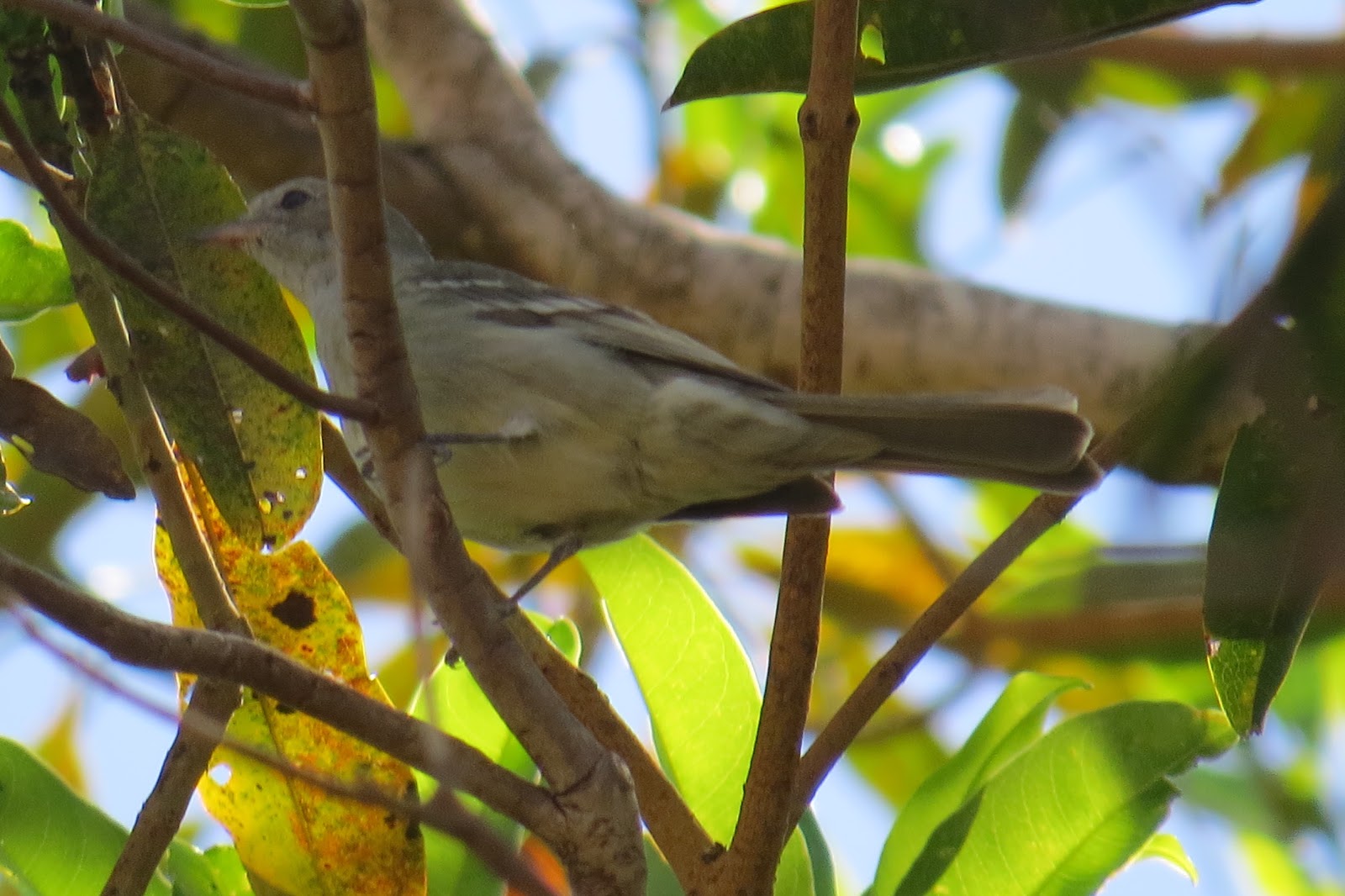
Yellow-bellied elaenia. Seen at Quinta do Sol. I'll start with the flycatchers because they tend toward the subtle side of beautiful, and I'll work up to the flamboyantly gorgeous as the post goes on.
Lesser elaenia. Seen at Fazenda Colorado. Thanks to the identification wizardry of Maris Benites, I was finally able to add a couple elaenia species to my life list.
Rufous casiornis. A bright ball of feathered rust. This species tricked me into thinking it was new, over and over. Nope, it was usually just another casiornis!
Vermilion flycatcher. Last time I showed you the streaky brown female and promised a shot of the male. Well, here he is, the prince!
White monjita. White may be the absence of all colors, or the mixture of all colors together, but either way it is stunning on a bird.
White-rumped monjita. White because much less striking when paired with a certain amount of grey.
Grey monjita. Or even more grey... but the red eye is a wicked touch.
Short-crested flycatcher. What do you see up there in the sky??
MAYBE a Swainson's flycatcher? That's Maris's best guess from the photo.
Brown-crested flycatcher. Ahh, what a nice rufous underside has your tail.
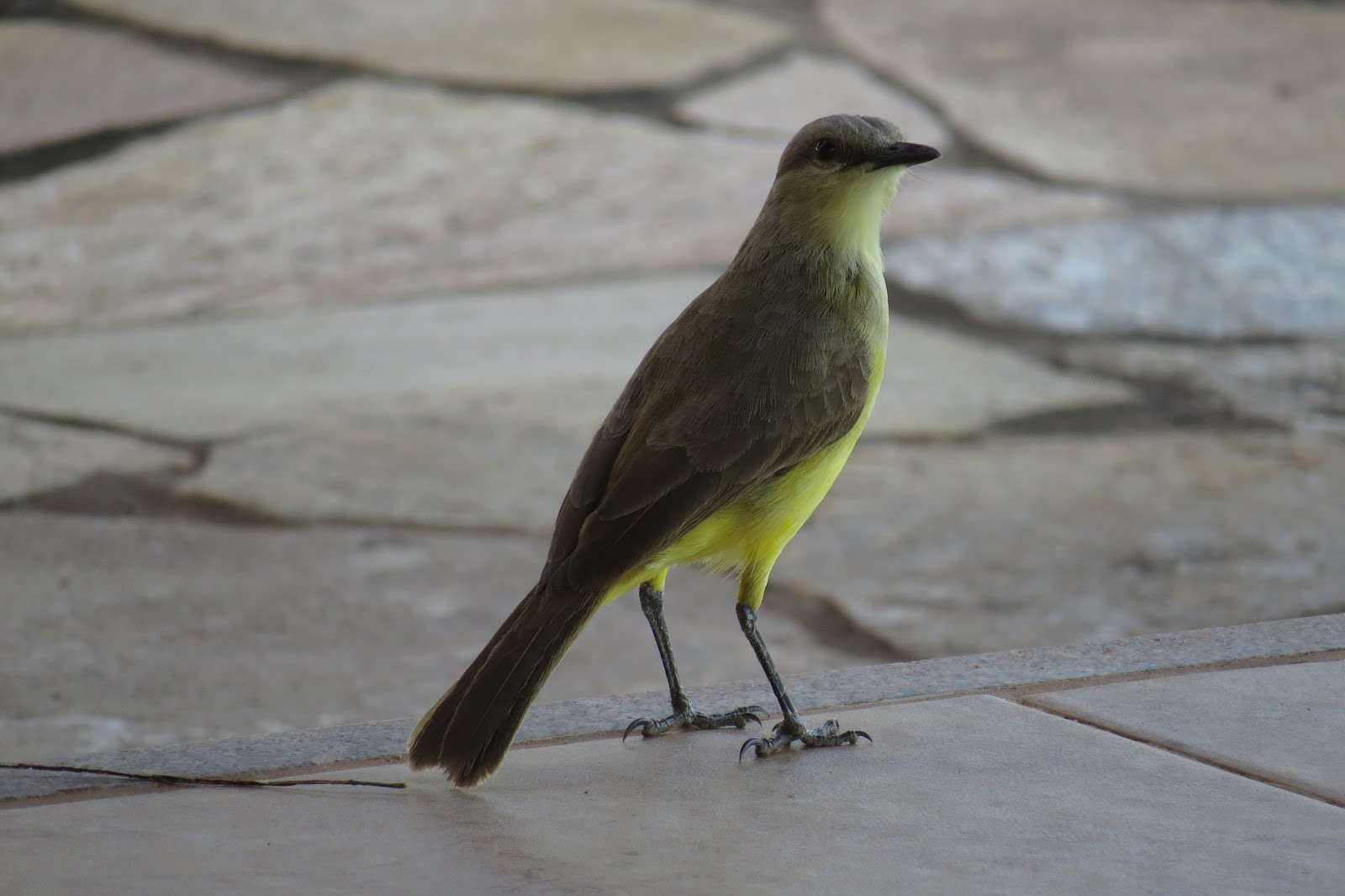
Cattle tyrant. A masked flycatcher of restaurant floors, lawns, and the backs of cows.
Variegated flycatcher. Black and white is the new yellow.
Streaked flycatcher. Like a winged zebra.
Social flycatcher. Standing guard on a rock-hard termite nest the same height as me.
Lesser kiskadee. Peering into a roadside pond in Pantanal.
Great kiskadee. An ever-present friend. I included his photo here so you could compare him with the rest of his clique. Notice how social flycatcher, lesser kiskadee, great kiskadee, and boat-billed flycatcher are all variations on a theme, with bill size being the main difference.
Boat-billed flycatcher. I had been sketching this species all summer, hoping for a glimpse!
Tropical kingbird. A southern cousin of our own western kingbird back home in Seattle.
Black-backed water tyrant. I wonder how water appears beautiful to this bird, who never seems to stray far from it.
Streamer-tailed tyrant. One of several flycatchers with an opulent tail-feather train. This one is distinguished by his white throat patch.
Fork-tailed flycatcher. It's not an optical illusion -- the tail is really that long!
Fork-tailed flycatcher with tail splayed. A view through branches, but it shows off the shape of the tail in flight.
Tityra
Black-tailed tityra. How lonely a family after the mighty flycatchers.
Parrots
Yellow-chevroned parakeet. In Cerrado, the parrot family can be roughly split into three groups: parakeets (small size, long tail); parrots (medium size, short tail); and macaws (large size, long tail.)
Monk parakeet. Nibbling acuri palm fruits on a feeding platform in Pantanal. Native fruits seem like a better way to feed native wildlife than birdseed, as long as enough are left for the other frugivores, like our friends the white-lipped peccary.
Nanday parakeet. Seen in Pantanal. If I were a bird, I think I'd dress in green and black.
Blaze-winged parakeet. Seen near Bonito. These guys look like they're wearing chain mail.
Peach-fronted parakeet. The most common species around Taboco and Quinta do Sol.
Yellow-faced parrot. A pair preening one another before sunset on Fazenda Colorado. This near-threatened species is found only in Brazilian Cerrado and neighboring Bolivia.
Blue-fronted parrot. Seen on a marsupial transect with Cyntia. This parrot, perched above his mate, nearly blended in with the philodendron epiphyte behind him. Nature is full of such beautiful greens.
Red-and-green macaw. Similar to the scarlet macaw, which lives in the Amazon and only reaches the northern edge of Pantanal.
Blue-and-yellow macaw. This pair has built their nest in the top of a broken-off bocaiuva palm.
Hyacinth macaw. The blue and yellow face looks like it was formed out of playdough.
Golden-collared macaw. Not all macaws are colorful giants! There is also a group of green macaws. On first glance they might look like parrots, but notice that long tail. (Parrot tails are radically stubby.) These cryptic macaws are my favorite parrot-family bird because they're stealthy about how cool they are.
Thrushes
White-collared thrush. This thrush's first record in southwestern Cerrado was so recent, it doesn't appear in the regional book. We glimpsed this bird in the forest of Fazenda Colorado, the cattle ranch I visited on my second day in Brazil. I hope her forest isn't converted to pasture before we can learn more of its secrets.
Pale-breasted thrush. Singing and slouching in the same bushes as the white-collared thrush, above.
Rufous-bellied thrush. A look-alike to the American robin, who also acts alike. I found this one hopping through a playing field in Campo Grande.
Creamy-bellied thrush. Pecking for worms in the same playing field.
Ovenbirds
Rufous hornero. As I mentioned in my last pot, this bird is affectionately called "João de barro," meaning "clay John." I have since learned that there are many John birds in Portuguese, from "twig John" (who builds a clunky nest out of sticks) to "painted John" (who looks like a can of orange paint was dumped on him).
The clay nest of the rufous hornero, giving him the Portuguese name "clay John," the Spanish name "hornero" (baker), the Latin name "Furnarius" (oven), and the English family name "ovenbird."
Buff-fronted foliage gleaner. Who doesn't love to glean some foliage now and again?
Great rufous woodcreeper. This group of birds acts similarly to the North American creepers, but woodcreepers are restricted to the neotropics. They belong in the ovenbird family, but they nest in tree cavities instead of building ovens.
Narrow-billed woodcreeper. Woodcreepers are methodical. They fly to the bottom of a tree and work their way up in a spiral, flicking off bark and snagging bugs to eat. When they reach the top, the fly down to the bottom of the next tree.
Red-billed scythebill. I nearly cried when I saw this bird! A dream come true. I didn't really believe the bill could be so delicate and curved until I saw the bird myself. It was an exceptional moment: six giant otters were squeaking in the pond below the tree as I took this photo.
Straight-billed woodcreeper. Along the banks of the Rio Paraguay in Pantanal.
Tanagers
White-lined tanager. A white mandible makes this tanager stand apart from black birds.
Swallow tanager. The male is bright blue and the female is leafy green.
Sayaca tanager. After many sightings, I've finally learned to notice the subtle grey-blue tint.
Palm tanager. Common, plain, and bold like the sayaca tanager, but more of a yellowish smog color.
Burnished buff tanager. Since buff literally means "dull yellow" and burnished means "polished," maybe this name cancels out to mean... yellow?
Silver-beaked tanager. Another tanager with a lower mandible like a tile of ivory (on the male only).
Bananaquit. Sometimes placed in the tanager family, sometimes labeled incertae sedis (Latin for "who the hell knows?") I love this bird for its sharp beak, nectar addiction and, most of all, its perfect name.
Pigeons
White-tipped dove. Okay, this species and the next are my nemeses. Can you tell them apart?!
Gray-fronted dove. One difference between this species and the previous one is that the gray-fronted dove has a less-gray forehead... But only Maris could tell the shades apart.
Picazuro pigeon. A hefty purplish bird that likes to strut in Pantanal mud.
Pale-vented pigeon. A staple of bare tree-tops in Cerrado dusk.
Scaled dove. A dragon in miniature.
Picui ground dove. Preferred diet: dropped corn around horse stalls.
Finches
Saffron-billed sparrow. Not a good shot, but a fun scavenger hunt. This bird's zebra-striped head and firey bill make it identifiable from a glimpse.
Double-collared seedeater. This individual is a young male with an incomplete black throat-patch. I watched a pair (you guessed it) eat seeds for an hour on Seu Claudio's farm.
Double-collared seedeater. This is the female. Note the bicolored bill, with black upper beak and yellow lower.
Red-crested finch. Just so you can see at least one finch-family species with "finch" in its name!
Saffron finch. Oh good, another one with an easy name. (But not in Portuguese! It's called canário-da-terra, or canary of the land. Not to be confused with the warbler, below...)
Purple-throated euphonia. The cute factor of this banana-colored ball is acknowledged by its Portuguese name, "fim-fim."
Warblers
Flavescent warbler. Known in Portuguese as canário-do-mato, or canary of the woods, but it's not related to domestic canaries (which are actually finches from the Macaronesian Islands, who knew?) I watched a pair of these warblers gather bamboo to build a nest.
Corvids
Plush-crested jay. I think neon blue eyebrows are about to be in style.
Purplish jay. From what I can tell, this bird takes on the crow role in Cerrado. When it spies a feeble researcher below, it caws out a warning to everything in earshot.
Mimids
Chalk-browed mockingbird. A fellow happy in human disturbance.
Swallows
Brown-chested martin. That polka-dot belly!
Southern rough-winged swallows. Almost like northern rough-winged swallows, but more... southern.
Gray-breasted martin. These youngsters yelled and squawked, demanding food from one another in vain while their parents were out insecting. I guess sibling squabbles are not limited to humans.
Woodpeckers
White woodpecker. Known for floppy wingbeats, important seed dispersal, and occasional wasp-nest raids. Badass.
Green-barred woodpecker. I can't help it, I love a bird who knows the value of green.
Crimson-crested woodpecker. A similar species to the lineated woodpecker of my first post, but with more red on the cheek and a kickin' mohawk. This species is harder to see locally, so we were lucky to view one from our front porch.
Duca and I discover that we have added a new woodpecker species to the list!
Little woodpecker. A male with a red hat.
Hawks
Black-collared hawk. A Halloween raptor.
Crane hawk. Or, as Duca calls it, the "seriema hawk," for its long red legs.
Had to include this photo of a crane hawk doing the strangest thing... Wedging its long legs into a gap in a tree trunk! Apparently it uses its legs to yank prey out of holes. Not the most graceful hunting strategy, but it works.
Snail kite. A juvenile mastering the patience of one who waits for snails.
Roadside hawk. It was a revelation to see one of these birds perched in a secropia along the Paraguay River. Before they conquered highways margins, maybe the specialized in riverbanks.
Savannah hawk. Red like clay.
Falcons
American kestrel. A fierce little falcon of North and South America.
Southern caracara. A juvenile, milk-chocolate brown and dashing.
Laughing falcon. I watched a pair of these laugh at each other for nearly an hour.
Aplomado falcon. Peeking out on Fazenda Colorado. I would have liked to include the bat falcon, but they are black streaks in the sky.
Owls
Ferruginous pygmy owl. This owl's sound is so menacing to songbirds, it's often used to draw out target species in which it provokes a mobbing response.
Great horned owl. The same species that hoots outside my window in Walla Walla, and a lifer for Duca.
Burrowing owl. Attitude.
A burrowing owl perches on fortified fence of a military compound in Campo Grande.
Vultures
Turkey vulture. The first to rip flesh from a dead carcass and open it up for the rest of the scavengers, what a dear.
Black vulture. Crowding around a dead caiman that may have been hit by a car. (Thanks to Russ for braving the ticks and investigating.)
King vulture. The king arrives last to a carcass, often scaring away the turkey and black vultures who opened up the hide.
Blackbirds
Crested oropendola. A large, rambunctious bird that weaves hanging nests.
Bay-winged cowbird. On the paler side of black.
Orange-backed troupial. Fittingly, I met one that likes to nest in an orange tree. Known as "painted John" in Portuguese.
Chopi blackbird. Notice the pointed neck feathers and groove in lower bill.
Solitary cacique. He's mad that he didn't get any colorful markings. Or any friends. :(
Unicolored blackbird. He makes even the solitary cacique feel special.
Giant cowbird. Compare to the horse's face to see how large these are.
Shiny cowbird. The blue iridescence is mesmerizing.
Screaming cowbird? They all start to look the same after a while...
Ducks
White-faced whistling duck. One morning, I set out with the sole goal of photographing this species in sunrise light. Now and then, nature cooperates.
Black-bellied whistling duck. The three stooges of Pantanal.
Muscovy duck. I learned in 4-H that these are the only domesticated ducks not descended from a mallard. Cool to see a wild muscovy!
Brazilian teal. Not a picky duck; any puddle will do.
Rails
Purple gallinule. A glorified purple chicken.
Why did the gray-necked wood rail cross the road?
Jacanas
Wattled jacanas. I caught this pair at the moment when they were defending their floating island of vegetation against a curious limpkin.
Grebes
Least grebe. A forlorn sight, this sleek diver in the pond on a wide open range.
Sungrebes
Sungrebe. A striking but shy bird. The only other species in its family are the finfoots of Africa and India.
Ibises
Bare-faced ibis. "All the better to stick my head into the mud with!"
Roseate spoonbill. A wannabe ibis with a utensil for a face.
Plumbeous ibis. Nicknamed the curicaca pantaniero in Portuguese. What stood out most about this gray fluffer was its knobtastic knee on each stout, scaly leg.
Ratites
Greater rhea. A flock of females under the watchful eye of their bustle-tailed male.
Puffbirds
White-eared puffbird. Puffy to the max. Even that bill looks vaguely puffy.
Chaco puffbird. That giant head though.
Toucans
Toco toucan in a papaya tree.
Chestnut-eared aracari with an eye of topaz.
Cardinals
Yellow-billed cardinal. Black and white with a flash of tropical.
Crested cardinal. Who needs a yellow beak when you have hair like this?
Sandpipers
A greater yellowlegs in front of a less orthodox cousin, the wattled jacana.
Collared plover. A sweet little bird fond of desiccating mud.
Pectoral sandpiper. In a semi-abandoned farm on the bank of the Paraguay River.
Kingfishers
Amazon kingfisher. Playing "pterodactyl," a popular game among kingfishers.
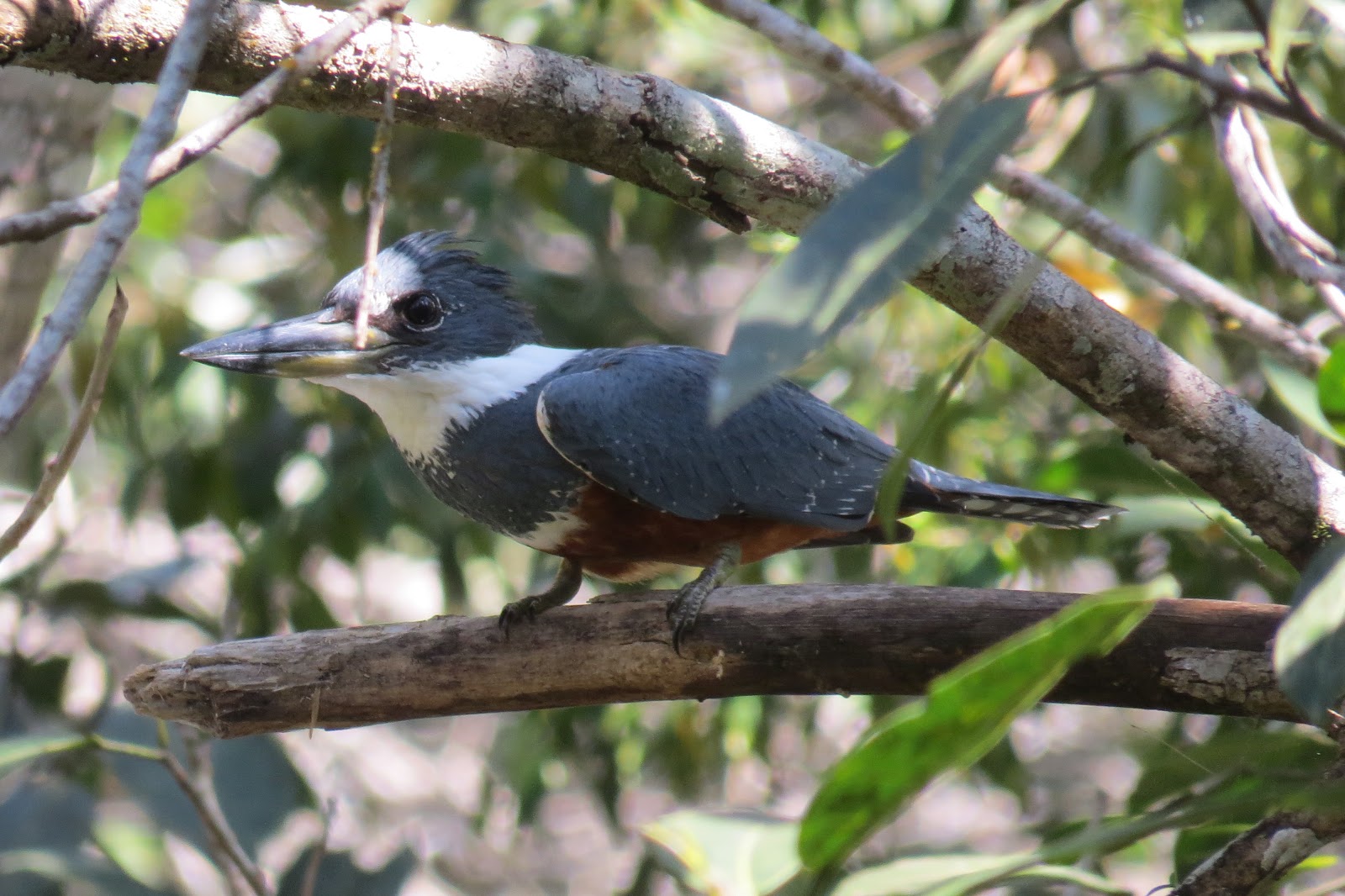
Ringed kingfisher. A matte blue to the Amazon's oily green.
Hummingbirds
Fork-tailed woodnymph caught in a cobweb. At first I thought a spider might have set the trap on purpose (like this praying mantis featured in the New York Times), but then I learned that hummingbirds steal spider silk to build their tiny, expandable nests. Maybe the dust on this web made it more perilous than the woodnymph knew.
Gilded sapphire. A jewel that sparkles only in the sun.
Antshrikes
Planalto antshrike. This is the male.
Planalto antshrike. And this, the female.
Barred antshrike. One day, I whooped as loud as I could to locate my friends on the side of a mountain. This bird burst out of the bushes right at me! So if you want to find a barred antshrike, try whooping instead of pishing?
Storks
Wood stork. A behemoth I first met in Florida.
Maguari stork. The only one I saw, standing alone in the rain, preening.
Jabiru, or tuyuyu in Portuguese. This bird is famous for always smiling, even leering. Many of the trash cans in Campo Grande were models of this gregarious dinosaur.
Saltators
Black-throated saltator. Currently classified under cardinals, but I'm taking the side of genetics and giving these guys their own family for now.
Grayish saltator. Just as described in the book, this bird was munching on the flowers of a yellow ipe like they were candy.
Manakins
Helmeted manakin. Soldadinho in Portuguese. This bird mewls like a baby among its many sounds. It had Renata and I convinced there was a puma watching us.
Cracids
Blue-throated piping guan. I marvel every time this hunk of bird takes flight.
Chaco chachalaca. "The voice of the Pantanal."
Cuckoos
Guira cuckoo. Preferred habitat: wire fences of cattle pastures.
Squirrel cuckoo. I prefer the Portuguese: alma de gato, soul of the cat.
Screamers
Horned screamer. I learned where the name comes from when I saw screamers standing on treetops and fields, squawking like a metronome as if the world depended on it.
Southern screamer. This beaut was a teenager surrounded by three siblings, mom, and dad.
Herons
A black-crowned night heron pretends to be a fish.
Rufescent tiger heron. At one point Russ asked, "What's that sound?" Used to being fooled by ruminants, I laughed: "It's a cow, Dad!" Nope, it was this heron. Turns out the Portuguese name soco-boi, bull heron, because I am not the only one to think it sounds exactly like a cow.
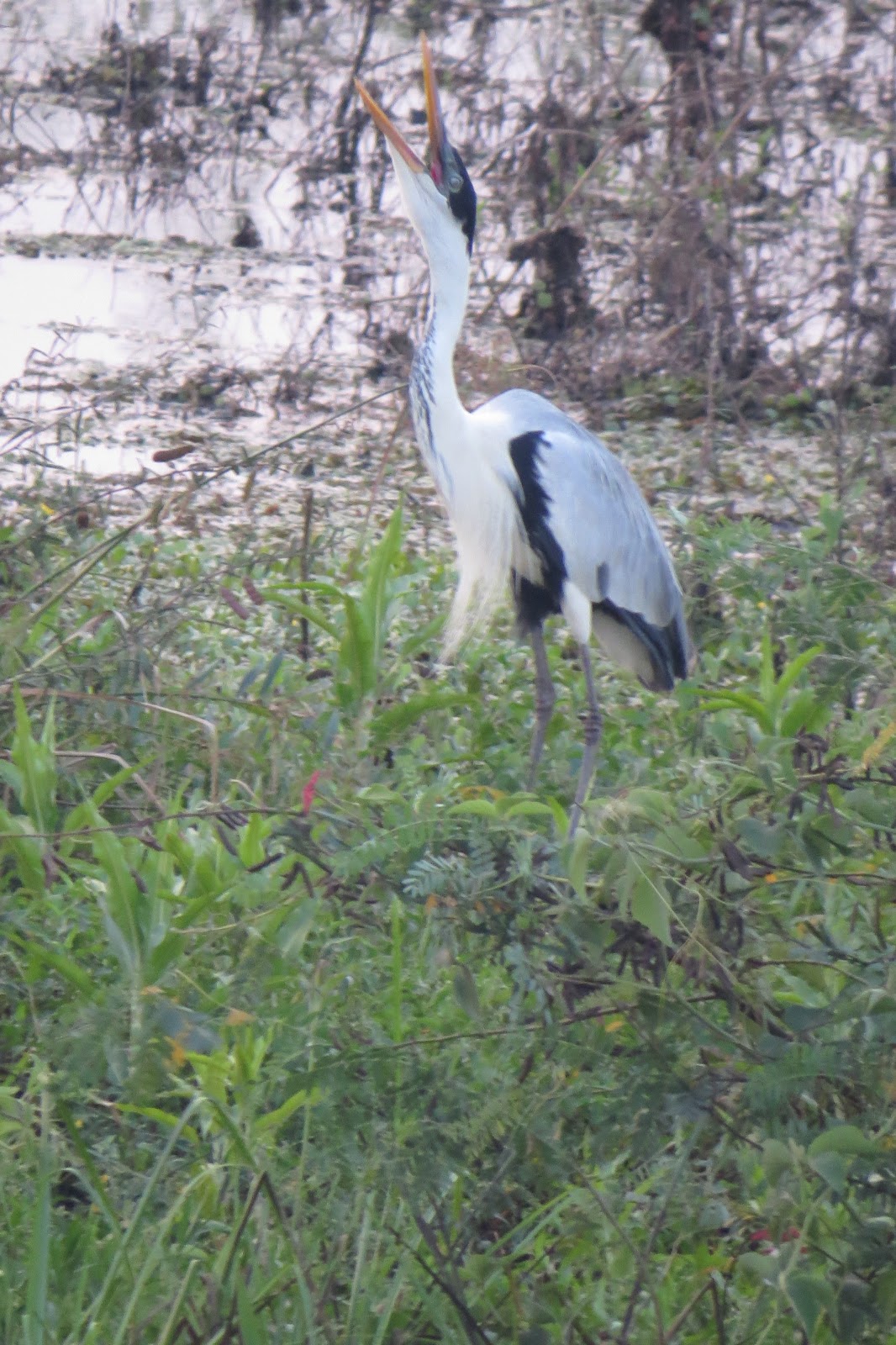
Cocoi heron. A frosty version of Seattle's great blue.
Terror Birds (I mean Seriemas)
Red-legged seriema. Not terrifying, but just take a glance at its closest relative, the extinct Terror Birds.
A seriema stands peacefully over its nest next to a pale-vented pigeon as lavendar dusk settles over Cerrado.