Health Education, Health Articles, Health Blog

Showing posts with label river. Show all posts

Essays Published in Edge Effects and Camas

Now and then, I submit my writing for publication. Far less frequently, it gets published. Well, today was one of those rare days. Head over to Edge Effects to read my essay, "Cottonwoods in Concrete: A Call for Collaborative Survival among Ruins." Edge Effects is a fascinating digital magazine produced by the Center for Culture, History, and Environment at the University of Wisconsin, Madison.


If you're more a fan of print media, I invite you to check out Camas: The Nature of the West, a biannual literary magazine produced by graduate students at the University of Montana. My essay, "The Sea Star's Warning," was published in the Winter 2015 issue, which can be purchased for $5.


And to all of you who read Natural Selections, thank you for putting up with nearly 150 posts (so far) that never benefitted from the red pen of an editor! Are any of you writers? Have you submitted your writing to a magazine? Let me know in the comments :)
Share:

My First Day on the Watson! Takeoff to Brazil

Come with me in a journey of pictures through the first day of the rest of my year.

After 13 months of planning, applying, interviewing, e-mailing conservationists, Skyping scientists from across the globe, an April Fool's engagement, equipment purchasing, budgeting, airline ticketing, goodbyes, and so much more... it begins.

Here I am at 6:40 am on my porch in Seattle. I'm steeling myself for 30 straight hours of transit. Oh boy.

I bought my first back-packing backpack (what a phrase) this summer from my personal Northface employee, Collin, and it's working perfectly so far. The airlines require bags to be less than 44 punds and mine weighed in at 35. Huzzah!

Here I am looking out over the airplane's wing at massive wetlands as we descend over Fort Lauderdale. I will admit, I was amazed and confused to see such vast wetlands, since I mistakenly thought Fort Lauderdale was in Texas. Turns out, it's in Florida and those are the Everglades. Mystery solved.

After a seven-hour flight to For Lauderdale (Florida!) and a eight-hour red-eye to Campinas (near Sao Paulo, Brazil), I walked into sunrise in the southern hemisphere. This photo taken in the Campinas airport.

Now for the third and final flight, a one-hour hop from Campinas to Campo Grande. Here is a view of the agricultural land outside Sao Paulo.

My cows! (Anyone?) These white zebu cattle are easy to spot from the air and along roads. They are a staple of the Brazilian countryside and one of my research subjects.

Here is the airplane-window view as I got closer to Pantanal. The straight lines of deforestation to create cattle pastures were a worrisome omen.

Here is Campo Grande right before I landed. It's the largest city near Pantanal. With nearly 800,000 people, it's the only big city in the state of Mato Grosso do Sul.

Smoke in Campo Grande. In the rural areas, this might be from a brush-burning fire after cutting down a forest to make pasture, but in this case I'm guessing it might have been from burning garbage... or a really hoppin' barbeque.

I made it Campo Grande! I could barely believe it! Until this massive sign helped reality sink in.

My incredible, brilliant, welcoming host Duca picked me up from the airport with a friend. We headed to the mechanic to pick up Duca's well-loved truck. From there, we stopped in to hand off papers to my other contact here, a wonderful peccary biologist named Alexine.

Embarrassing story time. When I first e-mailed Alexine, totally out of the blue, I addressed the message, "Dear Rua Spipe Calarge," the full name listed on the Wildlife Conservation Society website. (I can never be sure which name is first or last in other languages.) Alexine replied, "Hi, my name is Alexine Keuroghlian! The name you used is my street name." I was baffled. Is a street name like a gang name, or a very personal nickname? Why would it be listed on the WCS site? Why didn't it have any resemblance to her real name? Well, the mystery was solved today when I drove up to Alexine's house and read the street sign: Rua Spipe Calarge. Rua means street in Portuguese. It was literally her street's name. Cool.

Finally, we hit the grocery store. Here is the best-stocked portion of any Brazilian supermarket: the beef counter. We ordered ground beef and watched the butcher grind it before our eyes.

Next to the butcher was a hefty selection of barbeque implements.

On the street, a sapling truck!

Here's Duca posing with prato feito, a predetermined lunch dish that changes each day. It's common fare at local restaurants. We ordered peixe, fish, and it came with white rice, brown beans, undressed cabbage (bottles of oil and vinegar are standard condiments on the table), and a tiny portion of spaghetti with meat sauce. Like everything, it also came with farofa, a dry cassava flour resembling bread crumbs (I like to call it pó de pão, literally "bread powder," for its poetic value, but nobody knows what I'm talking about).


We arrived at my home for the next two months, Quinta do Sol! The sign is a little outdated because the Wildlife Conservation Society has terminated their Pantanal involvement, but the Projecto Queixada (Peccary Program) will continue under local advocates like Duca and Alexine.

Here is my house, all to myself. The 40 buff-necked ibis who sleep in a single tree in the yard provide a rowdy alarm clock around 5:00 am.

Here's our outdoor kitchen, where an open fire often cooks meat and smells heavenly.

Here's our water system. Duca fills 1.5-liter bottles at the chlorinated well in Taboco and brings them back to the house.

Here's the indoor kitchen, modeled by Duca and the friendliest of her four dogs, Ven Ven. This dog is always in the way, seeking attention, so it's ironic that his name means "Come Come." Duca is often saying, "Sai Ven Ven!" meaning "Get out, Come Come!" That's Quinta do Sol humor.

Right before sunset (which comes as early as 5 pm) we explored a beautiful river running through Quinta do Sol property.
  
Here is my shower for the next two months! The other fantastic woman who lives and works at Quinta do Sol is Lygia, next to me in the waterfall. She showed me the best places to sit and wash away "all the bad energy."

Yes, this is perfect.

"Let's come to the waterfall every day!" (Not hard to do, since it's a four-minute walk down the sandy road.)

Or if you prefer a bath to a shower . . .

This treefrog hopped through the river and played absolutely dead when I picked her up. I couldn't get her to move even when I put her down on the rock. I'd been very gentle, but I worried that I'd somehow killed her. She was convincing! But Duca says this kind of frog plays dead for several minutes, and she would hop away soon.
  
This ant was as big as half a finger, and it threatened us with open mandibles. I think I heard a tiny squeaking admonition, "Don't you dare walk barefoot!"

I will conclude with a daily ritual, as requested by my parents:

Dad's Daily Bug


This may not look like much, but the green smudge is an aquatic moth's cocoon. Yes, an aquatic moth, at least in the larval stage. The cocoon, plastered to bedrock under a cold, fast-flowing stream, is colonized by bright green algae that both protects and feeds the growing larvae. HOW COOL IS THAT.

Mom's Daily Bird


This buff-necked ibis was the first to land in our tree tonight. Forty friends soon followed. I can see why Apple didn't include "ibis call" as one of the iPhone alarm choices . . . It is not Mother Nature's most soothing invention.
Share:

Whistle Bird and the Art of Pishing: Day Sixteen on the Alaska Road Trip

Today was our bonus day, given to us by the breakdown of our planned ferry, the Columbia. We went birding at Mendenhall Wetlands on EVAR, the Emergency Vehicle Access Road.

Birding by the airport.

It started out about as picturesque as it sounds: airplanes bearing down above our heads, float planes taking off from the “liquid runway” next to the paved one.

The morning sun over the riverbank made for another set of shadow dancers.

Soon, however, we were past the aviation center. We saw savannah sparrows, a northern harrier, great blue herons, dowitchers,  and chestnut-backed chickadees. An iceberg floated out the brackish river, and a harbor seal poked her head above the surface.

Crows pick apart a salmon carcass.

There's a clear difference between a glaucous-winged gull...

... and the mew gull. Doesn't he look like Mr. Burns from the Simpsons?!


Dawww, a baby song sparrow.

Savannah sparrow.
  
Greater yellowlegs.

Dowitchers.

Best birdies of the day... we think we saw six Baird’s sandpipers. (Ornithologists, please comment!)

This looks like the book's description of "silvery with black spots" to me.

Dark gray legs, short black beak.

Marna met up with us for a lunch of tacos and enchiladas on the waterfront, and I got a stupendous surprise: my friend Sarah (we studied abroad together in the Galapagos Islands) was in town! She stayed at my family’s house in Seattle earlier this year, so I was ecstatic to get to see her hometown, too.

Two friends reunited at Sheep Creek.

She took my mom and me up a steep climb to Sheep Creek Ridge through majestic green rainforest and alpine shrubbery. We tasted bitter highbush cranberries, stuck our faces in the creek, and finally turned around at a cottonwood grove.

Jane and Nina in the cottonwood grove.

We rounded one corner and heard a piercing shriek whistle. Sarah, startled, replied with a nearly identical shriek. We looked at each other. What was that?!

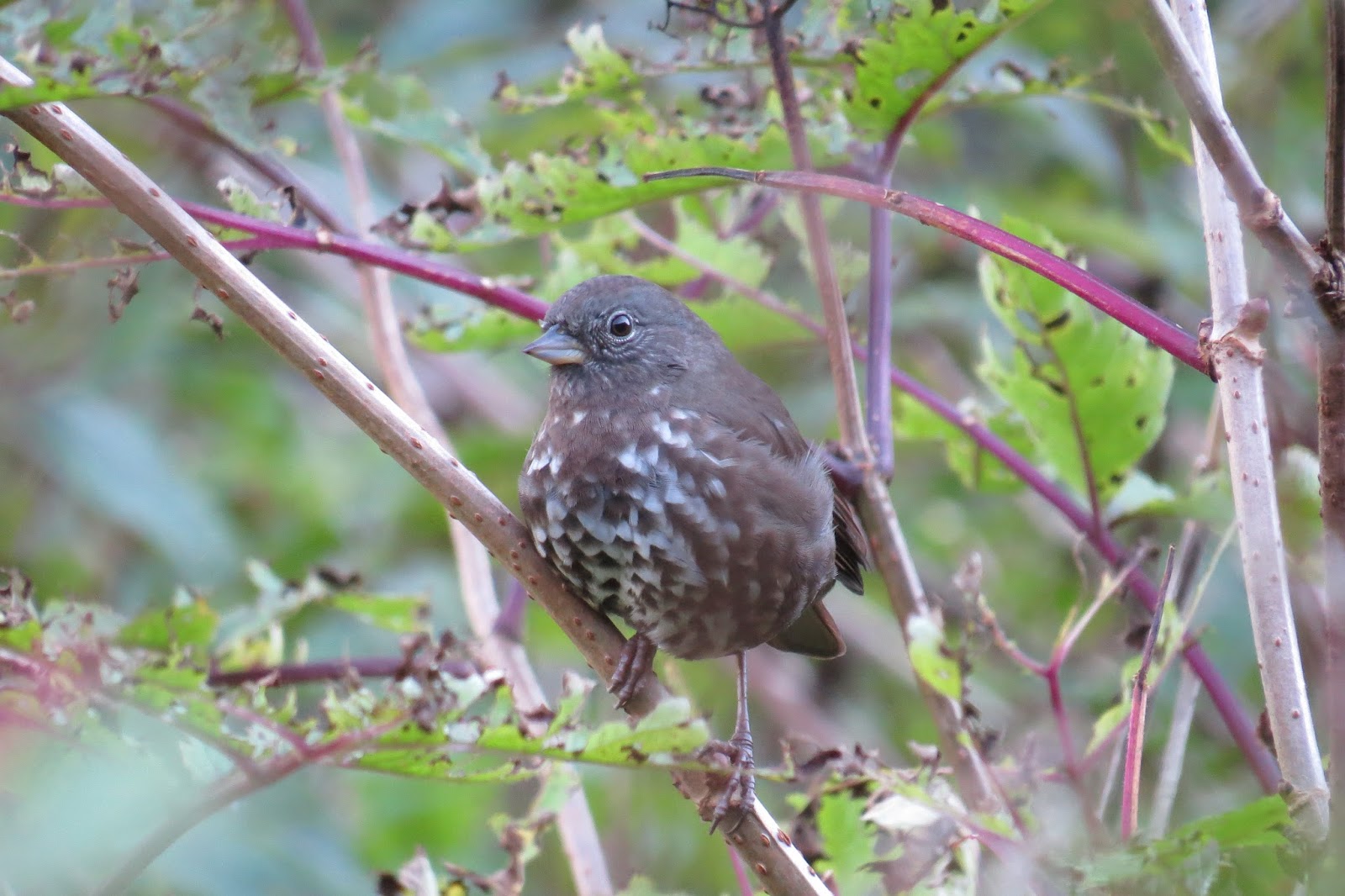
Jane started pishing, a birding technique where you say, “PSH PSH PSH!” and the birds (supposedly) emerge from their hiding spots out of curiosity. Suddenly, the whistle bird let out a perfect whistle! A blue Steller’s jay flew right up to us, and two fox sparrows nearly landed at our feet. I guess pishing does work! But the whistle bird never showed herself, and she is still a mystery.

Fox sparrow attracted by our pishing.

Marna served us another delicious dinner of lamb and homemade applesauce. Since our ferry didn’t board til 11:30 pm, Sarah invited us to spend a quiet evening by her fireplace. Sarah’s mom, Sarah, Jane and I had a great time reminiscing about the Amazon Rainforest and discussing their upcoming trip to Ireland in only two days.

Then I got another super surprise: my friend from Whitman and Sweets-co-captain Marlena paid us a visit! Juneau was the best part of our trip so far because we got to see it with locals and reunite with old friends.

At this point the day had grown long (just like this blog post), but we couldn’t sleep yet. We had a ferry to catch! It was a couple hours late, so we waited in line while Jane snoozed and I wrote postcards to the pop radio station.

The day held one surprise for us yet: once on the ferry, we went to the Purser’s Office to determine which cabin was ours.

“I’m sorry,” she told us, “but it looks like you don’t have a cabin on this ship.” Uh oh. Would we be sleeping outside with no sleeping bags or pads? With some pleading and kindness from our understanding purser, we managed to rent a four-berth cabin, just until we arrived in Ketchikan. Good enough – at least we will sleep tonight.

Knock knock.

A half-hour after we went to bed (so around 2 am) the night watchman knocked on our door. “Do you have a red Prius?” he asked.

I’d left the dome light on from writing postcards in the waiting lot. Down to the car deck I went, in my pajamas, to put Prius to bed. Finally, we were ALL tucked in and ready to sleep.

End of day summary:
  • Day of road trip: 16 
  • Start: Juneau, Alaska, United States 
  • Miles traveled: 50 
  • Hours driven: 1 
  • Favorite bird sighting: Baird’s sandpiper 
  • End: Malaspina ferry (Juneau), Alaska, United States
    Share:

    Drunken Forest and Caribou Velvet: Day Three on the Alaska Road Trip

    After we woke up in the northern British Columbian city of Fort St. John, we couldn’t resist starting our day with a scenic and enlightening stop at… Safeway?!

    Welcome to Fort St. John, The Energetic City.

    Turns out Fort St. John, “The Energetic City,” is a petroleum-exploration-fueled industrial town of strip malls and apartment buildings. We spent our night at Howard Johnson, ate a free breakfast of hard-boiled egg and dried-out sausage (pretty tasty, actually), and picked up two salads at the Safeway deli to hold us over during the long, upcoming stretches without access to food.

    We stopped to eat the first of those salads, which I’m calling “Italian pad thai” (a bright orange oily soup of oregano and rice noodles), at Buckinghorse River Wayside Provincial Park.

    Buckinghorse River.

    There were no nature trails listed in the Milepost, so we made our own. Within a few steps of the gravel parking lot, a flock of little brown birds flew overhead into a spruce tree.

    “Crossbills!” said Jane.

    “Siskins!” said I.

    Neither of us knew what these birds were, but in our experience when birds fly overhead chittering, her birding friends always dub them crossbills, and mine dub them siskins. The birds’ bright red heads and white wing patches disqualified them as either red crossbills or pine siskins. We looked up orioles, finches, even tanagers before we looped back around to a lifer (brand new species of bird for us): the white-winged crossbill!

    White-winged crossbill.

    Look closely: you can see the purposefully-crossed bill for cracking open cones.

    We treaded down to the river and admired the “drunken forest” of black spruce on the subsiding banks, the diverse wildflowers, and the downstream swimming pools mentioned in the Milepost.

    The "drunken forest" on a disintegrating river bank.

    Aster.

    Clover.

    Buttercup?

    Yarrow?

    Fireweed.

    Buttercup?

    Dandelion.

    Jane got too hungry to wait for dinner and went beaver on me!

    At the adjacent truck stop, we bought gas at a “24-hour public cardlock,” the Northern version of a self-serve gas station, and struggled through the twelve steps.

    Cardlock, Jane, and Prius.

    How to pump gas in the North: a twelve-step program.

    There, we met a pair of bicyclists making their way down the country from Prudhoe Bay, Alaska. Their bikes were loaded with four saddlebags each, and their ribs were probably showing under their Lycra jerseys.

    “How far you trying to go?” I asked one of the bikers.

    “Argentina,” he replied, with a shrug that showed he didn’t believe they would make it. “We’ve been pushing it to 100 miles a day, trying to break the world record. I’m pretty well beat…”

    We wished them luck and took heed of their advice to buy cinnamon rolls at the upcoming town of Muncho Lake.

    A (pine?) beetle in the parking lot.

    The first half of our drive was straight with large grassy verges and many side-roads with signs for “Sour Gas Compression Plant,” “Natural Gas Exploration Patch,” and “Sulfur Pellet Station.” The so-called Energetic City of Fort St. John depends mainly on natural gas and oil exploration for its economy, with a dose of logging and heavy construction as well.

    Oil or gas exploration.

    Sulfur pelletization.

    I didn’t understand how construction could be its own industry until I saw how much maintenance the Alaska Highway requires. We were stopped or slowed every few dozen miles for construction in any stage from clearing rocks to smoothing gravel to laying down fresh asphalt. Every town along the way hosts an enormous white tent filled with gravel (maybe to keep it free from snow?) while the accompanying equipment often sits outside, exposed to the elements.

    A burned portion of the forest.

    The halfway point of our drive was Fort Nelson, where we stopped at the Trapper’s Den and tried on wildlife hides. The proprietor, who has lived her whole life in that very log cabin and avoids the “big city” of Grande Prairie, Alberta because of the traffic, advised us we’d be seeing lots of wildlife on the next leg of our journey.

    Arctic fox was so soft (shout-out to Fella!)

    Raccoon.

    And she was right! The second half of our drive was spectacular. We climbed through the Canadian Rockies, dipping above and below the alpine tree line. Jane spotted a road-killed black bear while I took a nap. Later, a dark-brown, deer-like animal crossed the road in front of us.

    “Moose?” I identified it uncertainly. It was too dark for a deer; its feet and nose were oversized, and its antlers were velvety. “I wonder when the antlers flatten out…” I thought to myself. A few miles later, another crossed the road. This time we got a better view, and Jane pronounced it a caribou. So that explains the antlers!

    Caribou!

    Not your typical "deer crossing" sign.

    We stopped for a bathroom break at Summit Lake Provincial Campground, where the cool mountain wind and glassy lake took our breath away.

    Summit Lake.

    “Watch for Stone sheep along the road,” warned the Milepost. A minute later, there they were: two brownish sheep with curved horns, a dark subspecies of Dall sheep. Around the bend, a family with a lamb. We watched them nibble salt from the gravel then effortlessly scamper up the steep cliff.

    Stone sheep!

    Soon after, an actual cow moose and her calf crossed the road, clearing up any lingering confusion about the various deer-family species.

    Moose!

    After bear, caribou, sheep, and moose, we really didn’t feel like we’d seen enough big game... Luckily, we ended the day with a herd of a dozen bison in the foggy twilight near the entrance to our night’s home, Liard Hotsprings Lodge.

    Right after this sign...

    ... We found this guy!

    And his whole herd.

    We brought our bags inside just as a deafening thunderstorm broke loose over the spruce forest, and we fell asleep to a raindrop lullaby.

    End of day summary:
    • Day of road trip: 3 
    • Start: Fort St. John, British Columbia, Canada 
    • Miles traveled: 426 
    • Hours driven: 10 
    • Favorite bird sighting: White-winged crossbill 
    • End: Liard River Hotsprings, British Columbia, Canada
    Share:

    Popular Posts

    Labels