Health Education, Health Articles, Health Blog

Showing posts with label family. Show all posts

Lake Ballard: A Lively Capitalist Ruin

On May 27th, I explored Lake Ballard with my mother, Jane.

Jane birds Lake Ballard through a chain-link fence.

If you're from Seattle, you might pause to wonder what I'm talking about. The house-boated Lake Union is well known, as are the duck-filled Green Lake and the bridge-spanned Lake Washington. But Lake Ballard? You've probably never heard of such a thing.

That's because Lake Ballard is actually a puddle of water that has collected in a huge empty lot at the intersection of NW 46th St and 15th Ave NW (better known as the Ballard Bridge). It sits across the street from Ballard Blocks Shopping Mall, home to Trader Joe's and LA Fitness, among others.

Lake Ballard contains multiple habitats: calm freshwater, concrete pads, and blackberry brambles.

The concrete foundation has been growing a forest of Himalayan blackberries since its industrial buildings were torn down several years ago. Online neighborhood forums have generated many complaints about this "wasted" space, with commenters referring to it as an "eyesore" and calling for rapid development.

One commenter wrote, "You mean that swimming pool? It's about time they did something with that. Boggles the mind how property owners can afford to just sit on land like that without doing anything. At least turn it into parking for boats and RVs to pick up some cash."

The capitalist spirit is alive and well in Ballard.

You never know what you might find in Lake Ballard -- perhaps a chair and a fire extinguisher.

Seattle's bird-watching community has taken a different perspective, as have an impressive number of migrating shorebirds and urban resident species. Birders have dubbed the construction site "Lake Ballard." We frequent it with our binoculars, report sightings on the Tweeters listserv, and submit eBird checklists. Highlights have included semipalmated plovers, least sandpipers, greater yellowlegs, spotted sandpipers, and solitary sandpipers.

Because it is fenced off from human trespassers and isolated from most predators, Lake Ballard is a safe haven for a duck to raise her family.

I watched this mother mallard supervise six ducklings in the frothy waters.

Here, a mallard and her duckling sleep behind a killdeer, the only shorebird we saw today.

A female house finch picks seeds from a pioneering shrub.

Next to Lake Ballard runs one of Seattle's famous drawbridges, the Ballard Bridge. A host of streetwise birds make their homes here, in the traffic-rumbling shade.

Jane is framed between the Ballard Bridge and Lake Ballard.

Pigeons are the most dependable sightings.

European starlings live here, too.

A native and intelligent American crow watched my mother and I with interest from a telephone wire.

Most excitingly, a colony of cliff swallows have plastered their mud to the bridge's underside. Concrete cliffs suit them just fine.

This view is looking straight up at a hanging weed, fence-top pigeon perch, and cliff swallow nest below the bridge.

Close-up of a cliff swallow's mud nest.

Another nest with a white, blue, and orange head poking out.

A cliff swallow makes adjustments to her corner abode.

I have become fond of Lake Ballard and its avian inhabitants. To me, this empty lots holds several lessons:

1. Birds in Seattle are desperate for freshwater, and they need more aquatic and riparian habitat.

2. Nature is resilient, and it will fill in the weedy margins of capitalist development at any opportunity. We have the potential to coexist, humans and wildlife, in ecosystems that are contaminated and collaboratively built by all of us. (For more on this idea, I suggest reading The Mushroom at the End of the World: On the Possibility of Life in Capitalist Ruins by Anna Tsing.)

3. Waste is never wasted. What a developer sees as a "waste of money" or a neighbor sees as a "waste of space" is a resource that will be used by marginalized populations, in this case birds and blackberries.

And with these lessons in mind, I am sad to share the news that Lake Ballard will soon be developed into a grocery store, marine retail, and a restaurant. A big white board (formally known as Notice of Proposed Land Use Action) declares the lake's fate underneath graffiti of an incredulous fox. I picture a thought bubble over the spray-painted canine's head:

"Do we really need another grocery store across the street from Trader Joe's?"

A notice of Lake Ballard's impending demise, with commentary from a graffiti fox.

Of course, Ballard is growing, and the stores will be frequented by customers happy for a source of high-end foods on which to spend their money. It's a capitalist dream to replace this wasteful swimming pool with economically productive businesses.

Yet, I imagine an alternative use for this land. What if Lake Ballard were immortalized into a small urban park? What if Ballard's residents worked together to demand that this vacant lot be turned into a freshwater oasis for shorebirds and waterfowl amid bustling concrete and air-conditioned gyms and grocery stores? My dream has been met with enthusiasm when I shared it with Trader Joe's clerks and shoppers, my only audience so far.

Resistance to development is not a stranger in this place. Across from Lake Ballard, wedged between Ross Dress for Less and LA Fitness, sits an odd and unexpected home. It's the house of the late Edith Wilson Macefield, a Ballard legend who refused to sell her property for exorbitant offers. So, the Ballard Blocks Shopping Mall was built around her.

Edith Wilson Macefield's house tucked defiantly between behemoth units of Ballard Blocks Shopping Mall.

Clearly, the birds are willing to call this ruin home. I would like to take a leaf out of Edith's book and defend this "waste" for the organisms who recognized its potential not as a generator of profit, but as a nursery for ducklings, a source of home-building mud, and a garden of seeds and berries. I would feel more at home in my city if I could visit Lake Ballard years from now, spend a few moments with its inhabitants, and remember that all of us -- all organisms -- are in this game of survival together.
Share:

Mammals of Southern Arizona

Seeing mammals other than Homo sapiens and Canis familiaris is always a treat. In southern Arizona, I have run across fifteen species of wild mammal, or at least their sign, in the past three years.

And we've ridden a couple domestic mammals, too.

Deer family: Cervidae


1. Mule deer, Odocoileus hemionus

I'm used to finding mule deer in the green forests of Washington, so the small herd I saw picking their way through cacti and mesquite outside Vail, Arizona looked rather out of place. I suppose their big ears help them radiate extra heat in this sweltering desert.

I took this photo of a mule deer doe grazing at the Nisqually Delta in Washington State. June 2, 2014.

2. Coues white-tailed deer, Odocoileus virginianus couesi

Also known as the Arizona white-tailed deer or fantail deer, the Couse white-tailed deer live in mixed oak and pine woodlands at high altitudes. We saw a few of these very small deer bounding through just such a forest in Madera Canyon during the Christmas Bird Count.


Galen and I found this lower jawbone of a white-tailed deer on National Forest land north of Tucson.

Perfectly good lawn-mowing teeth.

Squirrel family: Sciuridae


3. Harris's antelope squirrel, Ammospermophilus harrisii

Harris's antelope squirrel perching near the Tanque Verde Trail, Saguaro National Park, AZ. January 2, 2017.

4. Rock squirrel, Otospermophilus variegatus

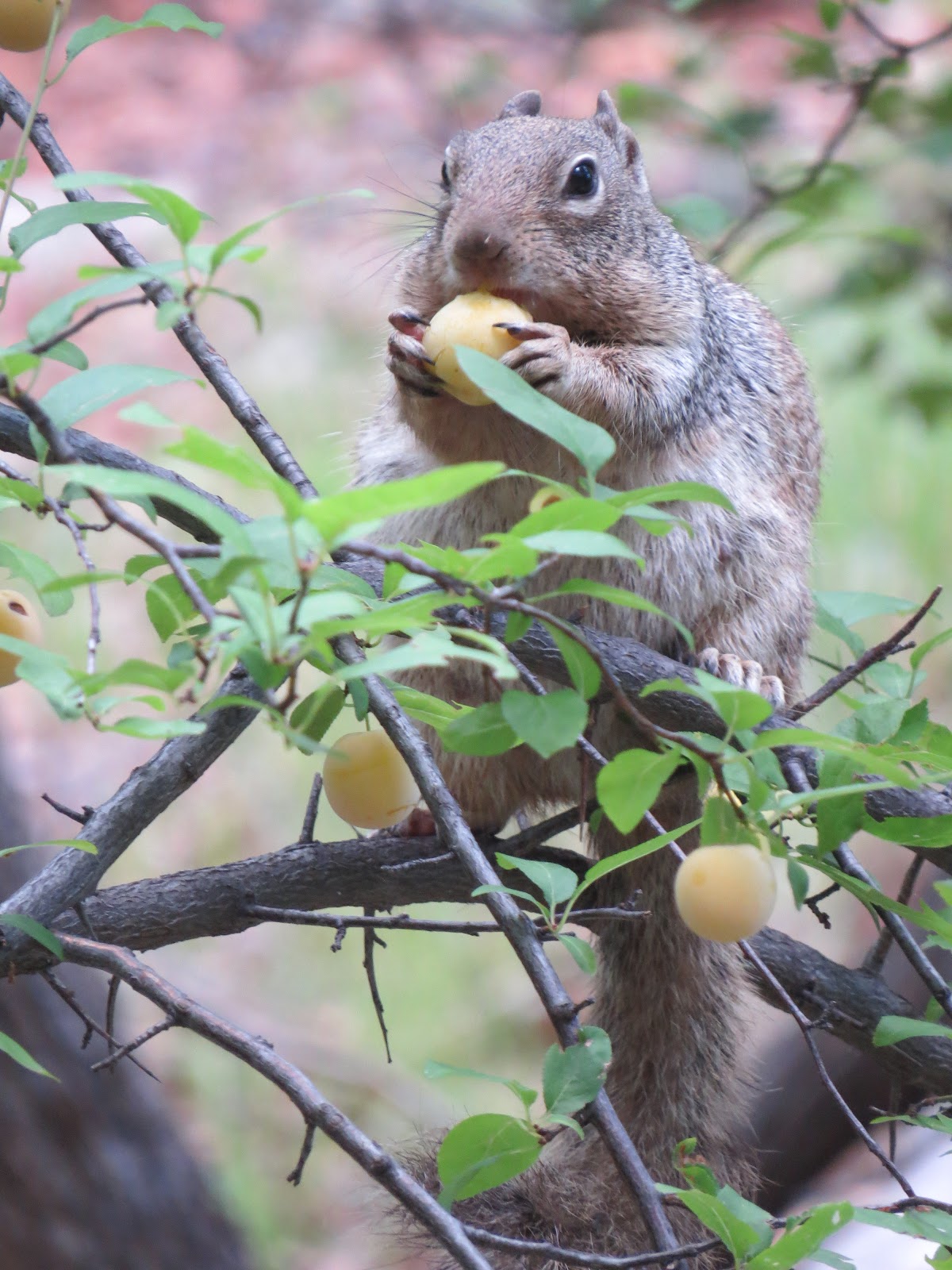
A rock squirrel eating fruits in Madera Canyon. August 2, 2015.

5. Arizona grey squirrel, Sciurus arizonensis

6. Round-tailed ground squirrel, Xerospermophilus tereticaudus

Hannah and I found a colony of round-tailed ground squirrels in Sweetwater Wetlands Park, Tucson, AZ. August 9, 2015.

7. Black-tailed prairie dog, Cynomys ludovicianus

Black-tailed prairie dogs have a long and fascinating history in southeastern Arizona. This species was once the most abundant prairie dog in North America. Its range covered the Southwestern and Midwestern United States and extended into both Mexico and Canada. One "town" in Texas was reported to cover 25,000 square miles and house 400 million black-tailed prairie dogs.

Beginning in the early 1900's, the U.S. government initiated a systemic eradication of prairie dogs to decrease the "waste" of rodent-consumed grass and maximize beef production on rangeland. The strychnine killed off prairie dogs in over 95% of their habitat, but it didn't increase the yield of beef. Turns out, prairie dogs control mesquite growth by devouring the seedlings that sprout after a hard rain. They like treeless colonies because predators are easier to spot. Due to overgrazing and, in large part, prairie dog eradication, invading mesquite has become the primary cause of pasture degradation and declining beef production in Arizona.

Occupied habitat plummeted from a historic high of 100 million acres to a low of 364,000 in 1961. The species was extirpated from Arizona in the early 1960's, and its dependent species, including black-footed ferrets and burrowing owls, suffered alongside it. The black-footed ferret, entirely dependent on prairie dog towns, was declared extinct in the wild in 1979 until a woman's dog brought a dead ferret to her Wyoming doorstep two years later.

Black-tailed prairie dogs were released into Las Cienegas National Conservation Area in 2008 and 2009, and that is where I was lucky to watch them go about their prairie-dog business. Captive-bred black-footed ferrets have been released elsewhere in Arizona, and burrowing owls found their own way back.

The black-tailed prairie dog town at Las Cienegas. August 14, 2016.

A sentry.

A burrowing owl, just where we would expect her to be!

The corrugated black plastic pipe indicating that this prairie-dog town was a reintroduction site.
  
The amount of effort and money that has gone in to first poisoning and now reintroducing prairie dogs is astounding.

But we are sure glad they're back.

Rabbit family: Leporidae


8. Black-tailed jackrabbit? Lepus californicus

9. Antelope jackrabbit, Lepus alleni

10. Desert cottontail, Sylvilagus audubonii

Desert cottontail in Sweetwater Wetlands Park. August 9, 2015.

Same cottontail. Look at those HUGE ears!

New World rat family: Cricetidae


11. Woodrat species, Neotoma sp.

My friend Hannah and I found this dead woodrat at Sweetwater Wetlands Park. August 9, 2015.

Weasel family: Mustelidae


12. American badger? Taxidea taxus

My mother, Jane, found this odd-looking object in a cave near Vail, AZ while scanning with her binoculars. We debated whether it was an animal, trash, or some strange mineral formation. I took this photo with 200X zoom, and we decided it must be a rock. An hour or so later, we came back to find the object missing! Could it have been an American badger guarding a food cache?

(Speaking of which, if you haven't seen this video of a badger burying a whole cow, you are missing out.)

Could it be a badger?

An American badger photographed at Point Reyes National Seashore. Photo credit: Yathin Krishnappa.

Dog family: Canidae


13. Coyote, Canis latrans (scat only)

I was shocked to find this coyote at the Montlake Fill in the heart of Seattle, Washington, a big city! March 14, 2016.

This coyote was getting fat on fallen dates at China Ranch Date Farm, a magical oasis in the Mojave Desert near Southern Death Valley. November 14, 2016.


Skunk family: Mephitidae


14. Road-killed skunk.

Yeah, not very exciting, I know. Four species of skunk live in Arizona (striped, spotted, hooded, and hog-nosed) but the striped is the most common, and the most commonly road-killed. Rich, Galen, and I noted this one on our nocturnal drive down to California Gulch.

Peccary family: Tayassuidae


15. Javelina, Pecari tajacu

Javelinas, also known as collared peccaries, are two-foot-tall, herbivorous, hoofed mammals. They resemble pigs, but the pig family belongs to the Old World and the peccary family to the New World. They travel in family groups and have large populations in suburban Tucson and Phoenix, as well as Mexico and Central and South America.

Journal Entry January 3, 2017:

Amelia, Galen and I gathered information at Catalina State Park, bought groceries at Walmart, and made camp out a National Forest road. For dinner: rice pilaf, beans, corn tortillas, yellow bell pepper, green onions and wilted spinach. Chamomile tea and strawberries for dessert. I was reading my book while Galen played guitar and Amelia drew a map of the United States, when suddenly I heard a whirring sound in the dark. I spun around as if something had stung me because I felt eyes watching me -- and there was a javelina standing in our camp, staring at us!!! We froze and made eye contact before I shooed him away. I've heard they can be aggressive but he turned tail and trotted off, not in too much of a hurry. Galen and I slept under the stars on a tarp. It felt like home. I wonder if the javelina watched us sleep.

A javelina photographed in the Melbourne Zoo. Photo credit: Fir0002/Flagstaffotos
Share:

Humans Who Love Birds Who Love Cacti

Over winter break I found myself in Tucson, Arizona. Flying in, I took these photos of the Central Arizona Project, a 336-mile canal diverting water from the Colorado River's Lake Havasu to the thirsty megalopolis of Phoenix and Tucson. The canal pumps water uphill using electricity from Navajo Generating Station, which is closing in 2019. For the fascinating story of water in the West, I recommend Water is for Fighting Over: and Other Myths About Water in the West by John Fleck. And for a broader overview of climate change in the Southwest, take a look at A Great Aridness by one of my favorite authors, William DeBuys.

Central Arizona Project.

The canal looks like a surgical incision in dry land, incomparable to the winding, rough-edged path of river.

First I explored Vail, a town south of the city, with my mother Jane, father Russ, and sister Lisa. Then I met up with great friends from college, the not-quite-twins Amelia and Galen, and we circumnavigated the urban zone in our study vehicle, Red Rover. We slept on tarps, cooked over a WhisperLite stove, and camped throughout Coronado National Forest. We even managed to execute a four-day backpacking excursion through Saguaro National Park, almost entirely thanks to Galen.

A panoramic view of the Rincon Mountains behind our National Forest campsite on USFS Road 35.

I will break up the journey into bite-size blog posts, but this one really gets to the core of our adventure: an entanglement among humans, the birds we love, and the cacti from which we were never far. Welcome to the Sonoran.

The painted table at a coffee shop near the University of Arizona.

Humans


A cholla skeleton is worth contemplating.

The Madera Canyon Christmas Bird Count took Jane and I into snowy territory.

An alligator juniper, huge and scaly, in Madera Canyon.

Snow in Arizona? Jane and I were underprepared.

Amelia the rock-hopper.

Family friends and supermodels Remy and Camlin tolerated my photography.

Our botany field camp: Red Rover, Galen, and I photographed by Mother Amelia.

Sometimes humans love cacti.

Birds


Phainopepla, a snazzy bird with a snazzy name.

Mourning dove, a bird whose sound reminds me of Walla Walla, New York, and Tucson all at once.

A house finch female.

Her red-tinged male.

A black-throated sparrow at dusk in Sabino Canyon.

Black-tailed (or blue-grey?) gnatcatcher.

Gila woodpecker on saguaro.

Male Gambel's quail in the Desert Botanical Garden of Phoenix.

Red-naped sapsucker.

Male gilded flicker on saguaro. Notice the brown cap and red malar.

Bridled titmouse.

Northern mockingbird on a saguaro.

Black-chinned sparrow.

Galen and I were very lucky to go camping and birding with a friend-of-a-friend, the accomplished birder and professional Wings guide, Rich Hoyer. Check out his blog, Birdernaturalist. We picked him up at his house with enough daylight to admire his lovely garden of vegetables, native plants, bird feeders, and (like any good Tucson yard) hard-packed dirt. Galen, Rich, and I headed two hours south to camp on US Forest Service land at California Gulch, near the US-Mexico border.

It was a trip for flycatchers, so I'll start with some background on them. The flycatcher family, Tyrannidae, is the largest family of birds. It contains more than 400 species native to North and South America. The most common genera of flycatchers in the US are:

  • Empidonax. Many familiar flycatchers are small, grey birds of this genus, including Willow, Alder, Least, Hammond's, and Pacific-Slope Flycatchers. They are best distinguished by voice, or the type of tree in which they prefer to sit!
  • Myiarchus. These flycatchers are larger and more colorful. Their ranges tend to be more southern than many Empidonax. The common US species (Ash-Throated, Great-Crested, and Dusky-Capped Flycatchers) have a faded yellow belly, rufous tail, and grey cap.
  • Contopus. These birds are the pewees: small, charcoal-grey flycatchers that like to vocalize and catch insects from high, dead branches. If you have ever walked in the woods of Washington State and heard a clear, descending, "Peeeeeeew!" it was probably a Western Wood Pewee declaring his presence. Look around, because you won't want to miss his jaunty crest. This genus also includes the Olive-Sided Flycatcher with his classy grey vest.
  • Tyrannus. These birds are the Kingbirds, and they are called tyrants in Latin for their aggressive, territorial behavior. Most have long, pointed wings and broad beaks. They include the Western, Eastern, and Tropical Kingbirds.

Ash-throated flycatcher, a member of the genus Myiarchus.

Ash-throated flycatcher.

When Rich, Galen, and I woke up the next morning, we set out with a mission: to find the lone Nutting's Flycatcher that had been sighted recently in this valley. We had a promising start when we found a different Myiarchus species, the Ash-Throated Flycatcher pictured above. Nutting's and Ash-Throated look very similar, so it was great to get a search image right away.

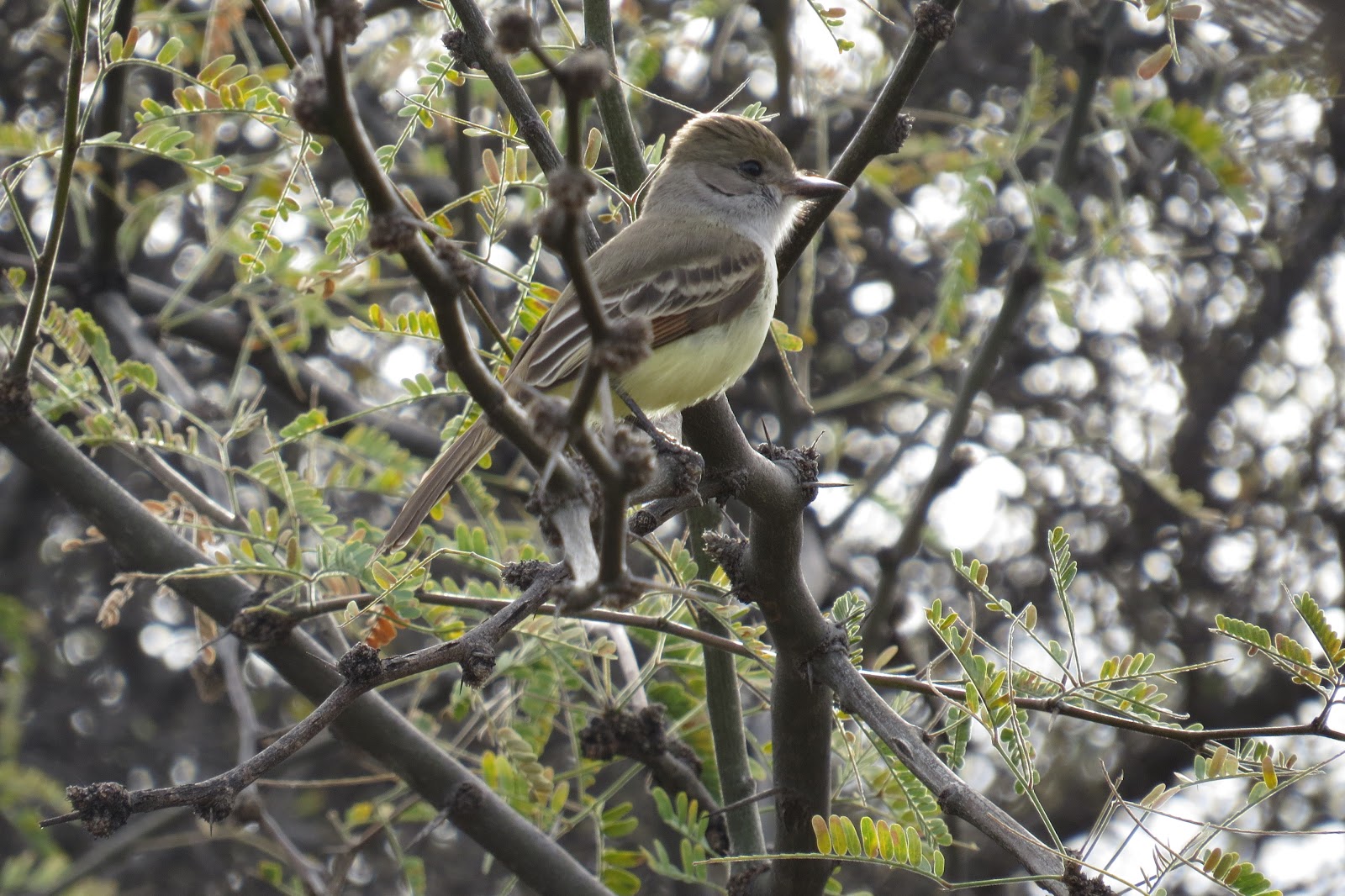
After a few hours, we came upon our target, the Nutting's Flycatcher!

Nutting's flycatcher from behind.

Nutting's flycatcher from the side.

Not only was this individual a lifer for me (the first sighting of this species in my life), but it was only the seventh record of a Nutting's Flycatcher in the United States. This individual had been sighted several times over the past week, so we were not stumbling upon it out of the blue, but it was still amazing to realize how rarely this bird is sighted north of the border.

If you want to read Rich's account of the day, and his expert tips for telling Ash-Throated and Nutting's Flycatchers apart, read his blog post here.

My sketch of a Nutting's flycatcher as a thank-you to our generous and knowledgeable host, Rich.

Cacti


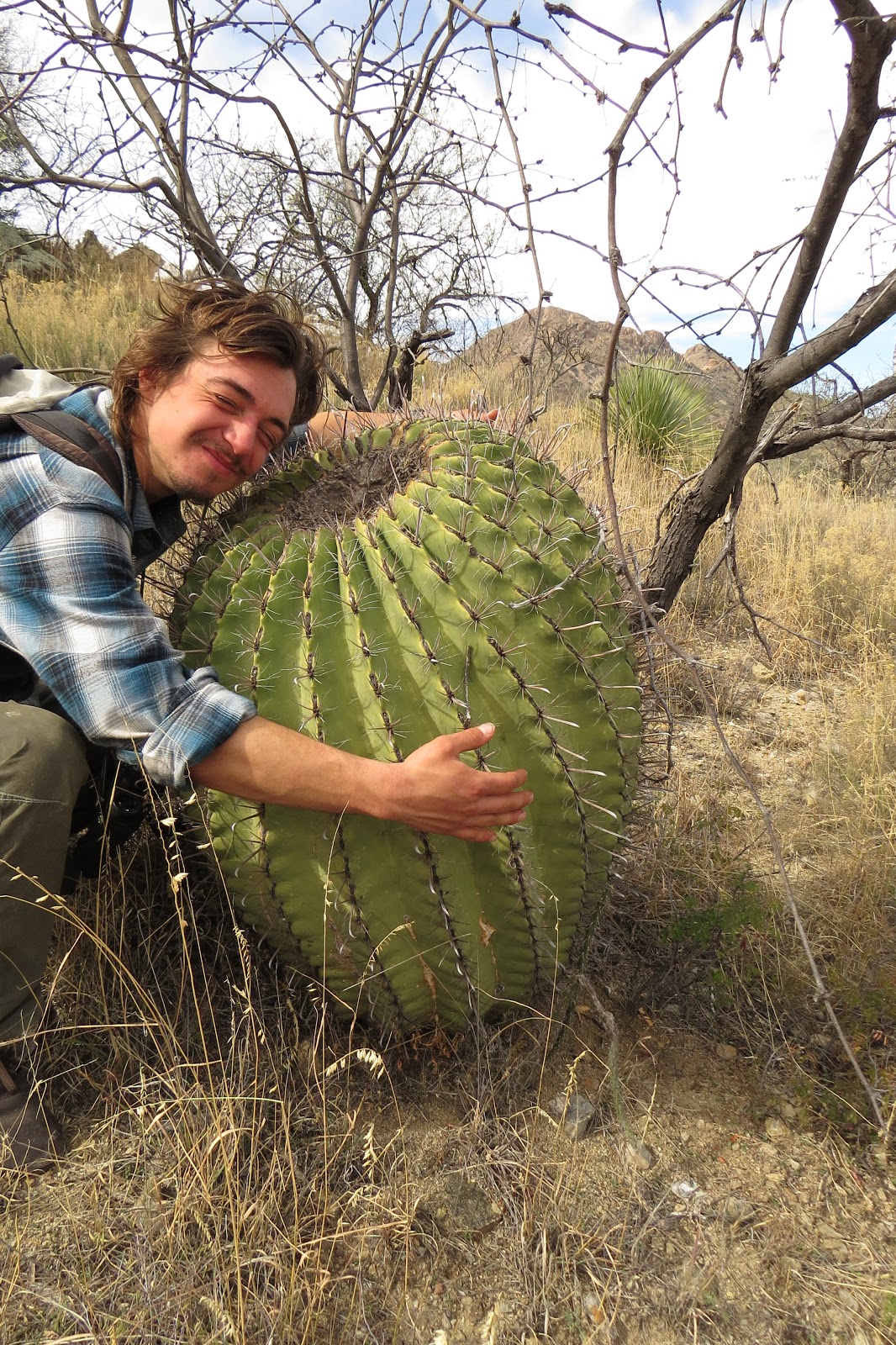
Arizona barrel cactus, Ferocactus wislizeni, often lean to the south, earning them the nickname "compass barrel cactus."

The Arizona barrel cactus has fishhook spines.

Smooth prickly pear, Opuntia laevis.

Sabino Canyon at dusk framed by saguaro.

Staghorn cholla, Cylindropuntia versicolor.

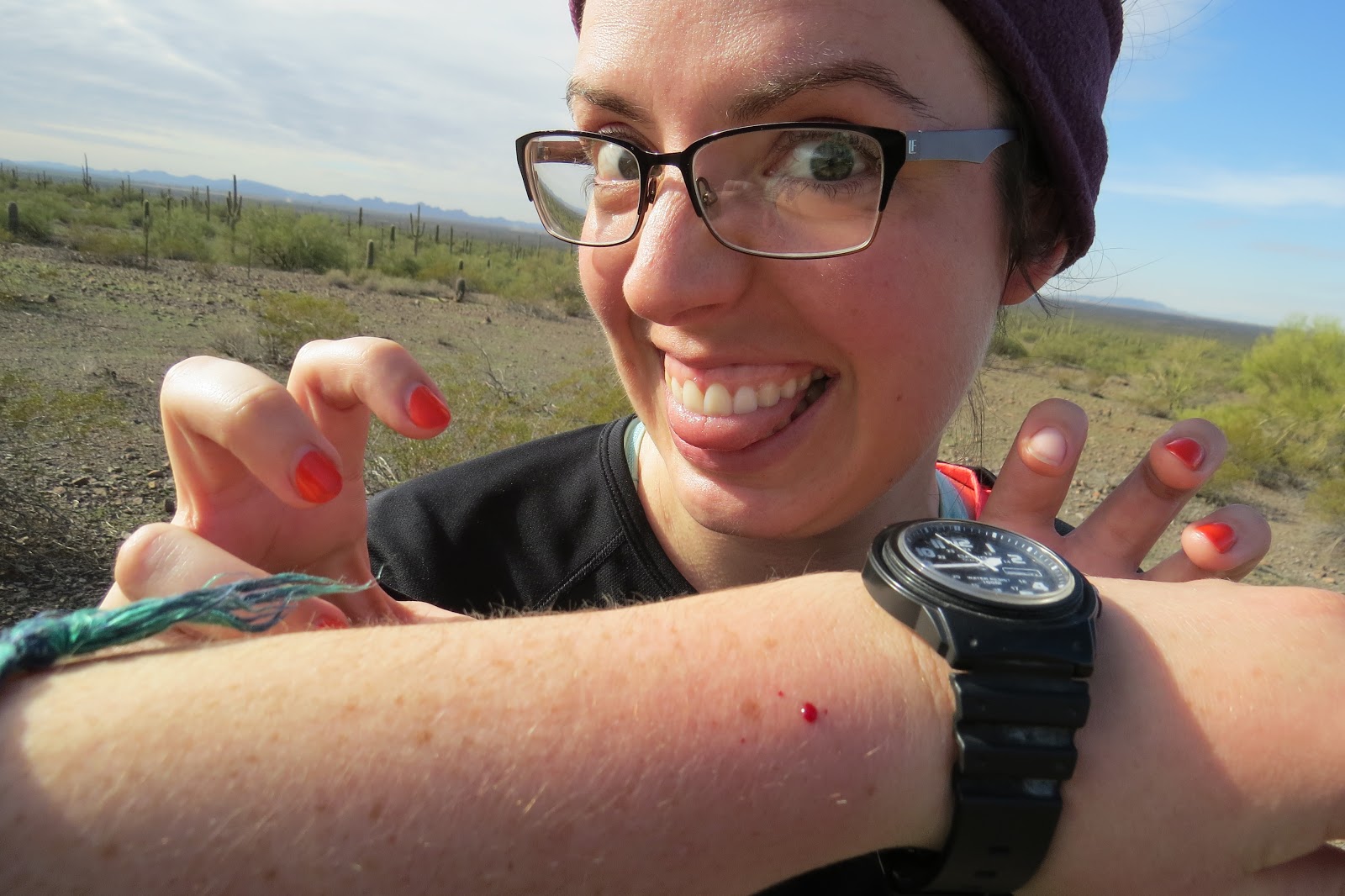
My vampiric sister, Lisa, thought the jumping cholla (Cylindropuntia fulgida) were cute and fuzzy...

So she dropped one on my hat, and it rolled onto my arm! We had to pry it out of my skin with pliers.

Arizona pincushion cactus, also known as Graham's nipple cactus, Mammillaria grahamii.

Another Arizona pincushion cactus nestled in club moss on the Tanque Verde Trail of Saguaro National Park.

This saguaro has the face of a nightmare clown!

"See you in your bad dreams..."

The trunks of saguaros are far less creepy.

Jane, Nina, and staghorn cholla.

If we were tortoises, we might take a bite of this Engelmann prickly pear, Opuntia engelmannii.

Perhaps a whipple cholla, Cylindropuntia whipplei?

A tree cholla, Cylindropuntia imbricata?

Rainbow hedgehog cactus, Echinocereus rigidissimus.

A field of starkly beautiful teddy bear cholla, Cylindropuntia bigelovii.
Share:

Popular Posts

Labels