Health Education, Health Articles, Health Blog

Showing posts with label marine biology. Show all posts

Man On A Beach

What luck! I met the Man On A Beach! He's an anonymous filmmaker who travels the coasts of Great Britain asking strangers one simple question: "What does the beach mean to you?"

Check out his excellent website, manonabeach: Journeys around the coast, to watch my answer.

Click here to visit the Man On A Beach website.

Here's the backstory.

On Sunday afternoon, I found myself fogged in on a northern Scottish isle. Here I was in Kirkwall, a town of 6,000 people and far more sheep and cows. I was supposed to continue on to the remote island of North Ronaldsay, population 65, but a white blanket of fog was making the journey impossible.

"The fog started on Thursday," the friendly Loganair employee explained. "No flights since then. Everyone who was waitin' took a ferry this mornin'."

"When's the next ferry?" I asked.

"Tha's just once a week," he told me. Darn.

"Well, you're from here," I reasoned "What does your intuition tell you? Will the fog lift soon?"

"Haven't seen fog last this long in two years," he replied with a bright smile. "So the intuition's useless!"

Four public bus rides, a full hostel, one Scottish chicken curry, and one Bed and Breakfast later, I woke up in Kirkwall to bright sunlight. The B&B owner had been right: easterlies had swept out the cloud. Our flight was good to go.

In the airport, I met my fellow passengers: an English couple who travels near the sea, a German birder who appreciates the avifauna of Sri Lanka and Scotland, and a man carrying nothing but snacks and his phone with a fuzzy microphone attached. This last individual turned out to be the Man On A Beach. He's camping in Kirkwall for a week and taking day-trips to the remote beaches, hoping to conduct an interview on each one. Serendipity at its finest.

The smallest flight I've ever taken.

An eight-seater propellor plane with one pilot.

We flew over a handful of gorgeous green isles, dotted with sheep and ringed with stone walls.

The North Ronaldsay Airport.

"Ewe are here" -- believe it or not!

A needle-felt mural in the airport shows North Ronaldsay's unique breed of seaweed eating sheep. (More on them later.)

North Ronaldsay: windswept cirrus in a big sky.
Share:

"I Dive Like a Girl, Try To Keep Up!" Celebrating Women's Dive Day in the Eelgrass of Puget Sound

Did you know that today, July 15th, 2017, is the third annual PADI Women's Dive Day?

Only about a third of certified scuba divers are women. Today I joined a welcoming and adventurous group of female divers from Seattle Scuba Schools to dive the Junkpile, a smattering of sunken debris off Alki Beach in West Seattle.

I came to the event alone, so I was paired with Hannah as my dive buddy. Diving is a great way to make friends, even though there's not much chance for conversation underwater...

These photos are to show my underwater-photography learning curve. I figured out how to take stills from a GoPro video, yay!

And so you can admire the beauty of neoprene-hood cheeks, of course.

It was my first chance to use my new GoPro, a Hero 2 I bought on Craig's List. Here's a short video of our dive through the eelgrass bed. (Sorry, no critter close-ups. My battery died before I found the sea stars.)


I adore diving in Puget Sound, even though the cold water requires bulky gear (a two-piece, 14 mm wetsuit plus boots, gloves and hood), and the green algae limits visibility to ten feet. What I love is getting to know this underwater ecosystem right next to my home, the city of Seattle.

We saw lots of flounder, a ratfish, a Dungeness crab, a striped sea jelly, and the siphon of an enormous clam. Best of all, we saw sea stars! A Leather Star, two Sunflower Stars, a Giant Pink Star (think Patrick from Spongebob), a Sunstar, and an orange star that could have been Ochre or Mottled.

This icing really took the cake.

After the dive, we were treated to a delicious summer barbecue hosted by Cathy from Seattle Scuba Schools. Now I have to go put away all my gear that's drying in the sun!

Happy, salty, hungry divers.

Share:

The Dismemberment of an Eight-Legged Giant

Our Alaskan ocean, with its cold year-round temperatures and high oxygen content, is home to some of the largest creatures in the world. One enormous mollusk happens to be as intelligent as she is large, and she's all the more intriguing for her eight arms, hundreds of suction cups, and quaint hobby of collecting shiny objects: the giant Pacific octopus.

These clever invertebrates average 16 feet in length and 110 pounds, but the record-holder was measured at 30 feet and 600 pounds! They also live longer than other octopuses, but don't expect much. They last around four years, with both males and females dying shortly after breeding.

Naturalist Kim points out an octopus den at China Poot Bay.

Octopuses live in dens that are submerged at all but the lowest tides. As a bonus, they prefer dens with two holes: both front and back doors.We were lucky to find this den at low tide. When Kim tickled the entrance with her finger, a red tentacle swooped out to investigate.

When searching for octopus dens, keep your eyes out for the midden, a trash pile of helmet-crab exoskeletons and snail shells discarded by the octopus.

Live octopuses are cool and all, but this blog is about a dismemberment, so let's get to the point!

On June 4th, a dead giant Pacific octopus washed up on Otter Rock.

The limp form of a freshly-dead octopus.

When the tide went out, I descended the rocky shore to investigate.

The octopus was smothered by another of our ocean's giants: sunflower stars! I knew these monstrous, soft-bodied stars to be predators of other sea stars, but I knew nothing of their fondness for octopus meat.

My hand for scale. The tentacles was thicker around than my arm, and the sunflower star could have covered my entire face and wrapped around to the back of my head. (I had no intentions of letting it.)

The octopus was stone-dead, but her sucker still held my finger tight was I pressed on it.

This squishy sunflower star was waiting for the tide to come back in so he could move freely over his meal.

My favorite shot. I love the juxtaposition of tube feet and suction cups: the echinodermatan and molluscan solutions for the tasks of moving around and holding on. 

Here's a video of the tube feet in action!


Three days later, the octopus had disappeared from the low intertidal zone and reappeared high-and-dry upon Otter Rock. The pair of bald eagles were spotted dragging and pecking it. The octopus's carbon was redistributed first to deep waters, then to the crown of a spruce tree, and who knows where else.

Each day I asked one of my visitors to be an octopus model -- for scale and, of course, the cute factor.

June 7th: "There it is, but I'm not touching it!"

June 8th: "There it is! Can I touch it?"

On June 8th, it smelled like bacteria were joining the food chain.

The suction cups, however, were still intact.

June 12th: my octopus models were unwilling to get any closer than this. I thought they were still brave, considering the stench and general goopiness.

June 12th was the last day our dear dead octopus was seen. Whether she got dragged into the woods by a bear or deep under the sea by a seal, or was chewed into goo by microbes during the next few tide cycles, we'll never know.

In theory, I knew that elements are recycled and dead things make up the living. But after watching the swift dismemberment of an octopus into the vibrant life of the intertidal zone I admire daily, I feel included in a secret.

On June 25th, I watched one of the three bald eagle chicks flap his wings for the first time.

Now, when I spy on our bald eagle chicks through my binoculars, I think of the octopus midden. In the chicks' emerging flight feathers, I see helmet crabs that became octopus that became eagle.
Share:

Across Kachemak Bay

Four days ago, I was fighting for a national championship with my ultimate team, the Whitman Sweets, at the National College Ultimate Championships in Raleigh, North Carolina. (We made school history and earned a silver medal!)

Three days ago, I was buying my first pair of Chacos in Seattle and stuffing polypropylene leggings into my waterproof duffel bag.

Two days ago, I was flying to Anchorage and then Homer, Alaska and settling in to my bunk room on the second floor of the Center for Alaskan Coastal Studies. I met an old friend and teammate for dinner (here in Homer, what wonderful coincidence) and fell asleep at 10:30 pm in broad daylight.

One day ago, I took a boat across Kachemak Bay to the Peterson Bay Field Station, a semi-remote campus of the Center for Alaskan Coastal Studies where I'll be living and guiding for the rest of the summer.

We passed Gull Island on our way to Peterson Bay Field Station.

Common murres were conspicuously absent in the water... and then we found them all huddled on top!

Black kittiwakes coated the cliffs and generated a constant pulsing wail.

Tufted puffins bobbed near our boat.

And this morning, I woke up to gossip of boreal chickadees, the indignant peels of black oystercatchers, and the melody of robins.

A bald eagle perches in this snag every day.

A group of eight Alaskan school-teachers are visiting for a three-day Teacher Academy. They'll take back what they learn to provide outdoor education for the students in their classrooms. It's a perfect first group for me because I get to learn about this ecosystem alongside curious educators who ask creative questions and find joy in the mucky details.

Gull Island, a pillow basalt home to thousands of birds.
Otter Rock: can you see the geological sea otter on her back, paws in the air?

Low tide.

Can you identify this dead duck head?

Our steep ramp from the dock to the Field Station.

If you're heading to the beach, take the stairs.

Our drinking water comes thrice-filtered from this steam, but it's still imbued with a rich brown color from leaf tannins.

Today we have a minus 3.2 tide at 7:30 am -- that's really low. We're off to Otter Rock to seek out the Fab Four Phyla and whatever else crosses our path!
Share:

Going with the Flow in Juneau: Day Fifteen on the Alaska Road Trip

I would like to begin this blog by highlighting my stupendous mom who made this whole trip possible and amazing and awesome.

Everybody, Jane in two habitats:

Jane birding on Mt. Roberts.

Jane and her alter-ego, the giant hoary marmot.

Thanks for everything, Mom! I love you!

Ok, now for the Day Fifteen update. Juneau was lovely and vital and full of people who seemed really happy to be there. Our friend Marna and her two daughters live in a house on a crooked street in a quirky neighborhood filled with steep hills, flower gardens, dead-ends and staircases. The waterfront, quiet in the morning, soon filled up with four enormous cruise ships, each of which disgorged a thousand passengers onto the quaint downtown streets to shop for jewelry and trinkets.

Jane and Marna on Basin Road.

Marna was impressed by the fast-paced road trip schedule we’d been keeping, so she gave us four different attractions to pack into our day. “My family would take on one of these in a day,” she told us, “but for you guys, no problem!” We started with a walk up Basin Road, a street that soon became a cantilevered wooden track under sheer cliffs of moss and precarious forest.

We then headed down the hill to the waterfront, where we caught the first tram up to Mount Roberts. It’s unbelievable how steeply the mountains rise around Juneau!

Looking down the tram wires from Mt. Roberts.

The network of alpine trails could take a backpacker weeks to explore, so we saw just a snippet with breath-taking views and a handful of shy songbirds. The Lobaria lichens were the lushest, greenest, shiniest, most lung-worty specimens I’ve ever seen!

So green!

Nice ascocarps!

We looked for willow ptarmigans, but instead found another thrush. We should be getting good at these guys by now, but we still can't tell... is she hermit or gray-cheeked?

Birders, what do you think: hermit or gray-cheeked?

We left, before we had seen enough, to catch the 1 pm tour of the NOAA (National Oceanic and Atmospheric Administration) fisheries science building. Compared to dramatic clifftops, touring a government building may sound dull, but I love seeing NOAA labs, and my mom indulged my strange request.

Compared to the NOAA Northwest Fisheries Science Center where I worked this summer in Seattle, the Juneau building was state of the art. A mural of 50 life-sized model fishes from the region adorned the lobby’s wall. Four projectors shone on a globe-shaped screen to give the impression of a rotating earth. We got to watch NOAA’s “Science on a Sphere” presentation about the world and climate change here.

Science on a Sphere and the fish wall.

The wet lab contained touch-tanks of my favorites, including a sunflower star, Pycnopodia helianthoides. The biology and chemistry labs were staffed with friendly, busy scientists, and the lobby’s aquarium contained the largest leather star, Dermasterias imbricata, I’ve ever seen.

Jane examines squid eggs.

Two sculpins, a great (Myoxocephalus polyacanthocephalus) and a buffalo (Enophrys bison), cuddle puddling.

The building is heated by an efficient heat-exchange system that draws energy from the chilly waters of Gastineau Channel. In winter, it also recaptures heat blowing up through vents from the chemical hoods. The conference room has a glass wall overlooking the ocean, and our tour guide told us he gets too distracted by breaching whales when he sits facing that way. What a life!

I want this poster for my wall!

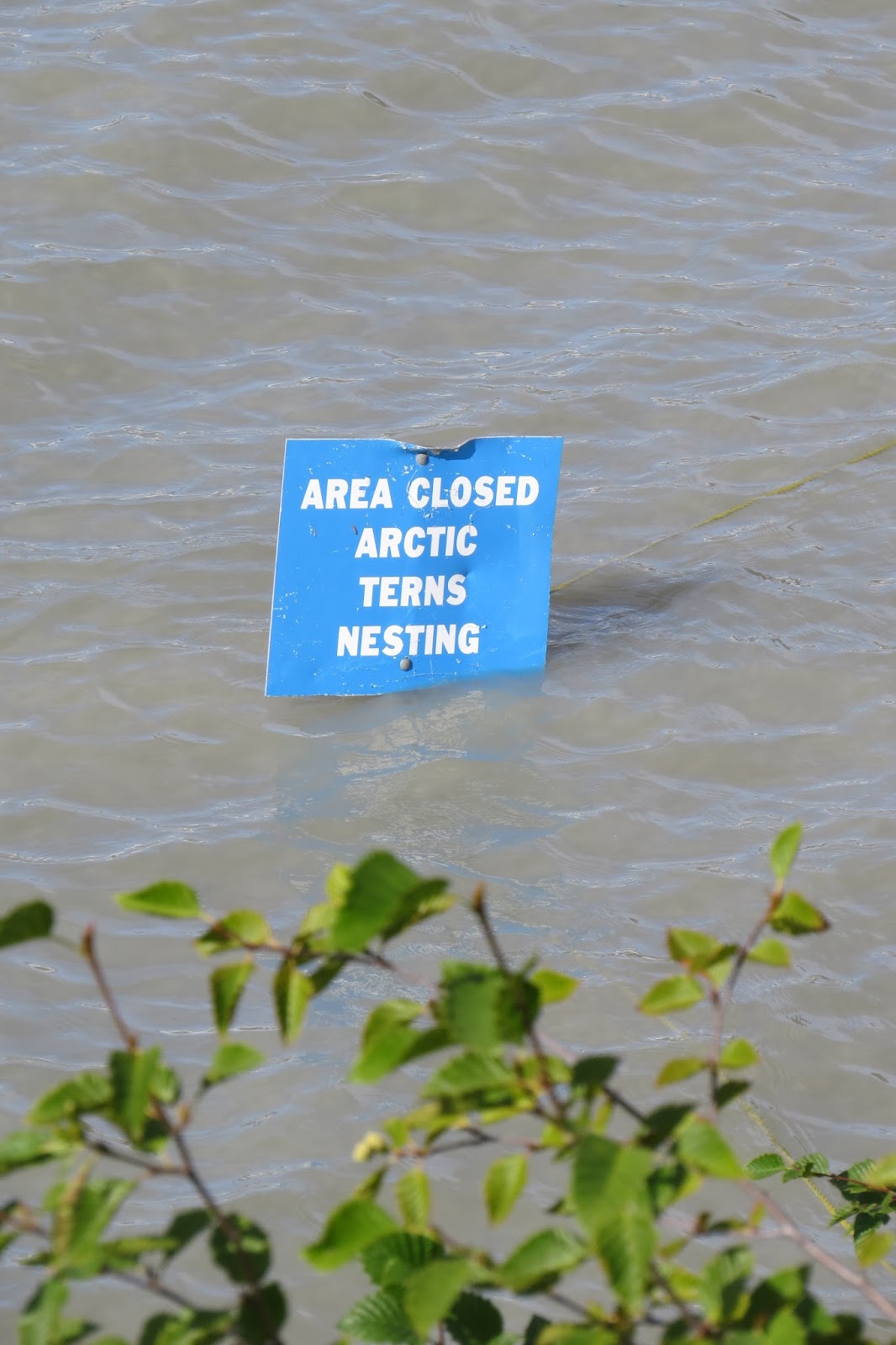
After the tour, we headed straight to Mendenhall Glacier. Two of the four trails were closed: one for bears, the other for flooding.

Mendenhall Glacier melts into Mendenhall Lake.

I think these terns may have been flooded out of house and home.

We fought our way through the crowd of cruise-boat tourists for a look at the receding blue ice, admired the icebergs she had calved into Mendenhall Lake, and moved on to the stream.

Red squirrel munching on a mushroom.

Here, bright red sockeye salmon were spawning! The waters were so shallow over the river rocks that the salmon had to expose their dorsal halves in their frantic push to move upstream. Several white carcasses rotted on the banks. I realized that I had never seen a healthy stream of salmon before! I’ve learned about these fish since grade school, visited the fish ladder at the Locks, witnessed the life stages at the Seattle Aquarium, watched documentaries about the fate of Alaskan salmon if Pebble Mine is dug… but here in front of me were the real thing, unaware of their symbolism, just trying to reproduce like the rest of us. I wish you the best, big sockeyes!

A sockeye too large for its small stream.

As we watched salmon from the bridge, a National Forest ranger approached us. “Are you looking for birds?” she asked. Finally, a ranger-ornithologist! Together we spotted juncos, yellow-rumped warblers, a Pacific slope flycatcher, and a western wood-pewee. She gifted us a Birds of Southeast Alaska checklist and recommended a trail for dippers.

Pacific slope flycatcher.

Western wood-pewee.

We were in luck. As we walked back to the parking lot, we passed a secluded bridge over another stream. The tree branches dripped with lichens, and the soil embankment was caked with emerald moss. “If I were a dipper, I’d live here!” I told my mom. “Oh my gosh, there’s a dipper!”

Ideal dipper (and Nina) habitat.

There she was, popping in and out of the clear water, the droplets rolling off her graphite back. A bird that loves mossy streams! I am so fond of dippers.

Dipping for bugs.

Ahhh!

Now back to Marna’s for a mouth-watering salmon dinner. Our first home-cooked meal. And after that, a jaunt back up the tram (tickets are good for the whole day, so we wanted to get our full use!) for sunset on Mount Roberts.

Gastineau Channel at sunset.

Looooong shadow dancers.

I think this black leafy stuff is tree pelt lichen, Peltigera collina.

We were hoping to get to bed early, but at 10:30 pm I realized I couldn’t find my (dead) iPhone, so I spent half an hour tearing apart my suitcase, the car, and everything in the room. Finally Annabelle (that’s my iPhone) appeared in the folds of an emergency blanket in the trunk of Prius. Oh, what can you do when inanimate objects play pranks on you…

End of day summary:
  • Day of road trip: 15 
  • Start: Juneau, Alaska, United States 
  • Miles traveled: 45 
  • Hours driven: 1 
  • Favorite bird sighting: American dipper 
  • End: Juneau, Alaska, United States
Share:

Popular Posts

Labels