Welcome to a most marvelous collection of living dinosaurs, the avifauna of the Cerrado, os pássaros, the birds!
I've named each species in English and Portuguese. All were identified by me, my camera, and my trusty book, A Field Guide to the Birds of Brazil by Ber van Perlo (2009). If you see any errors, oh PLEASE comment! I will be delighted for corrections and suggestions, especially on the mystery LBJs (little brown jobs, for you rookies out there).
Edit: this post has been drastically improved by the comments of Rich Hoyer (of Birdernaturalist) and Maris Benites (of Instituto Mamede Pesquisa Ambiental e Ecoturismo). Thank you for your help! I am lucky to have such bird-brained (in the finest sense) friends.
And that's not all folks. Did you think I would forget....
I've named each species in English and Portuguese. All were identified by me, my camera, and my trusty book, A Field Guide to the Birds of Brazil by Ber van Perlo (2009). If you see any errors, oh PLEASE comment! I will be delighted for corrections and suggestions, especially on the mystery LBJs (little brown jobs, for you rookies out there).
Edit: this post has been drastically improved by the comments of Rich Hoyer (of Birdernaturalist) and Maris Benites (of Instituto Mamede Pesquisa Ambiental e Ecoturismo). Thank you for your help! I am lucky to have such bird-brained (in the finest sense) friends.
 |
| Rusty-margined guan. Jacupempa. This gangly black bird was perching on a bush at the beginning of the Quinta do Sol driveway and swallowing large berries whole. The bush rustled and shook whenever this behemoth took a step. |
 |
| Yellow-headed caracara. Carrapateiro. In Portuguese, the name means "ticker" or "tick-eater," though I'm not sure if that's an accurate dietary description. This tropical raptor was perched in a legume tree next to the "upstairs" (big house up the hill) at Quinta do Sol. |
 |
| Green-barred woodpecker. Pica-pau-verde-barrado. I love the red, white, and black face on this friend. It reminds me of Arizona's acorn woodpecker a bit. This bird was diligently pecking for insects on a tree in our backyard. |
 |
| Edit: Blue-black grassquit. Tiziu. This was mystery bird number one until Maris commented. Thank you! The bird had a thick bill, streaked belly, and brown color. The size of a sparrow. It was hopping about in the branches of a small shrub in the yard. |
 |
| Edit: Brown-crested flycatcher. Maria-cavaleira-de-rabo-enferrujado. This flycatcher perches and fly-catches from the large front-yard tree every evening before sunset. He is one of the Myiarchus flycatchers, if you recall the genus from my Arizona post about Humans who Love Birds who Love Cacti. Thanks, Maris, for the correction! |
 |
| Great egret. Garça-blanca-grande. The large white heron is one of the few species found both here in Cerrado and at home in the United States, though seldom as far north as Seattle. This one is taking off from a roadside pond. |
 |
| Southern lapwing. Quero-quero. This bird, found at the same pond, did not take off. Southern lapwings are bold and common everywhere I've been, from the city of Campo Grande to the countryside of Corguinho. The Portuguese name is onomatopoeic for their call. |
 |
| Buff-necked ibis. Curicaca. This bird is even more common than the southern lapwing. When flying, it has the large, black profile of a witch on a broom with trailing robes. It dines in cattle pastures and roosts en masse in trees right next to bedroom windows... |
 |
| White-rumped monjita. Noivinha-branca. The Portuguese name means "white bride," but the English name is actually a Spanish word meaning "white-rumped little nun." If I were this bird, I would probably stick to Portuguese! |
 |
| Toco toucan. Tucanaçu. This bird is the largest toucan in Brazil and the most common around here. It flies, front-heavy with its giant orange bill, over the school yard and around town. Lygia holds a grudge against it because, she says, it eats ovo de ararara (macaw eggs), but I forgive it. Gotta get all the protein for that bill somewhere! |
 |
| Chestnut-eared aracari. Araçari-castanho. This small, greenish toucan has a saw-patterned bill and a clear blue eye. I found it in the fruit tree behind a rancher's house while I conducted an interview about his cats and dogs for my disease research. People are very understanding when I have to leap up in the middle of a conversation to take a photo of a bird. |
 |
| Amazon kingfisher. Martim-pescador-verde. This oil-green kingfisher is an old friend from the Ecuadorian Amazon. I'm amazed to see him here, in the dry riparian forests of Cerrado, but I suppose a river is a river. This sighting was all the more special because of my vantage point over a thundering waterfall. |
 |
| Prime kingfisher-watching spot. |
 |
| Planalto hermit. Rabo-branco-acanelado. A large and somewhat drab hummingbird until you see the tail. I'll try to get a photo of it in action. It splays out in a white and orange splash, like an elaborately-tatted lace doily. |
 |
| Edit: Ruddy-breasted ground dove. Rolinha-roxa. Female. This bird was a semi-mystery, solved by Rich and Maris. I'd thought this bird might be a plain-breasted ground dove (rolinha-de-asa-canela), but there were some signs it was a ruddy dove, like a "rufescent rump." |
 |
| Snail kite. Gavião-caramujeiro. This kite was perched over a wetland in Assentamento Camponesa Liberdade ("Freedom Peasant Settlement"), one of the government land-redistribution communities I wrote about earlier. (My understanding of settlements has been updated quite a bit after spending time in them, so stay tuned for another post.) |
 |
| Blue-and-yellow macaw. Arara-canindé. They nest in the broken-off tops of palm trees and preen each other to show affection. These macaws are doing better than other local species because they are generalists, and broken palm trees aren't hard to find (yet). |
 |
| Edit: Vermilion flycatcher. Príncipe. Female. This streaky LBJ was mystery bird number two until Rich gave the ID. She was perched over a wetland. I'll try to photograph the flashy, ruby-red male soon. |
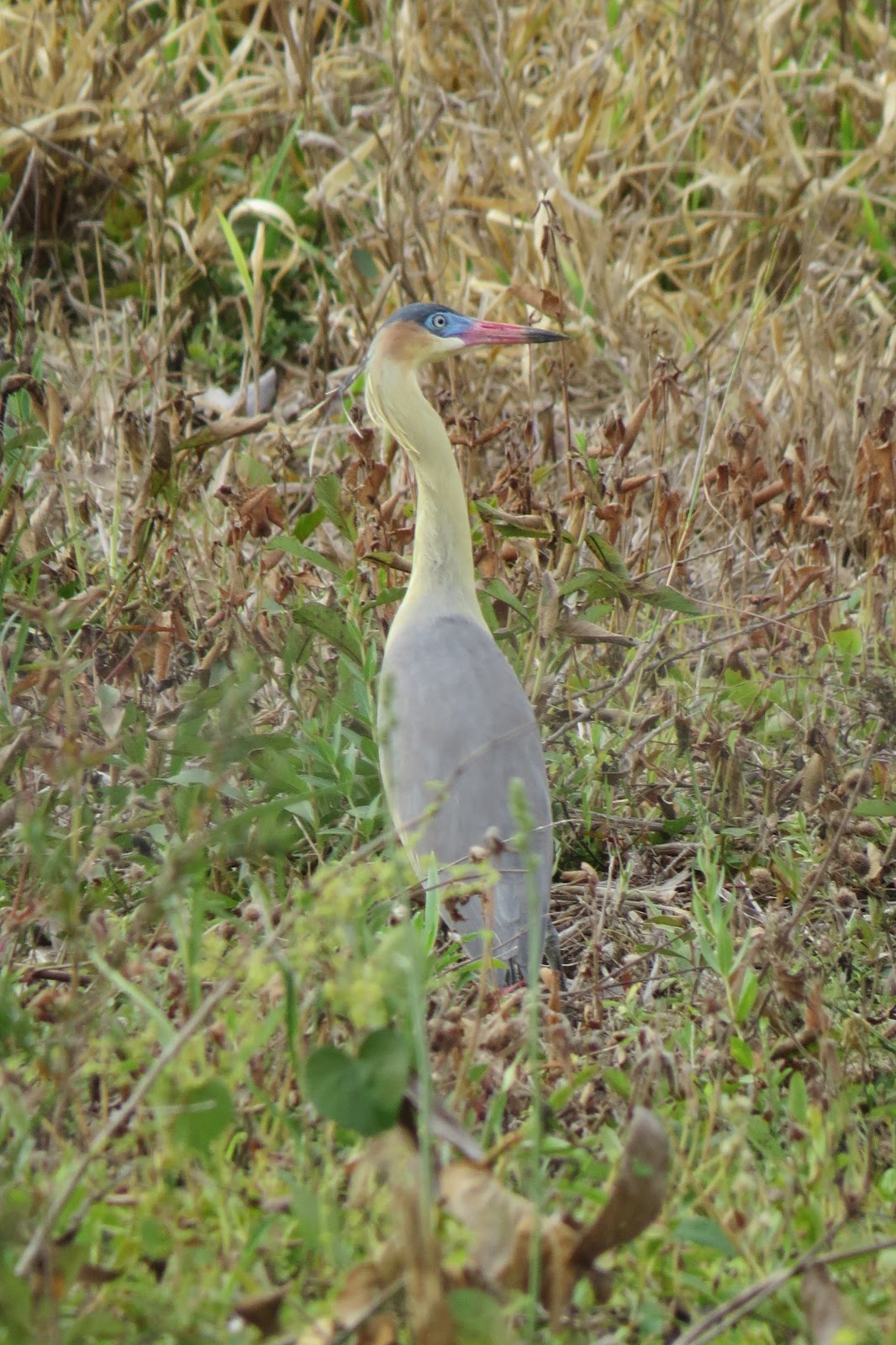 |
| Whistling heron. Maria-faceira. This heron looked very composed in its cerulean mask, until... |
 |
| ... it got the sudden urge to shake and erect all its feather on end, turning its silhouette from a sleek statue into something cuddly I would have liked to hug. |
 |
| Brazilian teal. Pé-vermelha. A small, somewhat common duck in roadside ponds. The male has crayon-red bill and legs; the female has white spots painted on her face. |
 |
| Great kiskadee. Bem-te-vi. This bird calls its Portuguese name constantly, like a braying donkey. It means, "I saw you well." This flycatcher is watching you, and it wants you to know. |
 |
| Campo flicker. Pica-pau-do-campo. This woodpecker likes to check bark for bugs in pairs. How cute. |
 |
| Another view of the campo flicker. I wasn't surprised to discover that this woodpecker is a flicker, like the familiar northern flickers of my home in Seattle. Both species hop along the ground checking for ants. (A note on diet: this species has been observed eating quite a few termites, but a study of its stomach contents revealed only ants and ant eggs. Maybe it just plays with the termites?) |
 |
| Peach-fronted parakeet. Periquito-rei. Here is a quick tip from Duca on how to tell apart members of the parrot family. Macaws are big with long tails. Parrots have short tails. And parakeets have long tails and long wings. |
 |
| Hyacinth macaw. Arara-azul-grande. Of the three macaw species here, this one is the rarest. Its population dropped to 1500 birds in the 1980s due to capture for the pet trade, but it has since rebounded to 5000 individuals. It's the longest parrot in the world, measuring 3.3 feet from tip of bill to tip of tail. And, to its detriment in Anthropocene Epoch, this macaw is a specialist, requiring cavities in old-growth manduvi trees to nest. These palms are becoming rare due to deforestation for cattle pasture. Check out the Wildlife Conservation Society's work to provide nest boxes. |
 |
| Blue-crowned motmot. Udu-de-coroa-azul. I saw this bird in a creek valley, deep in the humid forest called Vale do Bugio, Valley of the Howler Monkeys. I didn't see any howlers, but I did encounter an other-worldly slot canyon, towering walls of moss, and the bloated bodies of seven dead bats. More to come in the next blog post on that. |
 |
| Helmeted manakin. Soldadinho. He flitted in the same patch of gallery forest as the previous bird, and the next. It was a very birdy moment. |
 |
| Edit: Grey-headed tanager. Pipira-da-taoca. I previously misidentified this bird as a female white-shouldered tanager; thank you to Rich for the correction! A field guide and a camera are no substitute for years of experience in the field. |
 |
| Roadside hawk. Gavião-carijó. This is one bird that is true to its name. |
 |
| Chalk-browed mockingbird. Sabiá-do-campo. These mockers hopped around the entrance to an alien-themed town of aluminum-dome houses called Proyecto Portal. More to come, I promise. For now, just know that an extraterrestrial creature named Bilu hangs out here, and the end of the world is coming in the form of strong winds. Oh, and the earth is flat. |
 |
| Edit: Golden-crowned warbler. Pula-pula. This one was mystery bird number three. It was hopping around in riparian bushes, right next to a creek. The behavior was similar to a northern waterthrush, but those are exceedingly rare here. Interestingly, this bird is shown in my book as a white-bellied warbler (pula-pula-de-barriga-branca); the two species were recently lumped together into one. |
 |
| Flavescent warbler? Canário-do-mato. Another I'm-trusting-the-book identification. The yellow eyebrow, red legs, and riparian habitat were my indications, but I'm still calling this one with a question mark. |
 |
| Pale-breasted thrush. Sabiá-barranco. This bird a distinctly robin-like jizz (that's overall countenance, to you non-birders!) with a grey hood and rufous back. It was hopping and pecking in a shallow, paved part of the creek that went under a bridge. |
 |
| Helmeted guineafowl. Galinha angola. These birds are domestic, basically useless chickens that make a LOT of squeaky noises and look pretty. |
 |
| Bare-faced curassow. Mutum-de-penacho. A big ol' bird. This one was wild, but it didnc't mind strutting around with the guineafowl to find cracked corn. |
 |
| Rufous-bellied thrush. Sabiá-laranjeira. A glorified robin, if you ask me. The national bird of Brazil. |
 |
| Edit: Sayaca tanager. Sanhaçu-cinzento. Previously misidentified by me as a palm tanager. Thanks, Rich! |
 |
| Chopi blackbird. Graúna. That pointy beak though. |
 |
| Plush-crested jay. Gralha-picaça. An exotic-looking bird that's as common as a blue jay, and commonly called by that name. |
 |
| Smooth-billed ani. Anu-preto. A jokester with a jaunty expression on its wide bill, and a sweeping black tail I would expect on Katy Perry at the Met Gala. |
 |
| Small-billed tinamou. Inhambu-chororo. This round bird scuttled in the underbrush like a rail, but its down-curved bill, spotted underside, and rufous back make me think tinamou. |
 |
| Rufous hornero. João-de-barro. The English common name means "baker" (in Spanish) because this bird constructs sturdy mud nests that look like clay ovens. I'll get a picture soon, they're all over the telephone poles. The Portuguese name means "Neighborhood John," a sweetly familiar moniker. |
 |
| Scaled dove. Fogo-apagou. The perpetually-ruffled look called "scaling" comes from a dark edging on the wing and body feathers. |
 |
| Grassland sparrow. Tico-tico-do-campo. Looks like a savannah sparrow, doesn't it? |
 |
| Red-crested finch. Tico-tico-rei. Maybe I'm just getting homesick, but this guy reminds me of a house finch. |
 |
| Red-and-green macaw. Arara-vermelha-grande. Nope, Dorothy, we're not in Seattle anymore! This bird's backside coloration is like a cold rainbow snowcone before all the syrup drips to the bottom. |
And that's not all folks. Did you think I would forget....
Dad's Daily Bug?!
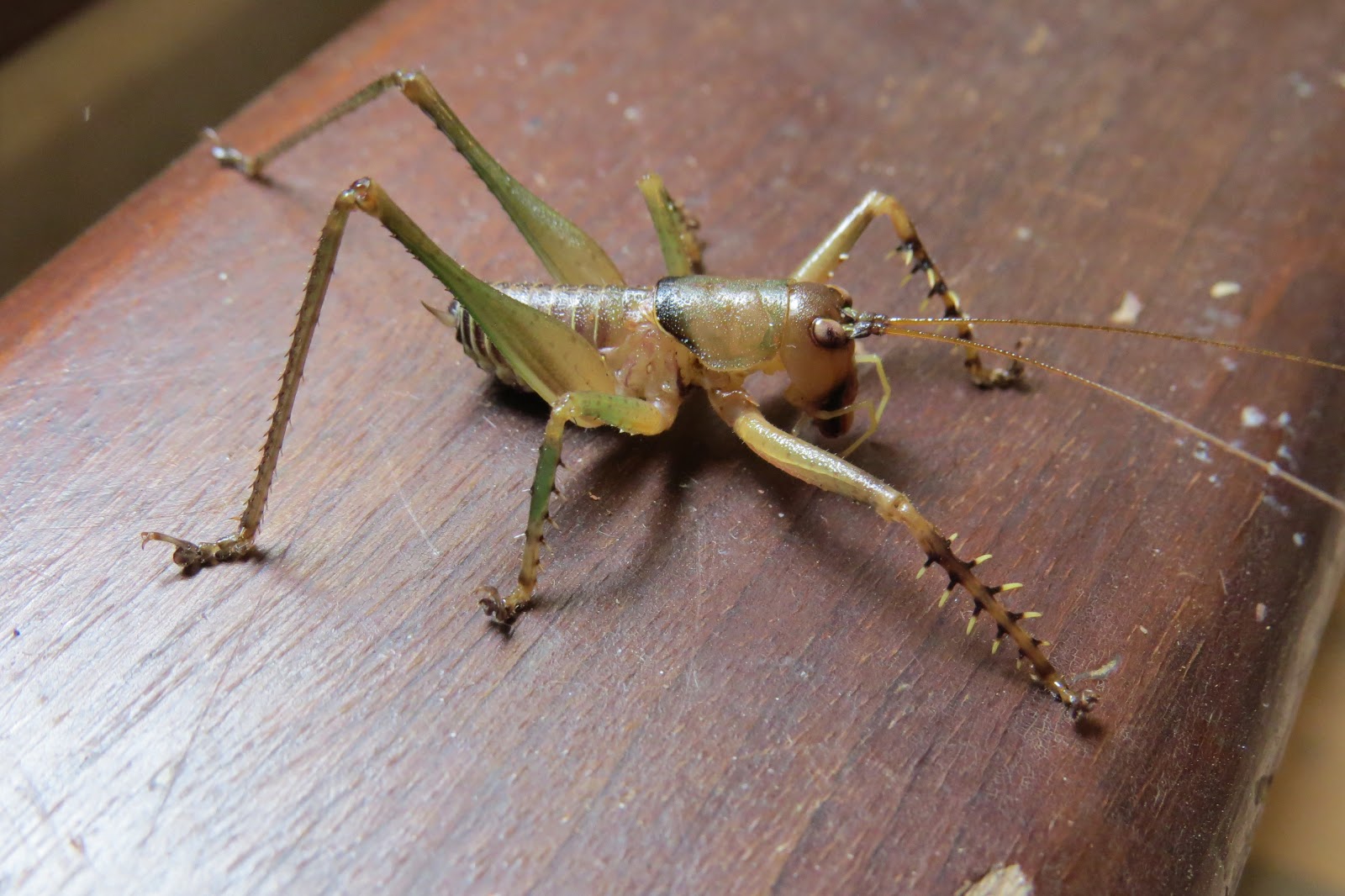 |
| A large and armor-legged cricket that lives in my bedroom. Isn't her green tinge dapper? |