Health Education, Health Articles, Health Blog

Showing posts with label algae. Show all posts

A Wild Volvox

Seldom does a day pass when I fail to learn something new from the guests on my tour. Today, a pair of freshwater ecologists from Chicago taught me about the life of Lost and Found Lake.

A dragonfly's-eye view of Lost and Found Lake.

Our dragonflies live four to five years as nymphs, chomping on mosquito larvae and overwintering in lake-bottom muck. They molt from nine to twelve times before finally emerging as royal-blue, winged adults. They fly for one summer before dying in the frosts of fall.

Damselflies go through a similar process but spend only two to three years as nymphs, a stage in which they have three tails and long, wriggly body. We found dragonfly and damselfly nymphs when I scooped lake water into my frisbee. (Just one more reason why you should never leave home without one!)

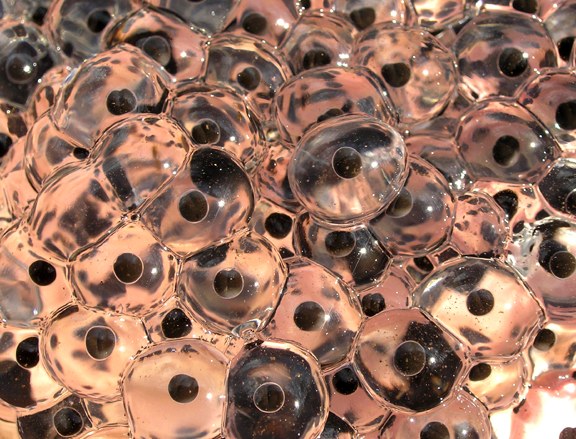
But the most incredible discovery of all came from the ecologists' daughter who scooped a firm, transparent goo blob from the lake. I'm used to unidentified blobs in the intertidal zone, but in freshwater I was out of my element.

Frog eggs? Nope, we have only one amphibian in Alaska (the wood frog, Lithobates sylvaticus) and its eggs look more like clear grapes with a black dot in the middle.

Snail eggs? Perhaps, though I've never seen a snail in this lake.

Then I looked closer. Thousands of tiny green dots were aligned within the blob, perfectly ordered like soldiers on the march. At the edges of the blob, where upper and lower surfaces overlapped, the dots gave a mossy sheen to the blob.

Could it be... Volvox? The spherical, chlorophytic protist from introductory bio lab?

The ecologists and I leaned in. "Look, it has five gas bubbles trapped inside!" one exclaimed. "I think it's respiring!" Oxygen building up inside was the final clue, and the blob was proclaimed to be Volvox.

A wild Volvox!

I sacrificed my water bottle for our new friend's transport. Back at the field station, we peered through a microscope to see the tiny green dots up close. They didn't look round, but rather like commas, and they jiggled like worms trapped in a force field.


Volvox is an important tool for biology education because it displays both sexual and asexual reproduction. Asexual reproduction is cooler: miniature, spherical daughter colonies form within the parent blob and are released into the world.

Scientists think Volvox switched from a single-celled organism to a communal enterprise about 200 million years ago, and research into that transition is providing clues about how the evolution of cooperation allowed our single-celled ancestors to become the plants and animals of modern times.

It always startles me to see laboratory species in the wild. The same thing happened with slime mold. In high school, I made mazes for slime mold using oats and Petri dishes, then filmed its decision-making with a time-lapse camera. Slime mold was recently featured in Nature for redefining intelligence! Now, on my daily hikes, I notice slime mold inching around the rotting logs of its home, the coastal temperate rainforest.

A banana-yellow slime mold seeks shade in the forest of Peterson Bay Field Station.

Watching slime mold and Volvox do their thing in the wild reminds me of the importance of intact ecosystems. Without old-growth rainforests and healthy lakes, scientists would never have encountered these model organisms that have led to dozens of laboratory-based discoveries and a better understanding of topics ranging from memory to cellular reproduction to our own evolution. 

Imagine how many more organisms are out there in unexplored regions of the Amazon, the Arctic, or the deep sea. Who knows what strange life form is going about its daily business of eating, competing, and reproducing, just waiting to be discovered next?
Share:

Spaghetti Worms on Sinclair Island

We leaned over the front panel of the aluminum boat in anticipation, pretending to be porpoises or just enjoying the sea smells. Islands dressed in Douglas firs passed us left and right: Guemes, Cypress, Dome. Salish Sea droplets sprinkled our arms and evaporated with the wind, leaving behind powdery jewels of salt.

Our boat landed directly on the rocks of Sinclair Island. In front of us stood a grassy lawn and wooden cabin where we would spend our weekend as grateful guests of Margo, Zach, Mike and Marni Heffron.

 The gang standing atop the lookout tower in the Sinclair Island meadow. From left to right: me, Annie, Mel, Margo, and Zach.

I had a track workout to run for my ultimate team, Seattle Underground, so I did it Sinclair style: sprinting after the back of a tractor.

Zach took the workout to a new level, pouncing onto the tractor like a hungry jaguar.

Annie "Annie Want" Want, everybody. #nevernotcute

Check out the intense baby-blue eyes.

Ms. American Robin eating an earwig.

Mr. White-Crowned Sparrow singing from a post.

Margo took me tide-pooling on her beach...

We were two happy clams.

Fair warning: all the intertidal identifications in this post are based on my favorite field guide, Seashore of the Pacific Northwest, and my own limited experience. Don't take them as certain, and if you see a mistake, don't hesitate to let me know.

This rock had a rockin' hairdo.

I could not find this bubbly brown algae in my field guide anywhere... Then I read the description for the shaggy, needle-like "black pine" (Rhodomela larix) and learned that it is often found with the strictly epiphytic Soranthera ulvoidea growing on top of it. So that's what you see here. There is no limit to the mysteries you can solve in the intertidal.

I found this lovely wrack, either Saccharina latissima (sugar kelp) or Saccharina bongardiana (split kelp), but I am not qualified to differentiate between the two.

Whatever its species, it certainly does have a nice hold on its rock.

Rockweed, a species in the Fucus genus.

A small dungeness crab (Metacarcinus magister) exoskeleton.

Margo convinced Mel and me to stick our tongues into the centers of an aggregating anemone (Anthopleura elegantissima) and they stung for an hour... Don't try it at home.

This red rock crab (Cancer productus) was high and dry on the shore, but it still made eating motions with its claws. I don't think it was healthy.

Limpet with a green mohawk, my dream hair style. Someday...

Frilled dog whelks (Nucella lamellosa) having a snail party.

I was delighted to find a northern clingfish (Gobiesox maeandricus), the research subject of two of my favorite people, Lisa Truong and Christina Linkem. You can follow those links to check out their Friday Harbor Labs research papers and learn all about clingfish ecology.

A red sea cucumber (Cucumaria miniata) with its oral tentacles partially extended. It uses them to filter the water and bring food particles back to its mouth.

The namesake of this post, the infamous spaghetti worm (Thelepus crispus), spread its thin web of tentacles out from the sand like a blob of pasta. I dug it up and discovered its body coated in a protective mud tube.

A baby green urchin (Strongylocentrotous drobachiensis) J-chilling and looking spiny, as it does.

Hello hermie!

We don't have any true eels in the Salish Sea, but this black prickleback (Xiphister atropurpureus) looks kinda like one.

These four fellas arranged themselves nicely for a comparative photo shoot of phyla. From lower left to upper right, we have an arthropod (the kelp crab, Pugettia producta), an echinoderm (the green urchin, Strongylocentrotous drobachiensis), a mollusc (a chiton), and a cnidarian (a closed anemone).

I was thrilled to find a population of healthy, vibrant purple sea stars (Pisaster ochraceus) when most of the species is currently suffering from an epidemic of sea star wasting disease.

Mel uncovers another healthy purple star...

...and helpfully points out the madreporite, the entry point for the sea star's water-vascular system. Sea stars use a mixture of seawater and cells, known as coelomic fluid, to move nutrients around their bodies rather than blood.

Even more abundant were the six-rayed stars, Leptasterias hexactis.

What a cutie.

Oh hey there.

This guy was not doing so well. I wonder how he lost two of his arms -- hopefully not because of wasting disease, since this species appears to be immune.

The coolest discovery of our voyage, in my humble opinion, was this dead fish.

It was huge! And orange! And very dead. After a little research, I believe it was a threatened yelloweye rockfish (Sebastes ruberrimus), one of the largest and longest-lived fishes in the Salish Sea. According to NOAA, they can live up to 118 years.


I relived the glory days of my front-porch lab in Ecuador (for some reason, my most popular blog post ever) as I inspected the fish's anatomy in detail. Here are the pads of spiny teeth on the maxilla, or upper jaw bone.

Here are the gills.

Look at those gill arches and and filaments.

Before the day was over, I took a moment to step back and admire the lovely intertidal zonation of the beach.

Here's a perfect example of an ecotone, a sharp boundary between two ecosystems. You might think of the tree line on a tall mountain, or the edge of a river. Here the ecotone between eelgrass and black pine/ulva seems to be the depth of the rock pool.

As you can see, our excursion to Sinclair Island was a success. Let's go seaweets!

Just as we were pulling away in the aluminum boat, this western tiger swallowtail (Papilio rutulus) showed up for a drink on one of Marni's beautiful pink flowers. See you next time, lady.
Share:

The Fruit Barn, Dead Geese, and a Bobcat: We're Off to Big Sky!

Finally, at three on Friday afternoon, the car was packed. Amelia had finished her environmental methods paper, Anna had ordered us take-out sandwiches from Graze, Galen had found his cross-country ski boots, and I had arranged all my plants in the living room for a friend to water over spring break.

We were off!

Taylor Swift dominated our soundtrack as we drove out of Walla Walla, through rolling brown wheat fields with thin green shoots, and past the stench of the Wallula Paper Mill. We stopped at one of the famous eastern Washington fruit barns for salted caramel and peanut butter fudge, honeycrisp and pink lady apples, and a cultural experience.

Galen and Amelia show off our $16.95/pound fudge and the endless racks of jams, jellies, and fruit butters.

I sampled chocolate-covered mangoes and chili-spiced almonds. (The elderly man next to me declined the almonds, citing his "gringo palate.") A customer at the soda bar received a jumbo-sized Pepsi cup stuffed with ice cream, and two enormous scoops were balanced on top. My cashier asked if I'd like my apples rinsed -- to remove the pesticide residue, I assume. The parking lot was home to a herd of absurdly long-horned cattle.

The warehouse of chocolate candies and canned fruit products made me dizzy. I asked the young woman who cut my quarter-pound chunk of fudge if she ever had to throw away unsold chocolate. She told me, "Never! I've never seen a batch last more than a couple days." These fruit barns are a quirky phenomenon.

As darkness fell, we continued north into Ponderosa pine forest. We stopped at the Sinclair Dino gas station in the impossibly sleepy town of Mullan, Idaho where we met the friendly young cashier who let me roll out my sore leg muscles on the floor. We filled the tank, thanked him, and left -- only to return in three minutes for directions.

It was my turn to drive on the dark stretch of I-90 East over Lookout Pass, the border between Idaho and Montana. Just after we crossed the state line, a bobcat ran across the road in front of us! She was the size of a dog, but with the regular gait and dark brown fur of a cat. Luckily I braked in time to let her get across safely.

Photo credit: Linda Tanner, Creative Commons License.

"Did you see that?!" I yelled. Nobody had. I was thrilled to see my first bobcat, but I wish it had been in rather different circumstances!

We spent the night at a friend's house in Missoula, and continued our trek the next morning. We stopped for lunch (bison burger, oh boy!) at the Hummingbird Cafe in Butte, Montana.

Miniature collages by a local artist adorned the walls of the Hummingbird Cafe.

My favorite piece was "Rat and Roses." Maybe I'll make my own version next time I have a rat skull on hand.

The broken windows, falling-over retaining walls and abandoned buildings of Butte reminded me of certain neighborhoods in Ecuador. The looming, dusty brown hills with paths and words etched into them reminded me of Cusco, Peru.

Unplanned street art of Butte.

Before we left town, we had to stop at the infamous toxic lake, Berkeley Pit. This mine produced one third of America's copper from 1955 to 1982. We approached the Pit through a fake mine-shaft for tourists.


The lake holds 40 billion gallons of water. It looked huge from the surface, and became even more impressive when I realized the sloped sides got progressively steeper as they went down below the surface.


An infographic sign informed us, "The water has very high concentrations of copper, cadmium, cobalt, iron, manganese, and zinc." It also mentioned the concentration of arsenic and the water's stunningly acidic pH of 2.5.

Meanwhile, a reassuring voice over the loudspeaker reminded us about the water treatment facility that's being built to meet EPA regulations. The facility will treat seven million gallons of water per day and discharge "clean water" into Silver Bow Creek. The treatment plant is "designed to operate forever."

Another infographic noted that "even with the metals and the acid, the Pit supports life." Two species, to be exact: waterboatmen insects and an iron-digesting algae. I think the sign was trying to convince us that the Pit isn't all that toxic after all, but it made the opposite impression on me. Life is amazingly adaptable -- the fact that only two species manage to survive in the Pit persuades me of its extreme toxicity.

Back in the car, we listened to a fascinating Radiolab podcast about the Berkeley Pit. We learned about a flock of 340 snow geese that died on the water in the 1990s, the first green slimy life in the Pit discovered by two married chemists from Montana Tech, and an incredible cancer-curing yeast. You don't want to miss it. Check out the podcast here: Even the Worst Laid Plans?

Site of the proposed Pebble Mine in the Bristol Bay region of southwest Alaska.
Photo credit: Erin McKittrick, Creative Commons License.

The Berkeley Pit got me thinking about a different copper mine: the proposed Pebble Mine near Bristol Bay, Alaska. Pebble Mine is being contested by native groups, fisherman and environmentalists for its potential to destroy the world's largest remaining wild salmon run. If it goes through, Pebble Mine will likely be the largest open pit ever built in North America, dwarfing the Berkeley Pit and rivaling the Grand Canyon with its depth of nearly a mile.

After seeing the Berkeley Pit, learning about its toxic effects on ground and surface water, hearing of the untenable plan to treat its water "forever," and listening to the clearly deceitful message of environmental consciousness at the Pit viewing site, I am convinced that we should take action to prevent the Pebble Mine from being built.

By the mid-afternoon, we arrived at Anna's house in the gorgeous snowy mountains of Big Sky, Montana for a hot meal of potato-leek soup and blackberry cobbler. (Thank you Barbara!) Finally, we made it to Amelia and Galen's house where we received a warm welcome from Beth and John. I can't wait to strap some skis on my feet for the first time and get out into the lodgepole pines, Douglas firs and Engelmann spruces out the back door!
Share:

Popular Posts

Labels