Health Education, Health Articles, Health Blog

Showing posts with label Whitman. Show all posts

Humans as Texts: Conservationists in Three Nations of the West

On Semester in the West, the Whitman College field program I completed in autumn 2016, our texts were not books, but the dozens of speakers who gave us their time and wisdom.

I once thought the West was contained within one country, the United States. And I thought a conservationist was someone who tried to save animals from extinction. Below are brief biographies of three of our speakers who challenged those ideas.

They are citizens of Mexico, the Diné (Navajo) Nation, and the Nimiipuu (Nez Perce) Nation, all of which compose the West. They fight to conserve things that matter, from language to habitat to the body parts of planet Earth. I hope they inspire you, as they did me. They remind us that there is an enormous diversity of ways to be good and be yourself.

Cross-posted from the Semester in the West blog.


Meet Our Speakers: Alejandra Calvo-Fonesca

November 18, 2016


“You’re going to have to swim!” These were the words of Alejandra “Alex” Calvo-Fonesca when our boat ran out of gas in Ciénega de Santa Clara, a vast marsh of recycled irrigation water in Sonora, México. Her mischievous smile told us she was joking, and she quickly produced a paddle with which to rescue us. Wildlife Survey Coordinator for ProNatura, Alex brims with enthusiasm for her job. “It’s like school,” she says. “I’m always learning. Sometimes I have a theory, and my coworkers know what’s going on in the place. We correlate the two and learn. That’s what I love.” When Alex majored in aquaculture at Universidad Autónoma de Guadalajara, she planned to design ornamental aquaria. Instead, she began working at a shrimp farm and surveying birds for ProNatura, a nonprofit that has been collaborating with governments and local communities to restore the Colorado River Delta since 1990. Now in her ninth year, Alex has risen from fieldwork to the office. “I knew nothing about biology when I started, but they provided a workshop,” Alex explains. She conducted vegetation and wildlife surveys, learning to identify marsh birds such as sora, least bittern, and the endangered Yuma clapper-rail by ear. Alex’s curiosity has earned her a vast and growing base of knowledge. She can point out native cattails and introduced cane, bird species in English and Spanish, and even the way out of a maze-like marsh when your boat runs out of gas.


Meet our Speakers: Valencia Edgewater

October 7, 2016


Valencia Edgewater is chíshí diné, of the Chiricahua Apache clan, from the Black Mesa region of the Navajo Nation. She teaches community-based Navajo language and culture classes near her home in Hardrock. In addition, she drives her own vehicle for a family-owned, non-emergency medical transportation company. After earning a master’s degree in bilingual bicultural education from Northern Arizona University, Valencia started using her training to pass on the Navajo language, which she began learning in childhood from her grandmother, to community members and visitors. Valencia teaches through immersion, speaking entirely in Navajo and focusing on ways of thought. Through gestures, images, and the natural environment, Valencia invites her students to learn. She begins a lesson with the sun, orienting her students to the cardinal directions of sunrise, sun passage, sunset, and the North Star. After only an hour of instruction, novice students can point out the directions of the sacred mountains, introduce themselves in Navajo, and ask others to do the same. As a mother of two boys, Valencia is committed to imparting Navajo language and culture to the next generation.


Meet Our Speakers: Allen Pinkham

September 3, 2016


“Son, do something for your people.” These were the words of advice left to Allen Pinkham, or Paaxat Higatin in the Nez Perce language, by his father. Pinkham is a Nimiipuu elder who has accomplished a great deal for his people, a vast family that includes salmon, deer, eagles, grizzly bears, wolves and insects. “Everything you see on this earth is your people,” Pinkham told us. “We have red blood just like them.” This concept, one of Pinkham’s “mythological truths,” was the basis for his 1999 book on Nez Perce fishing culture, Salmon and His People. Last year, Pinkham published a second book, Lewis and Clark Among the Nez Perce: Strangers in the land of Nimiipuu, to recount the famed explorers’ journey from his people’s perspective. As former Chairman of his tribal council, Pinkham fought to enact treaty rights, bring fish ladders to local hydroelectric dams, and reintroduce coho and fall chinook salmon to the Clearwater River. While he has won many battles as leader and activist, Pinkham’s greatest gift is his ability to weave together history and future through story-telling. He invited us to visualize our bodies as part of the earth, each finger representing a species. “When you lose the passenger pigeon, you lose your little finger,” he explained. Because we abuse ecosystems, we’re at risk of losing bison, salmon, and thousands of others. Wounded, fingerless hands seared across our imaginations. “The earth is squirming,” Pinkham concluded. “How much longer until we say, no more body parts lost?”
Share:

When Our Gods Take Us Back: A Western Podcast and Epiphany

Blast from the past! My work from Semester in the West, a Whitman College field program I completed August through December 2016, has been published on the program's website.

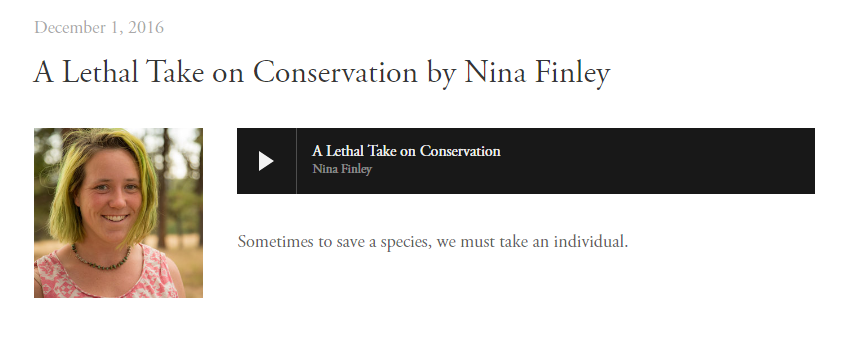
Click here and scroll down to listen to my podcast, "A Lethal Take On Conservation."

It's an eight-minute journey with three conservationists who have come to terms with a paradox: sometimes to save a species, we must sacrifice an individual.

Click here to listen.

Then click here and scroll to watch the public reading of my epiphany, "When Our Gods Take Us Back."


The essay imagines the Sixth Mass Extinction through the lens of Diné (Navajo) cosmology.

Click here to watch.

They don't show up in the video, but this epiphany reading was paired with a slideshow of images from the semester. I'll include them here, and you can view them with the video as you like.


While you're on the website, I highly encourage you to listen to the epiphanies and podcasts of my fellow Westies. These people are articulate, compassionate, insightful, and a whole long list of things I admire. Every single one of their epiphanies gives me shivers. Seriously. Check them out.

Signe, Griffin, Sophie, Willa, Amanda, Hunter, Abby, Maggie, Thomas, Gardner, Kenzie, Evan, Hannah, Grace, Rachel, Elizabeth, Maya, Fields, Emma, Sarah, Ysa, Collin, and Phil: you've changed my life. I miss you, and I am thankful for you.
Share:

What's a Watson? My Plans for the Year to Come

What's a Watson, you ask? Great question. Actually called the Thomas J. Watson Fellowship in honor of IBM's founder, it's an amazing program that funds 40 just-graduated-from-college students to travel the world for precisely 12 months and follow their passions. I am extremely lucky to be one of those  students, along with my fellow Whittie Sam Perkins. If you want more deets, check out these articles from the Whitman Newsroom and our student paper, the Whitman Wire.

My project, as described on the Watson website, is titled, "One Health: The Human Impacts of Emerging Wildlife Diseases." Here's my official project description:

During my Watson year, I will explore five manifestations of ecosystem disease. In Brazil, leptospirosis is spreading from endangered peccaries to cattle. In Madagascar, deforestation is ushering people into contact with rodent vectors and lemur viruses. Coral bleaching is impacting commercial fisheries in Indonesia and dive tourism in Malaysia. And in the remote north of Russia, thawing reindeer carcasses are bringing once-eradicated anthrax back from the dead. In each country, I will begin by investigating the biology of the disease itself – its pathogen, host, and habitat – by spending several weeks in the field with ecologists and the local community. My guiding questions ask: How are you and your community affected by this disease? What related cultural practices or stories exist? What is the root problem? What actions are being taken to mitigate the impacts? By synthesizing my experiences with ecologists and community members, I hope to gather local solutions for the global threat of emerging wildlife disease, and their impact on biodiversity and human health.


This map from the Watson website shows my destiations: Brazil, Madagascar, Indonesia, Malaysia, and Russia (or another Arctic nation.)

Here's a more detailed overview:

August to September: Taboco, Brazil. A small town in the Cerrado (dry grass and shrubland) adjacent to the Pantanal (the largest wetland in the world). I'll be working with a biologists from a local environmental nonprofit, Instituto Ambiental Quinto do Sol, to study two diseases. The first is leptospirosis, contagious between endangered white-lipped peccary and abundant domestic cattle. The second is canine distemper, an illness of pet dogs and cats that has the potential to infect wild felids (read: jaguars, pumas, and ocelots.) I may work alongside scientists from Wildlife Conservation Society and World Wildlife Fund, as well.

October to December: Ranomafana, Madagascar. A popular national park with tourists and the home of endangered, endemic lemurs. I'll be working from an international research station, Centre ValBio, to assist in a mouse-lemur-trapping project. We're trying to find out exactly how deforestation effects the possibility of spillover, the situation when a pathogen switches hosts to a human being from another animal species.

January to February: Bali, Indonesia. I will be helping monitor coral bleaching, a global crisis in which heat-stressed corals evict their algal symbionts, become weakened by hunger, and often die due to a secondary infection of Vibrio bacteria. I hope to converse with local dive-tourism guides and fisherpeople to understand how communities have adapted to this cyclic bleaching in the past, and what's changing now that the cycles are happening more frequently.

March to May: Borneo, Malaysia. I hope to make connections between rainforest conservation with access to human health care. Other projects of interest include ice-ice seaweed disease and a comparison to the canine distemper of Brazil.

June to July: The Arctic. Russia? Canada? Finland? I have many options and nothing set in stone (or ice). But I want to explore the melting permafrost and see how climate change interacts with pathogens and hosts, both wildlife and human, to impact indigenous subsistence.

One of my seemingly-infinite preparations was to buy an underwater camera. I found a used GoPro Hero 2 on Craig's List (what a deal) and tried to figure out how the jumble of plastic pieces fit together.

Of course, I had to try the thing out, too. Here I am snorkeling through the reeds of Lake Calhoun, an urban picnic spot in Minneapolis. There's a nearby swimming area, but I didn't notice any other snorkels. I may have attracted a few stares.

The Watson begins... tomorrow! I plan to blog as often as I can, hopefully every day. If you want to follow along, just type your e-mail in the Subscribe box to get notified when I post something new. And don't be afraid to leave comments. I'd love to hear your thoughts, requests, questions, or suggestions as I head into the year.

An enormous thanks to everyone who's been there for me along the way. I hope this blog will repay some of your support in vicarious adventure.
Share:

Why Two Whitman Seniors Returned to 9th Grade

It was spring of my senior year in college, and there was just one more class I needed to take before I graduated: 9th-grade biology.

Every Tuesday, my fellow nature-nerd Eva and I volunteered in a Wa-Hi classroom. You can watch our interview with the Walla Walla Public School District here, and read below for the whole story.


When you live in Walla Walla, the name "Wa-Hi" rolls off the tongue. It's short for Walla Walla High School, one of two (along with Lincoln High) in the Walla Walla Public School District. That's about all I knew until January, when I got to Whitman for my senior spring.

During my three years at Whitman, I'd been wanting to get more involved in community service, but there never seemed to be time. I volunteered in small ways: I brought Whitman's crested gecko and rock python to bilingual elementary-school classrooms and did yard work for the elderly on Martin Luther King, Jr. day. Then I got an e-mail from our Science Outreach Coordinator asking for volunteers in a Wa-Hi 9th-grade biology classroom. I signed up for one hour a week on Tuesdays. My friend Eva signed up for the same time so we could carpool and work together.

The Wa-Hi campus.
Photo credit: Breanna Baltrusch.

When we got to Wa-Hi, I was amazed to see a barn full of sheep. In high school, I would have given anything for the chance to attend a rural school with an Future Farmers of America (FFA) program. And here I was, living ten minutes from an FFA school! I wish I'd gotten involved on my first day in Walla Walla, maybe volunteering with the FFA kids or a local 4-H club.

The campus is spread out between green, grassy commons and bisected by a restored section of Yellowhawk Creek. Eva and I signed in at the main office and walked through a maze of outdoor hallways to find Ms. Burt's classroom.

The Wa-Hi hallways are outdoors.
Photo credit: The Whitman Wire.

Mary Burt is one of those teachers students feel lucky to have. Even though these 9th graders were not always thrilled to spend their 7th period learning about cells and forest ecology, they were always happy to see Ms. Burt. She has a sense of humor that keeps her classroom's attention through laughter instead of discipline.

Here I am in the classroom with Eva, my volunteer partner, and Ms. Burt, the 9th-grade biology teacher.

I loved working with Wa-Hi students. I would have liked to invest more than one hour a week, but even so, I got to know the students' names and personalities. That's the great thing about high schoolers -- they'll tell you exactly what they're thinking. When a student would tell me, "No, I'm not going to do the work; this is boring and I hate it," I took her at her word. I remember feeling trapped by worksheets and standardized curriculum.

I tried to make every interaction about the student first, asking how he was doing and building a human-to-human relationship instead of just a teacher-to-student one. Second, I tried to bring in curiosity.

"Science is not about memorizing things, it's about asking questions," I told one student. "So if you don't know the answers about cells, why don't you write a list of questions?" Then, we'd pick which question sparked the most curiosity, and I'd help the student pursue the answer to that question instead of the ones on the worksheet.

Some students were motivated by drawing, so I encouraged them to draw their work. Others were distracted by YouTube during class, so we found relevant videos as inspirations for project topics. One student was making a scene by drinking a Dr. Pepper instead of working, so I asked him to explain the day's concept, diffusion, in terms of soda. His improvised explanation was so good, I used it with other students for the rest of the class.

The barriers to success in this classroom were high. It was the last period of the day; the honors and Advanced Placement students had been separated into other classrooms; and I imagine Ms. Burt would have loved to have a full-time assistant rather than a couple of volunteers a week. There were simply not enough resources to allow for the creative, engaging education these students deserve.

This semester, I was a teaching assistant for a Whitman course, Plant Identification Laboratory. Spending Tuesdays at Wa-Hi and Thursdays in a Whitman lab, I was amazed and disappointed by the enormous gap between the two classrooms.

Picture Wa-Hi: the desks were mismatched and graffitied. They barely fit inside the small classroom. There are no paid assistants, only once-a-week volunteers. The students were responsible for stacking the chairs each Tuesday so the custodian could mop, and Ms. Burt was responsible for keeping the blackboard clean. There are about 1700 students, and the student-faculty ratio is 19:1.

Now picture Whitman: the students are spread out across five rows of pristine laboratory benches, with extra space in the back for projects. The microscopes and stools are upgraded regularly. There are two paid teaching assistants (me and my friend Lia). We can leave the blackboard messy with chalk because the custodian will take care of it. There are about 1500 students, and the student-faculty ratio is 8:1.

I made up a name for this divide: the Classroom Privilege Gap. Obviously, a private college and a public high school are not parallel institutions, but this gap also exists among high schools, rural or urban, private or public, north-end or south-end. Working in these two classrooms each week was a reminder of how unfair and damaging this gap is.

Behold the Whitman classroom, replete with 45 microscopes and carefully arranged plant samples.

The weekly lab is planned by our professor, Heidi (right), set up by two paid teaching assistants (Lia and me), and supported by the biology department staff. Compare that to Ms. Burt's five-days-a-week Wa-Hi biology class, run entirely by Ms. Burt and a couple volunteers.

Teachers like Ms. Burt need more support, and students like the Wa-Hi 9th-graders deserve better school infrastructure. There's no easy solution, but adequately funding public schools is a place to start. Only 2-3% of the federal budget goes to education, and the Trump administration's budget called for a $9.2 billion (or 13.5% cut) to education spending. We can do better.

Edit: My friend and relentless activist for justice, Annie Want, just sent me this NPR article about why funding in public schools is so unequal across America. Did you know that school funding depends on local property taxes? And that in 1973, the Supreme Court decided in a 5-4 decision that the U.S. Constitution guarantees no right to equal funding for education? And that by doing so, the Court negated the intention of the famous Brown v. Board of Education decision to provide equal and integrated public education to all children, regardless of race or economic means? If any of this is news to you, as it was to me, read that article! Seriously.

As Chief Justice Earl Warren wrote in Brown v. Board of Education:

"It is doubtful that any child may reasonably be expected to succeed in life if he is denied the opportunity of an education. Such an opportunity, where the state has undertaken to provide it, is a right which must be made available to all on equal terms."

Finally, I'll leave you with this sign I read every Tuesday in the Wa-Hi office:

I love this sign. It doesn't require you to believe that you are special or perfect or amazingly talented; it just reminds you to do what you can with what you have.

What can you do? Call your representatives. Volunteer in public schools. Vote for administrations and taxes that support education. If you have more ideas about getting involved, leave them in the comments. I'd love to hear from you.
Share:

Sweets in Suncadia

Five years of college.
One year in Ohio.
One semester in Galapagos, where this blog was born.
One semester split among Brazil, Peru, and mainland Ecuador.
One semester camping in the Intermountain West.
Two and a half years in Walla Walla, Washington.

Walla Walla was the place I called home for longest since leaving high school, and saying goodbye was the opposite of easy. Luckily, I got to spend three days after graduation with my adoptive family and ultimate frisbee team, the Sweets, in the eastern Cascades.

I felt strange and out-of-place in the luxury golf resort, Suncadia, but as soon as I wandered past the mowed green turf I found myself immersed in a dry Ponderosa pine forest filled with deer, lichen, wildflowers, and songbirds.

Ponderosa pine thrive on the "sunny side" of the Cascades.

Oregon grape in bloom.

Oregon grape flowers are elegantly layered and butter-yellow.

My first Nashville warbler! He was wearing a red cap, grey hood, and yellow belly.

Chocolate lily, Fritillaria affinis.

As I sat on a log to observe the Nashville warbler mine a shrub's catkins for their nutritious seeds, I was startled to find a chocolate lily. These flowers are rare. Their underground bulbs, resembling clumps of rice, are eaten by several Coast Salish tribes. I was so excited to photograph this flower from below, I was lying motionless on my belly for several minutes, and when I sat up I saw two well-dressed joggers staring at me.

"Oh my god, we thought you were a dead body!" the man gasped.

"Just looking at a flower," I told them. "Want to see a chocolate lily?"

"Umm, that's okay," he replied. They glanced at each other and jogged quickly away.

For the moment, this forest is still filled with rare beauty on the margins between golf greens and second homes with four-gar garages, but this ecosystem is nowhere near intact. Yesterday, I saw several new concrete foundations being poured for new mansions within this gated community. Only a few tall Ponderosas stood between existing houses.

I had to ask myself, what is the appeal of living or vacationing in a place like this? If the point is to live in a dry montane forest, then the appeal has been nullified by the density of homes and roads. (And why live in a forest if you don't even stop to notice the chocolate lilies?) I think the real appeal is exclusivity. Suncadia is known for being expensive and luxurious. To own a home here is a symbol of wealth. I imagine the wealthiest residents will soon move to a more remote, forested enclave as Suncadia becomes too suburban and accessible, and deforestation will continue to reduce chocolate lily and western toad habitat in the Cascades.

Look at the chocolate lily's gorgeous brown-and-green, mottled petals and six pollen-laden stamen.

Arrowleaf balsamroot, a sign of springtime in eastern Washington.

Wolf lichen, Letharia vulpina, is neon green-yellow because of its vulpinic acid, a toxin once used to poison wolves. It belongs to the family Parmeliaceae.

Deer scat.

A very young sapling growing from a nurse-log.

A chipping sparrow in a Douglas fir.

A few Sweets around our magical, self-igniting fire pit.

On our second day, I set out for a hike with Kevin and Hardy in the Teanaway Community Forest, along the West Fork Teanaway River.

Brown-eyed sunshine, Vulpicida canadensis. This bright yellow lichen also belongs to the family Parmeliaceae, but it differs from wolf lichen due to its brown ascocarps (sexual reproductive structures) and the texture of its thallus (the main, leafy body of the lichen.)
We went skinny-dipping in a shallow pool of the river (after this photo.)

A baby western toad, Anaxyrus boreas, was swimming in our shallow pool -- or rather, we were swimming in hers.


On our third and final day, we packed into cars with all our gear from the past one to four years of living in Walla Walla. Before we headed over the Pass to our various homes, I persuaded my teammates to stop for a picnic lunch at the Northern Pacific Railroad Ponds in Cle Elum, a birding hotspot. There, I talked with another woman from Seattle, a novice birder who was exploring the area for the first time. We saw a mallard with ducklings and many species of swallows over the water. 

Though I never wanted to say goodbye to Whitman, college, or the Sweets, these few days were a good transition from the bubble of school to the wide world beyond -- the birds and trees and waterways I can turn to when I don't have daily practices, weekend tournaments, dance parties, sprint workouts, weight lifting, potluck meetings, and pick-up games on Ankeny to bring me joy. At least I know I will find ultimate to play wherever I go next... and something tells me I'll be watching goofy Snapchats from my Sweets for a long time to come.

Kaitie holds a round, moss-lined nest we found on the ground. It must have blown down from a tree in the wind.
Share:

An Imagination (short story)

Here's something a little different: a fiction story! I wrote this during our Semester in the West writing workshop with author Ann Walka. She instructed us to write a story based on the place we were in, Comb Ridge, a magnificent geological formation near Bluff, Utah.

Sadly, the property was sold on October 17, 2016 from the State of Utah to a private corporation, Lyman Farms, and it will no longer be accessible to wanderers and writers looking for inspiration. More on that transaction here.

While you consider the privatization of public lands, please enjoy this simple story.

An Imagination

They walked to the top of the slick-rock hump. The dorsal fin of a stone whale, they called it.

“Do you remember when we pretended to ride the whale and held our breath?” she asked.

She loved his imagination. No matter where they went, he found magic lurking just beneath the sandstone, between the points of yucca leaves, hovering over one-seed junipers. His mind spun worlds.

The top of the whale-fin rock wasn’t really the top; it just looked that way from the bottom. The first time they had climbed there together, she has been devastated to find that their sweaty hike had yielded nothing but a taller peak in the distance. She was out of breath and thirsty. She has always assumed the top of things was objective.

But he’d taken her hand and called with full lungs, “We’re here!” And he’d been right. One step further in any direction, he’d claimed, would take them down. Even that peak in the distance was below. All it took to be on top was a choice of perspective.


She liked to come here still, to the top. On the whale’s flank, a rain-worn swath of stone, she spread her picnic blanket. Green cotton splashed with ruby bird feathers. Worn too thin to do much but mark a square for them on the sun-soaked ridge. She lifted pasta from her wicker basket, the kind with a flap on either side and a hinge in the middle. Two plums wrapped in paper. Biscuits, warm in the center. A stick of butter. A jar of prickly-pear jam they’d made three years ago from the last cacti he’d tended in the garden.


A spotted lizard watched from the shade of a single-leaf ash as she divided the food onto two plates. She ate her portion of pasta plain. She buttered both biscuits and chewed one as yellow fat dripped from the incision she’d made through the heart of the other. The plum, she consumed in three bites: top, side, then all the rest, just like always. It tasted like his lips. She spit the pit under the ash, and the lizard retreated deeper into its cool foliage.


“Happy anniversary, my love,” she said to the plate still piled with food.

It was then that she noticed. Once again, she’d forgotten to open the jam.
Share:

Reptiles and Amphibians of the Intermountain West

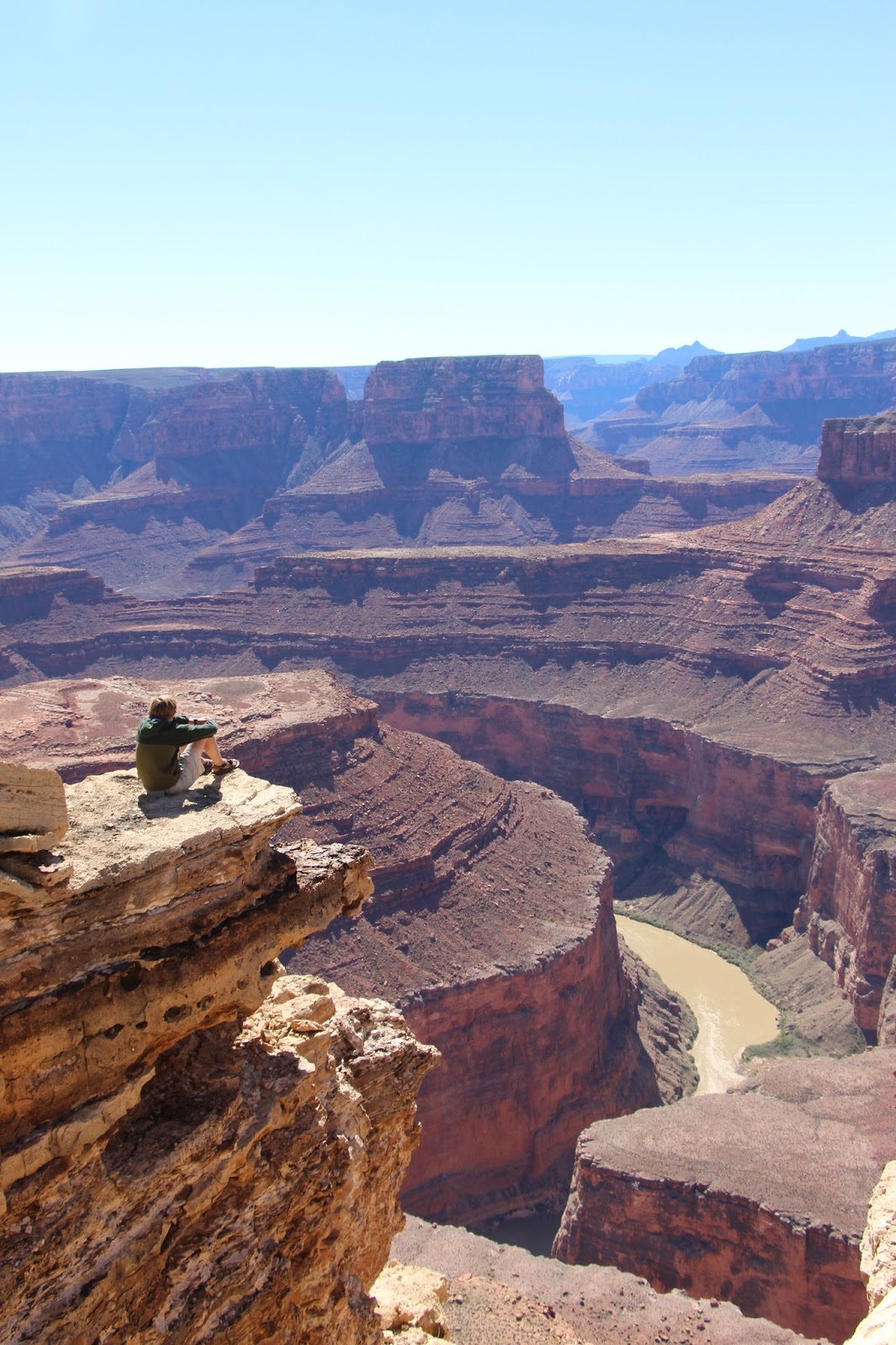
Hello from Comb Ridge, Utah. I'm travelling through the Intermountain West -- the arid lands of America between the Cascades and the Rockies -- on a Whitman College program called Semester in the West. There are oodles of things to write about, but let's begin with the reptiles I've seen along the way.

Ornate box turtle, Terrapene ornate.

We found this individual dead on the Pine Ridge Reservation in South Dakota.

Long-nosed leopard lizard, Gambelia wislizenii. We found her in a private yard full of native plantings in Castle Valley, Utah.

Note the long-nosed leopard lizard's orange spots and long, striped tail.

I think this guy is an eastern fence lizard, Sceloporus undulatus. However, he does not have a blue belly or throat (which may or may not be present, according to the field guide.) We found him at Sand Island, Utah among ancient rock art.

Another view of the supposed eastern fence lizard. Note the blue armpit.

This eastern fence lizard had a striking black and blue line down its side. We found him in Comb Ridge, Utah.

I don't know who this is. Could be a small eastern fence lizard, or perhaps a tree lizard, Urosaurus ornatus?

I found this side-blotched lizard, Uta stansburiana, soaking up my body heat under my sleeping bag on Comb Ridge, Utah!

Evan and the side-blotched lizard communed after breakfast.

Aren't those turquoise spots and long nails glamorous?

One of three northern Pacific rattlesnakes (Crotalus oreganus) found lurking around our campsite in the Methow Valley of Washington State. He chilled out in this empty cooler until we transported him to a better spot. Would have been an unpleasant surprise for anyone hoping for a cold drink...
Photo credit: Thomas Meinzen

Wildlife wrangler extraordinaire Kent deftly placed our venomous friend in an unoccupied cooler.
Photo credit: Thomas Meinzen

This garter snake (perhaps a wandering garter, Thamnophis elegans vagrans) was hiding under a plastic bin on the garlic farm made famous by Stanley Crawford's The Garlic Testament, near Dixon, New Mexico.

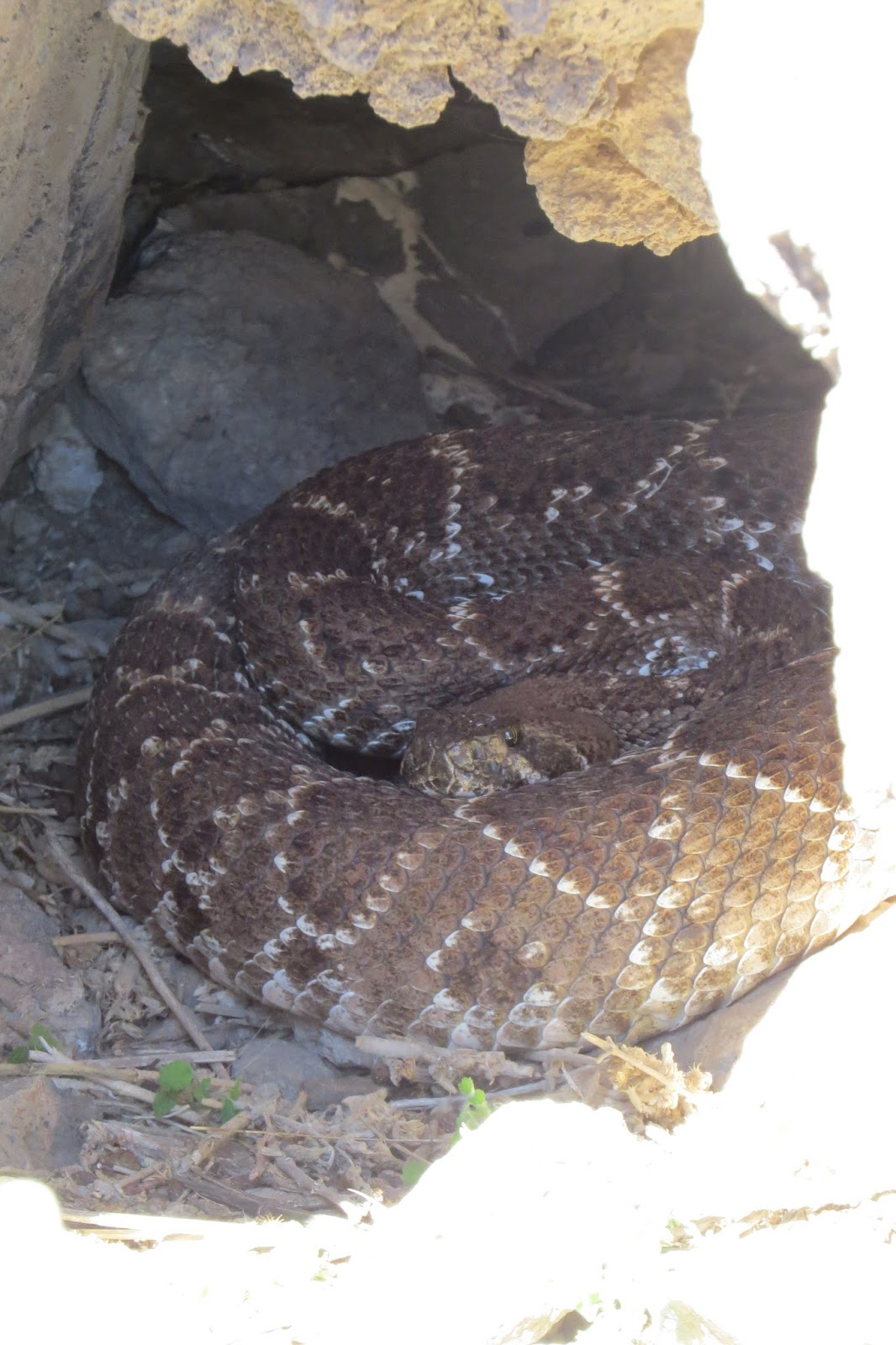
A 3-inch diameter rattlesnake (Crotalus sp.) near Santa Fe, New Mexico. The largest I've ever seen! She rattled at us from her crevice.

Our resident snake-o-phobe and serpent-detector, Fields, found a Chihuahuan night snake (Hypsiglena jani) coiled in a perfect S in the path to his tent. It was cool and docile! EDIT: I previously mis-identified this snake as a baby gopher snake and was corrected by a helpful, anonymous commenter. Thanks to Anonymous and iNaturalist for helping me get to the correct identification. This snake was found near Cieneguilla Recreation Area just outside Santa Fe, New Mexico.

The Chihuahuan night snake made a lot of friends, especially Thomas.

Sarah has a future career as a snake hand-model.

A snakeskin found by Amanda on Black Mountain in the Chihuahuan Desert of New Mexico as we surveyed for endangered night-blooming cereus cactus. It had a face with eye-lenses still intact!

A Texas horned lizard (Phrynosoma cornutum) skittered across our path near Black Mountain, New Mexico. They are what ecologist Paul Arbetan calls "a fermenting vat with legs," because they use their round bellies to digest ants.

A greater earless lizard (Cophosaurus texanus) posed in plank position at our campsite outside Big Bend National Park in Texas. Notice that pastel, rainbow belly!

An American bullfrog (Lithobates catesbeianus) made an appearance at Bosque del Apache National Wildlife Refuge in New Mexico. They are invasive throughout the West Coast and Southwest.

Tiny red-spotted toads (Anaxyrus punctatus) hopped on the mud banks of the Rio Grande.

Couch's spadefoot toad (Scaphiopus couchii) found hopping among our sleeping bags during a light rain on Adams Ranch on the Rio Grande, about an hour from Big Bend National Park.


We have also seen a plateau whiptail, Aspidoscelis velox, in Castle Valley, Utah and a short-horned lizard, Phrynosoma hernandesi, on the Navajo Nation in northern Arizona.

Our Navajo host, Adrian, taught us that the short-horned lizard is called che in Navajo. It is believed to have fought with a dark storm cloud and won because its thorny armor can deflect lightning. We learned how to bless the lizard with a sprinkle of water, and we would have added corn pollen if we'd had it. Then Adrian placed the lizard over his heart and feet to bless himself before returning it gently to its sagebrush home. To learn more about Navajo reptiles, have a look at Diné Traditional Teachings on Wildlife.

For my future reference, here are all the lizard species I have seen on this trip:
  1. Side-blotched lizard, Uta stansburiana
  2. Eastern fence lizard (northern plateau lizard), Sceloporus undulatus
  3. Plateau whiptail, Aspidoscelis velox
  4. Short-horned lizard, Phrynosoma hernandesi
  5. Long-nosed leopard lizard, Gambelia wislizenii
  6. Short-horned lizard, Phrynosoma hernandesi
  7. Texas horned lizard, Phrynosoma cornutum
  8. Greater earless lizard, Choposaurus texanus

Thanks to Southwest Guide Books and Utah Herps for the information I used to identify these reptiles. Please contact me if you notice any errors, and stay tuned for more posts from the West!
Share:

Popular Posts

Labels