Health Education, Health Articles, Health Blog

Showing posts with label reflection. Show all posts

Second Quarterly Report: Halfway through the Watson

Here we are, six months into the Watson year and six more to go. Below is my second quarterly report, one of the few deliverables required of me by the Watson Foundation. In case you missed it, you can read the first quarterly report here. Thanks for following along!

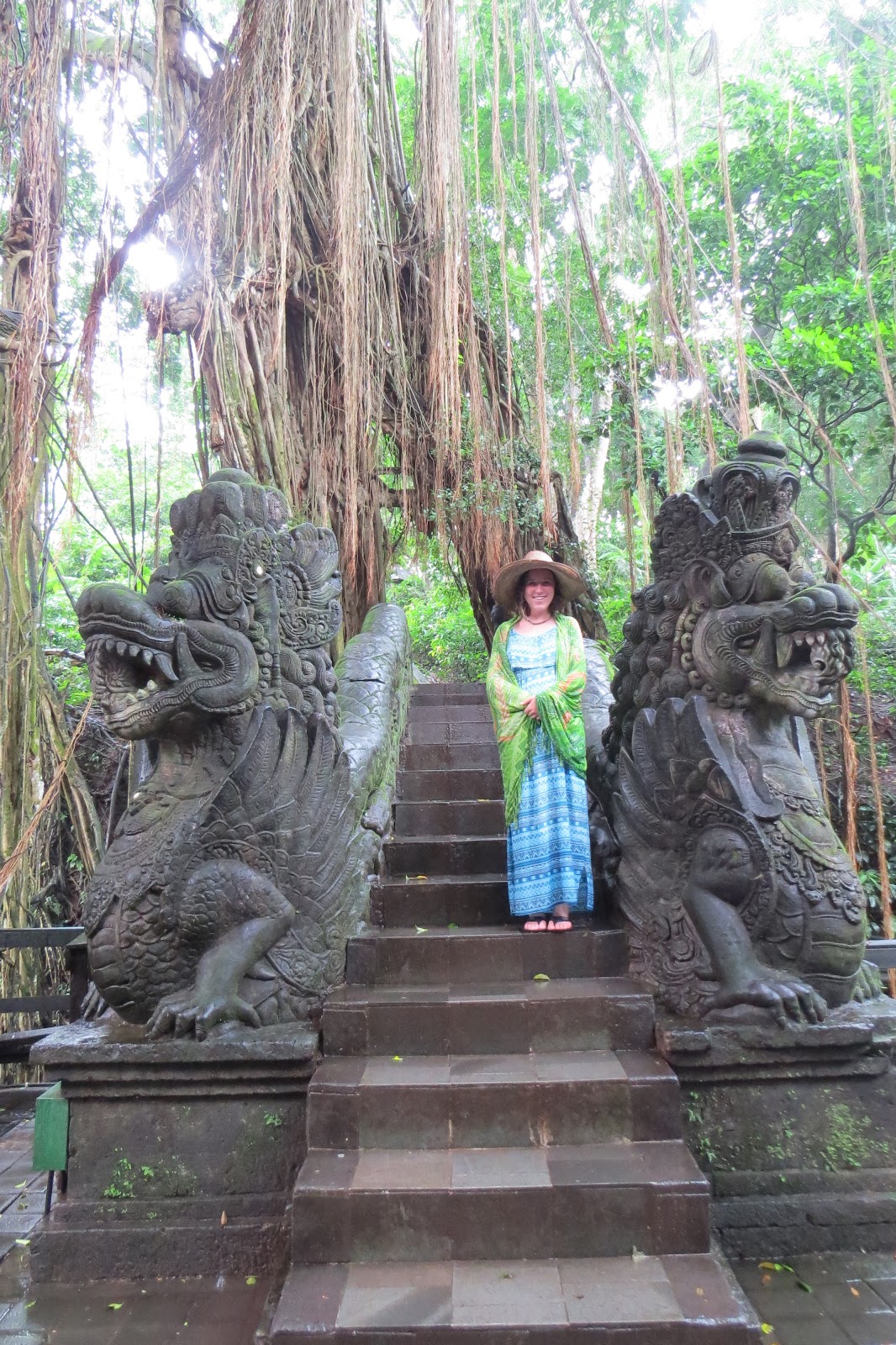
Draped in a cape of strangler-fig roots.

Second Quarterly Report


Date: January 27, 2018
Countries you were in: Madagascar, Indonesia
Countries for next quarter: Indonesia, Malaysia
Current location: Sanur, Bali, Indonesia

Dear Watson Foundation,

Apa kabar? Hai from Indonesia! Today I’m writing from the raised wooden floor of a gazebo on the roof of my homestay in Sanur, Bali. I’m surrounded by a sea of red tiles and stone shrines, adorned each morning with foods, flowers, and incense offered in folded banana leaves. I hear two roosters locked in a crowing battle. I have no idea where they’re hiding.

A crab-eating macaque and his mossy stone cousin in the Ubud Sacred Monkey Forest.

My flooded street in Sanur after a night of thunderstorms.

Last I wrote, I was finishing my first month in Madagascar. The challenges of that country did not get easier with time, but I did come to value them more. These struggles ranged from flesh-ripping vines to my heavy sense of guilt because the people with whom I lived had so few resources while I have so many. The average daily wage in Madagascar is $0.70, but poverty cannot be captured in a number. A house in a typical village around Ranomafana has a dirt floor and a thatch roof, with an open fire for cooking and black soot for breathing, but poverty cannot be described by architecture. Everyone I met told me stories of sand fleas burrowing into their feet because shoes were not in the budget, but poverty cannot be understood through parasites. I am just beginning to grasp the roots and results of Malagasy poverty after living amidst it for three months, so I cannot presume to convey it in a paragraph, but perhaps this conversation will give a taste of our global economic dissonance.

A mud-walled and thatch-roofed house in the tavy hills outside Ambatovory.

My superheroine guide, Menja, and I were sitting in one of our rainforest camps beneath a leaky blue tarp, biding our time until the afternoon when we would set lemur traps.

Menja: “I hate the rain.”
Me: “I love the rain! At my home in Seattle, it rains all the time.”
Menja: “Well, that makes sense. Because you have a raincoat that doesn’t leak.”
Me: “Oh. Good point.”
Menja: “And you have rain pants that don’t leak either, right?”
Me: “Yeah.”
Menja: “And your house – does it have a roof that doesn’t leak?”
Me: “Yes, it does have that.”
Menja: “And outside – you have sidewalks? So it’s not too muddy to walk in the rain?”
Me: “Ah, yes, we have sidewalks. No mud trails.”
Menja: “And shoes?”
Me: “Yes, shoes too.”
Menja: “And you have a car? So when you need to go, you are not walking?”
Me: “Yes, we do.”
Menja: “And furniture.”
Me: “Huh?”
Menja: “In your house. You have furniture, yes? So you can sit down while it rains?”

I couldn’t think of a response to that. I’d never thought of the connection between a recliner and a rainstorm, but to Menja it was obvious. In her experience, rain means crouching for hours in a smoky, one-room house with no furniture. Not only does my house have chairs, but it also has windows with glass, a furnace to heat it, electricity to keep the lights on, books to read, and a computer with WiFi to occupy me. Rain in Madagascar bears no relation to rain in Seattle. The water may be the same, but our experiences of rain could not be more different.

Following Menja down a slick, clay trail in the rain to conduct sand-flea interviews.

To fill the daylight hours in our field camps, I began bringing colored pencils and offering drawing lessons to the village kids who hung around after lunch, hoping for leftovers. One day, while hosting a gaggle of children to draw bugs and leaves on pages torn from my notebook, I was overwhelmed by the knowledge that these children deserved an education they would never be offered. Most had dropped out after fifth grade because no matter how hard their parents worked, they’d never earn enough to pay school fees. The unfairness tied my stomach in knots. Right then, I decided I would raise money for Madaworks, a small nonprofit that funds high-school education for Malagasy girls. In a blog post titled “The Power of Pencils,” I asked my readers to donate, and within two weeks we had exceeded my $1200 goal. The Madaworks founder, Diane, then challenged me to raise tuition for a full, three-year education for both girls, a total of $3600. As I uploaded more stories and photos, donations flowed in from teammates, family members, and even strangers who’d come across my blog. Now, as I type, we are $20 away from our new goal. I have received praise for this effort, but I ask myself, why do I have the power to run a fundraiser in the first place? My resources––contacts in the United States, writing experience, a camera, internet access––all come to me as unearned gifts. I do not deserve praise compared to the Malagasy girls who will receive these scholarships: they have overcome far greater obstacles to achieve what I have been given for free.

The kids of Bevoahazo, engrossed in my bird book and their scientific drawings.

As a side project, I interviewed 58 households about the sand flea, a translucent white parasite the size of a pinhead that burrows into skin around the toenails for four to six weeks unless someone digs it out with a needle. Sand fleas live in humans, pigs, and dogs, and they are zoonotic, meaning they can switch from animals to humans. I’d never heard of sand fleas, so I was astounded to learn that 100% of villagers had been infected by this parasite, and 12% were actively hosting sand-fleas at the time of my interview. How could I have studied zoonotic disease for years and never heard of this parasite that infects millions or billions of people? I had wonderfully enlightening conversations with mothers about the health of their families, but the interviews weren’t always easy. One angry man told me he wanted nothing to do with my survey if I wasn’t going to give him medicine for his son’s feet, which left me feeling inadequate and sorry. I couldn’t provide medicine, because there is no medicine for sand fleas, but I did learn to offer small bags of salt, sugar and soap as compensation, and I taught each family how to sterilize their needles. Along with my lemur mentor, Dr. Zohdy, and climatologist Dr. Eronen, I submitted an abstract of our sand-flea research to the Planetary Health Alliance. If it’s accepted, I’ll present at the Annual Meeting in Edenborough, Scotland at the end of May. My hope is to incite more research and remedies for sand fleas by getting them added to the World Health Organization’s list of Neglected Tropical Diseases—yet my hope is tempered by the knowledge that all the diseases on this list will remain neglected until we, as a planetary community, devote far more resources to the injustice of poverty.

A female sand-flea, removed from my friend's finger with this needle. Photo credit: Cindy Capurso.

This foot had at least six sand-fleas embedded in it, making it hard for the child to walk and attend school.

On Christmas Day, my flight out of Antananarivo took me through the tiny island nation of Mauritius and the high-tech city-state of Singapore, whose airport includes a pool, movie theater, and butterfly garden. My final flight, to the Indonesian island of Bali, had plenty of room because Bali’s tourism has plummeted by 70% since its volcano, Mount Agung, began spewing ash in November.

Antananarivo from the air: a sprawling city surrounded by endless rice paddies.

Welcome to Mauritius, former home of the dodo. It must be the only country that is most famous for a species it forced into extinction.

Now what? My volunteer stint at Reef Check would not begin until mid-January, and I had no destination until then. After claiming my backpack, Marmelade, I spent a few hours trying in vain to meet other travelers and split a cab to anywhere. That’s when I met Francisca.

“Excuse me, are you looking for a ride?” I asked the petite woman swiping at her phone in frustration.

“Sure, I’m calling a GoJek,” she replied. She was a Portuguese civil engineer working in East Timor, I would soon learn, and she stops by Bali whenever she wants to go shopping or eat great sushi. Francisca took me to Kuta, the rowdy tourist town where backpackers converge to surf and party. The ride cost 13,000 rupiah – under $1.00 – and when we didn’t have exact change, the driver introduced me to Balinese generosity. “12,000 will be fine!” he said with a wide smile before driving away.

My second day in Kuta with two fast friends, Renne and Arlo.

That night, I met back up with Francisca for sushi (what else?) and checked into a capsule-bed hostel (it’s like sleeping in a very comfortable drawer). Once I got an internet SIM card and my new favorite apps, GoJek and MapsMe, I could navigate Bali as if it were my own city.

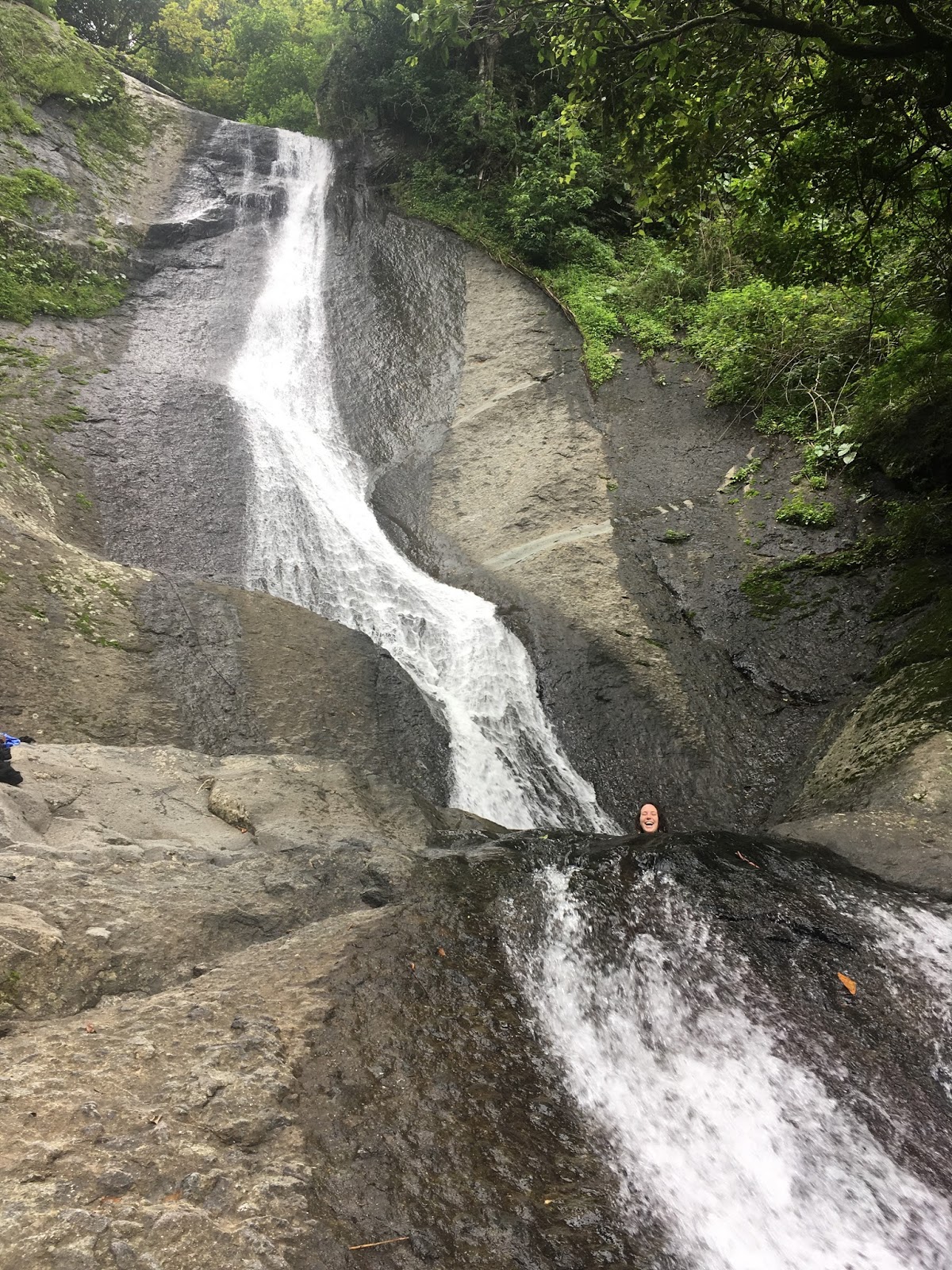
Can you spot my head? A secret waterfall flowing all the way down a mountain in West Bali.

Tracing Wallace's path to the ficus buttresses of Lombok.

I travelled from town to town, meeting new people and parting ways in a swirl of motion. I avoided eye contact with crab-eating macaques in the Ubud Sacred Monkey Forest, ate free banana pancakes at my favorite hostel, bargained for cheap sundresses in Kuta, and skinny-dipped in the Pacific Ocean to celebrate the first moments of 2018. In honor of Alfred Russel Wallace, I took a ferry from Bali to Lombok and whooped with excitement as we crossed Wallace’s Line. On Lombok, I examined giant millipedes, trekked to waterfalls, and read Wallace’s book, The Malay Archipelago, in the same steamy jungles where he wrote it.

Wallace would have loved to find this cicada...

... just down the trail from this cicada-mimicking moth. What notion about natural selection might it have inspired in his mind?

One afternoon, I hunched in a cramped bird-blind for an hour, sweat dripping off my nose and mosquitoes whining in my ears, as I waited for the green flash of an elegant pitta delivering insects to his chicks. I extended my Indonesian visa––a bureaucratic nightmare involving three visits to the Kantor Imigrasi––and became a certified rescue diver so I’ll be able to keep my fellow humans healthy while we examine the health of corals.

A stunning damselfly with translucent violet wings. (Any ideas, Thomas?)

I wonder if Wallace encountered quite as many giant millipedes as I did.

Late one Friday evening, I was bantering in a bar with a group of Balinese waiters, nursing my ginger tea, when I heard the word frisbee. Huh? “Did someone say frisbee?” I asked. It turned out that one of the waiters, a programmer named Sam, plays pick-up ultimate frisbee on Saturdays. So began my love affair with Bali Ultimate. I now attend three weekly pickup games in different corners of the island, and I’ve joined a team, UB7, for the Nusatara Cup at the end of March. While I can survive without ultimate, I am not thriving unless I can chase a frisbee down across a swampy field, gasp after sprints, and stay out at dinner past dark with teammates because we’re having too much fun to say goodbye.

Sunday pick-up ultimate in Canggu.

Black leggings? White socks? Or just a great day of mudtimate?

A week into January, I finally reported for duty at the Reef Check office. My role is to assist Sila, an earnest conservation biologist one year older than me, with the implementation of Reef Check’s new Climate Change Adaptation Program. For more than a decade, Reef Check has been partnering with local fishermen and divers from Tejakula, a sub-district on the northern coast, to collect data on coral health. Now, I’m working on curriculum to teach these local partners about the theory behind climate change and its impact on coral bleaching. I enjoy wrestling these abstract concepts into accessible terms, but I’m ready for my move away from the computer screen and into the Tejakula communities.

My first Tokay gecko, Gekko gecko, a species with which I've been obsessed since elementary school. You can't tell from the photo, but this lizard was a foot long, and clinging to a vertical mural like it was the ground!

A couple weeks ago, as a facilitator for the International Student Conference on Global Citizenship, I had the chance to take 40 undergraduate and graduate students snorkeling over a coral reef. Most of the participants were studying business or international relations. None were biologists, and many had never used a snorkel before. A few confident swimmers held their breath and dove to get eye-to-eye with massive blocks of Porites coral, finger-like Acropora, mushroom-shaped Fungia and delicate Gorgonian sea-fans. As we treaded in the choppy water, one student surfaced and, still catching his breath, called out to me, “Why are the corals bleaching?” It might have seemed an absurd moment for a scientific lesson, two bobbing heads hollering back and forth across the din of an ocean, but to me it was perfect. How many times had this man heard the sad tale of climate change in a lecture and tuned it out? Only here, as saltwater coated his tongue and the algae-cloaked corpses of dead corals swayed in his vision, did the question really matter. He wasn’t raising his hand to ask me why corals bleached because it was going to be on an exam. He hollered across the ocean because he couldn’t wait, because suddenly the survival of these calcium-and-jelly organisms was personal.

After snorkeling, we explored Taman Tirta Gangga, a Hindu temple known for its fountain of youth.

At the end of February, I’m heading to Malaysia with my boyfriend, Collin, to explore climate activism in Kuala Lumpur, marine life around Perhentian Kecil, and street food in Penang. I can’t wait to show him a little slice of my Watson life. Then, I’ll move to West Kalimantan on Indonesian Borneo to work with Health in Harmony, a ground-breaking nonprofit that protects orangutans’ rainforest habitat by providing healthcare to the surrounding communities. Already, the connections from this year are circling around to find me again. By coincidence, I met the Health in Harmony directors in Madagascar, and a conversation over rice and zebu blossomed into a partnership on Borneo.

Who did I meet at the Conference on Global Citizenship but Aimee Razafimanjary, a Master's student from Fianaratsoa, Madagascar! We couldn't stop laughing and speaking Malagasy amid the organic lettuce-fields of Bali.

My friends ask me if the year feels like it’s going by too fast. I tell them no. I have noticed these six months passing, and I know where the time has gone: to cat vaccines and hamburger nights, to waterfall baths and lemur lice, to colored-pencil art and coral funerals and sobbing confessions to the stars. I don’t feel like the year is going by too fast, but I can’t imagine it being over. Here’s to the next six months!

What is this, a leaf for GIANTS?

Sincerely,
Nina
Share:

First Quarterly Report: Three Months on the Watson

The Watson Foundation doesn't require much in the way of deliverables. The only products it requests are four quarterly reports in the form of "long letters home" and a short presentation at our final conference. Here's the first of those reports.

First Quarterly Report


Date: October 27, 2017
Countries you were in: Brazil, Madagascar
Countries for next quarter: Madagascar, Indonesia
Current location: Centre ValBio, Fianarantsoa Province, Madagascar

Dear Watson Foundation,

I’m writing from a slate-tiled balcony attached to Centre ValBio above a bamboo rainforest in eastern Madagascar. The research station is nestled into a cliff face. To exit on ground level, I can walk down three flights of stairs, or up one. Either way, I’ll be surrounded by tree ferns, rain that rises from the ground as mist, and the tinkling song of Souimanga sunbirds, an endemic species that fills the ecological role of hummingbirds. Right now I’m watching a Mascarene martin swoop insects at eye-level. The sun is casting a brilliant white light on Cumulus congestus clouds, a brewing thunderstorm. Today is my break between lemur-trapping sites, so I’ll be cozy and dry as I listen to raindrops strike the roof.

Looking down on Centre ValBio Research Station from Ranomafana National Park.

As you’ll probably hear from thirty-nine other Watson Fellows, my experiences over the first quarter of this year have been too expansive to summarize in a letter, but here goes! I spent my first two months in Mato Grosso do Sul, a Brazilian cattle-raising state that you can locate by pointing your finger smack-dab in the center of a map of South America. My initial plan was to study peccary leptospirosis and its impact on food security in Pantanal. That didn’t work out. The Wildlife Conservation Society unexpectedly closed its Pantanal program a few months before I arrived, so I was welcomed into the Watson by scientists at loose ends, without funding, unemployed. At least, I figured, my worries were minor compared to theirs.

Lygia led me up to the edge of a cliff in Cerrado with my eyes closed so she could surprise me with this panoramic view of Pantanal below us.

I feel extremely lucky to have found a homestay with two women who I’ll call friends for life, environmental journalist Lygia Freitas and Cerrado botanist Duca Andrade Santos. Duca spent the past decade as outreach director for the WCS, and she’s called “the Mayor of Taboco” because she’s the person everyone turns to for help. I lived at Quinta do Sol, the postage-stamp nature preserve Duca built from scratch. At first, I was disappointed to realize I would be living not in my dream ecosystem, the Pantanal wetland, but its arid neighbor, the Cerrado savannah. That disappointment turned to gratitude as I fell in love with Cerrado’s wacky fruits, endemic buriti-palm swamps called veredas, and semi-deciduous forests.

Alexine, me, and Duca looking out over an expanse of intact Cerrado ecosystem.

Duca and I crafted a low-cost research project: a survey of vaccination in domestic cats and dogs. The project is a step toward conservation of jaguars, pumas, ocelots, maned wolves and crab-eating foxes, all of which can contract canine distemper and other diseases from pets. It was also an ideal excuse to meet fifty of Duca’s neighbors and move quickly beyond small-talk into topics like zoonosis, human-wildlife conflict, and vaccination. If we stopped by a house between the hours of 12 and 2, we were nearly always invited to stay for amorço, a lavish meal for which “lunch” is a bland translation. One of my favorite menus was feijoão (soupy, salty brown beans), arroz (white rice), salada (raw cabbage or tomato with vinegar) and cebollada (sautéed chunks of zebu beef with onions).

One rancher told me about his practice of placing dead cows in termite nests as a form of pest control. A vegetable-farmer treats her ill chickens with injections of milk. A man from town shared his pathogen-specific protocols for eating beef, explaining in Portuguese, “To prevent rabies, foot-and-mouth disease, and carbuncle, you just have to cook it well, but brucellosis is hard to kill––you must cover it with salt and leave it in the freezer for at least one night before cooking.” I have no idea how these practices align with institutional scientific knowledge, but I’d be interested to test them on a sort of Microbial Mythbusters.

I taught ultimate frisbee for gym class at Taboco's public middle-school.

Beyond the anecdotes, I developed a deep map of Taboco through its culture surrounding animal disease. Nearly all residents vaccinate against rabies, which affects humans, but very few against other diseases that can cross into wildlife, like canine distemper and parvovirus. As a conservation tool, I’m proposing that the Brazilian Ministry of Environment, whose mission includes endangered-species health, and the Ministry of Health, which runs the annual rabies campaign, work together to offer vaccinations against critical wildlife zoonoses to Cerrado pets.

Need a rabies vaccine? Are you a dog or cat? You've come to the right place.

When I wasn’t discussing puppy diarrhea over lunch, I realized my dream of swimming with giant vitoria rede water lilies in Pantanal, completed my first freshwater scuba-dive in the nobody-knows-how-deep Lagoa Misteriosa, and showered in the wind-blown Rio Peixe waterfall. I waded up to my waist through a mossy slot canyon at Vale do Bugio until Lygia noticed an enormous rattlesnake, coiled on a chilly boulder and blocking the way forward. (On my way out, I counted the bodies of seven bloated bats floating around me, another good reason to leave.) I learned to vaccinate cats against rabies by first holding them up to a tree, which they conveniently latch onto with their razor claws, and then injecting the bubblegum pink serum under a tent of skin. I played ultimate frisbee with middle schoolers, surveyed a forest for peccary-edible fruits, drank guaraná soda and terere tea at barbeque dance parties, and sat in on a falconry class at the Federal University. For my last week in the country, I attended an infectious disease conference called DIERN and incubated a whole colony of thoughts on collaborative survival with microbes, the topic of my most recent blog post. The best moments surfaced when I stuck my neck out and struck up conversations with strangers.

The Lagoa Misteriosa sinkhole before my first freshwater scuba-dive.

On a personal note, I struggled in Brazil with the lack of structure. When I woke up without an agenda, I was pulled in two directions: inertia coaxed me to the computer screen, where I’d organize data or write a blog, while momentum urged me to hike through a vereda or plant seedlings in Duca’s agroforestry garden. Either way, I felt uncertain if I was doing the right thing. How late should I sleep? How often should I help wash dishes? I reflected on my anxious thoughts, which I like to call brain weasels, and realized how much I fear disappointing the people I look up to. Living, eating, and working in the same home as my mentors gave me little space in which I felt okay being imperfect. When I opened up about these insecurities in a blog post, Lygia and Duca responded with tears, hugs, and hours of advice about the struggle to balance life goals, avoid workaholism, and just be happy. They helped me relax. I started singing while I cooked, sleeping in a bit later, and saying no thanks to invitations when I felt overwhelmed. Duca and Lygia challenged me to love generously and live intentionally. I can’t thank them enough for helping me transition from the rigid scaffold of college into the open-ended uncertainty of a Watson year.

Facing my fear of heights by peering out over the cliff of the Rio Peixe waterfall.

My flight from São Paulo to Johannesburg was delayed by an hour-and-a-half, just long enough to strand me in South Africa for a night with no currency and no clue. I managed to arrange an afternoon tour to Lion Park, where I met the megafauna species I’d grown up watching on TV: white lions and sacred ibis, blesbok and giraffes. My taxi driver gave me a thorough, unsolicited, and hugely appreciated lesson on Apartheid and South African politics. The detour to continental Africa turned out to be a highlight of my Watson experience, perhaps because it was so unexpected.

Unusual white lions at the Lion Park outside Johannesburg.

The next day, I arrived in Madagascar’s capital, Antananarivo, or just Tana. In the customs line, I was handed a pocket-sized tourist pamphlet advertising the tropical beaches of Nosy Be and a public service announcement: Pour prévenir la maladie à virus Ebola, eviter de changer de siège assigné au cours du vol. English translation: “For prevention of Ebola virus disease, avoid changing seat assigned during the flight.” Intriguing, from a disease perspective, if a bit unnerving. In Tana, everything felt different than anything I’d felt before. Verdant green rice paddies filled roadside ditches. The smoke of burning garbage was heavy in my nostrils. Within 48 hours I was vomiting, and an outbreak of pneumonic plague had one out of every four pedestrians wearing facemasks. The streets felt hostile. After three frantic days of organizing research equipment, I was relieved (and more than a little nauseated) to leave the city behind on a nine-hour drive to Centre ValBio, my current home in the eastern highland rainforest.

A market in Antananarivo.

Plague surveillance in rural Madagascar: a military-medical checkpoint where cars are stopped and the passengers are asked if they feel sick.

My initial plan was to assist Dr. Sarah Zohdy with her lemur-disease project, but when Sarah decided against visiting Madagascar with her new baby, I found myself running Project Hydra. For every challenge I tackle, three more sprout in its place. There are the scientific tools, camping equipment, food, schedule, transportation. There are the traps. There are the Microcebus mouse lemurs, or tsitsidy in Malagasy, world’s smallest and cutest primate. There’s blood to draw, lice to collect, hairs to tweeze, feces to scoop. There is money to wire, cash to withdraw, receipts to submit. There was the government minister who suddenly announced he would be tagging along for a week in the backcountry, and the equally sudden cancellation of said visit. There was the evening a Malagasy graduate student knocked on my bedroom door to inform me he would be joining the project. Somehow, I turned out to be a grad student’s mentor. Rakotondrasoa Maminiaina Gaetan, the student, has turned out to be an integral part of Team Tsitsidy.

Our nocturnal, outdoor "lab" on a blue tarp.

An especially orange mouse lemur, Microcebus rufus. We will let her go back on the same tree where we caught her, once we've stolen her lice and taken a blood sample.

On expedition days, Team Tsitsidy swells to include fourteen porters, a local guide, American scientists, Malagasy researchers, and a cook. In interstitial moments, the team condenses to its nucleus: me, Gaetan, and our expert guides, Zakamanana François (Zaka) and Rabaovola Bernadette (Menja). We spend eight days at a stretch camping in the fragmented forests around rural villages, isolated from internet and electronics by a half-day hike. These days are precious. My mouth waters over unsalted white rice with round-beans. Uninterrupted, I sit cross-legged on a rice bag and read book after book. I press ferns in my journal. Some afternoons, I trade sketches for Malagasy words with girls who intrude shyly into our camp after school.

Our local cook, Velomanana Edmonde, serving bowls of white rice for Team Tsitsidy at our camp near the village of Ampitavanana.

Inside Centre ValBio, I’ve struggled with the sterility of life in a research dorm. I miss the fruit bats that roosted in my bathroom at Quinta do Sol, the tree frogs that lived in my toilet, and the jubilant smiles of Duca and Lygia at breakfast. Another regret is that, ironically, I’ve had little opportunity to explore the primary rainforest for which Ranomafana is famous. My focus on fragmentation and disease draw me to the seedy outskirts of ecosystems. I wade through vary, rice paddies of translucent orange water and shocking green leaf, and tavy, slash-and-burn agriculture whose smoke obscures all but the nearest mountains.

The vegetable market in Ranomafana Town, where Menja helped me purchase tomatoes, ground beef, and rolls so I could prepare American-style hamburgers for Team Tsitsidy.

Rice paddies are flooded because rice can grow dry or wet, and the water keeps pests at bay.

On the fifth of December, I’ll ship a box of dried blood, ear lice, and lemur hair off to the States and set out to explore more of Madagascar. I have my eye on the spiny dry forest, the boulevard of baobabs, the Ifaty coral reefs (which I’ve heard are thoroughly bleached, making for an interesting comparison to my next stop), the gorgeous mitso color of Phelsuma day geckos, and any bird-watching tour I can join for cheap. On Christmas, I’ll fly from Tana to Bali. I’ve heard the Indonesian island will be on collective holiday through the first half of January, so I’m looking forward to solitude, writing up my thoughts, and acquainting myself with the local curries and seafood and birdlife before diving (get it?) into a project with Reef Check Indonesia. I’ll be helping two coral conservationists, Derta and Jaya, evaluate how successful their reef restoration program has been so far. I can’t wait to move in with a homestay, survey diseased reefs by scuba, and improve my limited Bahasa Indonesia vocabulary from the few tantalizing lessons I took this summer in a Minneapolis Starbuck’s.

The surface is ringed in forest as I float in Lagoa Misteriosa. I'm excited to do saltwater diving in my next country, Indonesia.

The past seems like a lifetime ago, and the future is nearly unimaginable through the tangled underbrush of the present. Thank you, Watson Foundation, for trusting me with this enormous year. Until next quarter!

Yours truly in bamboo and bacteria, Microcebus and microbes, vary and viruses,
Nina
Share:

The Watson So Far: A Two-Month Reflection on Life, Structure, and Eavesdropping through Science

As I approach the two-month mark of the Watson, it's time to reflect. I was reading a former Watson fellow's excellent blog, Names Across Nations, and I was struck by something she wrote: "I learned to give myself structure in an unstructured world; to redefine productivity."

These months have reminded me how much I live for structure and productivity. A walk in the woods is not merely a walk: I take photographs, collect plant samples, and write numbered lists of birds. I once explained to my friend Jules why I order Thai food that's one star too spicy: it helps me increase my spice tolerance and, I told her, "I like to be productive when I eat" (a quote that has come back to haunt me and make me laugh ever since). That urge can be helpful when it propels me to get out of bed and do something, but it also makes me feel dissatisfied with a simple day of cooking, reading, reflecting, and passing time with those around me.

I like structure so much that I consider my life to have a scaffold around it. When I feel lost, I prefer the metaphor of "rebuilding the scaffold" to something less tangible, like "finding myself." In the loose-ended time after college graduation, my friend Melanie and I used markers to draft a new Life Scaffold on a poster:

A depiction of our Life Scaffold.

By definition, the Watson Fellowship offers very little structure. I am learning how to build a scaffold that contains something between too much structure, and too little.

My most structured time here has been small-mammal trapping (see my post on that). Those were eight days when my morning alarm, bedtime, meals, and even water breaks were decided for me. I felt supremely productive because I was contributing to a doctorate thesis. There were expectations for my work, and I could withstand the sweaty, buggy conditions to meet them.

My least structured time has been the days when I stay home at Quinta do Sol, the forest preserve where I live, and just hang out. I sit under the waterfall in the creek, write blog posts, play a Brazilian game called "Bozo," and cook American dinners for my hosts, Duca and Lygia. On a special night, we might even watch Game of Thrones together. (Lygia has taken to calling my Cersei Lannister for "being a traitor" and "abandoning her" in search of marsupials. I told her I'm holding the Nutella hostage until she forgives me.) These quiet days leave me feeling antsy but also invigorated for the work of another day. I remind myself that sustaining friendships through food, TV, card games, and inside jokes is the business of a meaningful life.

The night I made Sloppy Joes for Duca and Lygia.

In between are the working days, when I interview local farmers about their pets' diseases, or the traveling days, like the time I took a bus to the city of Campo Grande to watch my friend Renata's falconry class and visit the Natural History Museum with Cyntia. These days feel full because I am in motion, but I often look back and wish I had more to show for them -- more photos, more blog posts, more conclusions to draw.

As I plan the rest of my time in Brazil and my upcoming move to Madagascar, my instincts pull me toward more structure. For me, the easiest course would be to volunteer with one scientist after another, following instructions and collecting data. Yet, I know that is not "getting the Watson right." Getting it right will entail a balance, a healthy dose of hanging out and cooking to complement the backcountry treks through rainforest and the written reports. I think the structure I should seek is not one where my day is planned for me, but an intangible scaffold for why I am here. By connecting my daily interactions to a greater mission, I will feel at peace with my time passing.

During my Watson interview, my interviewer Mr. Chaudhary asked about the dual nature of my proposal. I had planned to split my time between researchers (disease ecologists) and community members (farmers, fisherpeople, tourism managers, and others who interact with wildlife disease).

"Are you more interested in the scientists or the community members?" Mr. Chaudhary asked.

My response was that my interest is neither scientists nor local people, but the human-inclusive ecosystem. I want to understand how microbes travel through time, space, and the bodies of other organisms -- plants, humans, and other animals. I am curious about how microbes interact with us (the big "us" of living things) as they go. To understand the multiple components of an ecosystem, I need to experience both nature-built environments, like buriti-palm veredas and coral reefs, and human-built environments, like rabies-vaccination clinics and the shop where Ana sells beer and ice-cream from her living room. (I cringe to separate "nature-built" from "human-built" because there is no difference; the shop is just as natural as the inner chamber of a termite's nest, only it has been built by a primate rather than an insect. But because we lack precise vocabulary, and "non-human-nature-built" gets awfully clumsy, I'll leave it for now.)

A nature-built environment (buriti-palm vereda).

A human-built environment (bathroom behind the beer and ice-cream shop).

I see scientists as translators. I am clumsy in Portuguese, so I rely on Duca to translate the stories of farmers into English; I am also clumsy in the language of nature, so I rely on biologists like Cyntia and Alexine (and the many-talented Duca) to translate the tropical savannah into words for me. I cannot interview an Agile Gracile Opossum to ask its opinions on disease. Instead, I watch Cyntia gently anesthetize the small animal with ether, pluck a dozen ectoparasites off its fur, and store them in a vial of ethanol for yet another collaborator to identify under a microscope, months down the line. This translation is clumsy. I will probably never know what that particular opossum knew of disease. But I hope to someday read the thesis quantifying the ticks, fleas, and lice of Cerrado mammals, and I will know that little opossum contributed to the story.
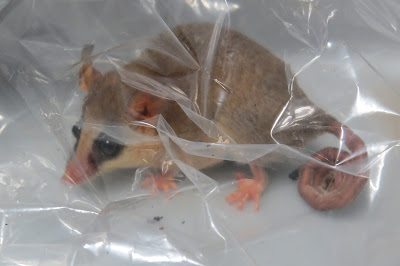
A Gracile Agile Opossum gets sleepy in ether so Cyntia can collect its ectoparasites.

In the past two months, I have spent countless hours sitting through dinner parties where I understand barely a word. I would strain to catch a phrase of familiar Portuguese, and I learned to laugh when others laughed, but I had no idea what was going on. Suddenly, the group would be ready to leave, and I found myself rushing to gather my things because I had not been able to hear the change in tone that signaled the end of the conversation. Other times, I'd think I had understood a story, but later Duca would translate for me, and I'd realize I had misinterpreted it entirely. Living in a world where I don't speak the language leaves me unaware of the happenings around me. I miss important information, and I miss the colorful details, jokes, and tales that make life rich. As I have become proficient in Portuguese, these details have come flooding back, and I realize how deeply I crave the ability to not only see or hear things, but to understand them.

This experience with language tells me that science, our attempt at multi-species translation, is important. If we do not attempt to translate the foreign languages of other organisms, we may see nature, but we will not understand it. We will miss the signal that the dinner party is ending, and we'll miss the rich jokes and stories that remind us why all organisms deserve freedom from extinction.

This is the scaffold I am building. When I commit myself to a week of marsupials or a month of mouse-lemurs (up next in Madagascar!), I do so not just to fill my days with structure, but to use science as a translator for the organisms I cannot interview.

The Watson is not meant to be a research year, at least not in the typical scientific sense. Perhaps it is in the spirit of the poet of John Keats that Watson fellows are not encouraged to publish a paper or even quantify our learning in numbers. In 1817, Keats light-heartedly complained that Newton had "destroyed the poetry of the rainbow by reducing it to a prism." Keats's poem, Lamia Part II, expresses the accusation more fully:

. . . and, for the sage,
Let spear-grass and the spiteful thistle wage
War on his temples. Do not all charms fly
At the mere touch of cold philosophy?
There was an awful rainbow once in heaven:
We know her woof, her texture; she is given
In the dull catalogue of common things.
Philosophy will clip an Angel’s wings,
Conquer all mysteries by rule and line,
Empty the haunted air, and gnomed mine—
Unweave a rainbow, as it erewhile made
The tender-person’d Lamia melt into a shade.

So I feel a little guilty about the "cold philosophy" of the spreadsheets of data I've gathered from my interviews with local farmers. I feel guilty about running statistics and making graphs to quantify the risk of canine distemper virus spreading from domestic cats to pumas and jaguars, about comparing a tick's mouthparts to a field guide to determine its species. Am I unweaving the rainbow? Am I killing the poetry?

Ticks awaiting mouthpart measurements.

No, my scaffold tells me I am not. Keats feared that knowledge would undermine poetry, but to me science does not "empty the haunted air." The more I understand of marsupials' lives, the more mysteries unfold and deepen around me, the more haunted with wonder the air becomes. That a Gracile Agile Opossom weighs between 13 and 21 grams does not relegate it to a "dull catalogue of common things," because the catalogue of common things is anything but dull. Real, tangible, common things compose my world. In the spirit of Anna Tsing and Donna Haraway, common things make my world-making projects possible, and I theirs.

Perhaps the discipline of science with which Keats was familiar, physics, attempted to "conquer all mysteries by rule and line," but ecology works peacefully with webs of interactions, complexity, and maybe even chaos -- at least, the ecology in which I am interested.

Two days ago, I had a conversation with one of the most knowledgeable bird-watching guides I've had the pleasure to meet, Maris Benites. Maris not only knew the Latin and Portuguese name of every bird we glimpsed, but she also knew the name of a strange, worm-like Amphisbaena lizard and a squishy, narrow-headed Microhylidae frog. I asked her if she loves birds more than other species, and she said no, she likes reptiles and amphibians just as much. She can't love one kind of animal on its own, because she knows how important each species is for the others. But she focuses on birds because of their value for teaching. In fact, she is just starting her PhD on birds as environmental educators.

Maris listens to the language of Pantanal.

"Why are birds such good educators?" I asked Maris.

"Because they interact with everything else," she told me (in Portuguese, so bear in mind that my translation may not be accurate!) Various bird species depend on freshwater, old-growth trees, specific fruits, cover from predators, consistently-timed army-ant swarms... the list goes on. Without a functioning forest, we have no birds. Maris hopes to get people to appreciate the little brown birds in the brambles, not just the colorful ibises and storks, and from there she hopes people will discover an understanding of ecological complexity and a conservation ethic, even for those animals that have the potential to harm us or eat our livestock, like jaguars and eagles and mosquitoes.

Maris's conversation got me thinking about microbes. When we talk about jaguars, we treat them with both fear and curiosity. They have the power to kill us, but we still feel curiosity about their lives, amazement at their strength, and awe at their beauty. I have seldom seen microbes treated the same way. Once labeled as a pathogen (something that causes disease), an organism is treated as a "sacrifice zone," an enemy particle that can and should be destroyed because we fear it. Yet, when we consider interactions, this tactic becomes nonsensical. We cannot squish every microbe like we shot nearly every cougar, grey wolf, and grizzly bear. Microbes are too small. They hide in dessicated capsules, only to emerge decades later. They evolve in minutes. They reproduce exponentially when resources exist. Their ideal habitat (in many cases) is the warm flesh and blood of human bodies, a resource that is becoming more abundant every day. We cannot eradicate microbes, so we are stuck with the task of living with them.

Evolutionary medicine, in contrast to the individualized medicine we get at the doctor's office, focuses on the weaknesses (vulnerabilities) of hosts rather than the strengths of pathogens. As humans, our principal vulnerability is that our bodies are rich with nutrients, protected habitat, and moisture. What we call a "body," a microbe considers a "home." By recognizing this pattern, we open up a wide new space for understanding disease. We can compare our bodies to thousands of other examples across ecology: soil that is home for termites, novateiro trees that are home for ants, ant nests that are home to fungus. We can look to evolved examples in which one organism becomes host for another and, instead of succumbing to disease, it thrives.

This tree, the novateiro (Triplaris americana) has a close symbiosis with ants (Pseudomyrmex triplarinus). The tree's name translates to "newcomer tree" because when a hapless tourist brushes the trunk, the ants swarm out to defend their home.

The ants live inside the trunk, feed on substances produced by it, and enter through small pores in the bark. This home may seem inanimate to the ants, but it is the body another organism, larger and slower but equally alive.

Here is another species of tree, populated by another species of ant.
This mutualist perspective leads to a change in the question of medicine. Instead of asking, "How can we avoid the pathogens?" we might ask, "How can be become better hosts for microbes?" Some quick answers might include populating our gut with diverse bacteria, limiting the use of systemic antifungals, and maybe even reintroducing parasitic worms. I hesitate to give these examples, because I do not want to close the conversation, but open it wider. What does it really take for a novateiro tree to make peace with a family of ants swarming up and down its veins every day? Do the ants ever take too much from their tree and kill it? Does the tree ever get tired of its guests and kick them out? How did the mutual trust for such an arrangement evolve?

Science does not take the mystery out of such happenings. It attempts, clumsily, to translate the languages in which other organisms are fluent, to the language we can read, that of numbers and words. I hope to learn this language with enough proficiency so I can not only understand the shouts, but so I may begin to eavesdrop on the whispered things, the inside jokes between ants and microbes and trees.

With that in mind, I think I'll go analyze the data from my last thirty interviews, and maybe write another blog about the species of amphibians I've seen. But I'll also take time to sit still, read a few pages of The Invention of Nature, and cook squash pappardelle for Duca and Lygia. Plus, I'm on deck to make brownies tonight, and we have an episode of Game of Thrones to watch.

This day will be productive, at least by my new working standards. And I trust that the scaffold will be built, piece by piece, as the day goes on.

Dad's Daily Bug

A butterfly on water flowers in the Paraguay River, drain of Pantanal.

Mom's Daily Bird

A young southern screamer pokes around in mud next to its four siblings and two parents.

Share:

Popular Posts

Labels