Health Education, Health Articles, Health Blog

Showing posts with label mountains. Show all posts

Green Light Over the Ocean: Day Seventeen on the Alaska Road Trip

Today we traveled on the Alaska Marine Highway.

Jane at the stern.

“Wait, but I thought you were on the ferry!” you say. You are correct! The ferry is considered part of the highway system in Southeast Alaska because there’s no other way to get your car around. No roads exist to the towns at which we stopped today: Juneau (where we began last night), Wrangell, Petersburg, and Ketchikan (the last city in Southeast Alaska).

The shoreline of Wrangell (I think).

Funny, rounded mountain peaks behind the town.

I was thrilled to be back on the ferry. I first traveled on this beautiful ship three years ago on the Senior Alaska Trip. In February and March of my senior year, 60 of my best friends and I embarked on a two-week expedition (with many teachers keeping watch) through Yukon, Whitehorse, frozen Lake Laberge, the Alaska Marine Highway, and headmaster Rob’s homestead in remote, rain-forested Ketchikan. That trip was the crowning experience of high school, and it was the inspiration for my mom’s and my great road trip north.

Throwback to the 2012 Senior Alaska Trip with my bestie Claire (mermaiding on the left). We rocked the puffy.
Photo credit: Nick Lew.

Nothing on the trip so far took me back as vividly as did this ferry. The yellow-windowed roof of the solarium (the third-level stern deck where hippies and students sleep under the stars in fleece blankets and tarps), the white-washed metal walls of an old but reliable ship, the underpriced vending machines, the old-fashioned magnetic announcement boards, the tinny loudspeaker announcements, and the stocking-footed elderly couples playing dominoes in the freezing Alaskan air because who would want to be inside on a marvelous day like today? None of these things had changed a bit.

Today’s voyage felt very different from the Senior Alaska Trip in many ways, too. For one, we had a cabin. We slept under a roof (or, rather, under other bunk beds) and kept our suitcases behind the safety of a locked door rather than sprawled among strangers. We had our own shower, sink, and toilet, so we weren’t running barefooted and damp across the deck looking for our towels and toothbrushes.

Jane shows off our four-person berth.

But we did spend as much time as possible outside on deck among the duct-taped tents and readers of Jack Kerouac’s On the Road. After seeing masses of impatient tourists disembark from cruise ships like Norwegian Star and Pacific Princess in Juneau, we were endlessly grateful to be among the down-to-earth passengers of the Alaska Marine Highway.

Down-to-earth readers of Jack Kerouac in front of the Solarium.

Kids found endless entertainment (driving toy trucks across the deck), as did Jane (spying on birds) and I (spying on the kids). 

One of my favorite things about this ferry route is how we are always close to land on both sides. You can’t get bored with a constantly-refreshing view of forest, rocky shores, tucked-away lighthouses, lookouts, and the occasional house.

Passing landscape.

It’s the best way to bird-watch, too – you sit still, and the ferry glides by birds at just the right speed for you to identify them!

A rocky lighthouse-base swarming with surfbirds and ruddy turnstones.

At one point, a commanding voice spoke over the loud speaker: “This is just a drill.”

Five minutes later: “Code green, a crew member is missing. I repeat, code green, a crew member is missing. Proceed to search patterns.” Dozens of crew members (who weren’t wearing uniforms, so we hadn’t before realized they were crew) assembled to don red life jackets and hustle around the decks.

Then: “Code safe, the crew member has been found. Complete all sweeps, then return to muster station.”

During the afternoon, drills were performed for fire, man overboard, missing crew member, and other emergencies. Every time the alarm bell rang, we had trouble convincing ourselves we should just keep watching the seabirds drift by.

At our stop in Ketchikan, we found the broken-down Columbia, the ferry on which we had originally been scheduled.

The night sky was spectacular, and I was a little sad that I wouldn’t be sleeping directly under it. Clear skies laid bare the Big Dipper, the North Star, and Cassiopeia.

Full moon over the Inside Passage.

Then, the best surprise of all: northern lights. Green curtains of light swept across the sky as if blown by cosmic wind. Bright pillars shot up from the horizon, then dissipated into a soft ocean of shimmering glow. When the lights were at their brightest green, a thin rim of orange formed on the lower edge, and it was simply breathtaking.

End of day summary:
  • Day of road trip: 17 
  • Start: Malaspina ferry (Juneau), Alaska, United States 
  • Miles traveled: 305 (ferry) 
  • Hours driven: 0 
  • Favorite bird sighting: surfbirds 
  • End: Malaspina ferry (Ketchikan), Alaska, United States
    Share:

    Whistle Bird and the Art of Pishing: Day Sixteen on the Alaska Road Trip

    Today was our bonus day, given to us by the breakdown of our planned ferry, the Columbia. We went birding at Mendenhall Wetlands on EVAR, the Emergency Vehicle Access Road.

    Birding by the airport.

    It started out about as picturesque as it sounds: airplanes bearing down above our heads, float planes taking off from the “liquid runway” next to the paved one.

    The morning sun over the riverbank made for another set of shadow dancers.

    Soon, however, we were past the aviation center. We saw savannah sparrows, a northern harrier, great blue herons, dowitchers,  and chestnut-backed chickadees. An iceberg floated out the brackish river, and a harbor seal poked her head above the surface.

    Crows pick apart a salmon carcass.

    There's a clear difference between a glaucous-winged gull...

    ... and the mew gull. Doesn't he look like Mr. Burns from the Simpsons?!


    Dawww, a baby song sparrow.

    Savannah sparrow.
      
    Greater yellowlegs.

    Dowitchers.

    Best birdies of the day... we think we saw six Baird’s sandpipers. (Ornithologists, please comment!)

    This looks like the book's description of "silvery with black spots" to me.

    Dark gray legs, short black beak.

    Marna met up with us for a lunch of tacos and enchiladas on the waterfront, and I got a stupendous surprise: my friend Sarah (we studied abroad together in the Galapagos Islands) was in town! She stayed at my family’s house in Seattle earlier this year, so I was ecstatic to get to see her hometown, too.

    Two friends reunited at Sheep Creek.

    She took my mom and me up a steep climb to Sheep Creek Ridge through majestic green rainforest and alpine shrubbery. We tasted bitter highbush cranberries, stuck our faces in the creek, and finally turned around at a cottonwood grove.

    Jane and Nina in the cottonwood grove.

    We rounded one corner and heard a piercing shriek whistle. Sarah, startled, replied with a nearly identical shriek. We looked at each other. What was that?!

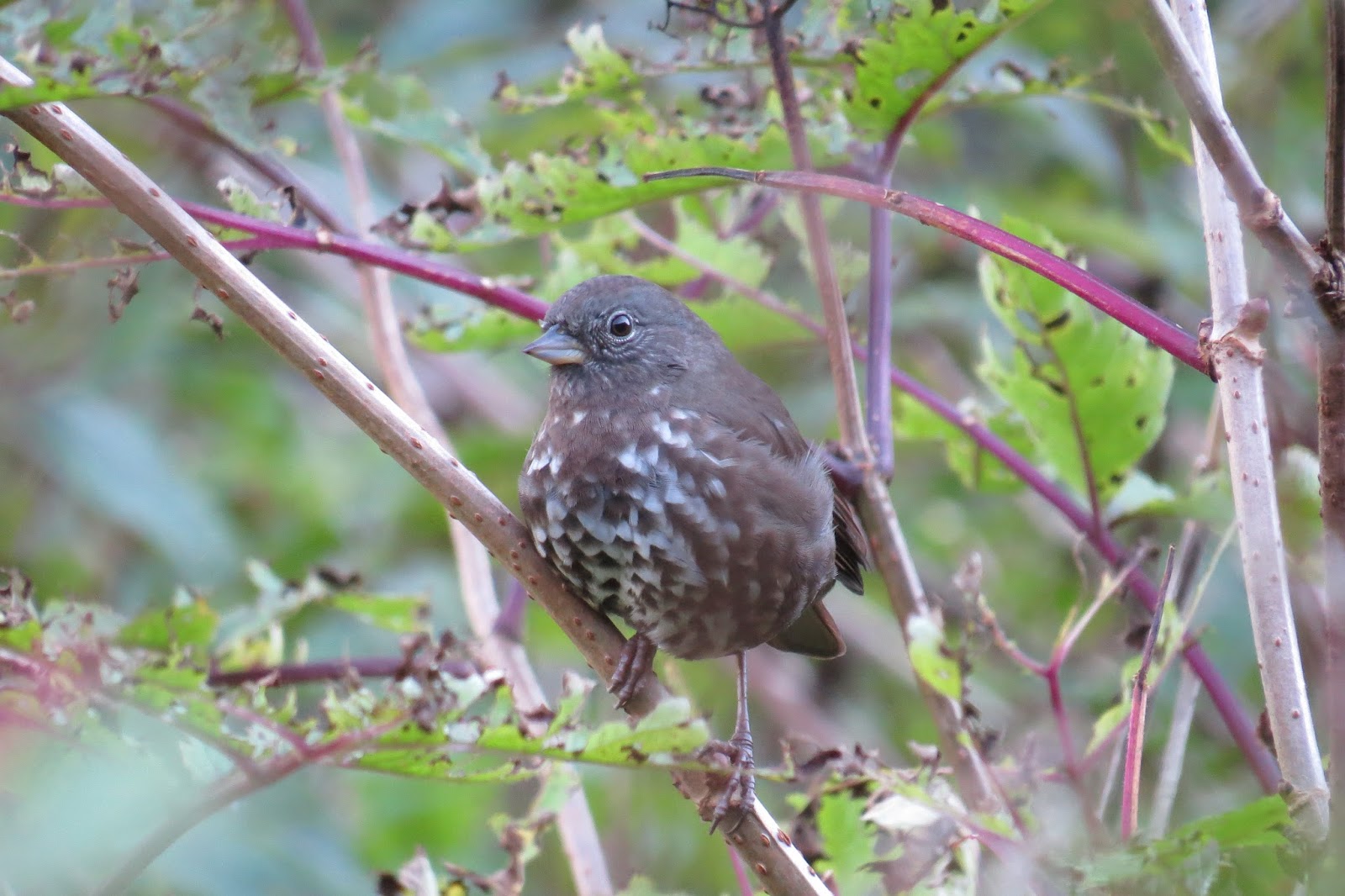
    Jane started pishing, a birding technique where you say, “PSH PSH PSH!” and the birds (supposedly) emerge from their hiding spots out of curiosity. Suddenly, the whistle bird let out a perfect whistle! A blue Steller’s jay flew right up to us, and two fox sparrows nearly landed at our feet. I guess pishing does work! But the whistle bird never showed herself, and she is still a mystery.

    Fox sparrow attracted by our pishing.

    Marna served us another delicious dinner of lamb and homemade applesauce. Since our ferry didn’t board til 11:30 pm, Sarah invited us to spend a quiet evening by her fireplace. Sarah’s mom, Sarah, Jane and I had a great time reminiscing about the Amazon Rainforest and discussing their upcoming trip to Ireland in only two days.

    Then I got another super surprise: my friend from Whitman and Sweets-co-captain Marlena paid us a visit! Juneau was the best part of our trip so far because we got to see it with locals and reunite with old friends.

    At this point the day had grown long (just like this blog post), but we couldn’t sleep yet. We had a ferry to catch! It was a couple hours late, so we waited in line while Jane snoozed and I wrote postcards to the pop radio station.

    The day held one surprise for us yet: once on the ferry, we went to the Purser’s Office to determine which cabin was ours.

    “I’m sorry,” she told us, “but it looks like you don’t have a cabin on this ship.” Uh oh. Would we be sleeping outside with no sleeping bags or pads? With some pleading and kindness from our understanding purser, we managed to rent a four-berth cabin, just until we arrived in Ketchikan. Good enough – at least we will sleep tonight.

    Knock knock.

    A half-hour after we went to bed (so around 2 am) the night watchman knocked on our door. “Do you have a red Prius?” he asked.

    I’d left the dome light on from writing postcards in the waiting lot. Down to the car deck I went, in my pajamas, to put Prius to bed. Finally, we were ALL tucked in and ready to sleep.

    End of day summary:
    • Day of road trip: 16 
    • Start: Juneau, Alaska, United States 
    • Miles traveled: 50 
    • Hours driven: 1 
    • Favorite bird sighting: Baird’s sandpiper 
    • End: Malaspina ferry (Juneau), Alaska, United States
      Share:

      Going with the Flow in Juneau: Day Fifteen on the Alaska Road Trip

      I would like to begin this blog by highlighting my stupendous mom who made this whole trip possible and amazing and awesome.

      Everybody, Jane in two habitats:

      Jane birding on Mt. Roberts.

      Jane and her alter-ego, the giant hoary marmot.

      Thanks for everything, Mom! I love you!

      Ok, now for the Day Fifteen update. Juneau was lovely and vital and full of people who seemed really happy to be there. Our friend Marna and her two daughters live in a house on a crooked street in a quirky neighborhood filled with steep hills, flower gardens, dead-ends and staircases. The waterfront, quiet in the morning, soon filled up with four enormous cruise ships, each of which disgorged a thousand passengers onto the quaint downtown streets to shop for jewelry and trinkets.

      Jane and Marna on Basin Road.

      Marna was impressed by the fast-paced road trip schedule we’d been keeping, so she gave us four different attractions to pack into our day. “My family would take on one of these in a day,” she told us, “but for you guys, no problem!” We started with a walk up Basin Road, a street that soon became a cantilevered wooden track under sheer cliffs of moss and precarious forest.

      We then headed down the hill to the waterfront, where we caught the first tram up to Mount Roberts. It’s unbelievable how steeply the mountains rise around Juneau!

      Looking down the tram wires from Mt. Roberts.

      The network of alpine trails could take a backpacker weeks to explore, so we saw just a snippet with breath-taking views and a handful of shy songbirds. The Lobaria lichens were the lushest, greenest, shiniest, most lung-worty specimens I’ve ever seen!

      So green!

      Nice ascocarps!

      We looked for willow ptarmigans, but instead found another thrush. We should be getting good at these guys by now, but we still can't tell... is she hermit or gray-cheeked?

      Birders, what do you think: hermit or gray-cheeked?

      We left, before we had seen enough, to catch the 1 pm tour of the NOAA (National Oceanic and Atmospheric Administration) fisheries science building. Compared to dramatic clifftops, touring a government building may sound dull, but I love seeing NOAA labs, and my mom indulged my strange request.

      Compared to the NOAA Northwest Fisheries Science Center where I worked this summer in Seattle, the Juneau building was state of the art. A mural of 50 life-sized model fishes from the region adorned the lobby’s wall. Four projectors shone on a globe-shaped screen to give the impression of a rotating earth. We got to watch NOAA’s “Science on a Sphere” presentation about the world and climate change here.

      Science on a Sphere and the fish wall.

      The wet lab contained touch-tanks of my favorites, including a sunflower star, Pycnopodia helianthoides. The biology and chemistry labs were staffed with friendly, busy scientists, and the lobby’s aquarium contained the largest leather star, Dermasterias imbricata, I’ve ever seen.

      Jane examines squid eggs.

      Two sculpins, a great (Myoxocephalus polyacanthocephalus) and a buffalo (Enophrys bison), cuddle puddling.

      The building is heated by an efficient heat-exchange system that draws energy from the chilly waters of Gastineau Channel. In winter, it also recaptures heat blowing up through vents from the chemical hoods. The conference room has a glass wall overlooking the ocean, and our tour guide told us he gets too distracted by breaching whales when he sits facing that way. What a life!

      I want this poster for my wall!

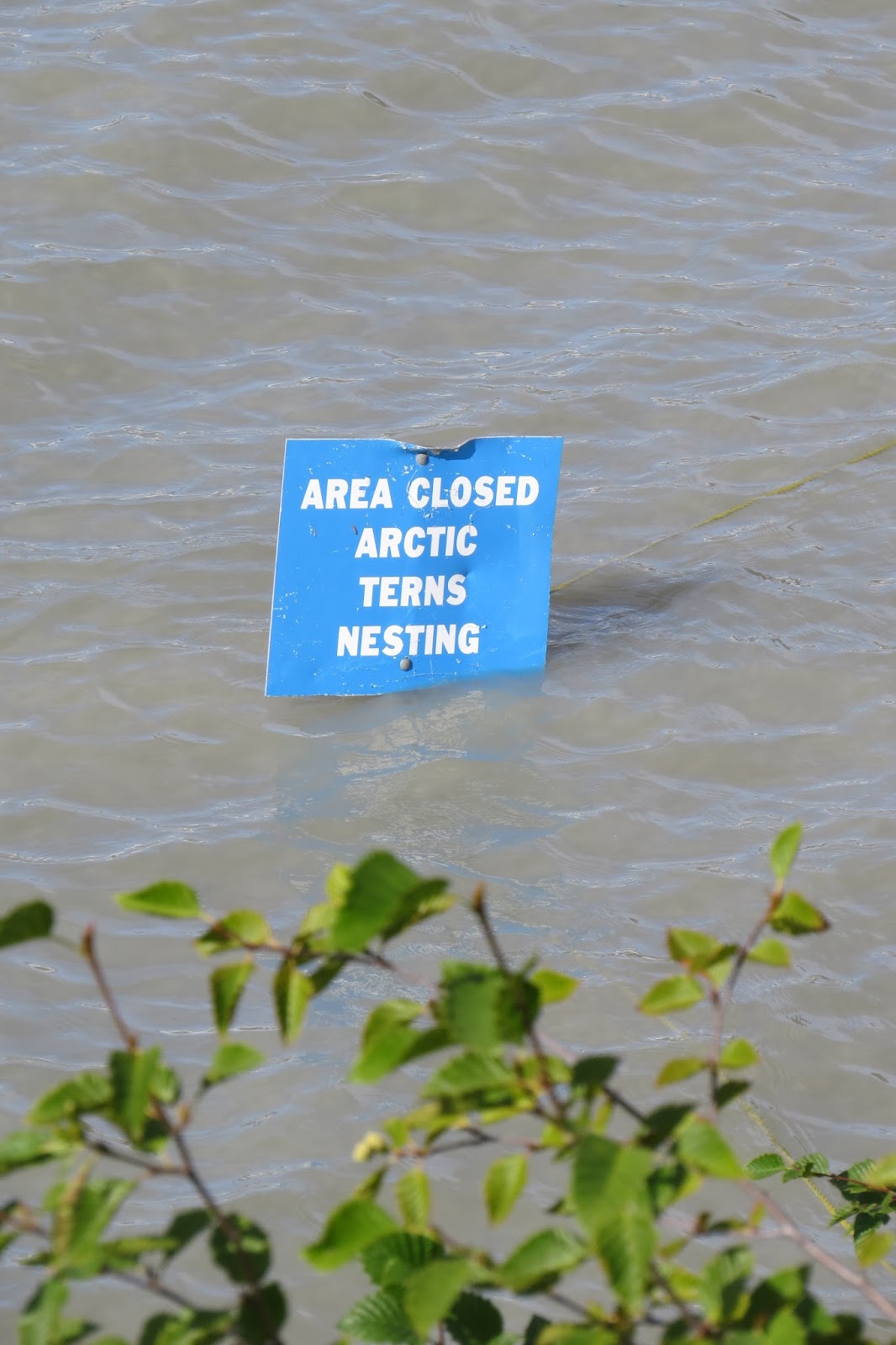
      After the tour, we headed straight to Mendenhall Glacier. Two of the four trails were closed: one for bears, the other for flooding.

      Mendenhall Glacier melts into Mendenhall Lake.

      I think these terns may have been flooded out of house and home.

      We fought our way through the crowd of cruise-boat tourists for a look at the receding blue ice, admired the icebergs she had calved into Mendenhall Lake, and moved on to the stream.

      Red squirrel munching on a mushroom.

      Here, bright red sockeye salmon were spawning! The waters were so shallow over the river rocks that the salmon had to expose their dorsal halves in their frantic push to move upstream. Several white carcasses rotted on the banks. I realized that I had never seen a healthy stream of salmon before! I’ve learned about these fish since grade school, visited the fish ladder at the Locks, witnessed the life stages at the Seattle Aquarium, watched documentaries about the fate of Alaskan salmon if Pebble Mine is dug… but here in front of me were the real thing, unaware of their symbolism, just trying to reproduce like the rest of us. I wish you the best, big sockeyes!

      A sockeye too large for its small stream.

      As we watched salmon from the bridge, a National Forest ranger approached us. “Are you looking for birds?” she asked. Finally, a ranger-ornithologist! Together we spotted juncos, yellow-rumped warblers, a Pacific slope flycatcher, and a western wood-pewee. She gifted us a Birds of Southeast Alaska checklist and recommended a trail for dippers.

      Pacific slope flycatcher.

      Western wood-pewee.

      We were in luck. As we walked back to the parking lot, we passed a secluded bridge over another stream. The tree branches dripped with lichens, and the soil embankment was caked with emerald moss. “If I were a dipper, I’d live here!” I told my mom. “Oh my gosh, there’s a dipper!”

      Ideal dipper (and Nina) habitat.

      There she was, popping in and out of the clear water, the droplets rolling off her graphite back. A bird that loves mossy streams! I am so fond of dippers.

      Dipping for bugs.

      Ahhh!

      Now back to Marna’s for a mouth-watering salmon dinner. Our first home-cooked meal. And after that, a jaunt back up the tram (tickets are good for the whole day, so we wanted to get our full use!) for sunset on Mount Roberts.

      Gastineau Channel at sunset.

      Looooong shadow dancers.

      I think this black leafy stuff is tree pelt lichen, Peltigera collina.

      We were hoping to get to bed early, but at 10:30 pm I realized I couldn’t find my (dead) iPhone, so I spent half an hour tearing apart my suitcase, the car, and everything in the room. Finally Annabelle (that’s my iPhone) appeared in the folds of an emergency blanket in the trunk of Prius. Oh, what can you do when inanimate objects play pranks on you…

      End of day summary:
      • Day of road trip: 15 
      • Start: Juneau, Alaska, United States 
      • Miles traveled: 45 
      • Hours driven: 1 
      • Favorite bird sighting: American dipper 
      • End: Juneau, Alaska, United States
      Share:

      Do Lichens Have Free Will? or Snowshoeing Congo Gulch

      Do lichens have free will?

      How do things as tiny as atoms and cells operate with so much complexity?

      Would an organism on the scale of the universe marvel at the complexity of tiny things like human beings or planets?

      These questions arose among the overnight snowshoers on Valentine's Day as we hiked a rather unsnowy mountainside and snowshoed up an icy road without lights. The crystalline fir boughs, hoarse ravens and wide starry night sky were a welcome respite from the grind of the semester, and they let our minds wander towards the existential.

      We stayed in Congo Gulch Cabin, owned by the U. S. Forest Service, in the Elkhorn Mountains of eastern Oregon.

      The adjacent Fremont Powerhouse was built in 1908 to produce more-affordable electricity for the local mines that were experiencing economic decline. Water was pumped through eight miles of steel and wood pipeline from Olive Lake to generate electricity until 1967, when the powerhouse was decommissioned and donated to the U. S. Forest Service as a historical landmark.

      The weather was oddly warm for February. It turns out we didn't need our snowshoes to climb the steep hillside behind our cabin. As we hiked, I got into some wonderful conversations. Allison and I pondered the meaning of free will: am "I" in control of my actions, or does my physiology control me? Are my physiology and I the same thing? Is the act of willing contained within the neurons that fire, and the endocrine and nervous systems that carry out desires? Does lichen, with no conscious mind, still have free will?

      It takes only fresh air, a forest, a lack of screens, and a little break from homework to get into the really fun questions of the world.

      Our first group photo turned out excellent. It was taken by the self-timer of my camera perched on a precarious platform of rocks and twigs.

      Our knowledgeable leaders told us that Ponderosa Pine bark smells like vanilla. Of course, we had to give it a try!

      The thick, scaly park has a reddish tint and deep grooves.

      The view from halfway up the mountainside was lovely.

      And the view from the top was breathtaking! The sunlight lit up the distant snowy peaks in a sparkling glow that's impossible to capture with a photo.

      I was collecting lichens during the hike, and at the peak I noticed all the lichens on the ground had been trampled. By what, I wondered? Then a pile of scat told the answer: elk.

      Elk scat.

      I noticed smaller pellets on our way back down the mountain. Deer scat, I am guessing.

      I did manage to find a few lichens, however. I got really excited about this one because it included ascocarps, the sexual reproductive structure of lichens. (Can you see the brown satellite-dish-shaped cups?) Also, its neon lime-green color was gorgeous! I identified this species as Letharia columbiana.

      My second lichen species turned out to be even more exciting! I brought this specimen back to the Whitman plant ID lab and scoured books and keys, trying to determine the species.

      Here's a photo of the lichen's "cup" taken by my iPhone through the lens of a dissecting microscope.

      The only species (out of hundreds) that fit my lichen was Cladonia multiformis, but the range listed for that species in my field guide did not overlap with any part of Oregon. What to do?! I e-mailed the book's author, Bruce McCune, with photos. He replied immediately: I was right! The true range must be larger than the one printed in the guide. I am now in love with lichens. :)

      In the evening, we finally got to the activity our trip was named for: snowshoeing!

      Used from Wikimedia Commons with permission from the Free Art License.
      I was expecting clunky wooden tennis rackets cris-crossed with leather... you know, the kind you might find hung over the door of an old mountain lodge.

      But modern snowshoes actually look like this! They're easy to strap on and walk in. Don't try to go backwards, though!

      We decided to walk up the icy road without lights so our eyes could adjust to the darkness. We stumbled into a couple ditches, but it was wonderful to be able to sense the trees, ground and sky without the blinding glare of a flashlight. 

      We marveled at the stars and constellations. We found Orion's belt (and then the rest of him) and spotted a reddish planet that might have been Venus. I saw two shooting stars but no satellites. I wonder why?

      Back in the cabin, a few dedicated fairies had prepared brownie scramble, the best wilderness desert in existence! We spent the night playing Settlers of Catan and Mafia, stoking the wood stove, and keeping our feet cozy in socks and slippers.

      The next morning we retraced our snowshoe path up the road, but this time we could admire the melting snow and sapling trees by sunlight.

      Baby tamaracks, Douglas firs, grand firs and ponderosa pines sprouted along the road like a nursery.

      I don't think I gave the group enough warning for our first attempt at a group self-timer photo...

      But the second time, we got it right!

      Most of us didn't know each other before we met in the Outdoor Program basement on Saturday morning. I loved getting to know each person as we played icebreaker games on the Whitman Lawn, drove four hours to the cabin, cooked, washed dishes, and raced to the outhouse through the frigid air. Every person brought energy and interest. I was lucky to experience the Elkhorns with such a group.

      As we prepared to leave, I noticed a clump of lush moss growing in the middle of a rushing stream.

      The moss was coated in ice! How did it manage to photosynthesize and prosper in its chilly bath?

      To end with a favorite image from the weekend: grassicles.

      Yum!
      Share:

      Popular Posts

      Labels