Health Education, Health Articles, Health Blog

Showing posts with label Navajo. Show all posts

Humans as Texts: Conservationists in Three Nations of the West

On Semester in the West, the Whitman College field program I completed in autumn 2016, our texts were not books, but the dozens of speakers who gave us their time and wisdom.

I once thought the West was contained within one country, the United States. And I thought a conservationist was someone who tried to save animals from extinction. Below are brief biographies of three of our speakers who challenged those ideas.

They are citizens of Mexico, the Diné (Navajo) Nation, and the Nimiipuu (Nez Perce) Nation, all of which compose the West. They fight to conserve things that matter, from language to habitat to the body parts of planet Earth. I hope they inspire you, as they did me. They remind us that there is an enormous diversity of ways to be good and be yourself.

Cross-posted from the Semester in the West blog.


Meet Our Speakers: Alejandra Calvo-Fonesca

November 18, 2016


“You’re going to have to swim!” These were the words of Alejandra “Alex” Calvo-Fonesca when our boat ran out of gas in Ciénega de Santa Clara, a vast marsh of recycled irrigation water in Sonora, México. Her mischievous smile told us she was joking, and she quickly produced a paddle with which to rescue us. Wildlife Survey Coordinator for ProNatura, Alex brims with enthusiasm for her job. “It’s like school,” she says. “I’m always learning. Sometimes I have a theory, and my coworkers know what’s going on in the place. We correlate the two and learn. That’s what I love.” When Alex majored in aquaculture at Universidad Autónoma de Guadalajara, she planned to design ornamental aquaria. Instead, she began working at a shrimp farm and surveying birds for ProNatura, a nonprofit that has been collaborating with governments and local communities to restore the Colorado River Delta since 1990. Now in her ninth year, Alex has risen from fieldwork to the office. “I knew nothing about biology when I started, but they provided a workshop,” Alex explains. She conducted vegetation and wildlife surveys, learning to identify marsh birds such as sora, least bittern, and the endangered Yuma clapper-rail by ear. Alex’s curiosity has earned her a vast and growing base of knowledge. She can point out native cattails and introduced cane, bird species in English and Spanish, and even the way out of a maze-like marsh when your boat runs out of gas.


Meet our Speakers: Valencia Edgewater

October 7, 2016


Valencia Edgewater is chíshí diné, of the Chiricahua Apache clan, from the Black Mesa region of the Navajo Nation. She teaches community-based Navajo language and culture classes near her home in Hardrock. In addition, she drives her own vehicle for a family-owned, non-emergency medical transportation company. After earning a master’s degree in bilingual bicultural education from Northern Arizona University, Valencia started using her training to pass on the Navajo language, which she began learning in childhood from her grandmother, to community members and visitors. Valencia teaches through immersion, speaking entirely in Navajo and focusing on ways of thought. Through gestures, images, and the natural environment, Valencia invites her students to learn. She begins a lesson with the sun, orienting her students to the cardinal directions of sunrise, sun passage, sunset, and the North Star. After only an hour of instruction, novice students can point out the directions of the sacred mountains, introduce themselves in Navajo, and ask others to do the same. As a mother of two boys, Valencia is committed to imparting Navajo language and culture to the next generation.


Meet Our Speakers: Allen Pinkham

September 3, 2016


“Son, do something for your people.” These were the words of advice left to Allen Pinkham, or Paaxat Higatin in the Nez Perce language, by his father. Pinkham is a Nimiipuu elder who has accomplished a great deal for his people, a vast family that includes salmon, deer, eagles, grizzly bears, wolves and insects. “Everything you see on this earth is your people,” Pinkham told us. “We have red blood just like them.” This concept, one of Pinkham’s “mythological truths,” was the basis for his 1999 book on Nez Perce fishing culture, Salmon and His People. Last year, Pinkham published a second book, Lewis and Clark Among the Nez Perce: Strangers in the land of Nimiipuu, to recount the famed explorers’ journey from his people’s perspective. As former Chairman of his tribal council, Pinkham fought to enact treaty rights, bring fish ladders to local hydroelectric dams, and reintroduce coho and fall chinook salmon to the Clearwater River. While he has won many battles as leader and activist, Pinkham’s greatest gift is his ability to weave together history and future through story-telling. He invited us to visualize our bodies as part of the earth, each finger representing a species. “When you lose the passenger pigeon, you lose your little finger,” he explained. Because we abuse ecosystems, we’re at risk of losing bison, salmon, and thousands of others. Wounded, fingerless hands seared across our imaginations. “The earth is squirming,” Pinkham concluded. “How much longer until we say, no more body parts lost?”
Share:

When Our Gods Take Us Back: A Western Podcast and Epiphany

Blast from the past! My work from Semester in the West, a Whitman College field program I completed August through December 2016, has been published on the program's website.

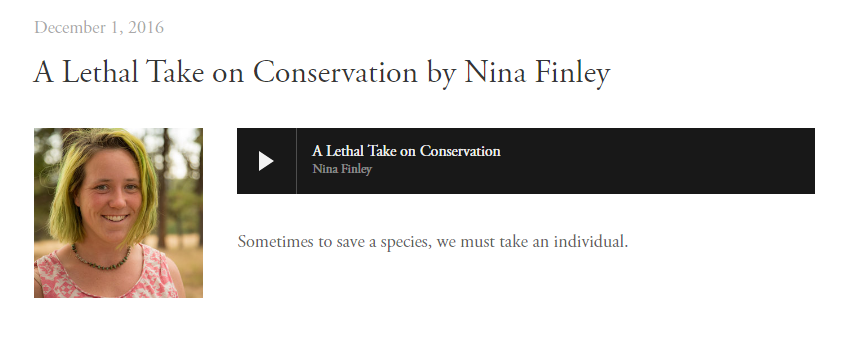
Click here and scroll down to listen to my podcast, "A Lethal Take On Conservation."

It's an eight-minute journey with three conservationists who have come to terms with a paradox: sometimes to save a species, we must sacrifice an individual.

Click here to listen.

Then click here and scroll to watch the public reading of my epiphany, "When Our Gods Take Us Back."


The essay imagines the Sixth Mass Extinction through the lens of Diné (Navajo) cosmology.

Click here to watch.

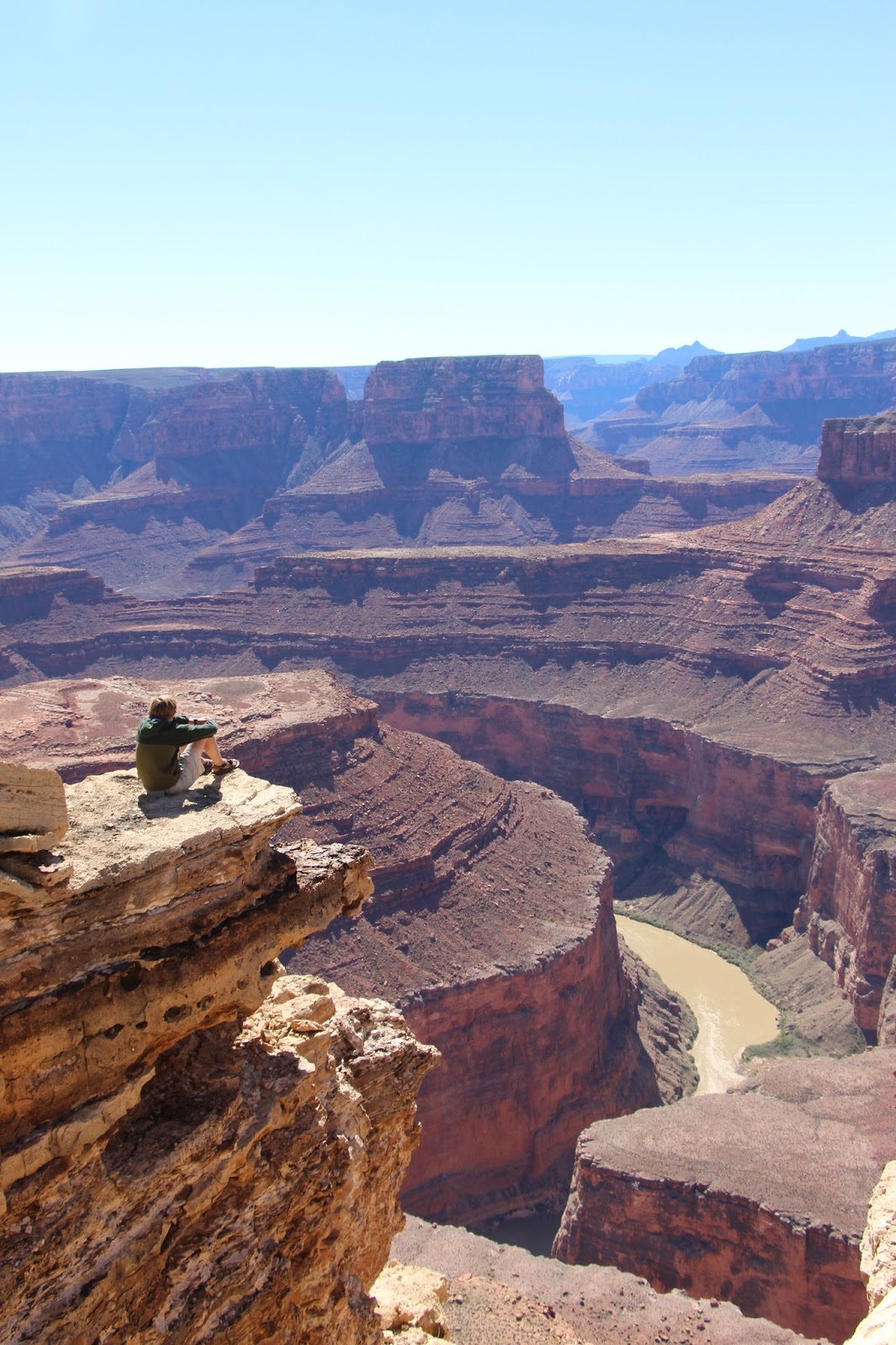
They don't show up in the video, but this epiphany reading was paired with a slideshow of images from the semester. I'll include them here, and you can view them with the video as you like.


While you're on the website, I highly encourage you to listen to the epiphanies and podcasts of my fellow Westies. These people are articulate, compassionate, insightful, and a whole long list of things I admire. Every single one of their epiphanies gives me shivers. Seriously. Check them out.

Signe, Griffin, Sophie, Willa, Amanda, Hunter, Abby, Maggie, Thomas, Gardner, Kenzie, Evan, Hannah, Grace, Rachel, Elizabeth, Maya, Fields, Emma, Sarah, Ysa, Collin, and Phil: you've changed my life. I miss you, and I am thankful for you.
Share:

Reptiles and Amphibians of the Intermountain West

Hello from Comb Ridge, Utah. I'm travelling through the Intermountain West -- the arid lands of America between the Cascades and the Rockies -- on a Whitman College program called Semester in the West. There are oodles of things to write about, but let's begin with the reptiles I've seen along the way.

Ornate box turtle, Terrapene ornate.

We found this individual dead on the Pine Ridge Reservation in South Dakota.

Long-nosed leopard lizard, Gambelia wislizenii. We found her in a private yard full of native plantings in Castle Valley, Utah.

Note the long-nosed leopard lizard's orange spots and long, striped tail.

I think this guy is an eastern fence lizard, Sceloporus undulatus. However, he does not have a blue belly or throat (which may or may not be present, according to the field guide.) We found him at Sand Island, Utah among ancient rock art.

Another view of the supposed eastern fence lizard. Note the blue armpit.

This eastern fence lizard had a striking black and blue line down its side. We found him in Comb Ridge, Utah.

I don't know who this is. Could be a small eastern fence lizard, or perhaps a tree lizard, Urosaurus ornatus?

I found this side-blotched lizard, Uta stansburiana, soaking up my body heat under my sleeping bag on Comb Ridge, Utah!

Evan and the side-blotched lizard communed after breakfast.

Aren't those turquoise spots and long nails glamorous?

One of three northern Pacific rattlesnakes (Crotalus oreganus) found lurking around our campsite in the Methow Valley of Washington State. He chilled out in this empty cooler until we transported him to a better spot. Would have been an unpleasant surprise for anyone hoping for a cold drink...
Photo credit: Thomas Meinzen

Wildlife wrangler extraordinaire Kent deftly placed our venomous friend in an unoccupied cooler.
Photo credit: Thomas Meinzen

This garter snake (perhaps a wandering garter, Thamnophis elegans vagrans) was hiding under a plastic bin on the garlic farm made famous by Stanley Crawford's The Garlic Testament, near Dixon, New Mexico.

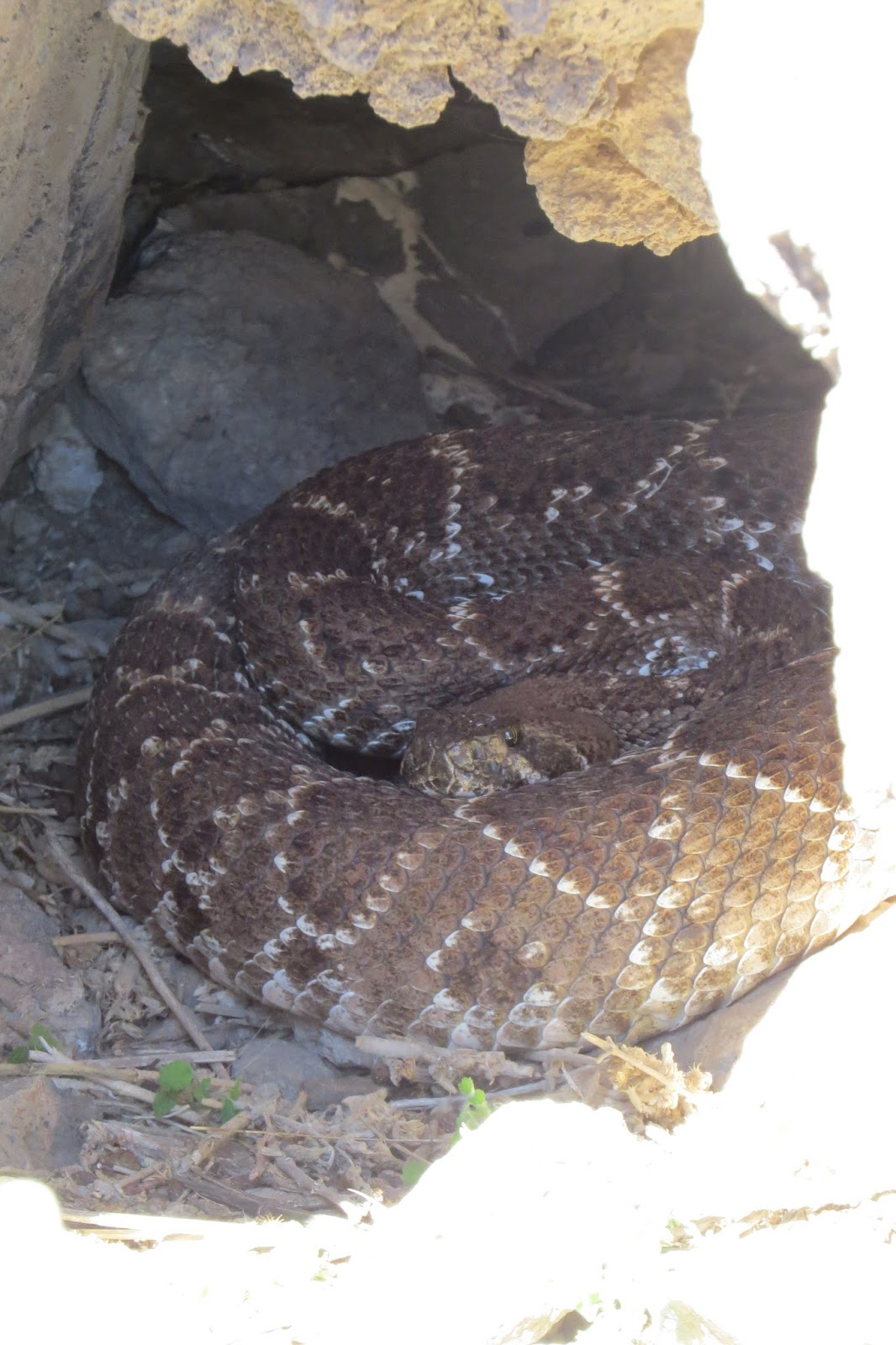
A 3-inch diameter rattlesnake (Crotalus sp.) near Santa Fe, New Mexico. The largest I've ever seen! She rattled at us from her crevice.

Our resident snake-o-phobe and serpent-detector, Fields, found a Chihuahuan night snake (Hypsiglena jani) coiled in a perfect S in the path to his tent. It was cool and docile! EDIT: I previously mis-identified this snake as a baby gopher snake and was corrected by a helpful, anonymous commenter. Thanks to Anonymous and iNaturalist for helping me get to the correct identification. This snake was found near Cieneguilla Recreation Area just outside Santa Fe, New Mexico.

The Chihuahuan night snake made a lot of friends, especially Thomas.

Sarah has a future career as a snake hand-model.

A snakeskin found by Amanda on Black Mountain in the Chihuahuan Desert of New Mexico as we surveyed for endangered night-blooming cereus cactus. It had a face with eye-lenses still intact!

A Texas horned lizard (Phrynosoma cornutum) skittered across our path near Black Mountain, New Mexico. They are what ecologist Paul Arbetan calls "a fermenting vat with legs," because they use their round bellies to digest ants.

A greater earless lizard (Cophosaurus texanus) posed in plank position at our campsite outside Big Bend National Park in Texas. Notice that pastel, rainbow belly!

An American bullfrog (Lithobates catesbeianus) made an appearance at Bosque del Apache National Wildlife Refuge in New Mexico. They are invasive throughout the West Coast and Southwest.

Tiny red-spotted toads (Anaxyrus punctatus) hopped on the mud banks of the Rio Grande.

Couch's spadefoot toad (Scaphiopus couchii) found hopping among our sleeping bags during a light rain on Adams Ranch on the Rio Grande, about an hour from Big Bend National Park.


We have also seen a plateau whiptail, Aspidoscelis velox, in Castle Valley, Utah and a short-horned lizard, Phrynosoma hernandesi, on the Navajo Nation in northern Arizona.

Our Navajo host, Adrian, taught us that the short-horned lizard is called che in Navajo. It is believed to have fought with a dark storm cloud and won because its thorny armor can deflect lightning. We learned how to bless the lizard with a sprinkle of water, and we would have added corn pollen if we'd had it. Then Adrian placed the lizard over his heart and feet to bless himself before returning it gently to its sagebrush home. To learn more about Navajo reptiles, have a look at Diné Traditional Teachings on Wildlife.

For my future reference, here are all the lizard species I have seen on this trip:
  1. Side-blotched lizard, Uta stansburiana
  2. Eastern fence lizard (northern plateau lizard), Sceloporus undulatus
  3. Plateau whiptail, Aspidoscelis velox
  4. Short-horned lizard, Phrynosoma hernandesi
  5. Long-nosed leopard lizard, Gambelia wislizenii
  6. Short-horned lizard, Phrynosoma hernandesi
  7. Texas horned lizard, Phrynosoma cornutum
  8. Greater earless lizard, Choposaurus texanus

Thanks to Southwest Guide Books and Utah Herps for the information I used to identify these reptiles. Please contact me if you notice any errors, and stay tuned for more posts from the West!
Share:

Popular Posts

Labels