I’ll keep it simple today: it kept raining. As we packed up in Healy, left Denali National Park behind, drove past glorious mountain ranges utterly obscured by clouds, and arrived four-and-a-half hours later in Anchorage… it kept raining!
Our respite came at Potter Marsh, a wetland just south of Anchorage that was created when the railroad berm blocked the flow of creeks, and freshwater backed up.
 |
| The sun was shining at Potter Marsh. |
The signs touted the “accidental wetland” and the unusual fact that industrial development actually created wildlife habitat for once, but most of the signs failed to mention the estuary that was here before. It may not have been so full of birds, but estuaries are critical habitats for different critters, like juvenile fishes and invertebrates. Basically, we have to remember you can’t get something for nothing, and every habitat is valuable.
Anyway, back to pretty birds. We saw waterfowl with feathers of many colors: red-necked grebes, northern shovelers, northern pintails, mallards, American wigeons, green-winged teals, and scaups.
 |
| Red-necked grebe. |
 |
| Red-necked grebe juvenile. |
 |
| Northern shoveler (what a pendulous bill!) |
 |
| Northern pintail (ballerina neck). |
 |
| A plain old mallard flaunts her blue speculum. |
 |
| Two American wigeons with their rocker black-tipped blue bills. |
 |
| A green-winged teal nestled in the reeds. |
 |
| We were convinced of this ID when she let her green wing peek out. |
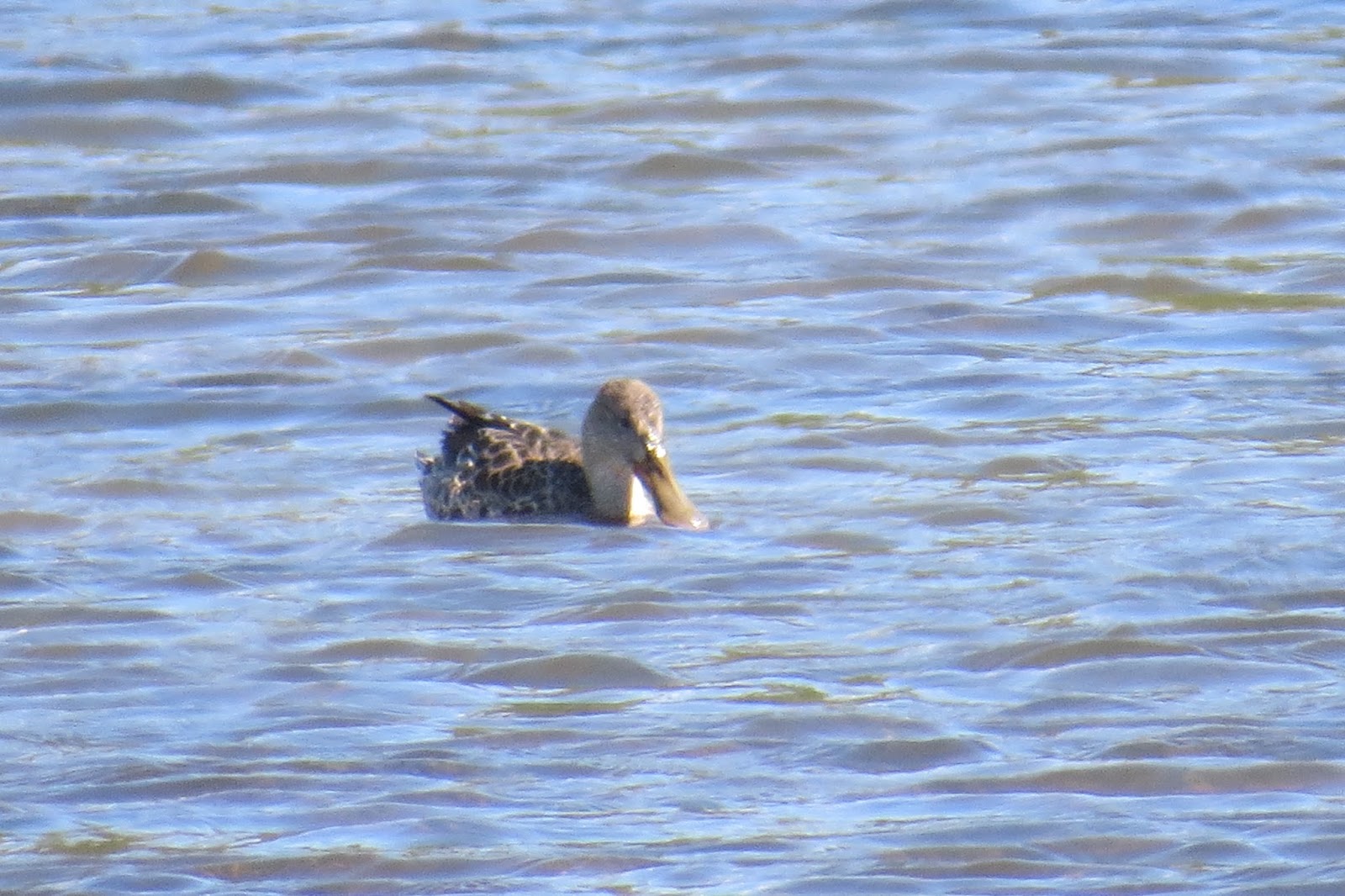
For the shorebirds, we are under the impression (ornithologist readers, correct us if we’re deluded) that both greater and lesser yellowlegs were mucking around in the same pool.
 |
| These two looked like greater yellowlegs. |
 |
| This one, on a nearby shore, looked like a lesser. |
 |
| She fanned her wings for us, but we still weren't sure about her lesser-ness! |
 |
| And two more yellowlegs in a different pond... greaters? |
My favorite spot was a Wilson’s snipe teetering in the weeds of a muddy tributary under the boardwalk!
 |
| A Wilson's snipe is an elusive bird. |
We also saw black-capped chickadees swinging around a willow, a herring gull (?) munching on gunk, a flock of Canada geese, a red-necked grebe with her stripey-faced chick, and a laughing belted kingfisher.
 |
| Pink legs, black wing tips, and a red spot on the lower mandible = Herring gull? (But why no streaks on the back of the neck?) |
I was amazed to see a large number of salmon braving the culverts of this estuary-turned-wetlands to reach their ancestral spawning creeks.
 |
| The salmon were coming in through culverts to spawn. |
 |
| Can any salmon scientists out there identify the species? |
The boardwalk was funded by the Highway Commission as a safety measure because so many cars of birders were stopping along the narrow highway to watch the ducks in Potter Marsh. The highway people tried building precarious gravel pullouts near the ponds and posting warning signs, but the problem continued, so they finally gave in and built the birders a boardwalk. Hooray!
We continued our drive around scenic Turnagain Arm, the shallow extension of Cook Inlet between Anchorage and the Kenai Peninsula.
 |
| Turnagain Arm. |
The tide was out, and we watched the waves break over miles of sandbars and mudflats. A bald eagle perched on an exposed piece of driftwood. Black-billed magpies danced around the parking lots.
 |
| A bald eagle on mud-flat driftwood. |
Of note is the ghost forest of Sitka spruce snags around the abandoned town of Portage. An earthquake hit this coastline in 1964, and this shard of land dropped between six and twelve feet in an instant. All that remains of the town were a rusty truck and the wood of a half-sunken building.
 |
| The dead Sitka spruce where saltwater inundated the forest during a massive earthquake. |
Our accommodations down in Seward had character. We stayed in a ground-floor apartment at the Taroka Inn, complete with two TVs, kitchenette, back door to an alley, and enthusiastic proprietor who gave us coupons.
I took a run tonight through town. I love Seward! The waterfront real-estate is all taken up by tent and RV-campsites. I ran past many campers with beach bonfires, and I watched a sea otter rolling and preening in the frigid saltwater. (I think I got too close, and he disappeared for a bit. The campers glared at me. I had to run away. Oops.) The buildings are coated with technicolor murals. My favorite: “Remembering Exit Glacier.” The impact of climate change is already felt heavily in Alaska.
 |
| "Remembering Exit Glacier." |
My mom and I ate baklava at a picnic table of a closed-for-the-night café after dusk. The sun set early behind the steep forested hills of Seward, a town nestled between water and mountains.
End of day summary:
- Day of road trip: 10
- Start: Healy, Alaska, United States
- Miles traveled: 373
- Hours driven: 7
- Favorite bird sighting: Wilson’s snipe
- End: Seward, Alaska, United States