Health Education, Health Articles, Health Blog

Showing posts with label environment. Show all posts

Planetary Health Education: ASRI Kids Learn How to Keep Their Whole Earth Healthy

I clutch a butcher knife and a sack of apples as I speed past goats and banana trees on the back of Amad's motorcycle. Today, I will be observing an ASRI Kids program and supplying a vital service: apple chopping.

In the one-room school building, Amad gives a lively PowerPoint about washing hands with soap and water. He explains nutrition and the importance of healthy foods. I steadily slice apple after apple into juicy quarters. Amad expected 24 kids, but apparently word has spread. Today, the classroom bulges with 33 rapt elementary-schoolers. I have to cut the larger apple slices in half to make sure everyone will get one.

Here I am helping rinse soap off a student's hands with her water bottle.

Look at those clean hands! (Human soap dispenser in background.)

The kids line up for lemon-scented hand soap and splashes of water. They scrub their fingers meticulously, embodying the essence of hygiene. I pass out an apple slice and a tart green orange to each student, then sit back to relish my own. Fresh fruit has never tasted so good.

ASRI Kids looking cool with their apples.

"Quiz time!" Amad announces in Bahasa Indonesia. "Who can name three healthy foods?"

The room erupts with eager kids, straining their hands to the sky, halfway off their chairs. Amad selects a serious girl who's sitting in the back corner. She stands to deliver her answer.

"Milk, rice," she begins confidently, then stalls out. The room hollers ideas at her, but I think they only add confusion. She looks to Amad for support. He gives her an encouraging smile. "Vegetables!" she finally gasps, doubling over in relief. She walks to the front of the room to claim her prize. Without looking, she dips her hand into a canvas bag of goodies and pulls out a magnifying glass. Maybe she'll use it to examine bugs in the schoolyard tomorrow.

The school where Amad and I served chopped apples as a healthy snack. The old school-building is on the right.

Education is one of the five prongs of Alam Sehat Lestari, better known as ASRI, the conservation-healthcare initiative in Indonesian Borneo where I'm a volunteer. (Check out my post, Spirit: from Balinese Frisbee to a Bornean Hospital, for background.)

The five prongs of ASRI are:
  1. Monitor
  2. Provide healthcare
  3. Find alternative livelihoods
  4. Educate
  5. Restore
Each of these prongs is supported by multiple projects on the ground. To learn about prong five, restoration, you can read Rainforest's Rebirth, my recent post about the Laman Satong reforestation nursery.

Over the past three weeks, I've been directly involved with prong four, education, through ASRI Kids. This program teaches fifth graders about Planetary Health topics ranging from nutritious eating and hand washing, to wildlife and ecosystems, to sustainable living. It's led by the wonder-woman educator, Etty Rahmawati, and her talented co-worker, "Amad" M. Zulkarnaen.

Etty poses with our resident Selfie Orangutan.

Amad straps a blender to his backpack and motorcycles to school, so he can make recycled paper with ASRI Kids.

Below is a three-minute video about ASRI Kids produced by Jane Huff, an ASRI volunteer and then-student of Northwestern University. It was filmed in 2013, one year after the program was created. ASRI Kids has come a long way since then.


The magic of ASRI lies in its combination of accurate knowledge with hands-on activity. One of the kids' favorite projects is making recycled paper. They learn to be creative with trash, appreciate forest resources, and reduce waste.

Two students carry a tub to the spigot for water.

Amad blends water and shredded scratch-paper into a violet pulp.

The kids watch as Amad strains out a rectangle of paper pulp.

Selvi, an ASRI Teen volunteer, demonstrates how to press the wet paper onto a drying board.

After paper-making, I brought out my frisbee. Tossing here are Oka Nurlaila of marketing and communications, Amad of education, and me.
Photo credit: Selvi.

Two of our students got the hang of it right away. This girl soon mastered the backhand. Here she is attempting a forehand.
Photo credit: Selvi.

The most important lesson in frisbee: mistakes are free lessons. When you drop the disc, pick it up again!
Photo credit: Selvi.

Behind the scenes, I've spent much of my time crafting new curriculum for Etty to use in her ASRI Kids classes. So far, I've made PowerPoints about mangrove swamps, coral reefs, climate change, plastics, microbes, zoonotic disease, and the lemurs of Madagascar. Climate change was a big hit with ASRI Teens. For the first time, the teens understood the connection between deforestation and sea level rise -- and why there is a giant poster of an iceberg in the ASRI clinic! They took a group photo with the iceberg and brainstormed ways to reduce emissions in Sukadana, like putting up signs at warungs (cafes) asking customers to think twice before requesting a plastic bag or straw. (Plastic trash is burned here because there is no landfill system. Plastic is made from carbon, and burning it releases carbon dioxide.) Long story short, teens are awesome.

ASRI Teens pose with the iceberg.
Photo credit: Etty Rahmawati.

Madagascar and lemurs might seem far removed from Borneo, but the links are strong. Two thousand years ago, Madagascar was originally colonized by seafaring traders from Sulawesi, an island next to Borneo. Malagasy shows more linguistic connections to Indonesian than to any other language. Borneo and Madagascar, two of the largest islands in the world, are both covered with fast-disappearing tropical rainforest. Both islands are home to endangered endemic primates: Bornean orangutans and proboscis monkeys here, and all species of lemur on Madagascar.

This year, Etty has finished her usual curriculum on Bornean wildlife, but her students keep coming back for more. Time to expand! And why not lemurs? After all, I grew up learning about African giraffes and Amazonian anacondas and Asian elephants. The strange creatures of another part of the world can be a reminder of how spectacular our own native organisms are.

Here are a few of my slides comparing Madagascar's lemurs to the primates of Borneo.

As much as possible, I show my own photos from the field.

I use lemurs as a tool to teach about scientific observation and animal behaviors. A popular new word was "biting."

Slash-and-burn agriculture is one pertinent similarity between Madagascar and Borneo. The term in Malagasy is tavy, while the Bahasa Indonesia word is ladang berpindah, literally meaning "shifting cultivation."

Making PowerPoints is fine, but it's nowhere near as fun as teaching. Last week, Etty gave me the wonderful opportunity to present my lemur slides to the Sungai Mengkuang ASRI Kids, a local group that meets behind the hospital after school. Etty acted as translator, repeating all my sentences in Bahasa Indonesia with the wide smile and clear enunciation of a seasoned educator. I couldn't have asked for a better teaching partner.

We love group photos!

The kids learned incredibly fast. It must be their combination of their young brains, their lack of inhibition about participating, their willingness to make mistakes, and their supportive environment cultivated by Etty. Near the end of class, I taught the kids about "nocturnal" and "diurnal" animals. Then I showed a photo of a tarsier, a tiny prosimian primate related lemurs, climbing a branch at night.

"Is this animal nocturnal or diurnal?" I asked.

Before Etty could translate, the children called out in a chorus, "NOCTURNAL!"

The next photo showed me in my signature broad-brimmed hat. "And what about this animal?" I asked. "Nocturnal or diurnal?"

The kids didn't miss a beat. "DIURNAL!" they shouted.

Etty and I looked at each other and laughed. In half an hour, the kids had outgrown their translator.

Etty hands back last week's ecosystem-drawing assignment.

For the comprehension quiz, I asked the group, "What are three behaviors of lemurs?"

One boy, smartly dressed in a button-up shirt and khaki shorts, stood to answer.

"Eating, moving, and preening," he answered in English. I was amazed. How many English-speaking fifth-graders know the word preening?

An underwater ecosystem drawn by an ASRI Kid, with Etty's encouragement written in red pen.

A forest of interactions among organisms. What could be better?

It's clear why education is one of ASRI's five prongs. As the Senegalese environmentalist Baba Dioum said in one of my favorite quotes, "In the end we will conserve only what we love, we will love only what we understand, and we will understand only what we are taught."

Since its inception in 2012, the ASRI Kids program has reached 800 children across 23 schools. Alumni of the program can pass on the learning as ASRI Teens. Etty has watched with pride as several of her kids moved on to college, including one young woman who is now studying forestry in the West Kalimantan city of Pontianak.

As I watched the kids follow Etty down a jungle trail after my lemur class, I thought about how lucky ASRI is to have dedicated educators like Etty and Amad passing on their love and understanding of the world to the next generation.

Share:

On Being a Small Polyp in a Big Ocean

I was reading cross-legged on my bottom bunk when a tattooed man came into the room. It was 11:00 pm, and he was just getting in from a long day fighting for an Indonesian visa extension. So it goes when you stay in hostel dorm rooms. I liked this hostel because I could pay the dorm price but, owing to the volcano and record-low numbers of tourists, I usually had the room to myself. Not tonight.

My new roommate made the usual small talk. His name was Federico. He was a dive instructor on Gili, one of the tiny, sandy, dive-and-party islands between Bali and Lombok.

“Where are you from?” I asked, unable to place his vaguely European accent and deeply tanned skin.

“Argentina,” he answered.

That got me excited – probably more energetic than my roommate would have liked as the clock neared midnight – because I love any opportunity to practice Spanish. I explained that I had lived in Ecuador for a year. Here, the conversation took an eerie turn. After a bit of back-and-forth, we realized that we had both lived in the same country (Ecuador), in the same town (Puerto Lopez), in the spare room OF THE SAME HOUSE!!! (The house belongs to our mutual friend, Pablo.)

Federico, my Argentine roommate in a Balinese hostel, and I take an excited midnight selfie to send to our mutual friends in Ecuador as proof that the world is small.

Now we were old friends. I told Federico about my Watson project on coral reef disease.

"You simply have to meet Anuar Abdullah," Federico told me. "He is a guru of coral propagation. He's the Man. You'll see what I mean when you take his class. You just have to meet him."

I am always happier to take personal recommendations than find random connections over the internet, so I looked up this Anuar character the next day. I found his organization, Ocean Quest Global, and a pretty inspiring video about his life's mission. I messaged Anuar on Facebook and signed up for his coral propagation class, two months down the road on Gili.

Gili Trawangan is a tiny circle of sand in the ocean. Motors are prohibited, so bicycles and mini-horse taxis prevail. You can walk around the whole island in two-and-a-half hours.

My hostel bathroom on Gili was home to one of the largest cockroaches I've seen (Madagascar Giant Hissing Cockroaches notwithstanding.)

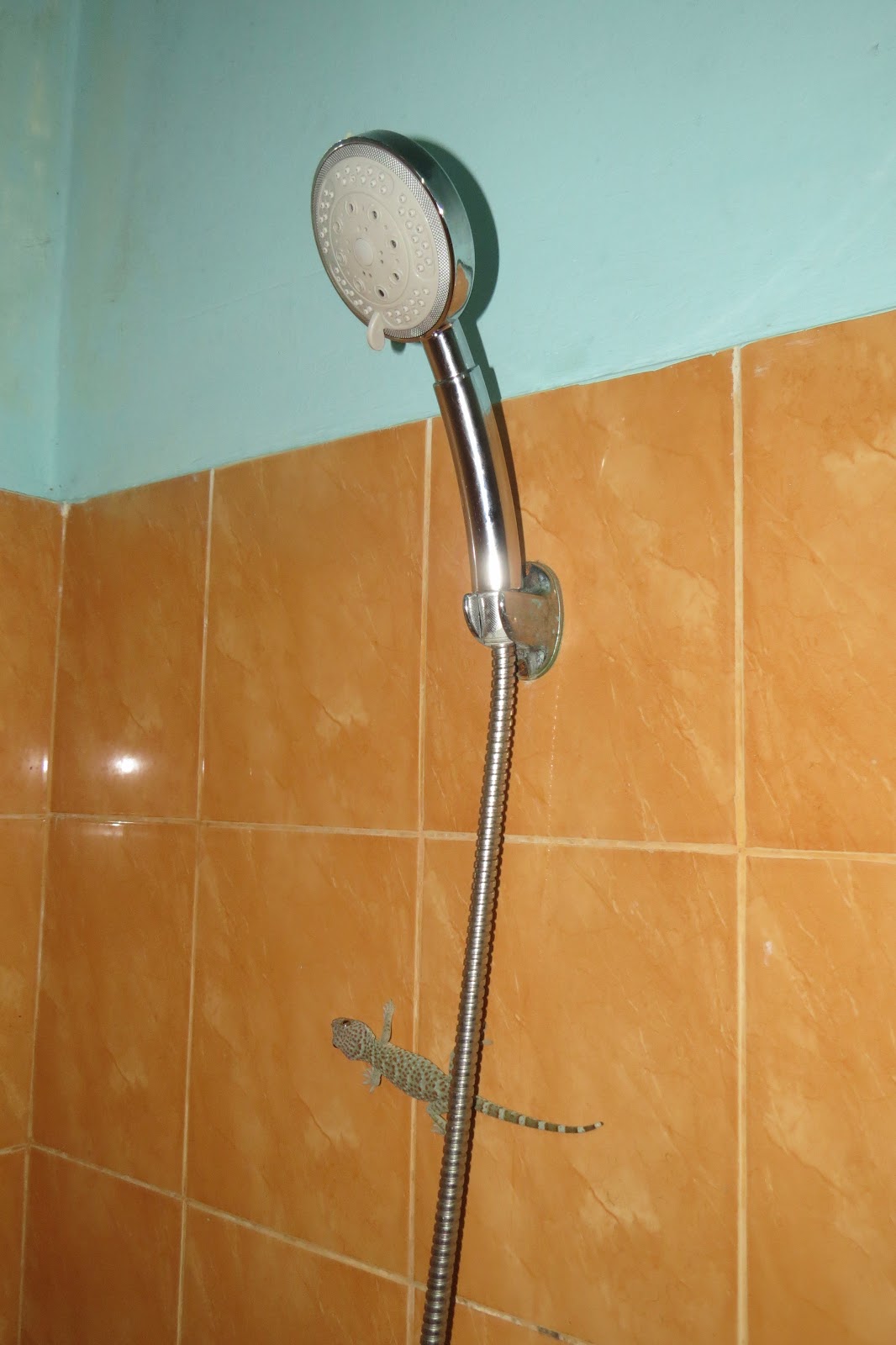
Luckily, the bathroom also came equipped with an enormous gecko!

A tokay gecko, Gekko gecko, to be exact. Look at that gorgeous red polka-dotting.

Fast forward. I've finished my work on Bali, moved to Malaysia for a month, returned to Bali, made my way by plane and van and boat to Gili... and here I was, ready to learn from the legendary Coral Man himself.

We met up for dinner, and immediately I was hit with the same impression as Federico: this was a person to know. Anuar didn't mess around.

"I just got back from a two-week research cruise through the Pacific," he told me. "Big things are happening there. Big things." His tone was intense but his volume soft. He had an intensity directed at no one. I got the sense he cared far more about what he was saying than about who he was talking to. "Big patches are DEAD. Gone. Nothing to regrow on. We need to stop playing around with conservation. This is too urgent."

Anuar teaches the first day of his coral propagation course in the upstairs restaurant of Trawangan Dive Shop on Gili.

Anuar's face is dark from the sun and lined from caring so deeply for another organism's life. Born in Malaysia, Anuar studied oceanography in the United States at Florida Institute of Technology before working in naval and tourism industries. Fifteen years ago he left it all behind. Coral has Anuar's entire heart, now that his two children are grown and his marriage has ended. The corners of Anuar's mouth are always pulled down in a slight frown, even when he's laughing. He has the worn expression of a soldier who's lost too many battles but who refuses to give up for love of his mission.

Sabine and I wait for a herd of lumbering brown cattle to cross the road as we walk across Gili for the sunset.

Then I met Anuar's counterpart, and she could not have contrasted more starkly. Sabine has a Swiss-French lilt to her English and corkscrew curls. Her smile, which she flashes often, spreads across her whole face. Over the following days, Sabine became my close friend. Over beach sunsets and gelato dinners, we learned we had much in common. We were both 23-year-olds (less than a month apart in age!) with a propensity to work on vacation and dream about fixing the world's problems.

Sabine met Anuar a few months ago as a dive student. On her gap year before starting occupational therapy school in Switzerland, she'd planned to see Southeast Asia, learn to dive, and follow wherever the path took her. Well, it took her straight into a full-time job volunteering as Anuar's assistant.

"I saw how much passion he had, and how disorganized his operation was, and I just had to help," she explained, almost as an excuse for why she was toiling away on a computer screen during this tropical vacation. Sabine sees organization as her greatest asset, and she certainly has the talent, but I'm not sure even a hard-working wonderwoman like Sabine can put decades of chaos into order.

The next day, I had a great surprise when I met the rest of my classmates. They were my coworkers from Reef Check and Coral Alliance in Bali, plus a few of the higher-up conservationists I'd never had a chance to meet! What luck. I got to spend three days picking their brains and talking marine-conservation over every lunch and dinner.

The Coral Team, from left to right: Chris, Nyoman Sugiarta, Jaya, Nyoman Swastika, me, Nikin.

Nyoman Sugiarta pulls on his wetsuit, always an unpleasant task, before we hit the water.

Anuar's paperwork and contact lists might be a rat's nest, but Anuar's coral propagation class lived up to its reputation. Anuar's goal is to replant corals all over the equatorial ocean, to give them a boost in the face of mounting stresses like rising temperatures, ocean acidification, plastic pollution, sewage runoff and destructive fishing techniques.

When it comes to coral propagation, I've always had one lingering doubt: if the coral has already died in a particular bay, why would replanting the same coral help? Won't it just die again, unless the root cause is addressed?

Anuar had a clear answer ready for me. "We only plant where we know the cause of the coral's original death," he explained. "So if it was killed by bomb fishing, and that's not happening anymore, for example, we will plant corals in that area."

Anuar shot and edited this video of our first day building a coral nursery on Gili Trawangan. The pile of rocks will be the nursery where corals grow from tiny fragments into large colonies, forming the broodstock for replanting the rest of the reef.


What about the bigger, global threats? I asked. What about rising temperatures and acidity? You can't stop those on the local level.

To that, Anuar explained that by planting corals, we are speeding up their recovery. We are allowing the reef to repopulate decades faster than it would without human intervention. By doing so, we are essentially accelerating evolution by natural selection.

Think of it this way: today, you have a full, healthy reef, 100%. Then a major storm hits and kills 90% of the reef. We use the remaining 10% to repopulate the reef. Already, by starting with the survivors, we have allowed natural selection to work; we have chosen the storm-resilient individuals to repopulate with. With our help, the reef recovers quickly, and in five years, it's full of healthy coral again. Then another disaster hits. This time, let's call it a heat wave that bleaches and kills 90% of the coral, again. Only 10% remains, and again, we replant from that stock. Now the corals have been selected to be both storm and heat resistant. Get it? It's far from perfect, but the idea is to give corals a chance to avoid extinction as they evolve to withstand their new, strange environment.

Human-induced climate change has accelerated the cycles of destruction for reefs, and without our help, corals wouldn't grow back quickly enough between major disasters to survive. But if we can also accelerate the cycles of regrowth, maybe we can give corals a chance to do what they've been doing so well for millions of years: evolve in response to changing oceans and survive.

Sabine and I watched this unreal sunset, but it left me with a deep melancholy. Maybe it was the techno dance music blaring on the beach, making me homesick for Sweets dance parties. Or maybe it was the heart swing for couples.

As I looked down the beach at the hordes of relaxed vacationers, I felt entirely alone. My heart and mind were too fiercely stuck on this urgent question, how to save our planet's corals? I'm glad I had Sabine at my side, or I might have imploded with the magnitude of the feeling.

That's the theory behind coral propagation in general. Anuar has some strongly-held and well-defended ideas about just how coral propagation should be done.

For one, he bans any use of plastic, concrete, or metal substrate. His experiments have shown than corals do much better when attached to aragonite stones, the porous, calcium-carbonate skeletons of long-dead corals. Plus, if you refuse to drop human-made junk in the ocean, you have done no harm in the event that you have to abandon a coral propagation project partway through (an unfortunately common occurrence).

Another of Anuar's unique gems is his glue system. He has a particular method of securing each type of coral to the rock. For hard corals, he suggests gluing the coral fragments to rock underwater using a combination of mineral gel and patented calcium-based catalyst. (If you don't have that, or if you're working on the surface, superglue will suffice.) For soft corals, pin the fragment into place with a pair of wooden toothpicks. For sea fans and sea whips, simply wedge the fragment into a crevice in the rock.

The third piece of Anuar's system is the nursery. Anuar discourages the "pluck and plant" method of cutting or gathering large chunks of healthy coral and gluing them to other parts of the reef. He says this method is haphazard, wasteful, and difficult to monitor. Instead, he recommends gathering only broken coral from the seafloor and cutting tiny pieces, about 1 cm long, and gluing each of those to its own rock in a centralized "nursery." Once the nursery matures, you can continually harvest those corals into tiny  pieces, which you then glue all over the wild reef you are trying to rehabilitate.

The turtle nursery on Gili is an example of a conservation strategy gone wrong. The turtles are often collected from their nests and put on display in this box-like tank to generate donations from tourists.

The baby turtles are too crowded, as you can tell from the scratches and bite marks on their shells and fins.
  
During the four days I was on Gili with Anuar and Sabine, my mind was working overdrive. I was inspired to have found a tool for conservation, since so many of my previous Watson projects have been merely attempts to study and understand the problems, not strategies for solving them. But was this the right tool? Would Anuar's coral nurseries prove scalable to the entire equatorial world? Did he have the necessary networking and organization to keep the momentum, or would the project fall apart once its charismatic founder retired?

Anuar and I pose with my certificate after I finished the course. I am now an official Coral Propagator.

Then the more existential questions set it. Is coral conservation the career I should pursue? What's the best way to make a difference in the world -- neat, published research from a university, or a messy underwater stab at growing things before they die forever? Yes, Anuar was right: the situation is urgent. The biosphere is unraveling. The oceans are emptying. The life is dying. But where does that leave me?

It was hard to say goodbye to Sabine, but I know we will both be working hard on whatever catches our hearts, and we can always commiserate about that from across the world.

For that, Sabine offered a trip to the gelato counter, and a bit of consolation. "Why do we always pretend we know everything?" she mused. "We don't control anything!" She told me about her worldview, which seems to center on sincere gratitude. From someone who is meticulous about filing and obsessive about doing good, the next piece of advice came as a surprise. "It's a wonderful thing to let things go," she told me. "Just let them really, really... go."

I was reminded of a poem Collin sent me back in September, when I was lonely in Brazil:

“Understory” by Mark Nepo

I’ve been watching stars
rely on the darkness they
resist. And fish struggle with
and against the current. And
hawks glide faster when their

wings don’t move.

Still I keep retelling what
happens till it comes out
the way I want.

We try so hard to be the
main character when it is
our point of view that
keeps us from the truth.

The sun has its story
that no curtain can stop.
It’s true. The only way beyond
the self is through it. The only
way to listen to what can never
be said is to quiet our need
to steer the plot.

When jarred by life, we might
unravel the story we tell ourselves
and discover the story we are in,
the one that keeps telling us.


I'm no expert at that process of letting go yet, but I accepted Sabine's reminder to stop analyzing everything for its lessons and just let the experience wash over me for a while. Without a chance encounter in a hostel and a stranger's advice, I never would have met Anuar or Sabine. I would not have glued my fingers to a baby coral by mistake. I would not have carried a laundry basket of stones across the bottom of the ocean or built Gili's first coral nursery from scratch. I wouldn't have felt the existential fear of being lonely when surrounded by dozens of laughing, drinking beachgoers, nor the nostalgic comfort of remembering that I'm always with myself, no matter who else I am with.

On the two-hour boat ride back to Bali, I was alone with the sun and the sea. Nothing was solved. The earth was still in biotic crisis. My graduate school plans were still nonexistent. The ideal career continued to elude me. But, for now, it all felt okay.

Share:

The Watson So Far: A Two-Month Reflection on Life, Structure, and Eavesdropping through Science

As I approach the two-month mark of the Watson, it's time to reflect. I was reading a former Watson fellow's excellent blog, Names Across Nations, and I was struck by something she wrote: "I learned to give myself structure in an unstructured world; to redefine productivity."

These months have reminded me how much I live for structure and productivity. A walk in the woods is not merely a walk: I take photographs, collect plant samples, and write numbered lists of birds. I once explained to my friend Jules why I order Thai food that's one star too spicy: it helps me increase my spice tolerance and, I told her, "I like to be productive when I eat" (a quote that has come back to haunt me and make me laugh ever since). That urge can be helpful when it propels me to get out of bed and do something, but it also makes me feel dissatisfied with a simple day of cooking, reading, reflecting, and passing time with those around me.

I like structure so much that I consider my life to have a scaffold around it. When I feel lost, I prefer the metaphor of "rebuilding the scaffold" to something less tangible, like "finding myself." In the loose-ended time after college graduation, my friend Melanie and I used markers to draft a new Life Scaffold on a poster:

A depiction of our Life Scaffold.

By definition, the Watson Fellowship offers very little structure. I am learning how to build a scaffold that contains something between too much structure, and too little.

My most structured time here has been small-mammal trapping (see my post on that). Those were eight days when my morning alarm, bedtime, meals, and even water breaks were decided for me. I felt supremely productive because I was contributing to a doctorate thesis. There were expectations for my work, and I could withstand the sweaty, buggy conditions to meet them.

My least structured time has been the days when I stay home at Quinta do Sol, the forest preserve where I live, and just hang out. I sit under the waterfall in the creek, write blog posts, play a Brazilian game called "Bozo," and cook American dinners for my hosts, Duca and Lygia. On a special night, we might even watch Game of Thrones together. (Lygia has taken to calling my Cersei Lannister for "being a traitor" and "abandoning her" in search of marsupials. I told her I'm holding the Nutella hostage until she forgives me.) These quiet days leave me feeling antsy but also invigorated for the work of another day. I remind myself that sustaining friendships through food, TV, card games, and inside jokes is the business of a meaningful life.

The night I made Sloppy Joes for Duca and Lygia.

In between are the working days, when I interview local farmers about their pets' diseases, or the traveling days, like the time I took a bus to the city of Campo Grande to watch my friend Renata's falconry class and visit the Natural History Museum with Cyntia. These days feel full because I am in motion, but I often look back and wish I had more to show for them -- more photos, more blog posts, more conclusions to draw.

As I plan the rest of my time in Brazil and my upcoming move to Madagascar, my instincts pull me toward more structure. For me, the easiest course would be to volunteer with one scientist after another, following instructions and collecting data. Yet, I know that is not "getting the Watson right." Getting it right will entail a balance, a healthy dose of hanging out and cooking to complement the backcountry treks through rainforest and the written reports. I think the structure I should seek is not one where my day is planned for me, but an intangible scaffold for why I am here. By connecting my daily interactions to a greater mission, I will feel at peace with my time passing.

During my Watson interview, my interviewer Mr. Chaudhary asked about the dual nature of my proposal. I had planned to split my time between researchers (disease ecologists) and community members (farmers, fisherpeople, tourism managers, and others who interact with wildlife disease).

"Are you more interested in the scientists or the community members?" Mr. Chaudhary asked.

My response was that my interest is neither scientists nor local people, but the human-inclusive ecosystem. I want to understand how microbes travel through time, space, and the bodies of other organisms -- plants, humans, and other animals. I am curious about how microbes interact with us (the big "us" of living things) as they go. To understand the multiple components of an ecosystem, I need to experience both nature-built environments, like buriti-palm veredas and coral reefs, and human-built environments, like rabies-vaccination clinics and the shop where Ana sells beer and ice-cream from her living room. (I cringe to separate "nature-built" from "human-built" because there is no difference; the shop is just as natural as the inner chamber of a termite's nest, only it has been built by a primate rather than an insect. But because we lack precise vocabulary, and "non-human-nature-built" gets awfully clumsy, I'll leave it for now.)

A nature-built environment (buriti-palm vereda).

A human-built environment (bathroom behind the beer and ice-cream shop).

I see scientists as translators. I am clumsy in Portuguese, so I rely on Duca to translate the stories of farmers into English; I am also clumsy in the language of nature, so I rely on biologists like Cyntia and Alexine (and the many-talented Duca) to translate the tropical savannah into words for me. I cannot interview an Agile Gracile Opossum to ask its opinions on disease. Instead, I watch Cyntia gently anesthetize the small animal with ether, pluck a dozen ectoparasites off its fur, and store them in a vial of ethanol for yet another collaborator to identify under a microscope, months down the line. This translation is clumsy. I will probably never know what that particular opossum knew of disease. But I hope to someday read the thesis quantifying the ticks, fleas, and lice of Cerrado mammals, and I will know that little opossum contributed to the story.

A Gracile Agile Opossum gets sleepy in ether so Cyntia can collect its ectoparasites.

In the past two months, I have spent countless hours sitting through dinner parties where I understand barely a word. I would strain to catch a phrase of familiar Portuguese, and I learned to laugh when others laughed, but I had no idea what was going on. Suddenly, the group would be ready to leave, and I found myself rushing to gather my things because I had not been able to hear the change in tone that signaled the end of the conversation. Other times, I'd think I had understood a story, but later Duca would translate for me, and I'd realize I had misinterpreted it entirely. Living in a world where I don't speak the language leaves me unaware of the happenings around me. I miss important information, and I miss the colorful details, jokes, and tales that make life rich. As I have become proficient in Portuguese, these details have come flooding back, and I realize how deeply I crave the ability to not only see or hear things, but to understand them.

This experience with language tells me that science, our attempt at multi-species translation, is important. If we do not attempt to translate the foreign languages of other organisms, we may see nature, but we will not understand it. We will miss the signal that the dinner party is ending, and we'll miss the rich jokes and stories that remind us why all organisms deserve freedom from extinction.

This is the scaffold I am building. When I commit myself to a week of marsupials or a month of mouse-lemurs (up next in Madagascar!), I do so not just to fill my days with structure, but to use science as a translator for the organisms I cannot interview.

The Watson is not meant to be a research year, at least not in the typical scientific sense. Perhaps it is in the spirit of the poet of John Keats that Watson fellows are not encouraged to publish a paper or even quantify our learning in numbers. In 1817, Keats light-heartedly complained that Newton had "destroyed the poetry of the rainbow by reducing it to a prism." Keats's poem, Lamia Part II, expresses the accusation more fully:

. . . and, for the sage,
Let spear-grass and the spiteful thistle wage
War on his temples. Do not all charms fly
At the mere touch of cold philosophy?
There was an awful rainbow once in heaven:
We know her woof, her texture; she is given
In the dull catalogue of common things.
Philosophy will clip an Angel’s wings,
Conquer all mysteries by rule and line,
Empty the haunted air, and gnomed mine—
Unweave a rainbow, as it erewhile made
The tender-person’d Lamia melt into a shade.

So I feel a little guilty about the "cold philosophy" of the spreadsheets of data I've gathered from my interviews with local farmers. I feel guilty about running statistics and making graphs to quantify the risk of canine distemper virus spreading from domestic cats to pumas and jaguars, about comparing a tick's mouthparts to a field guide to determine its species. Am I unweaving the rainbow? Am I killing the poetry?

Ticks awaiting mouthpart measurements.

No, my scaffold tells me I am not. Keats feared that knowledge would undermine poetry, but to me science does not "empty the haunted air." The more I understand of marsupials' lives, the more mysteries unfold and deepen around me, the more haunted with wonder the air becomes. That a Gracile Agile Opossom weighs between 13 and 21 grams does not relegate it to a "dull catalogue of common things," because the catalogue of common things is anything but dull. Real, tangible, common things compose my world. In the spirit of Anna Tsing and Donna Haraway, common things make my world-making projects possible, and I theirs.

Perhaps the discipline of science with which Keats was familiar, physics, attempted to "conquer all mysteries by rule and line," but ecology works peacefully with webs of interactions, complexity, and maybe even chaos -- at least, the ecology in which I am interested.

Two days ago, I had a conversation with one of the most knowledgeable bird-watching guides I've had the pleasure to meet, Maris Benites. Maris not only knew the Latin and Portuguese name of every bird we glimpsed, but she also knew the name of a strange, worm-like Amphisbaena lizard and a squishy, narrow-headed Microhylidae frog. I asked her if she loves birds more than other species, and she said no, she likes reptiles and amphibians just as much. She can't love one kind of animal on its own, because she knows how important each species is for the others. But she focuses on birds because of their value for teaching. In fact, she is just starting her PhD on birds as environmental educators.

Maris listens to the language of Pantanal.

"Why are birds such good educators?" I asked Maris.

"Because they interact with everything else," she told me (in Portuguese, so bear in mind that my translation may not be accurate!) Various bird species depend on freshwater, old-growth trees, specific fruits, cover from predators, consistently-timed army-ant swarms... the list goes on. Without a functioning forest, we have no birds. Maris hopes to get people to appreciate the little brown birds in the brambles, not just the colorful ibises and storks, and from there she hopes people will discover an understanding of ecological complexity and a conservation ethic, even for those animals that have the potential to harm us or eat our livestock, like jaguars and eagles and mosquitoes.

Maris's conversation got me thinking about microbes. When we talk about jaguars, we treat them with both fear and curiosity. They have the power to kill us, but we still feel curiosity about their lives, amazement at their strength, and awe at their beauty. I have seldom seen microbes treated the same way. Once labeled as a pathogen (something that causes disease), an organism is treated as a "sacrifice zone," an enemy particle that can and should be destroyed because we fear it. Yet, when we consider interactions, this tactic becomes nonsensical. We cannot squish every microbe like we shot nearly every cougar, grey wolf, and grizzly bear. Microbes are too small. They hide in dessicated capsules, only to emerge decades later. They evolve in minutes. They reproduce exponentially when resources exist. Their ideal habitat (in many cases) is the warm flesh and blood of human bodies, a resource that is becoming more abundant every day. We cannot eradicate microbes, so we are stuck with the task of living with them.

Evolutionary medicine, in contrast to the individualized medicine we get at the doctor's office, focuses on the weaknesses (vulnerabilities) of hosts rather than the strengths of pathogens. As humans, our principal vulnerability is that our bodies are rich with nutrients, protected habitat, and moisture. What we call a "body," a microbe considers a "home." By recognizing this pattern, we open up a wide new space for understanding disease. We can compare our bodies to thousands of other examples across ecology: soil that is home for termites, novateiro trees that are home for ants, ant nests that are home to fungus. We can look to evolved examples in which one organism becomes host for another and, instead of succumbing to disease, it thrives.

This tree, the novateiro (Triplaris americana) has a close symbiosis with ants (Pseudomyrmex triplarinus). The tree's name translates to "newcomer tree" because when a hapless tourist brushes the trunk, the ants swarm out to defend their home.

The ants live inside the trunk, feed on substances produced by it, and enter through small pores in the bark. This home may seem inanimate to the ants, but it is the body another organism, larger and slower but equally alive.

Here is another species of tree, populated by another species of ant.
This mutualist perspective leads to a change in the question of medicine. Instead of asking, "How can we avoid the pathogens?" we might ask, "How can be become better hosts for microbes?" Some quick answers might include populating our gut with diverse bacteria, limiting the use of systemic antifungals, and maybe even reintroducing parasitic worms. I hesitate to give these examples, because I do not want to close the conversation, but open it wider. What does it really take for a novateiro tree to make peace with a family of ants swarming up and down its veins every day? Do the ants ever take too much from their tree and kill it? Does the tree ever get tired of its guests and kick them out? How did the mutual trust for such an arrangement evolve?

Science does not take the mystery out of such happenings. It attempts, clumsily, to translate the languages in which other organisms are fluent, to the language we can read, that of numbers and words. I hope to learn this language with enough proficiency so I can not only understand the shouts, but so I may begin to eavesdrop on the whispered things, the inside jokes between ants and microbes and trees.

With that in mind, I think I'll go analyze the data from my last thirty interviews, and maybe write another blog about the species of amphibians I've seen. But I'll also take time to sit still, read a few pages of The Invention of Nature, and cook squash pappardelle for Duca and Lygia. Plus, I'm on deck to make brownies tonight, and we have an episode of Game of Thrones to watch.

This day will be productive, at least by my new working standards. And I trust that the scaffold will be built, piece by piece, as the day goes on.

Dad's Daily Bug

A butterfly on water flowers in the Paraguay River, drain of Pantanal.

Mom's Daily Bird

A young southern screamer pokes around in mud next to its four siblings and two parents.

Share:

Popular Posts

Labels