Health Education, Health Articles, Health Blog

Showing posts with label Malaysia. Show all posts

Third Quarterly Report: Nine Wild Months of Watson

Holy moly, this deadline came up fast! Here's my third quarterly report for the Thomas J. Watson Foundation, one of the few requirements asked of fellows. If you like, you can revisit my first and second quarterly reports here. Without further ado...


Third Quarterly Report


Date: April 27, 2018
Countries you were in: Indonesia, Malaysia
Countries for next quarter: Indonesia, Malaysia, Scotland, England, Canada
Current location: Sukadana, West Kalimantan, Indonesia

Dear Watson Foundation,

I am sitting at a kitchen table inlaid with green and blue tiles, under a leaky thatch roof in the town of Sukadana, West Kalimantan, Indonesia. Water is billowing in through two windows and pooling in an aluminum pot. The splatter occasionally coats my laptop screen with mist. I know the storm is directly overhead because the thunder is almost simultaneous with blue-white flashes of lightning, and every clap sounds as loud as an old-growth tree crashing into the kitchen. I love these nightly tempests because they keep the rainforest steamy and damp. They also turn my yard into a mud puddle.

A Sukadana scene: concrete swiftlet house (the bird's salivary nests are a Chinese soup ingredient), drying coconuts, rainforested mountain and brewing storm.

Last I wrote, I was beginning my month with Reef Check on Bali. Although I did produce some documents – a fish identification guide, an infographic on Bali’s 2016 coral bleaching event – the work was unsatisfying. Many days, I arrived at the open-air office to find no tasks. I came to expect the phrase, “Why don’t you take the day off?” with disappointment that this organization was not utilizing my potential. On reflection, I realize most of the blame was my own. I should have invented tasks and been vocal about my strengths, respectfully reminding my supervisors that I can be an author, grant-writer and marine ecologist. Instead, I presented myself as disposable, and that led me to feel disposable.

I found this Cerulean kingfisher (Alcedo coerulescens) behind Bali's garbage dump on an unplanned day-off.

I also found this temple with walls of dirt and moss! If I were spiritual, this would be my place.

For my Reef Check capstone I joined a gathering of Pokwasmas, a fishermen’s cooperative in the village of Penuktukan, to present on reef resilience to climate change. I was honored to speak, but because I presented in English with no translation, only a handful of the audience understood. Since then I have learned to advocate for my language needs. Now when I present, I directly ask one bilingual person to translate for me, and I pause between each sentence to make sure my meaning gets across.

Shaumi, a marine science student from Udayana University, mops to prepare for the Pokwasmas meeting. Posters about marine conservation decorate the open-air room.

After the meeting, I spoke with Nyoman Sugiarta, a tourism-operator turned full-time conservationist. He pours concrete hexadomes for coral substrate and canoes the marine preserve to discourage poaching. On his forearm, an inky ecosystem of turtle, coral, fish and sea grass entwine the word “Conservation” in newspaper font.

Photo credit: Nyoman Sugiarta.

“Why do you feel strongly about coral conservation?” I asked Nyoman.

“I used to think corals were rocks,” he explained. “Then Reef Check came here and told us they were animals.” Nyoman became a diver and began paying attention to the strange, gelatinous lifeforms. “Now that I know they’re alive, there’s so much to learn! I can’t let them die.”

I was surprised that Nyoman’s explanation contained no economics. As an environmental biology student, my training often implied that wealthy Westerners can afford to conserve an ecosystem for beauty and curiosity, but subsistence resource-users conserve ecosystems for practical reasons, like increasing the harvest of fish. How quickly Nyoman dispelled that myth. Driven by his urge to learn, he traded his job for unpaid conservation and occasional scuba-dive guiding. Two summers ago, when I was a wilderness educator in Alaska, I tried to cultivate curiosity for slimy things: marine invertebrates, microbes, slime molds. In Nyoman I found an example of how powerful curiosity can be.

Corals and echinoderms I photographed in Indonesia.

In mid-February I moved to the Malaysian metropolis of Kuala Lumpur. My boyfriend Collin and I converged for a marvelous two weeks diving the corals of Perhentian Kecil, celebrating the end of Chinese New Year with 40,000 revelers in Penang, and visiting our friend Marra during her English-teaching Fulbright in Melaka. We tried to understand the threads that weave Malaysia’s tapestry of religions, genders, and races.

My three favorite postcards before I sent them: a street-art girl from Penang, public buses from Kuala Lumpur, and a stone plant from Melaka.

Once Collin left, I enjoyed the resources of a big city by touring One Health labs and giving a lecture at Monash University on “monsters and microbes.” I reunited with a great friend from high school, Nithya, who is loving her life as a solar-energy firmware engineer in Cambodia. Seeing Nithya’s drive and joy about her career got me thinking hard about my own. Compared to Nithya’s startup – young, efficient, impact-driven – my environmental nonprofits seemed ineffective and bureaucratic. I struggled to reconcile the fundamental difference between engineering, a building science, and ecology, a science of observation. Nithya had been trained to solve problems; I’d been trained to study them.

For her last night, Nithya and I tracked down the last cendol cart open in KL and enjoyed a midnight bowl of shaved ice, canned corn and green jelly (hold the durian, please).

With that mixture of inspiration and apprehension, I returned to Bali for Anuar Abdullah’s course in coral propagation. Anuar had an intense face, tan and deeply lined. His black T-shirt bore the skull-and-crossbones of Sea Shepherd, an organization of vegan pirates famous for sinking whalers. Coral gardening and piracy might seem like odd partners, but it makes sense: both groups have a take-no-prisoners attitude toward conservation. The first words out of Anuar’s mouth were, “Big things are happening. Corals are dead. We don’t have time to mess around. This is too urgent.” Anuar taught me details, like how many drops of superglue to use when attaching a fragment of Acropora to aragonite rock, but I was more interested to uncover why Anuar is successful (his fever-pitch drive to save the ecosystem he calls home) and why he is not more so (he works alone). I was daunted by Anuar’s stance that purely-academic careers are unethical in this critical moment of our planet’s health. Is a life of solitude and heartbreak the only way to fight for an ecosystem? I wondered.

We piled rocks to create an underwater nursery for coral fragments.

Before I left Bali, I met up with my ultimate frisbee team, UB7, for the tournament they host every year, the Nusantara Cup. Our team leader Alex invited me to be Spirit Captain, a uniquely-ultimate role that entails holding the team accountable for high integrity and leading a conversation after each game to discuss our opponent’s sportsmanship. I am proud to report that UB7 was the first Indonesian team in history to win the Nusantara Cup!

No mark!

The following morning had an inauspicious beginning. I was exhausted as only frisbee players will understand. My lungs burned, my hips flexors ached, the skin on my lower lip ballooned into painful blisters, and I wheezed with a nasty cold. The next ten hours in planes and cars were miserable. Little did I know, I was en route for the best month of my year.

ASRI staff jump on the beach, and I'm a bit late to the game.

That evening I arrived in Sukadana, a village nestled on the edge of Gunung Palung National Park in Kalimantan (Borneo), Indonesia. This lowland dipterocarp rainforest is home to 3,000 of the last Bornean orangutans. I’m volunteering here with Yayasan Alam Sehat Lestari (ASRI), roughly translating to Healthy Balanced Nature, a pathbreaking Planetary Health hospital with a mission to “save the rainforest with a stethoscope.” The model behind ASRI is simple: orangutans are expected to go extinct by 2050 due to habitat loss; most illegal loggers wish to stop but cannot because timber is their only source of cash for healthcare; to save orangutans, we need a human hospital.

A photo I took of a reforested orangutan corridor posted to the ASRI Instagram.

Over the past month, I have worked on education with Amad and Etty, communications with Oka, grant-writing with Monica, and reforestation with Dika. I’ve gotten to share a house and meals with ASRI’s founder, Kinari. All day I feel respected and productive. In the afternoons, the clinic staff becomes a riotously fun group of friends. We watch the sun set over the ocean, sip kelapa coklit susu (fresh coconuts filled with iced chocolate milk), watch horror films and play cards. I’ve taught the staff to bake chocolate-chip cookies and buttercream cupcakes. They've taught me to speak Bahasa Indonesia and slow down my pace. I leave tomorrow, but on no account am I ready to bid this place goodbye.

One day I baked Tollhouse cookies for the ASRI staff. It's a family recipe, the first one I learned as a kid, and Natalia asked me to write it for her. On my last morning, she pulled out a tupper of fresh-baked Tollhouse cookies! They tasted just like home.

Kelapa coklit susu on the beach.

For the past few years, I've been seeking an interdisciplinary lens through which to approach my work, one that embraces complexity. The Anthropocene Epoch demands a reckoning with entanglement; we will not find success by inspecting any one element in isolation. Initially, I titled my Watson project "One Health" because that movement -- the intersection of human, veterinary and environmental medicine -- seemed like a good stab at integration. But here at ASRI, I’ve learned that I identify even more with "Planetary Health," the recognition that solutions for human and ecological health must be integrated. ASRI does not draw a line between trees and bodies. It delivers babies, provides dental checkups, plants rainforest saplings, and buys back chainsaws from loggers to facilitate a regenerative economic spiral. With this lens, I have a new goal for my PhD. I want to identify and implement win-win solutions in which human health problems are addressed by restoring ecosystems.

A logger revs his chainsaw one last time. Today, he will sell it to ASRI's Chainsaw Buyback program in exchange for a micro-loan and training to launch a small business.

Working at ASRI is emotionally exhausting in the best way. Every day, I find myself revising my place in conservation and developing hope that real change is possible. Since 2007, ASRI has recorded an 89% decrease in logging households and a 25,000 hectare increase in forest cover. The end of illegal logging in Gunung Palung National Park is within reach.

An organic farmer, recently trained by ASRI, takes fastidious care of his black-pepper trellises. With tools like homemade compost and crop rotation, farmers can move away from slash-and-burn agriculture.

In Brazil, I learned how humans, pets and wildlife are connected by disease across a rapidly-changing landscape. In Madagascar, I probed that connection to find out whether forest fragmentation directly contributes to zoonotic spillover of viruses. Now, in Indonesia, I am seeing how the upward spiral of integrated human and ecological restoration really works to create health.

My housemate Bella, a medical student from Jakarta, tests out Marmelade (my backpack). She didn't believe all my things would fit inside.

Though I’m still in denial about leaving Sukadana, I will fly tomorrow to Tanjung Puting National Park to witness rehabilitated orangutans in their wild habitat. I then cross to Malaysian Borneo for two weeks of coral propagation and one of hornbill research. At the Planetary Health Alliance Annual Meeting in Scotland, I’ll present on Malagasy sand-flea season and climate change. I have tickets to visit a bird observatory on a northern Scottish isle and the London School of Hygiene and Tropical Medicine. In mid-June, I helicopter in to the most extreme leg of my Watson journey, the Arctic. In lieu of my original plan to visit anthrax-infested caribou carcasses in Russia (which is now on the do-not-travel list), I will volunteer with Dr. Emily Jenkins to test Arctic foxes and mosquitoes for emerging pathogens at Karrak Lake, a remote outpost in Nunavut, Canada.

Amad stole my camera and captured this candid moment. I am lost somewhere deep in thoughts.

I can’t decide if I’ve learned more about myself or the world these past nine months. I suppose it hardly matters. As I prepare to leave Asia for three Western nations, I’m starting to sense the Torschlusspanik (an excellent German term for “the panic one feels as gates are closing or an end is nearing”), but I can hardly imagine August as an ending. Every day, the world feels larger and richer with beginnings than before.

Love,
Nina
Share:

Nina and Collin Explore Malaysia: A Break from Solo Travel

One of the hardest things on the Watson has been balancing immersion in place with relationships from home.

The original Watson fellows, striking out fifty years ago, often travelled by ocean-going ships and sent news to family only through delayed letters. Communication today could not be more different: my messaging apps barely fit on one screen of my phone! I intentionally limit contact, because I've found that loneliness kicks me out of my comfort zone and inspires me to make friends with the people around me. Luckily, my friends and family back home forgive me for being out of touch.

But, as I said above, it's a balance. I don't want to cut off from the world entirely, because my relationships at home matter immensely. Those people are my past and my future. They've been there for me through difficult times, and I want to be there for them now -- even if we'll be talking over a crackly Facebook connection instead of sharing a bowl of chocolate ice cream.

While I've been travelling, my boyfriend Collin has been marketing for a public television station and surviving the incompatible-with-life-temperatures of a Minnesota winter. Over the past eight months,  we've learned how to not only maintain our relationship but allow it to grow and change over distance. For one, we figured out how to stop interrupting each other by accident, despite five-second delays in phone calls!

At the end of February, Collin and I converged in Kuala Lumpur, Malaysia. (I was coming from Bali, and he from Subzero Hell... I mean, Minnesota.) Our main activity: eating. Here's a photo album of our adventures, featuring just a little wildlife disease and a whole lot of street food, plus some stories from my journal.

Our first stop was Perhentian Kecil, pronounced "per-hen-tee-AHN keh-CHEEL" and meaning "small stop." This island and its larger cousin, Perhentian Besar, were frequent stopping places for trading vessels off the northeast coast of Malaysia.

Collin models the hillside Alunan Resort, where I was delighted to get a half-price, early-bird rate. (We arrived at the tail end of the monsoon season, when the island is closed down for bad weather.) 

Mama Mia.

Today we trekked through the jungle to Coral Bay and Long Beach, tourist villages that are just starting to open up after monsoon season. We found an outdoor restaurant-theater showing Mama Mia at 7 pm. Not only did we sing along to "Money, money, money!" and "Dancing queen" with a crowd of (Dutch?) tourists who'd appeared out of the small island's woodwork, but it was also the first time I tried roti canai (pronounced ROH-tee cha-NAY). We didn't know what it was. "What's this? Is it good?" I asked our nervous waiter. He couldn't answer the first question, but to the second, he gave a vigorous affirmative. He was right! The hot, doughy, greasy, Indian bread with a small dish of orange curry became a staple of our diet.

A beachy Pandanus, the same genus of still-rooted "screw pines" I fell in love with in Madagascar.

Plantain squirrel, Callosciurus notatus. They're considered as boring here as a eastern gray squirrels in Seattle, but the I find them beautiful. Notice that white and black stripe over a rusty-red belly!

Look, a pretty beach.

We found a flip-flop on the beach, but instead of picking it up as litter, we threw it back in the ocean. Why?

It was home to a big ol' family of goose-necked barnacles!

A rock, an ocean, and a boy.

Big lizards.

Great, fat monitor lizards would startle from their sunning patches along the concrete jungle trails that led to the Fisherman's Village (to the left) or Coral Bay (to the right). Once active, they ignored us and rooted around in the leaf litter -- for eggs to eat?

Asian water monitor, Varanus salvator

Fishing birds.

When we first pulled up to Alunan Resort, I noticed one of these sooty-blue birds fishing intently from a buoy. I asked the captain what kind of bird it was, and he told us, "A Fishing Bird!" I loved that description because it meant more than simply knowing a name. The man had noticed the bird's patient work and respected it as a fellow fisher. Collin and I adopted the term Fishing Bird for all the heron we met from then on.


Fishing bird, or Pacific reef heron, Egretta sacra.

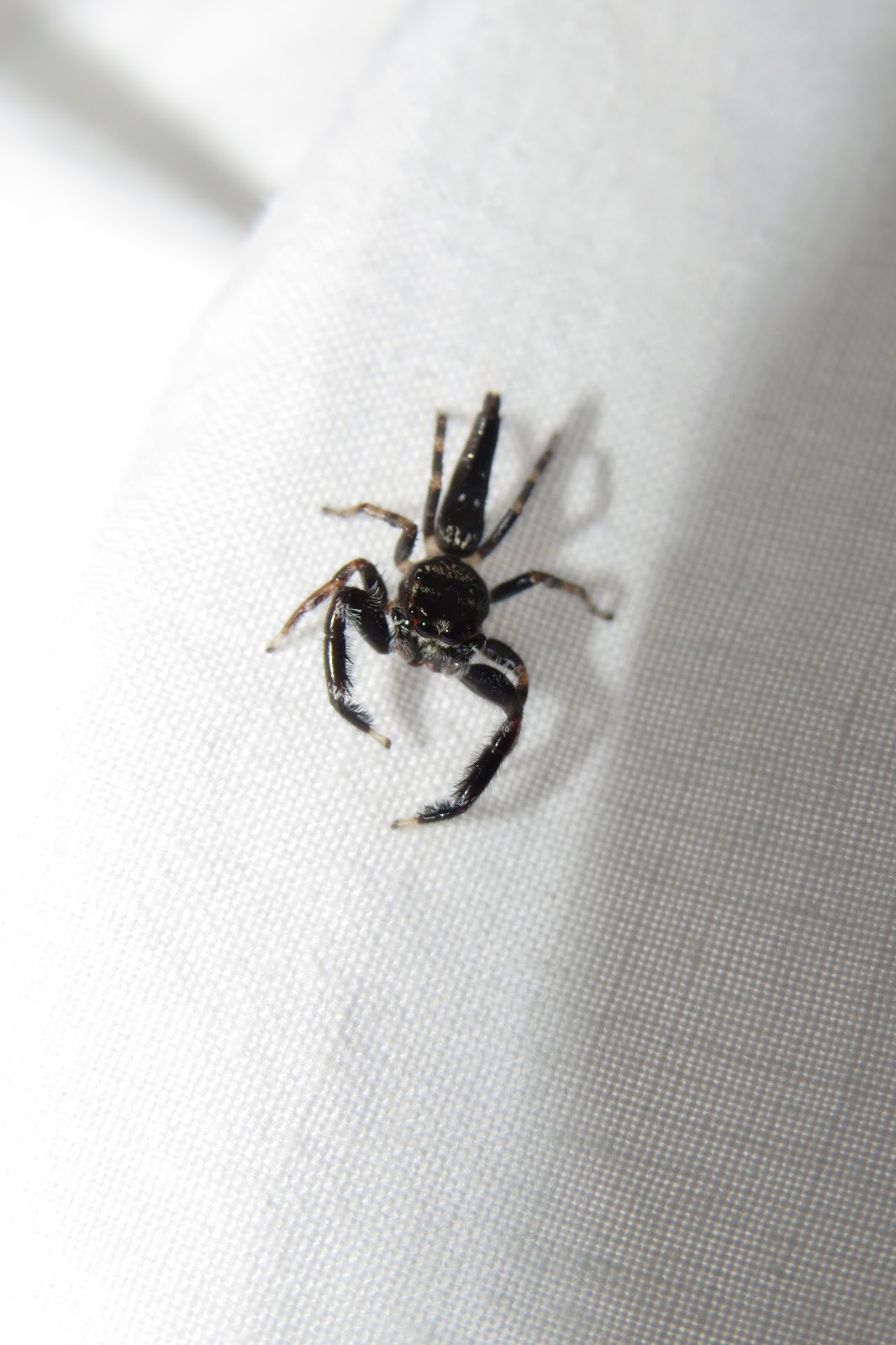
A jumping spider hopping around on the bed.

An acrobatic intruder.

On our second night, we heard a couple fighting at the next-door cabin. A man was locked out, banging on the door and yelling things like, "What are you thinking?" and "You're crazy!" A woman screamed back from inside. We tried to tune it out. Then! I heard a clanging on our wall. It was dark, but through the curtain, I saw the silhouette of a man creeping past our window -- ten feet above the ground! He was shimmying along an iron rail bolted to the outside wall. I called Collin over and told him what I'd seen. At this point, I was very glad not to be alone. Nothing makes you afraid of the dark like strange men climbing the walls. A few minutes later, the man crossed back. He must have been trying to break into out neighbor's cabin through the roof deck. Next time you think your vacation is going badly... just be glad you haven't hit the level of attempting an acrobatic break-in!

Walking up the mountainside staircase to our bungalow.

Our next stop was Penang, an island off the northwest coast known as the street-food capital of Southeast Asia.

Didn't get enough MSG in your soup? Not to worry. You can buy 300 grams of pure monosodium glutamate at the grocery store!

Oops! It took us a while to remember to take a photo of our food before we ate it.

Ais kacang (pronounced ICE kah-CHANG), a mysteriously popular dessert of shaved ice with a rainbow of syrups and toppings.

Cendol (pronounced CHEN-dole), an even more popular mixture of shaved ice, coconut milk, green jelly worms, canned corn, and red beans.

By pure luck we arrived in Penang, the heart of Chinese-Malaysia, for the final days of Chinese New Year. Red lanterns decorated the streets.

A very Georgetown scene: new construction behind a preserved historic facade, dotted with red lanterns and sprouting an unlikely tree.

Stoked on samosas! These delicious Indian snacks are triangles of crispy dough stuffed with spicy potatoes. And the best part: each one costs 60 Ringgit cents, or 15 cents in American money!

The heat and humidity were too much for Collin's floppy hair, so a new haircut was one of his first souvenirs.

If you buy dried fruit, expect sour and salty, not sweet. It's pickled!

Penang is famous for its official street art, but my favorite was this grafiti bunny hopping into its hole. Where'd he go?
 
We celebrated the final day of Chinese New Year at a massive music festival on the Georgetown Esplanade.

Forty thousand people showed up for the lanterns, dances, and fireworks.

And don't forget the food! This tent specialized in deep-fried oddities. Collin and I purchased the last squid-on-a-stick (pictured in the foreground). The server quickly removed the stick, chopped the squid into chunks using hefty shears, and dumped it into a greasy paper bag along with shakes of red and white spices. It was a challenge to finish the whole mollusc, but we did it!

A breakfast favorite: Chinese wanton soup with squiggly yellow noodles, boiled bok choy, flavorful broth, and bit of barbeque pork if you're lucky.


Penang Hill.

One of the best things about travelling with someone else is that I don't have to do all the planning. Collin decided we should walk up Penang Hill, a forested high-point on the island where British colonists built their mansions to escape the tropical heat. SO STEEP. My calves were sore for days. The road was five kilometers of switchbacks. We saw the 0.1 kilometer-marker in disbelief, already sweaty and exhausted. After two hours of dragging ourselves up the hill, we reached a kind of Disneyland. Tourists swarmed with selfie sticks among balloon shops and silly photo booths. How did they all get here?! Apparently, there is a slow and expensive (yet popular) tram that takes tourists up the other side of the hill. We were baffled, but glad we'd made the trek on foot.

We stopped to catch our breath every 0.1 kilometers up the infernal hill. Here, Collin investigates the geology of the retaining wall. The switch-backs were so tight, and the grade so steep, that landslides were almost as abundant as the walls meants to hold the land back.

My, what big eyes you have! (I wonder who took a bite of the lower right wing?)

An intact but eye-spot-less butterfly.


Green snake.

We found a thin, green, road-killed snake on Penang Hill. I asked a passing construction worker if he knew the name of the snake. "Speak Bangla, sapa! Speak English?" he asked. I told him the word in English was "snake." We each practiced the sound of the new words: sapa, snake. I'd been expecting a specific name in Malay, and instead I learned the word for snake in Bangla! You never know what will happen when you ask a simple question. Sapa written in the Bangla alphabet looks like this: সাপ. Wow.


Green vine snake, Ahaetulla nasuta.

Beware of snapping trees?

But really, beware of thieving monkeys! This is a long-tailed macaque, Macaca fasicularis, a species that adapts smashingly to cities, temples, and garbage dumps.

A panoramic view of Georgetown from Penang Hill, the goal of our climb. Tall white skyscrapers dot the city, giving the impression of density, but we suspected that many condominiums were vacation homes owned by foreigners. The Malaysian government encourages expats to settle through its "Malaysia My Second Home" program.

Can you believe it: these sundaes are made of plastic! Giant shaved-ice and ice-cream bowls are a speacilty at the top of Penang Hill.

We ordered a real one, and it looked just like the plastic version. Shaved ice, chocolate syrup, chocolate ice cream, sliced mango, and boba on top for good measure.

At the bottom of Penang Hill was the botanical garden. These giant, rim-edged pads looked strangely similar to the Victorian water lilies that I'd swum with in Brazil's Pantanal. Indeed, the sign confirmed my suspicion. They are introduced here as a pond ornamental. How globalized is the world!

The next day, our calves were tight and aching, but we ended up on another hill climb. This time, we crossed the virgin rainforest of Taman Negara Pulau Pinang, or Penang Island National Park.

Collin was excited to reach Tasik Meromiktik, or Meromictic Lake, a strange hydrologic phenomenon where a lake retains stable layers of freshwater (above) and saltwater (below). Apparently there are only 19 meromictic lakes in the world.

Once we saw the lake, we were dubious. A wide, open channel connects the lake to the ocean, and saltwater rushes in with every wave. Looked more like a tidal lagoon to us!

Mango lassi.

Teh C Peng Special, or Three-Layer Tea: palm sugar, condensed milk, a red tea. Stir til its sweet!

Food.

First morning in Penang, we walked toward the Indian cart for roti canai and Milo, a ubiquitous hot-chocolate marketed by Nestle as health food. From there we just followed our stomachs for the rest of the week. Char kway teow -- flat, squishy noodles. Cendol and ais kacang, also known as ABC. Teh O -- black tea with no gula (sugar) or susu (milk). Mango lassi in a plastic bag with a straw. Mie (noodles) and nasi (rice). Fried oyster omelet. And our winner-winner-chicken-dinner, nasi kandarWe got to try twice as many foods by splitting everything. I am a huge fan of eating-with, as compared to eating alone!

On our last day in Penang, we tried the much-acclaimed local dish, nasi kandar. It's a fusion of Indian and Malaysian curry, where every sauce is spooned over a pile of white rice with whatever meat you choose. We agreed that this was our favorite food of the trip.

Our third stop was Melaka, a city with Portuguese colonial roots, to visit our friend Marra Clay. Check out her super blog, Vagabond Viewfinder, where she writes about her year as an English-teaching Fulbright.

We continued our trend of eating with a three-hour, all-you-can-eat, Korean hot-pot lunch. 

Succulents for sale on the streets of Melaka.

Collin explores the ruins of a colonial church.

Marra demonstrates how this tiny gecko could easily fit in her mouth.

I love finding my old obsessions in new places. Did you know I committed years of my childhood to a passion for Volkswagen beetles?

Green beetle-butt street art = perfection.

I kept my eye out for arthropod-vectored disease, and I noticed this public service announcement about avoiding mosquito bites to prevent zika. This sign made sense, but the next one...

Along the river, I encountered another sign about mosquito-borne disease... but this sign was explaining that "HIV tidak berjangkit melalut gigitan nyamuk," meaning, "HIV is not contagious by mosquito bites." I wonder why that is such an important announcement? Maybe it's an indirect way to allude to the fact that HIV is a sexually transmitted disease, in an Islamic country with strict standards of public decency? Or a campaign to reduce the stigma and fear of HIV-positive individuals?

A semi-abandoned community perched among the mangroves of Melaka River.

I wish I could be a fern like you!

Kuala Lumpur and, to a lesser extent, Melaka are cities swallowed by malls. Sooner or later, you end up lost in the escalator mazes and air-conditioned halls of a mega-mall. I found this furniture store selling green velvet armchairs and fake plastic succulents, and I wanted to move in!

The Strait of Malacca, a narrow passage between peninsular Malaysia and the Indonesian island of Sumatra, has been one of the world's most important shipping lanes throughout history. 

Two confusing bus-rides later, Collin and I found ourselves back in the tropical metropolis of Kuala Lumpur, home to seven million humans.

The flashing billboards and zooming trains made us feel like we were in Times Square... not that either of us has been to New York City...

Among the shopping jungles, I stumbled across a store for Watsons!

Pavilion Mall's basement food court was legendary, for a mall, but it couldn't compare to the streets of Penang. Collin tried to make a duck face with the roasted ducks.

A green tea cream puff, anyone?

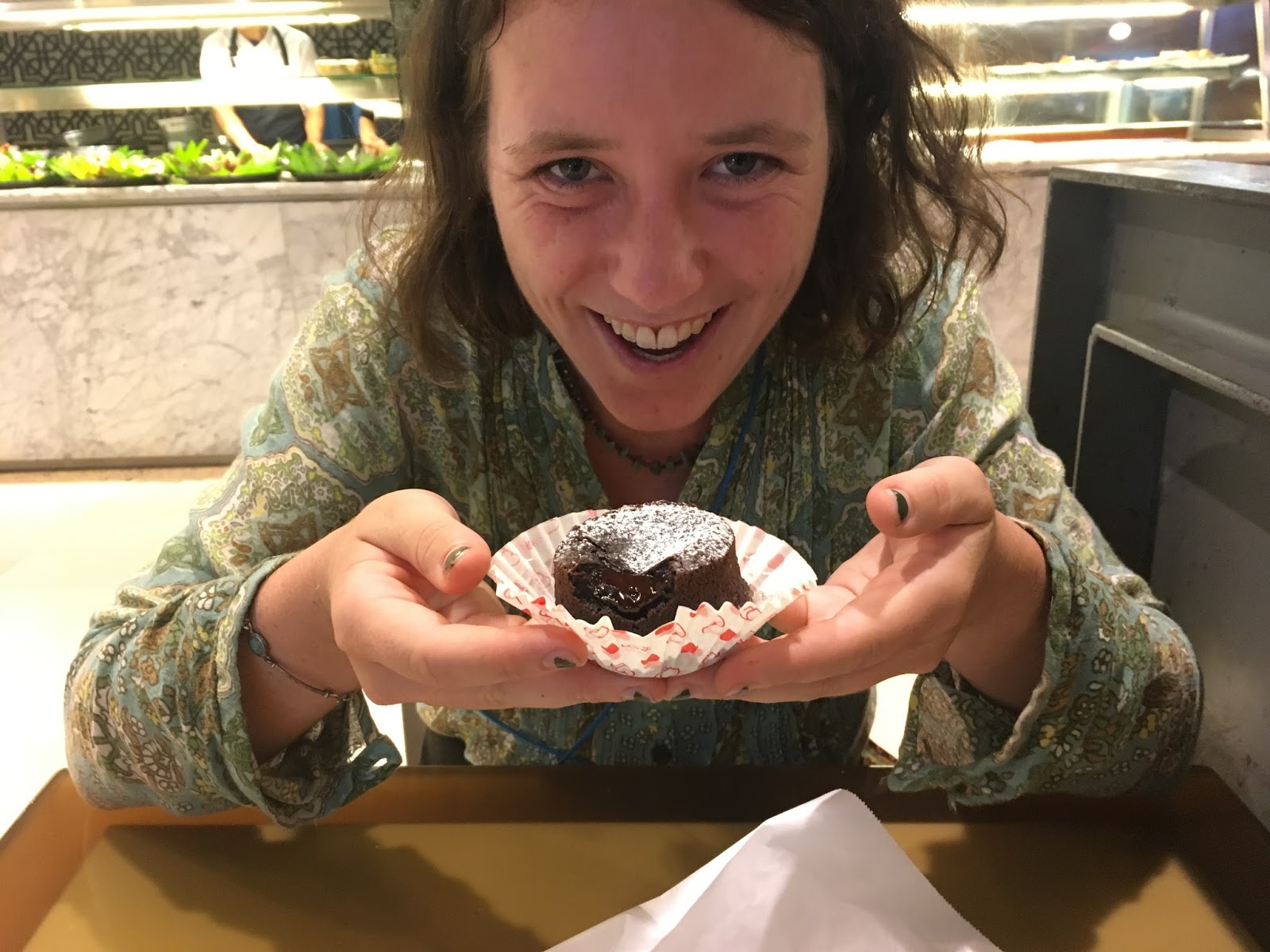
How about molten chocolate cake?

We finished our trip with a walk through Perdana Botanical Gardens in KL. The deer park was eerily empty, and the sign alluded to trouble with wildlife disease.

Soon we were overwhelmed by the smell of rabbit urine, and we discovered 15 rabbits on the verge of death. Their ears were crusted with fungus, their noses raw, their eyes swollen shut, and their fur matted with ungroomed moisture. In all my years of rabbit 4-H, I've never encountered disease like this. A couple days later, I reported the rabbits to my friend EeLynn Wong, who volunteers with the Malaysian SPCA. A government veterinarian immediately removed the rabbits for treatment or, if needed, euthanasia. Turns out, botanical gardens are best for keeping plants, not rabbits!

It's not hard to keep plants healthy here! A great old street-tree harbors its own jungle of epiphytes in the city.

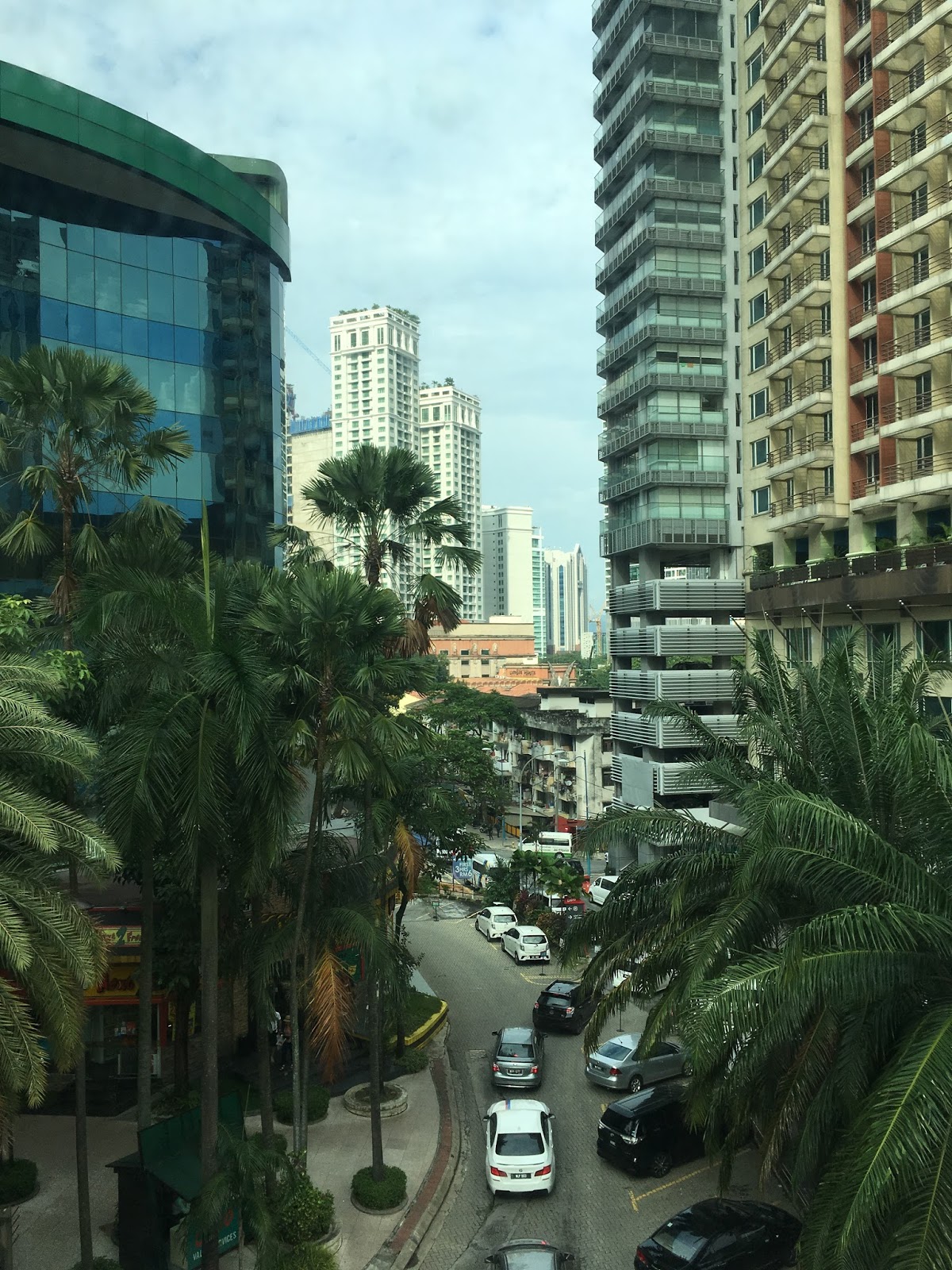
Mosques and skyscrapers, a KL view.

Finally, proof that we were in the same place at the same time! Here we are on the rooftop of Aloft, a tower near the transit hub, KL Sentral Stesen.

Looking out over KL.

The Watson is a year for immersion and independence. Transitioning away from that, and back into it, made me anxious, but the chance to travel-with (as opposed to travelling solo) was worth it all. Once Collin returned home, it took me a few days to feel comfortable with solo travel again. The city felt strangely alive, a bit scary, and full of ghosts.

Whenever I pass a restaurant where Collin and I ate or a train we rode, memories jump out to make me feel lonely, but for the most part, the ghosts are friendly.
Share:

Popular Posts

Labels