Health Education, Health Articles, Health Blog

Showing posts with label Centre ValBio. Show all posts

Madaworks Update: A Christmas Story from Tana

It's time for an update on my campaign to send two Malagasy girls to high school! For those of you just joining this story, check out:


I am continually amazed by the moments this project of mine has produced. Here's a Christmas story for you.

I was sitting on the floor of the Madagascar Underground Hostel in Antananarivo on Christmas Eve Eve (the day before the day before Christmas), scribbling thank-you notes on kids' drawings from the rainforest. I was rather conspicuous: in my pajamas because I was just getting over a nasty illness (have you ever had a fever that made your hands and feet go numb? I don't recommend it), surrounded by stacks of papers and stamps and ibuprofen, muttering addresses under my breath.

My fever-survival supplies: iPhone charger, electrolytes, antibiotics, suspiciously-pink Malagasy ibuprofen, two bottles of water, and the piece of plain toast I nibbled for a day.

Naturally, the other guests asked what I was up to. When I told them, one guest asked me to show him the Madaworks website, and I watched as he donated $600 on the spot. WOW. Another guest told me she couldn't donate online because she's Iranian and there's some weird embargo stuff... so she asked if she could just hand me some cash instead. (She didn't end up donating, but still, it's the thought that counts!) I couldn't believe the trust from these strangers, but after travelling in Madagascar, they were eager for a chance to help address this most obvious problem, the lack of education for young women.

Here's a breakdown by the numbers:

  • total donations so far: 30
  • from people I've never met: 7
  • from people I met playing frisbee: 7
  • from people I'm related to: 4
  • via PayPal: 6
  • via Venmo: 11
  • directly to Madaworks: 13
  • number of people who downloaded an app just to be able to donate: 1 (that I know of)
  • total money raised so far: $3,280
  • our goal: $3,600
  • percentage of goal raised so far: 91%

Because a lot of these donations flowed in around the holidays, I'll end with a story of my Christmas in Madagascar. I didn't have any family or old friends, but I was lucky to have the company of two new friends, Haja and Mahery. They came over to my hostel and helped me cook a Christmas Brunch that would've made the Lester Finleys proud.

It started on Christmas Eve. I spent the morning with Mahery, Haja, Haja's sister, and a trio of adorable nieces and nephews at a holiday gift market selling the incredible silver jewelry that Haja's family has been crafting for generations.

Selling silver is a family affair.

Then I walked to the enormous Antananarivo market, just before it closed, to buy groceries. That was an excellent adventure! I purchased potatoes and onions in the vegetable quarter, then wove through the dry goods stalls, a maze unlike any I've seen. Each stall stocks an unwieldy assortment of products. I managed to find the items on my list, but each from a different stall: ketchup, black tea, butter, a tiny bottle of oil, and dark chocolate. Then I held my nose and headed for the meat market, where I asked for hena kisoa, pork, the closest thing I could find to bacon. It was the end of the day, so I had to buy out the last hunks of meat hanging from the hooks of two different vendors. Mangoes, lychees, and bananas were easy (it's harder to avoid buying fresh fruit on these streets than to just give in and buy it, the vendors are so persistent), but the eggs were nowhere to be found. I asked everyone, "Aiza ny atody azafady?" Please, where are the eggs? Everyone had an answer: down that alley, around that corner, oh sure, eggs! But nobody had the eggs. Finally I found a girl cracking eggs into a cauldron of boiling soup, and I asked where she got her supply. A woman overheard and, eager to make a few cents, offered to find the eggs and bring them to me. Good luck, I thought, but I agreed. Five minutes later, she appeared holding a small plastic bag filled with straw and a dozen perfectly clean brown chicken-eggs. Christmas brunch was on!

The market is a sea of colorful umbrellas taking over the streets and sidewalks for miles of downtown Tana.

Christmas Eve was a breakthrough. If I'm being blunt, this city intimidates me. The traffic is aggressive, the streets take dizzying turns up cliffs, the air smells like diesel exhaust, and when I counted the number of times I was verbally bothered on the sidewalk, it was once every twenty seconds. Children beg for money, gripping your shirt and following you for blocks while whimpering, "Madame, madame." Men say hello in French whether or not you make eye contact. Taxi drivers block your path to ask if you might need a ride. Plus, I seem to get seriously ill whenever I enter this city. So, given all that, I was proud of myself for learning how to navigate the gritty streets confidently and finding a way to enjoy Tana for my last day here.

Mahery shows off our tropical fruit salad of mango, lychee, and tiny banana.

Haja scolded me for buying three normal mangoes and three squishy papaya-mangoes (woops!) but she quickly solved the problem by turning the squishy ones into juice.

Scrambled eggs and salty pork strips.

My babies: vegetarian and decidedly not-vegetarian home fries.

It wouldn't be Christmas without potatoes!

We cooked enough for a dozen people, and we served Christmas brunch to everyone who, for one reason or another, found themselves stuck in a backpackers' hostel on Christmas morning. Our happy family consisted of businessmen and hippie travellers, a young family in the process of moving houses, the cleaning and cooking staff, Haja, Mahery, and me.

Merry Christmas and Happy New Year to everyone reading this! If you're feeling inspired, perhaps you'd like to donate to my Madaworks campaign and get that final 9% of our goal reached, to send two Malagasy girls to a fully-funded, three-year, high-school education.

Here are three ways to donate:

PayPal: ninafinley176@gmail.com

Venmo: @Nina-Finley

Madaworks website: https://www.madaworks.org/donate/

And hey, let's also take a moment to be grateful for being 91% of the way there. Every supportive thought, message, and dollar has been a gift in this unconventional holiday season.

Now that I'm in Bali (what?! I know, I'm a little behind on the blog posts), writing thank-you notes has a very different vibe. I loved writing postcards from this low table in the back of a Balinese restaurant. Just look at that rice-paddy view, complete with a sitting-cushion and the sweetest ginger-lemon tea I've ever tasted.
Share:

Lemurs of Ranomafana

Madagascar captured my imagination as a young girl and never let go. Maybe it was watching Zoboomafoo, a kids' nature show starring a wacky Coquerel's sifaka---both a puppet and a real lemur. Maybe it was walking into Fin and Feather, a smelly pet shop in the University District of Seattle, to buy food for my sister's mouse and getting distracted by the knobby old chameleon next to the register. Maybe it was going to Woodland Park Zoo and heading straight for the Standing's day gecko enclosure because I couldn't get enough of that baby-blue lizard that climbs straight up glass. More recently, images of massive-trunked baobabs and spiny octopus trees have compounded my fascination.

All those influences put together are the reason why Madagascar became a stop on my Watson itinerary, and I can't wait to share them all with you. I'll start, to get 'em out of the way, with the charismatic megafauna. Photos of lemurs have been the item most requested by my friends (followed by requests for photos of me in the field---but a great ape is so boring compared to prosimians!)

Ranomafana National Park and the fragments of rainforest surrounding it are home to seven species of diurnal lemur and four genera of nocturnal lemur. Here they are!


Red-Fronted Brown Lemur (Eulemur rufifrons)


My first diurnal lemur sighting! I tagged along with the study-abroad group from Stony Brook University, and we were treated to a very close encounter with some curious and agitated red-fronted browns.

It was fun to be with a bunch of lemur nerds who'd recently taken an exam on lemur nomenclature. What better way to learn the Latin and English names of all the prosimians?

The female has a gray face with white mutton-chops and a dusty-gold crown.

The male has a striking black nose and a carrot-top hairdo.

Acrobats!

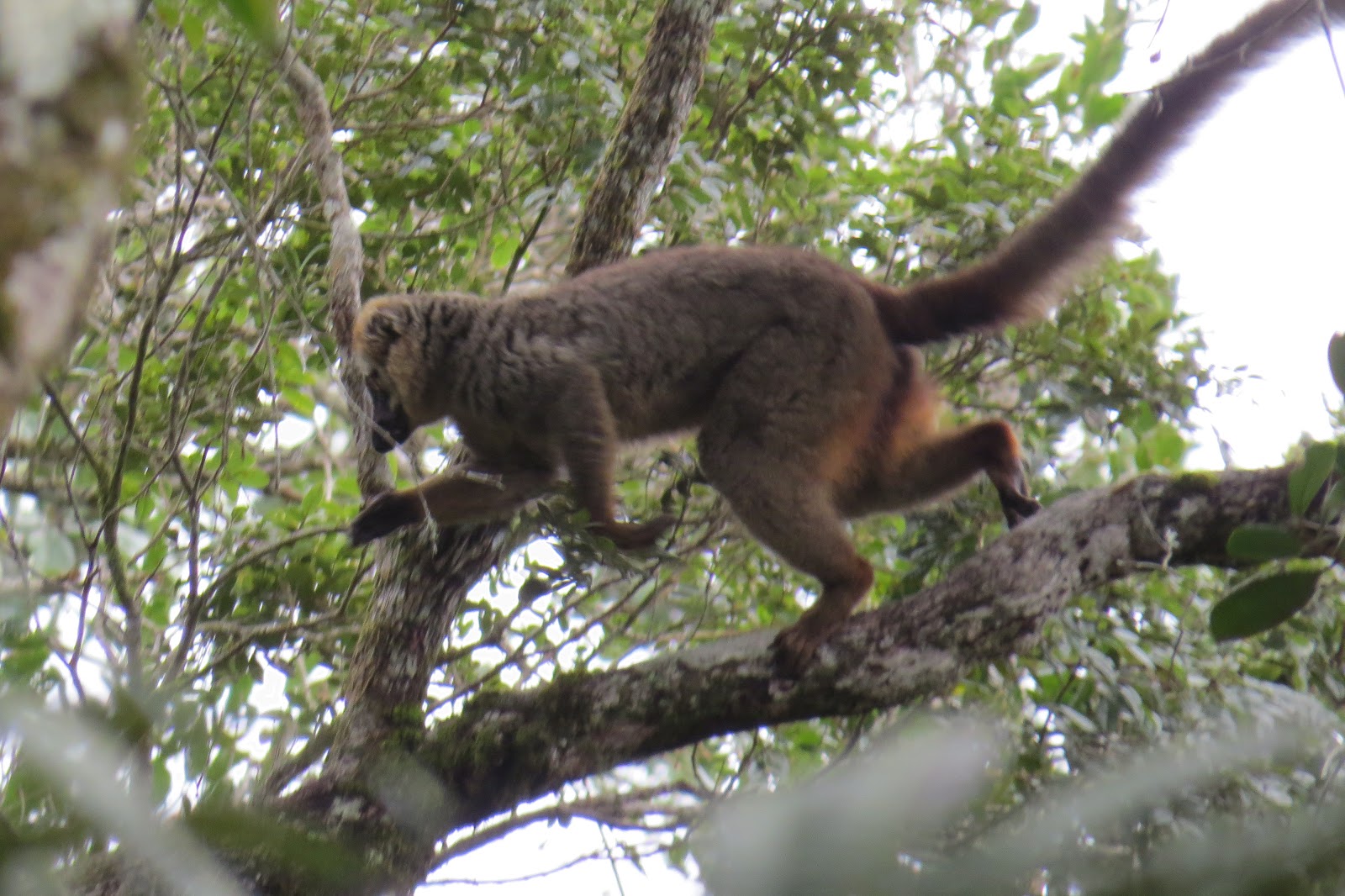
I like this photo because it shows how nimble our cousins can be, running across tree limbs high in the canopy.

Like most diurnal lemurs, red-fronted brown mothers carry their babies piggy-back style. (Actually, the baby clings to the belly for the first month of life, and then it crawls around to the back when it's strong enough.) I was blown away by the cuteness the first time I saw a little black-and-orange face peeking out of its mama's fur.

Females do most of the heavy lifting, but males are very involved in childcare. Here's a father grooming his mate and baby.

One day I was walking through the rainforest alone near our research camp, and a troupe of 12 red-fronted brown lemurs galloped overhead, snorting like pigs. When they saw me, they stopped to glare at me.

The lemurs swished their tails back and forth in a very pointed gesture of irritation. Maybe you can see the motion in this photo? Can you feel their agitation? It was like an impatient librarian was tapping her foot and breathing down my neck, way out there in the rainforest!

Red Bellied Lemur (Eulemur rubriventer)


The red bellied lemur is closely related to the red-fronted brown lemur, but you can tell the difference in the male's faces. Notice the white teardrops and black nose here.

Lemur feet are the COOLEST. Why, what a bulbous thumb pad you have!

On a birdwatching tour with Menja and her boyfriend, Rhodan, we noticed this strange youngster. It should be dark brown, but instead it had light caramel fur, no dark facial markings, and slightly pale eyes. Maybe an albino or leucistic individual?? 

Here, the light-colored juvenile clambers through a tree fern after a typically-colored juvenile of the same size. This photo gives a nice comparison of the two, but what I really like is how it captured the lemurs' relationship to tree ferns. I love this plant, and I wish I could grasp its prickly branches and swing through its drooping fronds with grace.

Ranomafana Bamboo Lemur (Hapalemur griseus ranomafanensis)


The Ranomafana bamboo lemur (a subspecies of the eastern lesser bamboo lemur) is one of three species of bamboo lemur living in Ranomafana National Park. Take a moment to think about that: these are primates living on tough, tall grasses! They have been called the "giant panda of Madagascar" because they fill the same ecological niche.
  
These fluffy lovebugs are also known as "gray gentle lemurs," presumably because their grass-munching habits don't require violence. Ironically, this was the only species of lemur I witnessed fighting. Two troupes of about eight lemurs each clashed over my head on a morning bird-walk.


Golden Bamboo Lemur (Hapalemur aureus)


Here is a golden bamboo lemur, being golden and eating bamboo, how fitting!

This species was discovered in 1986 by Dr. Patricia Wright, the founding director of Centre ValBio (the lab where I work) and PhD advisor of Dr. Sarah Zohdy (my own research mentor). All this interwoven history made my chance to see a golden bamboo lemur even more exciting.

Greater Bamboo Lemur (Prolemur simus)


The greater bamboo lemur is a sluggish, easy-going guy.

Like the other bamboo lemurs, he's a vertical climber. Can you imagine clinging to the top of a slick, bendy bamboo pole and feeling as comfortable as if you were lounging on a couch?


These three bamboo lemurs pose an ecological quandary: how do three species with the same diet coexist? Why doesn't one species outcompete the others? Last month, while sitting on a log near the village of Bevoahazo, I devoured a book on this subject and many others: The Song of the Dodo by David Quammen. Currently obsessed. Highly recommend.

Anyway, the answer lies in the fact that these three lemurs each specialize in different parts of the bamboo. The Ranomafana bamboo lemur prefers leaves, the greater bamboo lemur uses its hefty teeth to crack open stems and gouge out the inner pith, and the golden bamboo lemur consumes the new shoots and creepers.

But the plot thickens: the new shoots are overflowing with cyanide, bamboo's chemical defense against herbivory. Every day, the golden bamboo lemur consumes 12 times the lethal dose of cyanide for other animals of its size! As far as I know, how they do that is still a mystery.

Once I knew about the arms-race between a poisonous, tree-sized grass and its cyanide-immune connoisseur, I had to get a photo with Ranomafana's bamboo. I forgot to take any lemur selfies, but really I'd rather pose with this symbol of sympatry and evolution anyway!

Milne-Edwards' Sifaka (Propithecus edwarsi)


The sifakas, pronounced "shi-faks," are the largest living lemurs after the Indri. (Did you know that there are also 17 species of giant lemur, all of which went extinct in the last few thousand years?)

I got to watch this individual bound through the trees with jaw-dropping leaps. The Milne-Edwards' sifaka is the long-jumper of the canopy. It starts on one tree with it belly toward the trunk. It then shoves off with its powerful legs, swinging its tail and one arm forward for momentum. It flies up to 30 feet through the air before landing, hind-legs first, on its target tree. While it flies, it does a 180-degree twist so it can land with its belly facing the new trunk.

There she goes!

The sifaka's little-old-man face made me want to laugh, but it also held a sort of sorrow.

No other species of lemur made me feel as much kinship as this one. I am often hit with a wave of desire to prevent the extinction of the lemurs because of their unique traits, evolutionary history, and ecological roles. But in this moment, it was a simpler and more painful desire. I felt compassion for this fellow primate and her shrinking home.

Black-and-White Ruffed Lemur (Varecia variegata)


My favorite lemur species is this one, the black-and-white ruffed lemur. I only glimpsed it once, but I heard its looping, erratic song all through the forest, and even in some of the fragments where I camped. Turn on your volume for this video!