Health Education, Health Articles, Health Blog

Showing posts with label Seattle. Show all posts

"I Dive Like a Girl, Try To Keep Up!" Celebrating Women's Dive Day in the Eelgrass of Puget Sound

Did you know that today, July 15th, 2017, is the third annual PADI Women's Dive Day?

Only about a third of certified scuba divers are women. Today I joined a welcoming and adventurous group of female divers from Seattle Scuba Schools to dive the Junkpile, a smattering of sunken debris off Alki Beach in West Seattle.

I came to the event alone, so I was paired with Hannah as my dive buddy. Diving is a great way to make friends, even though there's not much chance for conversation underwater...

These photos are to show my underwater-photography learning curve. I figured out how to take stills from a GoPro video, yay!

And so you can admire the beauty of neoprene-hood cheeks, of course.

It was my first chance to use my new GoPro, a Hero 2 I bought on Craig's List. Here's a short video of our dive through the eelgrass bed. (Sorry, no critter close-ups. My battery died before I found the sea stars.)


I adore diving in Puget Sound, even though the cold water requires bulky gear (a two-piece, 14 mm wetsuit plus boots, gloves and hood), and the green algae limits visibility to ten feet. What I love is getting to know this underwater ecosystem right next to my home, the city of Seattle.

We saw lots of flounder, a ratfish, a Dungeness crab, a striped sea jelly, and the siphon of an enormous clam. Best of all, we saw sea stars! A Leather Star, two Sunflower Stars, a Giant Pink Star (think Patrick from Spongebob), a Sunstar, and an orange star that could have been Ochre or Mottled.

This icing really took the cake.

After the dive, we were treated to a delicious summer barbecue hosted by Cathy from Seattle Scuba Schools. Now I have to go put away all my gear that's drying in the sun!

Happy, salty, hungry divers.

Share:

Lake Ballard: A Lively Capitalist Ruin

On May 27th, I explored Lake Ballard with my mother, Jane.

Jane birds Lake Ballard through a chain-link fence.

If you're from Seattle, you might pause to wonder what I'm talking about. The house-boated Lake Union is well known, as are the duck-filled Green Lake and the bridge-spanned Lake Washington. But Lake Ballard? You've probably never heard of such a thing.

That's because Lake Ballard is actually a puddle of water that has collected in a huge empty lot at the intersection of NW 46th St and 15th Ave NW (better known as the Ballard Bridge). It sits across the street from Ballard Blocks Shopping Mall, home to Trader Joe's and LA Fitness, among others.

Lake Ballard contains multiple habitats: calm freshwater, concrete pads, and blackberry brambles.

The concrete foundation has been growing a forest of Himalayan blackberries since its industrial buildings were torn down several years ago. Online neighborhood forums have generated many complaints about this "wasted" space, with commenters referring to it as an "eyesore" and calling for rapid development.

One commenter wrote, "You mean that swimming pool? It's about time they did something with that. Boggles the mind how property owners can afford to just sit on land like that without doing anything. At least turn it into parking for boats and RVs to pick up some cash."

The capitalist spirit is alive and well in Ballard.

You never know what you might find in Lake Ballard -- perhaps a chair and a fire extinguisher.

Seattle's bird-watching community has taken a different perspective, as have an impressive number of migrating shorebirds and urban resident species. Birders have dubbed the construction site "Lake Ballard." We frequent it with our binoculars, report sightings on the Tweeters listserv, and submit eBird checklists. Highlights have included semipalmated plovers, least sandpipers, greater yellowlegs, spotted sandpipers, and solitary sandpipers.

Because it is fenced off from human trespassers and isolated from most predators, Lake Ballard is a safe haven for a duck to raise her family.

I watched this mother mallard supervise six ducklings in the frothy waters.

Here, a mallard and her duckling sleep behind a killdeer, the only shorebird we saw today.

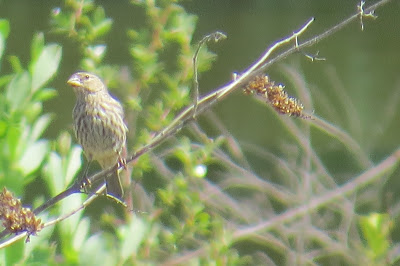
A female house finch picks seeds from a pioneering shrub.

Next to Lake Ballard runs one of Seattle's famous drawbridges, the Ballard Bridge. A host of streetwise birds make their homes here, in the traffic-rumbling shade.

Jane is framed between the Ballard Bridge and Lake Ballard.

Pigeons are the most dependable sightings.

European starlings live here, too.

A native and intelligent American crow watched my mother and I with interest from a telephone wire.

Most excitingly, a colony of cliff swallows have plastered their mud to the bridge's underside. Concrete cliffs suit them just fine.

This view is looking straight up at a hanging weed, fence-top pigeon perch, and cliff swallow nest below the bridge.

Close-up of a cliff swallow's mud nest.

Another nest with a white, blue, and orange head poking out.

A cliff swallow makes adjustments to her corner abode.

I have become fond of Lake Ballard and its avian inhabitants. To me, this empty lots holds several lessons:

1. Birds in Seattle are desperate for freshwater, and they need more aquatic and riparian habitat.

2. Nature is resilient, and it will fill in the weedy margins of capitalist development at any opportunity. We have the potential to coexist, humans and wildlife, in ecosystems that are contaminated and collaboratively built by all of us. (For more on this idea, I suggest reading The Mushroom at the End of the World: On the Possibility of Life in Capitalist Ruins by Anna Tsing.)

3. Waste is never wasted. What a developer sees as a "waste of money" or a neighbor sees as a "waste of space" is a resource that will be used by marginalized populations, in this case birds and blackberries.

And with these lessons in mind, I am sad to share the news that Lake Ballard will soon be developed into a grocery store, marine retail, and a restaurant. A big white board (formally known as Notice of Proposed Land Use Action) declares the lake's fate underneath graffiti of an incredulous fox. I picture a thought bubble over the spray-painted canine's head:

"Do we really need another grocery store across the street from Trader Joe's?"

A notice of Lake Ballard's impending demise, with commentary from a graffiti fox.

Of course, Ballard is growing, and the stores will be frequented by customers happy for a source of high-end foods on which to spend their money. It's a capitalist dream to replace this wasteful swimming pool with economically productive businesses.

Yet, I imagine an alternative use for this land. What if Lake Ballard were immortalized into a small urban park? What if Ballard's residents worked together to demand that this vacant lot be turned into a freshwater oasis for shorebirds and waterfowl amid bustling concrete and air-conditioned gyms and grocery stores? My dream has been met with enthusiasm when I shared it with Trader Joe's clerks and shoppers, my only audience so far.

Resistance to development is not a stranger in this place. Across from Lake Ballard, wedged between Ross Dress for Less and LA Fitness, sits an odd and unexpected home. It's the house of the late Edith Wilson Macefield, a Ballard legend who refused to sell her property for exorbitant offers. So, the Ballard Blocks Shopping Mall was built around her.

Edith Wilson Macefield's house tucked defiantly between behemoth units of Ballard Blocks Shopping Mall.

Clearly, the birds are willing to call this ruin home. I would like to take a leaf out of Edith's book and defend this "waste" for the organisms who recognized its potential not as a generator of profit, but as a nursery for ducklings, a source of home-building mud, and a garden of seeds and berries. I would feel more at home in my city if I could visit Lake Ballard years from now, spend a few moments with its inhabitants, and remember that all of us -- all organisms -- are in this game of survival together.
Share:

Well, Officer, We're Poaching!

The Washington State Fish and Wildlife game warden pulled up next to the boat. "Whatcha fishing for?" he asked.

"Bocaccio," Nick replied.

The game warden gave him a skeptical look, owing to the fact that Puget Sound bocaccio rockfish are an endangered species, totally off-limits to fishermen.

"And canary," Nick continued.

The canary rockfish, a lovely orange-creamsicle with scales, is listed as threatened in our area.

"Really," responded the game warden, not sure now whether he was kidding.

"Oh! and yelloweye," Nick finished, naming the third and final species of threatened rockfish in the Sound. [Click here to read about my impromptu beach necropsy of a dead yelloweye!]

The warden's eyes got wide as he began to believe Nick's story. I've caught the dumbest poachers in Washington State! he must have been thinking.

That's when Nick hit him with the final piece of information. "Oh, and we're with NOAA under a federal fisheries research permit."

Nick keeps the game warden on his toes.

Sadly, I was not present when this conversation took place. I've heard it retold by my NOAA Hollings Scholarship mentor, Nick, and I can only imagine that game warden's face. I was, however, lucky enough to accompany Nick and a band of dedicated local anglers on a similar mission.

Our goal was to obtain genetic samples of these three endangered species of rockfish to determine whether their south Puget Sound populations were distinct from their open coastal counterparts, as had been predicted when these populations were given endangered status, or if they moved and bred freely with coastal fishes.

The yelloweyes, canaries and bocaccios evaded us that day, but I proudly hauled up one brown rockfish, Sebastes auricuculatus.

My most exciting catch, the relatively common a brown rockfish.

We measured each fish before releasing it with a special weighted pressure-release clip that held the fish by its lower jaw without damaging it.

The rockfishes, used to being at depths of at least 100 feet, had a little expansion trouble at the surface. This one's stomach can be seen protruding from its mouth. The hope is that everything returns to its normal deflated state once the fish is released at depth.

The crew also caught two species of sculpin: a buffalo or Enophrys bison, shown here, and a red Irish lord or Hemilepidotus hemilepidotus, my personal favorite. I sure wish I could have magically shipped these guys back in time and space to Friday Harbor Labs, where my Puddle research crew could have studied the functional morphology of their jaw muscles!

A buffalo sculpin shows off his preopercular spines and makes cute little growling sounds.

But mostly we caught dogs. By which I mean sharks.

"I got a big one!!!"

A spiny dogfish, Squalus acanthias, to be exact.

Another dog!

Did I mention it was Shark Week?

We recorded the size and sex of each dogfish we caught, even though we weren't there for shark research. The day's motto: "Don't waste an opportunity to take data because you'll never know when you might need it!" I lost count around fifty. Next time you're trying to sex a shark, just remember:

A male spiny dogfish has two claspers, modified pelvic fins that transfer sperm to the female during sexual reproduction.

A female spiny dogfish has no claspers. 

Dude, that's private!

We also hooked some unexpected invertebrates...

Such as this scallop.
And this purple sea star, Pisaster ochraceus.

We didn't accomplish our goal of sampling endangered rockfish genetics, but we had a great time out on the water. There's no such thing as a bad day spent boating on the Puget Sound, sandwiched between silver water and pewter sky.


I think these gulls, hitching a leisurely ride on a barge of sand, would certainly agree.
Share:

And So Begins A Beautiful Summer

This summer I am delighted, honored, and freakin' excited to have a National Science Foundation-funded research internship at University of Washington Friday Harbor Labs.

How did I get this opportunity? Listen close all you undergrads, both present and future: apply for an REU (Research Experiences for Undegraduates) or two. Or five (like me). Or ten (if you're that dedicated!) Yeah, the odds are slim and the competition is stiff, but the worst that can happen is you don't get the job. And the best that can happen is, you do!

Months before the internship began I was already making friends over e-mail with my groovy (as he would say) mentor Nick and my bitchin' (as she would say) lab partner Anna. Being from Missouri, Anna needed to fly into Seattle and I was graced with her presence a few days early. I got to play tour guide!

We hit up all the best local sites (Theo's Chocolate sampling room, Gasworks Park, The Essential Bakery) but this trip was particularly fish-themed with the Seattle Aquarium, Pike Place Market, and an extreme low-tide at Carkeek Park. We didn't even have time for the Fish Ladder at the Ballard Locks!

We found lots of cool things at Carkeek, like this (ironically very small) Big Skate (Raja binoculata) stranded in an eelgrass bed. At the end you can see how fascinated the kids were by this "baby sting ray."