
I would like to begin this blog by highlighting my stupendous mom who made this whole trip possible and amazing and awesome.
Everybody, Jane in two habitats:
 |
| Jane birding on Mt. Roberts. |
 |
| Jane and her alter-ego, the giant hoary marmot. |
Thanks for everything, Mom! I love you!
 |
| Jane and Marna on Basin Road. |
Marna was impressed by the fast-paced road trip schedule we’d been keeping, so she gave us four different attractions to pack into our day. “My family would take on one of these in a day,” she told us, “but for you guys, no problem!” We started with a walk up Basin Road, a street that soon became a cantilevered wooden track under sheer cliffs of moss and precarious forest.
We then headed down the hill to the waterfront, where we caught the first tram up to Mount Roberts. It’s unbelievable how steeply the mountains rise around Juneau!
 |
| Looking down the tram wires from Mt. Roberts. |
The network of alpine trails could take a backpacker weeks to explore, so we saw just a snippet with breath-taking views and a handful of shy songbirds. The Lobaria lichens were the lushest, greenest, shiniest, most lung-worty specimens I’ve ever seen!
 |
| So green! |
 |
| Nice ascocarps! |
We looked for willow ptarmigans, but instead found another thrush. We should be getting good at these guys by now, but we still can't tell... is she hermit or gray-cheeked?
 |
| Birders, what do you think: hermit or gray-cheeked? |
We left, before we had seen enough, to catch the 1 pm tour of the NOAA (National Oceanic and Atmospheric Administration) fisheries science building. Compared to dramatic clifftops, touring a government building may sound dull, but I love seeing NOAA labs, and my mom indulged my strange request.
Compared to the NOAA Northwest Fisheries Science Center where I worked this summer in Seattle, the Juneau building was state of the art. A mural of 50 life-sized model fishes from the region adorned the lobby’s wall. Four projectors shone on a globe-shaped screen to give the impression of a rotating earth. We got to watch NOAA’s “Science on a Sphere” presentation about the world and climate change here.
The wet lab contained touch-tanks of my favorites, including a sunflower star, Pycnopodia helianthoides. The biology and chemistry labs were staffed with friendly, busy scientists, and the lobby’s aquarium contained the largest leather star, Dermasterias imbricata, I’ve ever seen.
The building is heated by an efficient heat-exchange system that draws energy from the chilly waters of Gastineau Channel. In winter, it also recaptures heat blowing up through vents from the chemical hoods. The conference room has a glass wall overlooking the ocean, and our tour guide told us he gets too distracted by breaching whales when he sits facing that way. What a life!
After the tour, we headed straight to Mendenhall Glacier. Two of the four trails were closed: one for bears, the other for flooding.
As we watched salmon from the bridge, a National Forest ranger approached us. “Are you looking for birds?” she asked. Finally, a ranger-ornithologist! Together we spotted juncos, yellow-rumped warblers, a Pacific slope flycatcher, and a western wood-pewee. She gifted us a Birds of Southeast Alaska checklist and recommended a trail for dippers.
We were in luck. As we walked back to the parking lot, we passed a secluded bridge over another stream. The tree branches dripped with lichens, and the soil embankment was caked with emerald moss. “If I were a dipper, I’d live here!” I told my mom. “Oh my gosh, there’s a dipper!”
There she was, popping in and out of the clear water, the droplets rolling off her graphite back. A bird that loves mossy streams! I am so fond of dippers.
Now back to Marna’s for a mouth-watering salmon dinner. Our first home-cooked meal. And after that, a jaunt back up the tram (tickets are good for the whole day, so we wanted to get our full use!) for sunset on Mount Roberts.
We were hoping to get to bed early, but at 10:30 pm I realized I couldn’t find my (dead) iPhone, so I spent half an hour tearing apart my suitcase, the car, and everything in the room. Finally Annabelle (that’s my iPhone) appeared in the folds of an emergency blanket in the trunk of Prius. Oh, what can you do when inanimate objects play pranks on you…
End of day summary:
 |
| Science on a Sphere and the fish wall. |
The wet lab contained touch-tanks of my favorites, including a sunflower star, Pycnopodia helianthoides. The biology and chemistry labs were staffed with friendly, busy scientists, and the lobby’s aquarium contained the largest leather star, Dermasterias imbricata, I’ve ever seen.
 |
| Jane examines squid eggs. |
 |
| Two sculpins, a great (Myoxocephalus polyacanthocephalus) and a buffalo (Enophrys bison), cuddle puddling. |
The building is heated by an efficient heat-exchange system that draws energy from the chilly waters of Gastineau Channel. In winter, it also recaptures heat blowing up through vents from the chemical hoods. The conference room has a glass wall overlooking the ocean, and our tour guide told us he gets too distracted by breaching whales when he sits facing that way. What a life!
 |
| I want this poster for my wall! |
After the tour, we headed straight to Mendenhall Glacier. Two of the four trails were closed: one for bears, the other for flooding.
 |
| Mendenhall Glacier melts into Mendenhall Lake. |
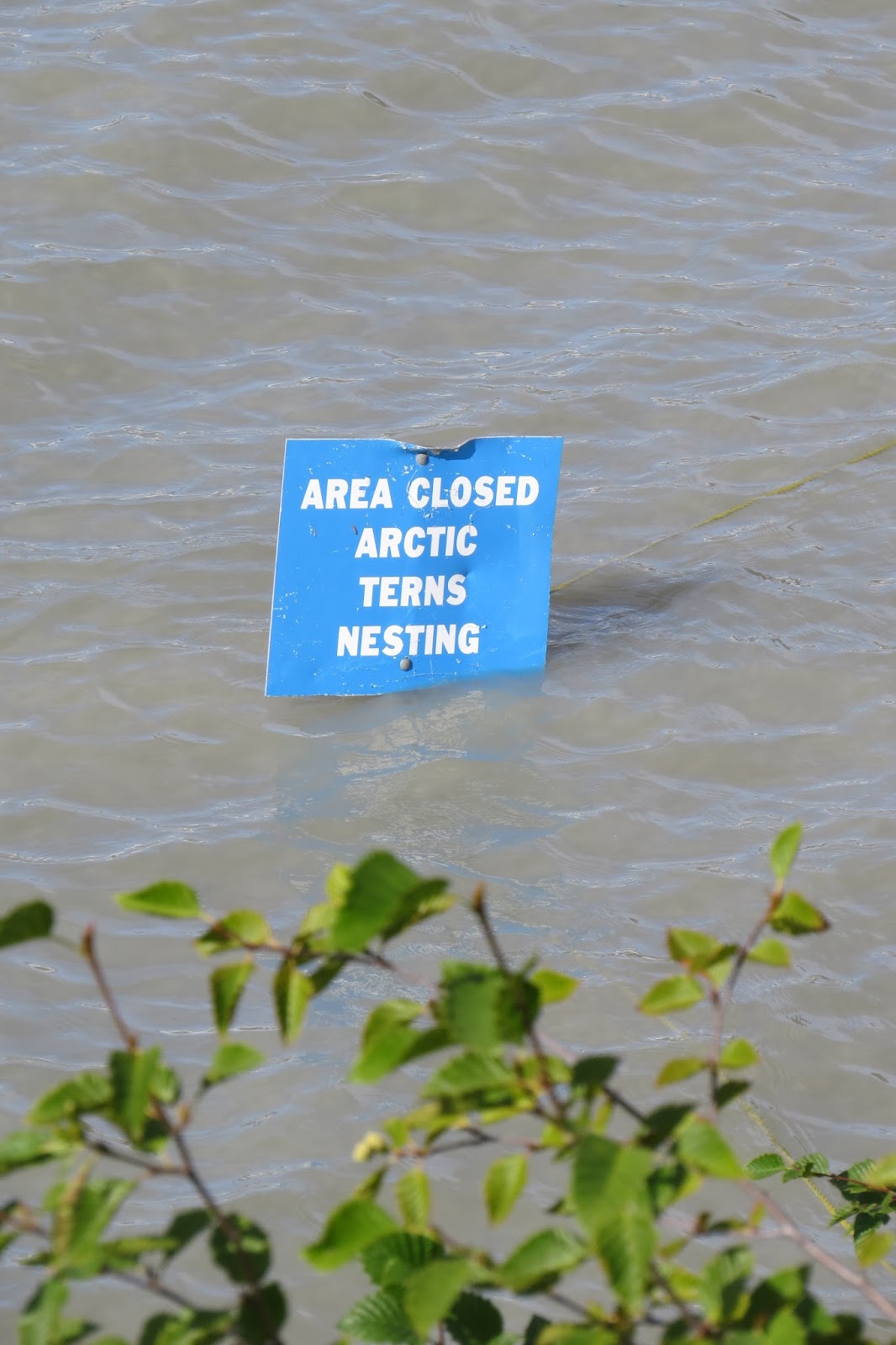 |
| I think these terns may have been flooded out of house and home. |
We fought our way through the crowd of cruise-boat tourists for a look at the receding blue ice, admired the icebergs she had calved into Mendenhall Lake, and moved on to the stream.
 |
| Red squirrel munching on a mushroom. |
Here, bright red sockeye salmon were spawning! The waters were so shallow over the river rocks that the salmon had to expose their dorsal halves in their frantic push to move upstream. Several white carcasses rotted on the banks. I realized that I had never seen a healthy stream of salmon before! I’ve learned about these fish since grade school, visited the fish ladder at the Locks, witnessed the life stages at the Seattle Aquarium, watched documentaries about the fate of Alaskan salmon if Pebble Mine is dug… but here in front of me were the real thing, unaware of their symbolism, just trying to reproduce like the rest of us. I wish you the best, big sockeyes!
 |
| A sockeye too large for its small stream. |
As we watched salmon from the bridge, a National Forest ranger approached us. “Are you looking for birds?” she asked. Finally, a ranger-ornithologist! Together we spotted juncos, yellow-rumped warblers, a Pacific slope flycatcher, and a western wood-pewee. She gifted us a Birds of Southeast Alaska checklist and recommended a trail for dippers.
 |
| Pacific slope flycatcher. |
 |
| Western wood-pewee. |
We were in luck. As we walked back to the parking lot, we passed a secluded bridge over another stream. The tree branches dripped with lichens, and the soil embankment was caked with emerald moss. “If I were a dipper, I’d live here!” I told my mom. “Oh my gosh, there’s a dipper!”
 |
| Ideal dipper (and Nina) habitat. |
There she was, popping in and out of the clear water, the droplets rolling off her graphite back. A bird that loves mossy streams! I am so fond of dippers.
 |
| Dipping for bugs. |
 |
| Ahhh! |
Now back to Marna’s for a mouth-watering salmon dinner. Our first home-cooked meal. And after that, a jaunt back up the tram (tickets are good for the whole day, so we wanted to get our full use!) for sunset on Mount Roberts.
 |
| Gastineau Channel at sunset. |
 |
| Looooong shadow dancers. |
 |
| I think this black leafy stuff is tree pelt lichen, Peltigera collina. |
We were hoping to get to bed early, but at 10:30 pm I realized I couldn’t find my (dead) iPhone, so I spent half an hour tearing apart my suitcase, the car, and everything in the room. Finally Annabelle (that’s my iPhone) appeared in the folds of an emergency blanket in the trunk of Prius. Oh, what can you do when inanimate objects play pranks on you…
End of day summary:
- Day of road trip: 15
- Start: Juneau, Alaska, United States
- Miles traveled: 45
- Hours driven: 1
- Favorite bird sighting: American dipper
- End: Juneau, Alaska, United States


