It was one of those perfect coincidences. I was reading a post on Names Across Nations (seriously, what a blog) in which the author, a previous Watson Fellow, stumbles across a university in her German host-city with an onomastics department. A whole department dedicated to her niche topic, the study of names and naming, and she didn't even plan it! Naturally, she meets with a professor there, and they have a three-hour conversation fueled by their mutual delight that someone else in the world is obsessed with names.
I thought to myself, I should really try to meet with some professors at the Universidade Federal do Mato Grosso do Sul (UFMS) before I leave. So, I Googled “zoonotic disease UFMS” and e-mailed the first five names for which I found contact information: three veterinarians, an ecologist, and a medical doctor. One of these professors replied saying, “I’ll be at a zoonosis conference on the exact days you’re in town. Why don’t we just meet there?”
Talk about luck! The conference was called DIERN: Doenças Infecciosas, Emergentes, Reemergentes, e Negligenciadas. Scientific language tends to be easy to understand in Portuguese because, like in English, its words stem from Latin. The conference’s name is a cognate: Infectious, Emerging, Reemerging, and Neglected Diseases.
I read the conference program with glee, sent a Facebook message to everyone I knew from Campo Grande asking for a couch to sleep on, and bought a bus ticket to the city. The one thing I failed to do was actually register for the conference. I was waiting until the last day in case my plans fell through. (It’s a tricky gamble, this waiting game. Last month I paid ahead for a 5K race in Campo Grande, and then I had to skip it because I got invited to trap marsupials.) This time, my gamble did not pay off. When I finally tried to register, a red warning streaked across the screen: “registrations closed, conference full.” Gulp. Luckily, the conference organizers responded sympathetically to my pleading e-mail and welcomed me to attend anyway.
On Saturday morning, I stuffed Marmalade (my turquoise backpack) to bursting, said a tearful farewell to Lygia and Duca, and spent the day vaccinating cats and dogs against rabies in the town of Corguinho (more on that later). Then I took an evening bus into Campo Grande, a city of a million people and the capital of this cattle state.
I was excited to realize that epidemiology is detective work. (In fourth grade, I was obsessed with solving mysteries. After reading Harriett the Spy, I founded the American Mystery Association, drafted bylaws in which “a good attitude” was mandatory, and established the headquarters in my treehouse. The AMA charged 10 cents per mystery. Bonus: if I didn’t crack your case, you didn’t pay.)
Epidemiological mysteries are far more tantalizing than the kind I tackled, which usually involved finding lost household objects. In the world of disease, the mystery asks: what is the source of disease, and how can we stop it? Outbreaks involve three kinds of clue: people, place, and time. When epidemiologists catch wind of an outbreak, usually though a medical center’s report to the federal Ministerio de Saude (Ministry of Health), they scramble to collect their equipment and get to the field, wherever the outbreak is occurring.
They start with the first clue, people, by tracking down every possible patient. Which people are getting sick? How many? Then then move to place by plotting cases on a map. The highest density of cases is the focal point, the probable source. Finally, they use a tool called an “epidemic curve” to understand time. For most diseases, we know the minimum and maximum incubation time (the shortest or longest time it can take a person to get sick after being exposed to a pathogen). By counting backward from the first and last cases of the outbreak, scientists can determine the period of time in which the disease’s source was infectious.
I imagine that many epidemiological mysteries are never solved, but we went through a couple case studies where the pathogen’s source was traced to a single batch of oranges at a Luau or the water reservoir of a town. In each case, the epidemiologists recommended public health actions to prevent a recurrence. How satisfying!
When the mini-course ended, my day’s adventures had only just begun. I didn’t have any way to get from FAMED to the house of Giovana, a friend of Renata’s who’d agreed to host me for the next three nights. Without a SIM card or WiFi, I couldn’t call an Uber, nor could I walk three kilometers with all my earthly possessions on my back. So I asked around, and I found a friendly medical-student volunteer who agreed to give me a ride.
While I waited for him to finish cleaning, I talked with medical students and learned how different the higher-education systems are in Brazil and the United States. Here, high-schoolers take a national exam to determine which professions and universities they are qualified to enter. Many students then select the highest-ranked profession and school available to them. Theoretically, this system encourages a meritocracy by providing free college to any citizen who earns it, regardless of wealth. In reality, wealthy high-schoolers from private schools take most of the spots. The Brazilian system sounds rigid and status-driven to me, but I can’t say the United States does it any better. Another difference is that medicine is an undergraduate program in Brazil. Some of these students will be doctors by the age of 22!
Then my driver was ready, so I told him my address and we lurched through Campo Grande, his car dying at every stop sign. “It just started doing this today!” he told me, exasperated. He dropped me on the curb, restarted his poor car, and sputtered away.
I looked around to assess my situation: an iron fence, a locked gate, and curtained windows. It was after dark. I was an hour earlier than I’d told Giovana to expect me, and she obviously was not home. Across the street, a glowing green church had just started to attract people, so I walked over and asked if it was a public service. The man at the door gave me a puzzled look, but eventually I ascertained that I could attend. Turns out, it was Sunday! I sat myself down in a center pew, hiking boots dangling from Marmelade, DIERN name-tag around my neck.
The Catholic service was, in a word, Brazilian. The woman in charge had a black page-boy haircut and a microphone turned all the way up. We began by crowding outside to welcome Nossa Senhora Aparecida, the patron Mary of Brazil, who is always (in my experience) a statue wearing a long cloak. We danced and sang her onto the stage. It’s unclear if she was a new statue, or if this happens every week.
The service lasted for an hour-and-a-half of standing and kneeling, a music video, eruptions of applause, some scolding to open the word of God as often as we open our cell phones, and golden chalices. There was a ritual involving fire, holy water, and a Bible being fed to each in turn. There was singing, holding hands, and crossing across the head and shoulders.
According to one of the songs (which was in Portuguese, so take my translation with a grain of salt), Nossa Senhora Aparecida was a statue discovered in a certain Brazilian river by fishermen 300 years ago. Her name literally means “Our Lady Who Appeared.” She’s one of many worldwide “appearances of Mary” and the only official black Mary. The best parts of the service were sudden outbursts when the otherwise soft-spoken leader would blast into the microphone, “Let’s make some noise for NOSSA SENHORA APARECIDA!!!!” and we would all cheer like crazy for the statue.
After, I was approached by curious congregants. One asked, “Are you Brazilian?” but clearly knew the answer already. Another asked, “Were you at DIERN today?” Turns out, she works at the Ministry of Health with one of my classmates from the Outbreaks course. An elderly woman didn’t say anything, she just petted my hair and face and smiled at me.
I wove through the crowd and crossed the street. Giovana’s lights welcomed me through her window, a relief. I was ready for bed.
I thought to myself, I should really try to meet with some professors at the Universidade Federal do Mato Grosso do Sul (UFMS) before I leave. So, I Googled “zoonotic disease UFMS” and e-mailed the first five names for which I found contact information: three veterinarians, an ecologist, and a medical doctor. One of these professors replied saying, “I’ll be at a zoonosis conference on the exact days you’re in town. Why don’t we just meet there?”
Talk about luck! The conference was called DIERN: Doenças Infecciosas, Emergentes, Reemergentes, e Negligenciadas. Scientific language tends to be easy to understand in Portuguese because, like in English, its words stem from Latin. The conference’s name is a cognate: Infectious, Emerging, Reemerging, and Neglected Diseases.
 |
| A poster for DIERN, the Central-Eastern Conference on Infectious, Emerging, Reemerging, and Neglected Diseases. (Don't be confused by the dates; this must be a poster from last year.) |
I read the conference program with glee, sent a Facebook message to everyone I knew from Campo Grande asking for a couch to sleep on, and bought a bus ticket to the city. The one thing I failed to do was actually register for the conference. I was waiting until the last day in case my plans fell through. (It’s a tricky gamble, this waiting game. Last month I paid ahead for a 5K race in Campo Grande, and then I had to skip it because I got invited to trap marsupials.) This time, my gamble did not pay off. When I finally tried to register, a red warning streaked across the screen: “registrations closed, conference full.” Gulp. Luckily, the conference organizers responded sympathetically to my pleading e-mail and welcomed me to attend anyway.
 |
| Marmelade, my champion backpack supplied by my champion North Face employee. |
On Saturday morning, I stuffed Marmalade (my turquoise backpack) to bursting, said a tearful farewell to Lygia and Duca, and spent the day vaccinating cats and dogs against rabies in the town of Corguinho (more on that later). Then I took an evening bus into Campo Grande, a city of a million people and the capital of this cattle state.
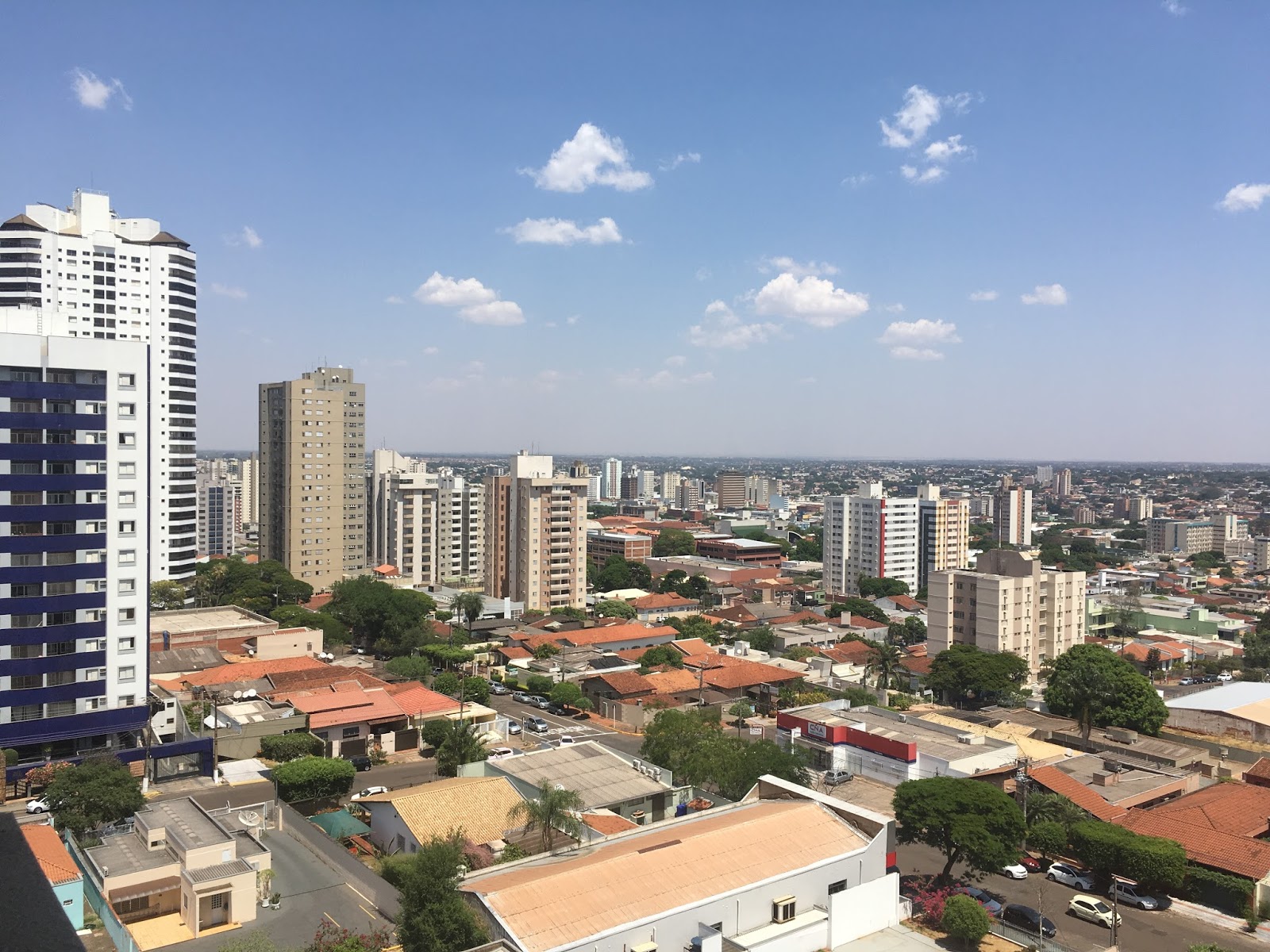 |
| Campo Grande from a skyscaper apartment. |
I stayed the first night on the couch of my friend Renata. She was very enthusiastic about the Theo’s dark chocolate bars I gave her. Brazil exports cacao but, ironically, even “dark chocolate” here is mostly sugar and milk, so 70% cacao Theo’s bars from my neighborhood of Seattle are precious.
The next morning, I took an Uber to Faculdade Medica (FAMED), the university’s medical school. My driver was a little confused when his map took him through a gate, down a cobblestone road, through a narrow dirt alleyway sprouting plants, and into a parking lot surrounded by walls of rusty sheet-metal. We had arrived at FAMED!
I had signed up for an all-day mini-course called, “Investigacãos de Surtos,” investigations of outbreaks. First we defined an outbreak: a higher-than-normal incidence of a certain disease over restricted space and time. Not to be confused with endemic disease (always present in a given zone), an epidemic (widespread in space and/or time), or a pandemic (affecting multiple countries or continents).
 |
| Dark chocolate from Fremont! |
 |
| Here, Renata holds a rehabilitated roadside hawk as part of the falconry class she took me to last month. |
I had signed up for an all-day mini-course called, “Investigacãos de Surtos,” investigations of outbreaks. First we defined an outbreak: a higher-than-normal incidence of a certain disease over restricted space and time. Not to be confused with endemic disease (always present in a given zone), an epidemic (widespread in space and/or time), or a pandemic (affecting multiple countries or continents).
 |
| The four outbreak professors: Dr. Larissa, Dr. Adriana Lucena, Dr. Liana Blume, and Dr. Marcelo Wada. |
I was excited to realize that epidemiology is detective work. (In fourth grade, I was obsessed with solving mysteries. After reading Harriett the Spy, I founded the American Mystery Association, drafted bylaws in which “a good attitude” was mandatory, and established the headquarters in my treehouse. The AMA charged 10 cents per mystery. Bonus: if I didn’t crack your case, you didn’t pay.)
Epidemiological mysteries are far more tantalizing than the kind I tackled, which usually involved finding lost household objects. In the world of disease, the mystery asks: what is the source of disease, and how can we stop it? Outbreaks involve three kinds of clue: people, place, and time. When epidemiologists catch wind of an outbreak, usually though a medical center’s report to the federal Ministerio de Saude (Ministry of Health), they scramble to collect their equipment and get to the field, wherever the outbreak is occurring.
 |
| Dr. Marcello explains how this map of cases in a Toxoplasmosis outbreak allowed the epidemeologists to locate the source at a water reservoir. |
They start with the first clue, people, by tracking down every possible patient. Which people are getting sick? How many? Then then move to place by plotting cases on a map. The highest density of cases is the focal point, the probable source. Finally, they use a tool called an “epidemic curve” to understand time. For most diseases, we know the minimum and maximum incubation time (the shortest or longest time it can take a person to get sick after being exposed to a pathogen). By counting backward from the first and last cases of the outbreak, scientists can determine the period of time in which the disease’s source was infectious.
 |
| My attempt to estimate the time period during which an outbreak started, using an epidemic curve. |
I imagine that many epidemiological mysteries are never solved, but we went through a couple case studies where the pathogen’s source was traced to a single batch of oranges at a Luau or the water reservoir of a town. In each case, the epidemiologists recommended public health actions to prevent a recurrence. How satisfying!
 |
| Outbreak students 2017! |
When the mini-course ended, my day’s adventures had only just begun. I didn’t have any way to get from FAMED to the house of Giovana, a friend of Renata’s who’d agreed to host me for the next three nights. Without a SIM card or WiFi, I couldn’t call an Uber, nor could I walk three kilometers with all my earthly possessions on my back. So I asked around, and I found a friendly medical-student volunteer who agreed to give me a ride.
While I waited for him to finish cleaning, I talked with medical students and learned how different the higher-education systems are in Brazil and the United States. Here, high-schoolers take a national exam to determine which professions and universities they are qualified to enter. Many students then select the highest-ranked profession and school available to them. Theoretically, this system encourages a meritocracy by providing free college to any citizen who earns it, regardless of wealth. In reality, wealthy high-schoolers from private schools take most of the spots. The Brazilian system sounds rigid and status-driven to me, but I can’t say the United States does it any better. Another difference is that medicine is an undergraduate program in Brazil. Some of these students will be doctors by the age of 22!
Then my driver was ready, so I told him my address and we lurched through Campo Grande, his car dying at every stop sign. “It just started doing this today!” he told me, exasperated. He dropped me on the curb, restarted his poor car, and sputtered away.
I looked around to assess my situation: an iron fence, a locked gate, and curtained windows. It was after dark. I was an hour earlier than I’d told Giovana to expect me, and she obviously was not home. Across the street, a glowing green church had just started to attract people, so I walked over and asked if it was a public service. The man at the door gave me a puzzled look, but eventually I ascertained that I could attend. Turns out, it was Sunday! I sat myself down in a center pew, hiking boots dangling from Marmelade, DIERN name-tag around my neck.
The Catholic service was, in a word, Brazilian. The woman in charge had a black page-boy haircut and a microphone turned all the way up. We began by crowding outside to welcome Nossa Senhora Aparecida, the patron Mary of Brazil, who is always (in my experience) a statue wearing a long cloak. We danced and sang her onto the stage. It’s unclear if she was a new statue, or if this happens every week.
The service lasted for an hour-and-a-half of standing and kneeling, a music video, eruptions of applause, some scolding to open the word of God as often as we open our cell phones, and golden chalices. There was a ritual involving fire, holy water, and a Bible being fed to each in turn. There was singing, holding hands, and crossing across the head and shoulders.
According to one of the songs (which was in Portuguese, so take my translation with a grain of salt), Nossa Senhora Aparecida was a statue discovered in a certain Brazilian river by fishermen 300 years ago. Her name literally means “Our Lady Who Appeared.” She’s one of many worldwide “appearances of Mary” and the only official black Mary. The best parts of the service were sudden outbursts when the otherwise soft-spoken leader would blast into the microphone, “Let’s make some noise for NOSSA SENHORA APARECIDA!!!!” and we would all cheer like crazy for the statue.
After, I was approached by curious congregants. One asked, “Are you Brazilian?” but clearly knew the answer already. Another asked, “Were you at DIERN today?” Turns out, she works at the Ministry of Health with one of my classmates from the Outbreaks course. An elderly woman didn’t say anything, she just petted my hair and face and smiled at me.
 |
| Giovana greets the same hawk Renata was holding above. I met Giovana at this falconry class, and then she let me stay at her house a month later. You never know when falconry classmate will reappaer in your life! |
 |
| Giovana holds the roadside hawk. |
I wove through the crowd and crossed the street. Giovana’s lights welcomed me through her window, a relief. I was ready for bed.