Health Education, Health Articles, Health Blog

Fazenda Colorado

Today we visited the neighbors on their vast property, Fazenda Colorado. In Brazil, a lot of land is owned by a few people. This fazenda, or cattle ranch, was a prime example. The red, sandy roads stretched for miles through pasture, forest, and rock outcroppings without ever leaving the property.

A red-legged seriema on Fazenda Colorado. These birds are three feet tall. They run like Big Bird, and they are always seen in pairs. I've never seen either partner without red lipstick.

The land is owned by one man, Luiz, but he wasn't there today. His son (also Luiz) and a couple of family friends were visiting from Sao Paulo, where they live. It's about a 14-hour drive, so the families flew. Each family consisted of a mother, father, and two kids between the ages of five and eight. With all that land to roam, a swimming pool, a few palm trees, and the warm climate, it seemed like an ideal winter getaway.

Here is the ranch house where we stayed for a traditional and generous barbeque lunch.

I learned that agriculture in Brazil is very profitable now, more so than medicine or most other careers, but the economy is unpredictable, so that might not be the case for long. Beef production is split into three stages: the breeding, the growing, and the slaughtering. This farm, Fazenda Colorado, is for breeding. There are 3,000 cattle on the land now, two-thirds adults and one-third calves. The owner has another farm a few hours away, Fazenda California, where the growing takes place.

Blue-and-yellow macaw. These large birds also travel in pairs, but sometimes they group together in noisy flocks. They always fly with purpose.

Duca, Lygia, and I were invited over today so Duca could give Luiz and his friends a tour of their own farm. She has been given permission over the past years to do research on this land, so she knows it well.

Duca shoos white zebu cattle away from the road after opening one of a dozen gates.

The "slipping monkey tree," or cumbara, is covered with rusty powder that poofs into a cloud when touched. I imagine its purpose is more to stop epiphytes from growing than monkeys from climbing.

João, grandson of the owner, poses with a slipping monkey tree.
The most incredible part of the farm is that it borders the Pantanal. To orient you in space: the Pantanal is the world's largest tropical wetland, covering 75,000 square miles smack-dab in the middle of South America. It is mostly contained in the Brazilian state of Mato Grosso do Sul (where I am), but the edges spill into Mato Grosso to the north, Bolivia to the west, and Paraguay to the south.

The lime-green blob is the Pantanal, world's largest tropical wetland.

Pantanal is a geological wonder. Unlike most wetlands, it is neither a coastal estuary nor a permafrost marsh. It's a vast inland delta, essentially a low spot in the floor with no drain (an engineer's worst nightmare). Two-and-a-half million years ago, the continent simply sagged in the middle due to the same tectonic forces that are uplifting the Andes.

Rain falls. Rivers flow. Water collects at the bottom.

The Pantanal goes through enormous seasonal changes. In the wet season (January-March), up to 80% of the area floods. Cattle and wildlife huddle on the few emergent islands of forest. In the dry season (July-September), water evaporates until only a few puddles are left.

To the north and east, the Pantanal is surrounded by the Serra de Maracaju, the Hills of Maracaju. These hills are coated in dry, semi-deciduous forest called Cerrado (pronounced "say-ha-doo.") Both Fazenda Colorado and Quinta do Sol are located in Cerrado.

Once we arrived at the edge of Fazenda Colorado, Lygia covered my eyes and made me walk blind. Then she removed her hand and told me to look. What I saw took my breath away.

A panoramic view of the Pantanal from the edge of the Cerrado.

You can't tell from the photo, but I am standing on the edge of a sheer cliff, hundreds of feet above the Pantanal. Looking to my left and right, I could see the cliff extending out like the vertical edge of a vitória-régia, a Victorian water lily. The Pantanal itself was flat, spreading outward until the curvature of the earth hid it from my sight.

These are the Victorian water lilies that tempted me to come to Pantanal in the first place. It is fitting that the entire flat-bottomed pan of the Pantanal would resemble one of these iconic plants. Photo credit: Max Pixel.

Seeing the Pantanal spread out beneath me was a moment of awe.

From up here, I couldn't miss the amount of deforestation that has taken place in Pantanal for cattle pasture. The intermingling of yellow grass and dark-green forest looked pleasingly natural at first glance, but then I noticed the straight edges between the colors. These were lines drawn by humans.

After awe, it's time to refresh with terere, also known as yierba mate. Here, my friend Lygia shares it with the farm's manager and veterinarian, Alex.

Terere drinking is a ritual. The ice-cold water is poured from a large jug (left) into a small, cow-horn cup with an embedded metal filter-straw (right). The bitter, caffeinated tea is drunk by everyone in a circle. Each person must pass the horn back to the pourer (the person with the cold-water jug) between every drink so she can refill it. If you are finished, just say, "Obrigada," or "Thank you," when you hand back the horn.

Jatoba, a fruit that smells like stinky feet but tastes . . . okay.

Eight-year-old Dora examines a jatoba pod under the branches of its tree.

We hiked through the intact Cerrado forest to an amazing, hidden cave.

A gaping rift in sandstone.

Cave drawings inside. Duca says this cave was a temporary shelter for humans several thousand years ago.

Spirals painted on another cave wall. Duca says this cave was a permanent dwelling.

We had to be very, very quiet at the caves because the cliff faces were coated with quivering bees.

Even worse, the cave entrances were guarded by a posse of black wasps.

The wasps did not move. The looked languid and slow and deadly. I think they may have come straight out of the Hunger Games (any Katniss fans out there?) Then, one wasp started flying in loud circles. We got the hell out.

The wasps made this palm-sized spider look like no big deal.

A southern caracara.

Burrowing owls were abundant in the cattle pastures. They live in holes and perch atop termite mounds and fence posts.

A gray monjita.

A chopi blackbird. These guys sang constantly around the house.

A lineated woodpecker. I took out my binoculars to play with my five-year-old friend, João, and he promptly led me under a fence to show me this bird. You never know what a kidnergartener can teach you!

A white-rumped monjita.

An ordinary black vulture.

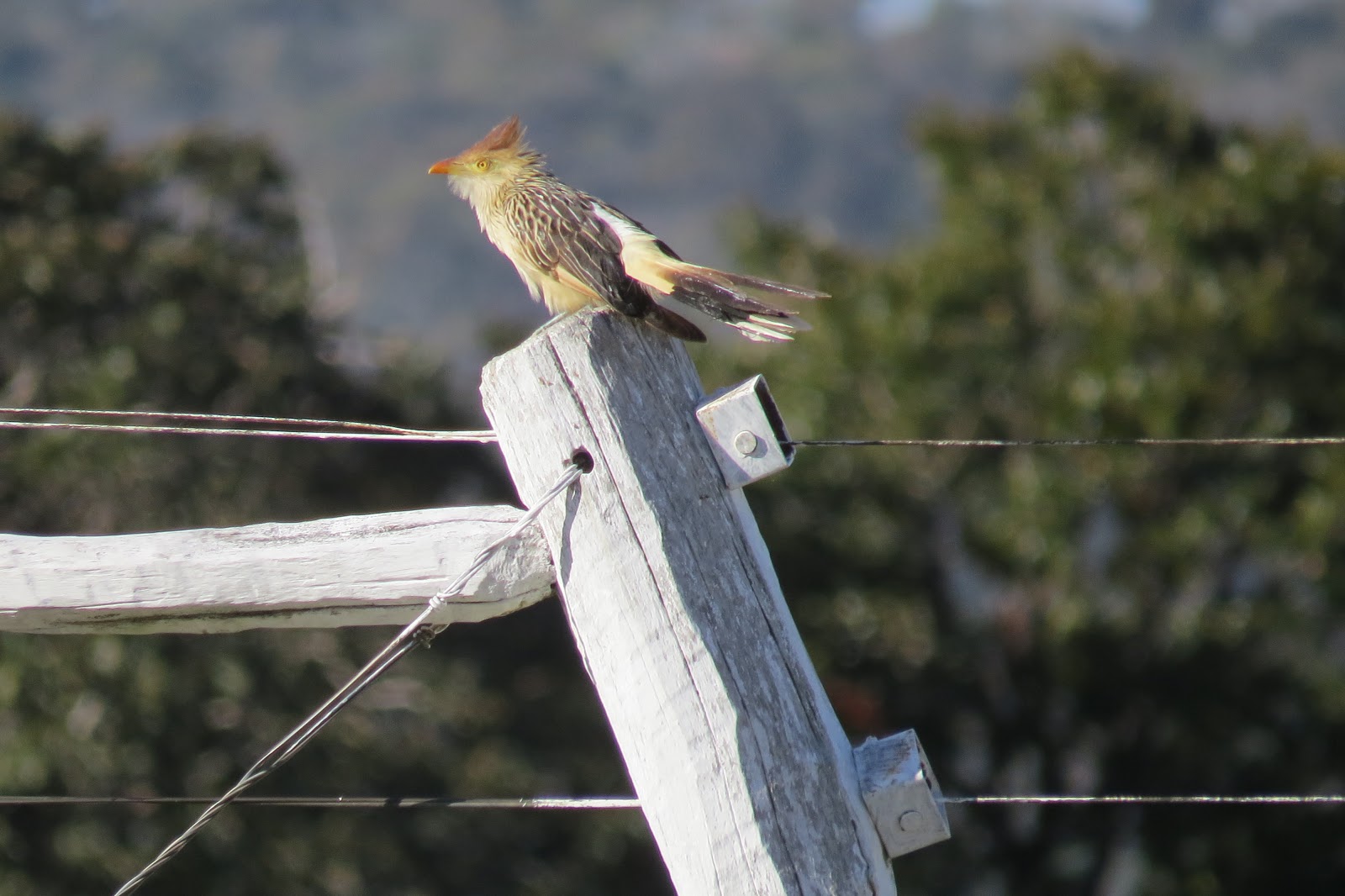
A guira cuckoo.

This guy looks like a regular roadside hawk to me.

The grasslands yielded huge biodiversity to my temperate eyes, but I was sad to learn that this land was 95% forest when Luiz's family bought it 30 years ago. Luiz told me proudly how his family had cleared the trees and replaced them with African grass to pasture cattle. They plan to reduce the forest cover to 20%, the amount mandated by federal law to remain forested as a reserve.

Notice the rows of blackened branches in the background. This sandy land was recently cleared in a version of slash-and-burn agriculture. Now, it is vulnerable to erosion before the African grass seeds take hold.

Luiz told me his family is aggressively transitioning the land from forest to pasture because they need to qualify for "production" status. Otherwise, their land is at risk for federal take-over under a controversial (and generally dysfunctional) agrarian reform program. The Brazilian government can seize large blocks of private, non-"production" land and redistribute them in 10-hectare parcels to landless citizens who camp out along the roads in wood-and-cardboard shacks.

While it seems obvious that Brazil needs to redistribute its wealth more evenly among the population, this land reform program is full of holes. For one, the landless recipients generally cannot sustain themselves by gardening 10 hectares of dry pasture, nor do they have farming skills; they sell the land as soon as they get the deed for a small sum. Furthermore, the law is apparently accelerating deforestation in the Cerrado and Pantanal, directly conflicting with environmental regulations that limit such activities.

Sausages, a small but strong cow-dog.

In the afternoon, we rode nameless horses around a yard. The cattlemen live in houses on the property with their families.

I could not identify this bird. A tanager? Help?

Picking oranges with Dora. They are verde mais doce, green but sweet.

Dad's Daily Bug


A cave cricket.

Mom's Daily Bird


A rhea, or ema in Portuguese. I appreciate the equally-tall cow in the background for scale.
Share:

My First Day on the Watson! Takeoff to Brazil

Come with me in a journey of pictures through the first day of the rest of my year.

After 13 months of planning, applying, interviewing, e-mailing conservationists, Skyping scientists from across the globe, an April Fool's engagement, equipment purchasing, budgeting, airline ticketing, goodbyes, and so much more... it begins.

Here I am at 6:40 am on my porch in Seattle. I'm steeling myself for 30 straight hours of transit. Oh boy.

I bought my first back-packing backpack (what a phrase) this summer from my personal Northface employee, Collin, and it's working perfectly so far. The airlines require bags to be less than 44 punds and mine weighed in at 35. Huzzah!

Here I am looking out over the airplane's wing at massive wetlands as we descend over Fort Lauderdale. I will admit, I was amazed and confused to see such vast wetlands, since I mistakenly thought Fort Lauderdale was in Texas. Turns out, it's in Florida and those are the Everglades. Mystery solved.

After a seven-hour flight to For Lauderdale (Florida!) and a eight-hour red-eye to Campinas (near Sao Paulo, Brazil), I walked into sunrise in the southern hemisphere. This photo taken in the Campinas airport.

Now for the third and final flight, a one-hour hop from Campinas to Campo Grande. Here is a view of the agricultural land outside Sao Paulo.

My cows! (Anyone?) These white zebu cattle are easy to spot from the air and along roads. They are a staple of the Brazilian countryside and one of my research subjects.

Here is the airplane-window view as I got closer to Pantanal. The straight lines of deforestation to create cattle pastures were a worrisome omen.

Here is Campo Grande right before I landed. It's the largest city near Pantanal. With nearly 800,000 people, it's the only big city in the state of Mato Grosso do Sul.

Smoke in Campo Grande. In the rural areas, this might be from a brush-burning fire after cutting down a forest to make pasture, but in this case I'm guessing it might have been from burning garbage... or a really hoppin' barbeque.

I made it Campo Grande! I could barely believe it! Until this massive sign helped reality sink in.

My incredible, brilliant, welcoming host Duca picked me up from the airport with a friend. We headed to the mechanic to pick up Duca's well-loved truck. From there, we stopped in to hand off papers to my other contact here, a wonderful peccary biologist named Alexine.

Embarrassing story time. When I first e-mailed Alexine, totally out of the blue, I addressed the message, "Dear Rua Spipe Calarge," the full name listed on the Wildlife Conservation Society website. (I can never be sure which name is first or last in other languages.) Alexine replied, "Hi, my name is Alexine Keuroghlian! The name you used is my street name." I was baffled. Is a street name like a gang name, or a very personal nickname? Why would it be listed on the WCS site? Why didn't it have any resemblance to her real name? Well, the mystery was solved today when I drove up to Alexine's house and read the street sign: Rua Spipe Calarge. Rua means street in Portuguese. It was literally her street's name. Cool.

Finally, we hit the grocery store. Here is the best-stocked portion of any Brazilian supermarket: the beef counter. We ordered ground beef and watched the butcher grind it before our eyes.

Next to the butcher was a hefty selection of barbeque implements.

On the street, a sapling truck!

Here's Duca posing with prato feito, a predetermined lunch dish that changes each day. It's common fare at local restaurants. We ordered peixe, fish, and it came with white rice, brown beans, undressed cabbage (bottles of oil and vinegar are standard condiments on the table), and a tiny portion of spaghetti with meat sauce. Like everything, it also came with farofa, a dry cassava flour resembling bread crumbs (I like to call it pó de pão, literally "bread powder," for its poetic value, but nobody knows what I'm talking about).


We arrived at my home for the next two months, Quinta do Sol! The sign is a little outdated because the Wildlife Conservation Society has terminated their Pantanal involvement, but the Projecto Queixada (Peccary Program) will continue under local advocates like Duca and Alexine.

Here is my house, all to myself. The 40 buff-necked ibis who sleep in a single tree in the yard provide a rowdy alarm clock around 5:00 am.

Here's our outdoor kitchen, where an open fire often cooks meat and smells heavenly.

Here's our water system. Duca fills 1.5-liter bottles at the chlorinated well in Taboco and brings them back to the house.

Here's the indoor kitchen, modeled by Duca and the friendliest of her four dogs, Ven Ven. This dog is always in the way, seeking attention, so it's ironic that his name means "Come Come." Duca is often saying, "Sai Ven Ven!" meaning "Get out, Come Come!" That's Quinta do Sol humor.

Right before sunset (which comes as early as 5 pm) we explored a beautiful river running through Quinta do Sol property.
  
Here is my shower for the next two months! The other fantastic woman who lives and works at Quinta do Sol is Lygia, next to me in the waterfall. She showed me the best places to sit and wash away "all the bad energy."

Yes, this is perfect.

"Let's come to the waterfall every day!" (Not hard to do, since it's a four-minute walk down the sandy road.)

Or if you prefer a bath to a shower . . .

This treefrog hopped through the river and played absolutely dead when I picked her up. I couldn't get her to move even when I put her down on the rock. I'd been very gentle, but I worried that I'd somehow killed her. She was convincing! But Duca says this kind of frog plays dead for several minutes, and she would hop away soon.
  
This ant was as big as half a finger, and it threatened us with open mandibles. I think I heard a tiny squeaking admonition, "Don't you dare walk barefoot!"

I will conclude with a daily ritual, as requested by my parents:

Dad's Daily Bug


This may not look like much, but the green smudge is an aquatic moth's cocoon. Yes, an aquatic moth, at least in the larval stage. The cocoon, plastered to bedrock under a cold, fast-flowing stream, is colonized by bright green algae that both protects and feeds the growing larvae. HOW COOL IS THAT.

Mom's Daily Bird


This buff-necked ibis was the first to land in our tree tonight. Forty friends soon followed. I can see why Apple didn't include "ibis call" as one of the iPhone alarm choices . . . It is not Mother Nature's most soothing invention.
Share:

What's a Watson? My Plans for the Year to Come

What's a Watson, you ask? Great question. Actually called the Thomas J. Watson Fellowship in honor of IBM's founder, it's an amazing program that funds 40 just-graduated-from-college students to travel the world for precisely 12 months and follow their passions. I am extremely lucky to be one of those  students, along with my fellow Whittie Sam Perkins. If you want more deets, check out these articles from the Whitman Newsroom and our student paper, the Whitman Wire.

My project, as described on the Watson website, is titled, "One Health: The Human Impacts of Emerging Wildlife Diseases." Here's my official project description:

During my Watson year, I will explore five manifestations of ecosystem disease. In Brazil, leptospirosis is spreading from endangered peccaries to cattle. In Madagascar, deforestation is ushering people into contact with rodent vectors and lemur viruses. Coral bleaching is impacting commercial fisheries in Indonesia and dive tourism in Malaysia. And in the remote north of Russia, thawing reindeer carcasses are bringing once-eradicated anthrax back from the dead. In each country, I will begin by investigating the biology of the disease itself – its pathogen, host, and habitat – by spending several weeks in the field with ecologists and the local community. My guiding questions ask: How are you and your community affected by this disease? What related cultural practices or stories exist? What is the root problem? What actions are being taken to mitigate the impacts? By synthesizing my experiences with ecologists and community members, I hope to gather local solutions for the global threat of emerging wildlife disease, and their impact on biodiversity and human health.


This map from the Watson website shows my destiations: Brazil, Madagascar, Indonesia, Malaysia, and Russia (or another Arctic nation.)

Here's a more detailed overview:

August to September: Taboco, Brazil. A small town in the Cerrado (dry grass and shrubland) adjacent to the Pantanal (the largest wetland in the world). I'll be working with a biologists from a local environmental nonprofit, Instituto Ambiental Quinto do Sol, to study two diseases. The first is leptospirosis, contagious between endangered white-lipped peccary and abundant domestic cattle. The second is canine distemper, an illness of pet dogs and cats that has the potential to infect wild felids (read: jaguars, pumas, and ocelots.) I may work alongside scientists from Wildlife Conservation Society and World Wildlife Fund, as well.

October to December: Ranomafana, Madagascar. A popular national park with tourists and the home of endangered, endemic lemurs. I'll be working from an international research station, Centre ValBio, to assist in a mouse-lemur-trapping project. We're trying to find out exactly how deforestation effects the possibility of spillover, the situation when a pathogen switches hosts to a human being from another animal species.

January to February: Bali, Indonesia. I will be helping monitor coral bleaching, a global crisis in which heat-stressed corals evict their algal symbionts, become weakened by hunger, and often die due to a secondary infection of Vibrio bacteria. I hope to converse with local dive-tourism guides and fisherpeople to understand how communities have adapted to this cyclic bleaching in the past, and what's changing now that the cycles are happening more frequently.

March to May: Borneo, Malaysia. I hope to make connections between rainforest conservation with access to human health care. Other projects of interest include ice-ice seaweed disease and a comparison to the canine distemper of Brazil.

June to July: The Arctic. Russia? Canada? Finland? I have many options and nothing set in stone (or ice). But I want to explore the melting permafrost and see how climate change interacts with pathogens and hosts, both wildlife and human, to impact indigenous subsistence.

One of my seemingly-infinite preparations was to buy an underwater camera. I found a used GoPro Hero 2 on Craig's List (what a deal) and tried to figure out how the jumble of plastic pieces fit together.

Of course, I had to try the thing out, too. Here I am snorkeling through the reeds of Lake Calhoun, an urban picnic spot in Minneapolis. There's a nearby swimming area, but I didn't notice any other snorkels. I may have attracted a few stares.

The Watson begins... tomorrow! I plan to blog as often as I can, hopefully every day. If you want to follow along, just type your e-mail in the Subscribe box to get notified when I post something new. And don't be afraid to leave comments. I'd love to hear your thoughts, requests, questions, or suggestions as I head into the year.

An enormous thanks to everyone who's been there for me along the way. I hope this blog will repay some of your support in vicarious adventure.
Share:

Why Two Whitman Seniors Returned to 9th Grade

It was spring of my senior year in college, and there was just one more class I needed to take before I graduated: 9th-grade biology.

Every Tuesday, my fellow nature-nerd Eva and I volunteered in a Wa-Hi classroom. You can watch our interview with the Walla Walla Public School District here, and read below for the whole story.


When you live in Walla Walla, the name "Wa-Hi" rolls off the tongue. It's short for Walla Walla High School, one of two (along with Lincoln High) in the Walla Walla Public School District. That's about all I knew until January, when I got to Whitman for my senior spring.

During my three years at Whitman, I'd been wanting to get more involved in community service, but there never seemed to be time. I volunteered in small ways: I brought Whitman's crested gecko and rock python to bilingual elementary-school classrooms and did yard work for the elderly on Martin Luther King, Jr. day. Then I got an e-mail from our Science Outreach Coordinator asking for volunteers in a Wa-Hi 9th-grade biology classroom. I signed up for one hour a week on Tuesdays. My friend Eva signed up for the same time so we could carpool and work together.

The Wa-Hi campus.
Photo credit: Breanna Baltrusch.

When we got to Wa-Hi, I was amazed to see a barn full of sheep. In high school, I would have given anything for the chance to attend a rural school with an Future Farmers of America (FFA) program. And here I was, living ten minutes from an FFA school! I wish I'd gotten involved on my first day in Walla Walla, maybe volunteering with the FFA kids or a local 4-H club.

The campus is spread out between green, grassy commons and bisected by a restored section of Yellowhawk Creek. Eva and I signed in at the main office and walked through a maze of outdoor hallways to find Ms. Burt's classroom.

The Wa-Hi hallways are outdoors.
Photo credit: The Whitman Wire.

Mary Burt is one of those teachers students feel lucky to have. Even though these 9th graders were not always thrilled to spend their 7th period learning about cells and forest ecology, they were always happy to see Ms. Burt. She has a sense of humor that keeps her classroom's attention through laughter instead of discipline.

Here I am in the classroom with Eva, my volunteer partner, and Ms. Burt, the 9th-grade biology teacher.

I loved working with Wa-Hi students. I would have liked to invest more than one hour a week, but even so, I got to know the students' names and personalities. That's the great thing about high schoolers -- they'll tell you exactly what they're thinking. When a student would tell me, "No, I'm not going to do the work; this is boring and I hate it," I took her at her word. I remember feeling trapped by worksheets and standardized curriculum.

I tried to make every interaction about the student first, asking how he was doing and building a human-to-human relationship instead of just a teacher-to-student one. Second, I tried to bring in curiosity.

"Science is not about memorizing things, it's about asking questions," I told one student. "So if you don't know the answers about cells, why don't you write a list of questions?" Then, we'd pick which question sparked the most curiosity, and I'd help the student pursue the answer to that question instead of the ones on the worksheet.

Some students were motivated by drawing, so I encouraged them to draw their work. Others were distracted by YouTube during class, so we found relevant videos as inspirations for project topics. One student was making a scene by drinking a Dr. Pepper instead of working, so I asked him to explain the day's concept, diffusion, in terms of soda. His improvised explanation was so good, I used it with other students for the rest of the class.

The barriers to success in this classroom were high. It was the last period of the day; the honors and Advanced Placement students had been separated into other classrooms; and I imagine Ms. Burt would have loved to have a full-time assistant rather than a couple of volunteers a week. There were simply not enough resources to allow for the creative, engaging education these students deserve.

This semester, I was a teaching assistant for a Whitman course, Plant Identification Laboratory. Spending Tuesdays at Wa-Hi and Thursdays in a Whitman lab, I was amazed and disappointed by the enormous gap between the two classrooms.

Picture Wa-Hi: the desks were mismatched and graffitied. They barely fit inside the small classroom. There are no paid assistants, only once-a-week volunteers. The students were responsible for stacking the chairs each Tuesday so the custodian could mop, and Ms. Burt was responsible for keeping the blackboard clean. There are about 1700 students, and the student-faculty ratio is 19:1.

Now picture Whitman: the students are spread out across five rows of pristine laboratory benches, with extra space in the back for projects. The microscopes and stools are upgraded regularly. There are two paid teaching assistants (me and my friend Lia). We can leave the blackboard messy with chalk because the custodian will take care of it. There are about 1500 students, and the student-faculty ratio is 8:1.

I made up a name for this divide: the Classroom Privilege Gap. Obviously, a private college and a public high school are not parallel institutions, but this gap also exists among high schools, rural or urban, private or public, north-end or south-end. Working in these two classrooms each week was a reminder of how unfair and damaging this gap is.

Behold the Whitman classroom, replete with 45 microscopes and carefully arranged plant samples.

The weekly lab is planned by our professor, Heidi (right), set up by two paid teaching assistants (Lia and me), and supported by the biology department staff. Compare that to Ms. Burt's five-days-a-week Wa-Hi biology class, run entirely by Ms. Burt and a couple volunteers.

Teachers like Ms. Burt need more support, and students like the Wa-Hi 9th-graders deserve better school infrastructure. There's no easy solution, but adequately funding public schools is a place to start. Only 2-3% of the federal budget goes to education, and the Trump administration's budget called for a $9.2 billion (or 13.5% cut) to education spending. We can do better.

Edit: My friend and relentless activist for justice, Annie Want, just sent me this NPR article about why funding in public schools is so unequal across America. Did you know that school funding depends on local property taxes? And that in 1973, the Supreme Court decided in a 5-4 decision that the U.S. Constitution guarantees no right to equal funding for education? And that by doing so, the Court negated the intention of the famous Brown v. Board of Education decision to provide equal and integrated public education to all children, regardless of race or economic means? If any of this is news to you, as it was to me, read that article! Seriously.

As Chief Justice Earl Warren wrote in Brown v. Board of Education:

"It is doubtful that any child may reasonably be expected to succeed in life if he is denied the opportunity of an education. Such an opportunity, where the state has undertaken to provide it, is a right which must be made available to all on equal terms."

Finally, I'll leave you with this sign I read every Tuesday in the Wa-Hi office:

I love this sign. It doesn't require you to believe that you are special or perfect or amazingly talented; it just reminds you to do what you can with what you have.

What can you do? Call your representatives. Volunteer in public schools. Vote for administrations and taxes that support education. If you have more ideas about getting involved, leave them in the comments. I'd love to hear from you.
Share:

"I Dive Like a Girl, Try To Keep Up!" Celebrating Women's Dive Day in the Eelgrass of Puget Sound

Did you know that today, July 15th, 2017, is the third annual PADI Women's Dive Day?

Only about a third of certified scuba divers are women. Today I joined a welcoming and adventurous group of female divers from Seattle Scuba Schools to dive the Junkpile, a smattering of sunken debris off Alki Beach in West Seattle.

I came to the event alone, so I was paired with Hannah as my dive buddy. Diving is a great way to make friends, even though there's not much chance for conversation underwater...

These photos are to show my underwater-photography learning curve. I figured out how to take stills from a GoPro video, yay!

And so you can admire the beauty of neoprene-hood cheeks, of course.

It was my first chance to use my new GoPro, a Hero 2 I bought on Craig's List. Here's a short video of our dive through the eelgrass bed. (Sorry, no critter close-ups. My battery died before I found the sea stars.)


I adore diving in Puget Sound, even though the cold water requires bulky gear (a two-piece, 14 mm wetsuit plus boots, gloves and hood), and the green algae limits visibility to ten feet. What I love is getting to know this underwater ecosystem right next to my home, the city of Seattle.

We saw lots of flounder, a ratfish, a Dungeness crab, a striped sea jelly, and the siphon of an enormous clam. Best of all, we saw sea stars! A Leather Star, two Sunflower Stars, a Giant Pink Star (think Patrick from Spongebob), a Sunstar, and an orange star that could have been Ochre or Mottled.

This icing really took the cake.

After the dive, we were treated to a delicious summer barbecue hosted by Cathy from Seattle Scuba Schools. Now I have to go put away all my gear that's drying in the sun!

Happy, salty, hungry divers.

Share:

Popular Posts

Labels