Health Education, Health Articles, Health Blog

The Sonoran Four: Agave, Yucca, Sotol, Beargrass

If you look out the window as you drive past Tucson, Arizona, you'll probably notice spiky plants bursting from the ground.

"Duh, they're cacti," you may be thinking.

But wait! Aside from the cacti, there are dozens of rosette-forming species that put up tall flower stalks called inflorescences. Most of these knife-sharp pompoms belong to one of four genera that I call the Sonoran Four:

1. Agave (genus Agave)
2. Yucca (genus Yucca)
3. Sotol (genus Dasylirion)
4. Beargrass (genus Nolina)

Let's take a closer look. See if you can tell the difference!

Agave


Agave, a genus native only to the New World, is easily confused with Aloe, a genus native only to the Old World (mostly Africa). The two genera belong to different families and appear similar due to convergent evolution.

Agave from the top down.

Agave have thick, succulent leaves with serrated edges. Each leaf ends in a sharp, pointed tip.

Jane points out a dead agave inflorescence.

These plants flower only once in a lifetime before dying. They spread predominantly by underground roots that put up new shoots. The flower stalk looks like multilayered tree, and the flowers are usually yellow.

Galen uses a desiccated agave as a weapon.

This notorious species, Agave schottii, is known as "shindagger" because it draws blood on contact.

Yucca


Yucca leaves are thinner and straighter, without the succulent base of agave leaves. Instead of serrated points, they are often edged with wispy, white hairs.

This yucca species grows a trunk and beard with time.

Unlike agave, most yucca can bloom more than once before they die. Their flowers are white and bell-shaped. Some famous yucca species grow trunks, like the Joshua tree (Yucca brevifolia) and the soaptree yucca (Yucca elata).

The roots of soaptree yucca, Yucca elata, are used to make soap.

Sotol


Sotol, also known as "desert spoon" because of the concave bases of its leaves, goes by the Latin name Dasylirion wheeleri. Its leaves are edged with tiny, upward-pointing serrations. Its inflorescence consists of thousands of small, white flowers in a dense, vertical plume.

Jane shows off the height of an impressive sotol inflorescence.

Beargrass


Beargrass includes several species in the genus Nolina. It is not a grass, but a member of the Asparagus family.

It looks like a clump of soft grass at a distance, but beargrass will leave you with worse than a grass-cut.

The leaves are narrower and floppier than those of Agave, Yucca, or Sotol, but they are just as deadly to bare skin. These leaves are edged with nearly-microscopic serrations.

The narrow, microscopically-serrated leaves of beargrass.

The beargrass inflorescence consists of spindly, upward-growing branches coated in creamy, white flowers.

I tended to find Yucca and Agave at lower elevations, while Sotol and Beargrass became more common as I climbed higher. Keep paying attention, and your Sonoran Four identification skills will get better and better. You know you've made it when you can lean out the car window and identify rosettes at 40 miles per hour. But don't forget to get up close and personal with these spiny friends, too. The details hold many surprises. 

On this agave, the serrated edges are mirrored in a pattern on the leaf itself.
Share:

An Imagination (short story)

Here's something a little different: a fiction story! I wrote this during our Semester in the West writing workshop with author Ann Walka. She instructed us to write a story based on the place we were in, Comb Ridge, a magnificent geological formation near Bluff, Utah.

Sadly, the property was sold on October 17, 2016 from the State of Utah to a private corporation, Lyman Farms, and it will no longer be accessible to wanderers and writers looking for inspiration. More on that transaction here.

While you consider the privatization of public lands, please enjoy this simple story.

An Imagination

They walked to the top of the slick-rock hump. The dorsal fin of a stone whale, they called it.

“Do you remember when we pretended to ride the whale and held our breath?” she asked.

She loved his imagination. No matter where they went, he found magic lurking just beneath the sandstone, between the points of yucca leaves, hovering over one-seed junipers. His mind spun worlds.

The top of the whale-fin rock wasn’t really the top; it just looked that way from the bottom. The first time they had climbed there together, she has been devastated to find that their sweaty hike had yielded nothing but a taller peak in the distance. She was out of breath and thirsty. She has always assumed the top of things was objective.

But he’d taken her hand and called with full lungs, “We’re here!” And he’d been right. One step further in any direction, he’d claimed, would take them down. Even that peak in the distance was below. All it took to be on top was a choice of perspective.


She liked to come here still, to the top. On the whale’s flank, a rain-worn swath of stone, she spread her picnic blanket. Green cotton splashed with ruby bird feathers. Worn too thin to do much but mark a square for them on the sun-soaked ridge. She lifted pasta from her wicker basket, the kind with a flap on either side and a hinge in the middle. Two plums wrapped in paper. Biscuits, warm in the center. A stick of butter. A jar of prickly-pear jam they’d made three years ago from the last cacti he’d tended in the garden.


A spotted lizard watched from the shade of a single-leaf ash as she divided the food onto two plates. She ate her portion of pasta plain. She buttered both biscuits and chewed one as yellow fat dripped from the incision she’d made through the heart of the other. The plum, she consumed in three bites: top, side, then all the rest, just like always. It tasted like his lips. She spit the pit under the ash, and the lizard retreated deeper into its cool foliage.


“Happy anniversary, my love,” she said to the plate still piled with food.

It was then that she noticed. Once again, she’d forgotten to open the jam.
Share:

Reptiles and Amphibians of the Intermountain West

Hello from Comb Ridge, Utah. I'm travelling through the Intermountain West -- the arid lands of America between the Cascades and the Rockies -- on a Whitman College program called Semester in the West. There are oodles of things to write about, but let's begin with the reptiles I've seen along the way.

Ornate box turtle, Terrapene ornate.

We found this individual dead on the Pine Ridge Reservation in South Dakota.

Long-nosed leopard lizard, Gambelia wislizenii. We found her in a private yard full of native plantings in Castle Valley, Utah.

Note the long-nosed leopard lizard's orange spots and long, striped tail.

I think this guy is an eastern fence lizard, Sceloporus undulatus. However, he does not have a blue belly or throat (which may or may not be present, according to the field guide.) We found him at Sand Island, Utah among ancient rock art.

Another view of the supposed eastern fence lizard. Note the blue armpit.

This eastern fence lizard had a striking black and blue line down its side. We found him in Comb Ridge, Utah.

I don't know who this is. Could be a small eastern fence lizard, or perhaps a tree lizard, Urosaurus ornatus?

I found this side-blotched lizard, Uta stansburiana, soaking up my body heat under my sleeping bag on Comb Ridge, Utah!

Evan and the side-blotched lizard communed after breakfast.

Aren't those turquoise spots and long nails glamorous?

One of three northern Pacific rattlesnakes (Crotalus oreganus) found lurking around our campsite in the Methow Valley of Washington State. He chilled out in this empty cooler until we transported him to a better spot. Would have been an unpleasant surprise for anyone hoping for a cold drink...
Photo credit: Thomas Meinzen

Wildlife wrangler extraordinaire Kent deftly placed our venomous friend in an unoccupied cooler.
Photo credit: Thomas Meinzen

This garter snake (perhaps a wandering garter, Thamnophis elegans vagrans) was hiding under a plastic bin on the garlic farm made famous by Stanley Crawford's The Garlic Testament, near Dixon, New Mexico.

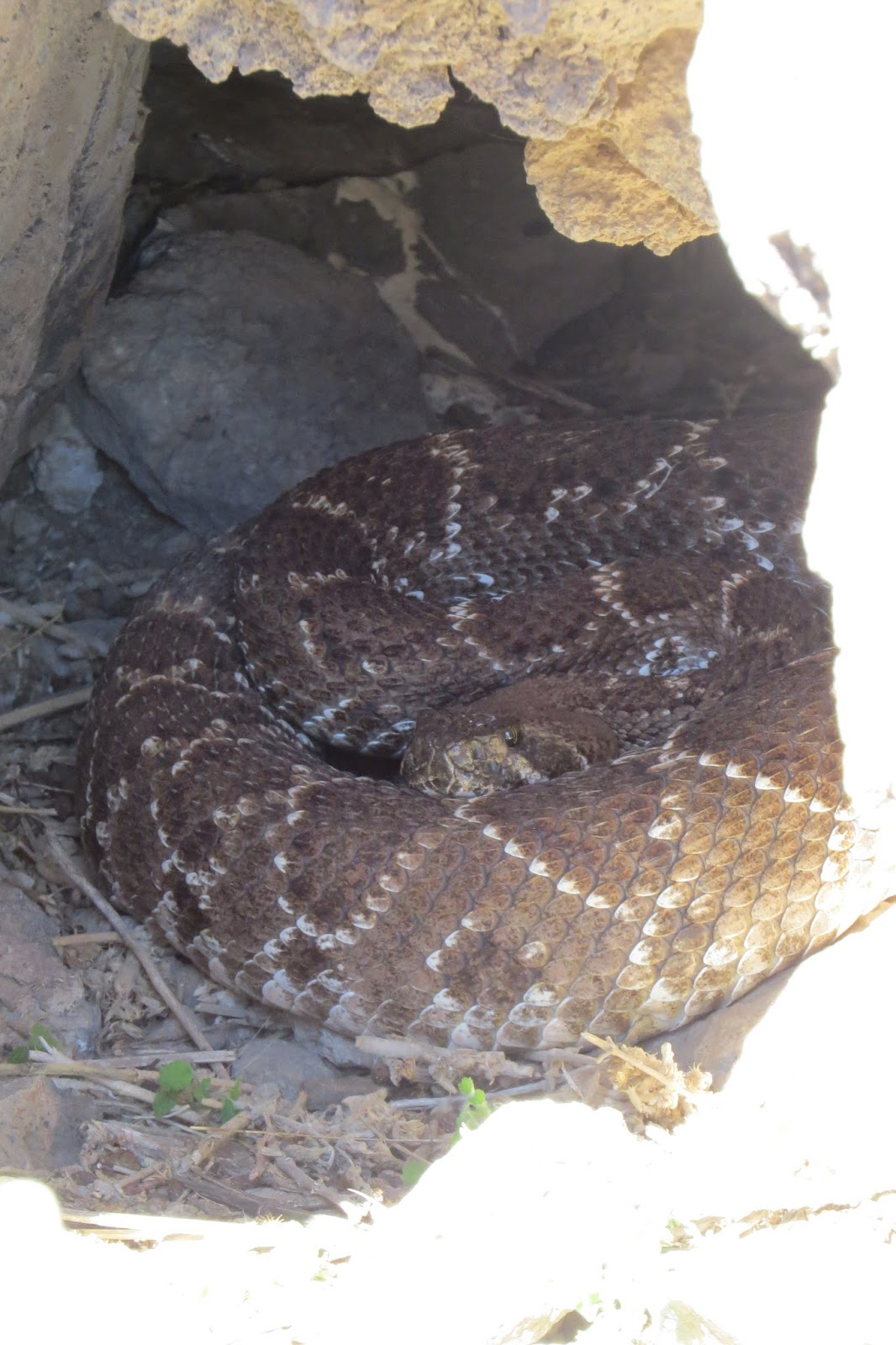
A 3-inch diameter rattlesnake (Crotalus sp.) near Santa Fe, New Mexico. The largest I've ever seen! She rattled at us from her crevice.

Our resident snake-o-phobe and serpent-detector, Fields, found a Chihuahuan night snake (Hypsiglena jani) coiled in a perfect S in the path to his tent. It was cool and docile! EDIT: I previously mis-identified this snake as a baby gopher snake and was corrected by a helpful, anonymous commenter. Thanks to Anonymous and iNaturalist for helping me get to the correct identification. This snake was found near Cieneguilla Recreation Area just outside Santa Fe, New Mexico.

The Chihuahuan night snake made a lot of friends, especially Thomas.

Sarah has a future career as a snake hand-model.

A snakeskin found by Amanda on Black Mountain in the Chihuahuan Desert of New Mexico as we surveyed for endangered night-blooming cereus cactus. It had a face with eye-lenses still intact!

A Texas horned lizard (Phrynosoma cornutum) skittered across our path near Black Mountain, New Mexico. They are what ecologist Paul Arbetan calls "a fermenting vat with legs," because they use their round bellies to digest ants.

A greater earless lizard (Cophosaurus texanus) posed in plank position at our campsite outside Big Bend National Park in Texas. Notice that pastel, rainbow belly!

An American bullfrog (Lithobates catesbeianus) made an appearance at Bosque del Apache National Wildlife Refuge in New Mexico. They are invasive throughout the West Coast and Southwest.

Tiny red-spotted toads (Anaxyrus punctatus) hopped on the mud banks of the Rio Grande.

Couch's spadefoot toad (Scaphiopus couchii) found hopping among our sleeping bags during a light rain on Adams Ranch on the Rio Grande, about an hour from Big Bend National Park.


We have also seen a plateau whiptail, Aspidoscelis velox, in Castle Valley, Utah and a short-horned lizard, Phrynosoma hernandesi, on the Navajo Nation in northern Arizona.

Our Navajo host, Adrian, taught us that the short-horned lizard is called che in Navajo. It is believed to have fought with a dark storm cloud and won because its thorny armor can deflect lightning. We learned how to bless the lizard with a sprinkle of water, and we would have added corn pollen if we'd had it. Then Adrian placed the lizard over his heart and feet to bless himself before returning it gently to its sagebrush home. To learn more about Navajo reptiles, have a look at Diné Traditional Teachings on Wildlife.

For my future reference, here are all the lizard species I have seen on this trip:
  1. Side-blotched lizard, Uta stansburiana
  2. Eastern fence lizard (northern plateau lizard), Sceloporus undulatus
  3. Plateau whiptail, Aspidoscelis velox
  4. Short-horned lizard, Phrynosoma hernandesi
  5. Long-nosed leopard lizard, Gambelia wislizenii
  6. Short-horned lizard, Phrynosoma hernandesi
  7. Texas horned lizard, Phrynosoma cornutum
  8. Greater earless lizard, Choposaurus texanus

Thanks to Southwest Guide Books and Utah Herps for the information I used to identify these reptiles. Please contact me if you notice any errors, and stay tuned for more posts from the West!
Share:

A Wild Volvox

Seldom does a day pass when I fail to learn something new from the guests on my tour. Today, a pair of freshwater ecologists from Chicago taught me about the life of Lost and Found Lake.

A dragonfly's-eye view of Lost and Found Lake.

Our dragonflies live four to five years as nymphs, chomping on mosquito larvae and overwintering in lake-bottom muck. They molt from nine to twelve times before finally emerging as royal-blue, winged adults. They fly for one summer before dying in the frosts of fall.

Damselflies go through a similar process but spend only two to three years as nymphs, a stage in which they have three tails and long, wriggly body. We found dragonfly and damselfly nymphs when I scooped lake water into my frisbee. (Just one more reason why you should never leave home without one!)

But the most incredible discovery of all came from the ecologists' daughter who scooped a firm, transparent goo blob from the lake. I'm used to unidentified blobs in the intertidal zone, but in freshwater I was out of my element.

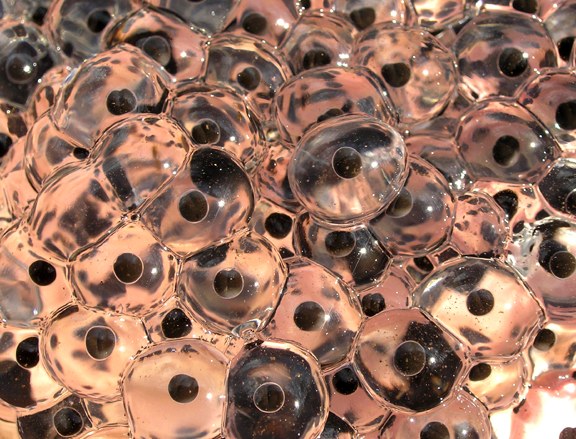
Frog eggs? Nope, we have only one amphibian in Alaska (the wood frog, Lithobates sylvaticus) and its eggs look more like clear grapes with a black dot in the middle.

Snail eggs? Perhaps, though I've never seen a snail in this lake.

Then I looked closer. Thousands of tiny green dots were aligned within the blob, perfectly ordered like soldiers on the march. At the edges of the blob, where upper and lower surfaces overlapped, the dots gave a mossy sheen to the blob.

Could it be... Volvox? The spherical, chlorophytic protist from introductory bio lab?

The ecologists and I leaned in. "Look, it has five gas bubbles trapped inside!" one exclaimed. "I think it's respiring!" Oxygen building up inside was the final clue, and the blob was proclaimed to be Volvox.

A wild Volvox!

I sacrificed my water bottle for our new friend's transport. Back at the field station, we peered through a microscope to see the tiny green dots up close. They didn't look round, but rather like commas, and they jiggled like worms trapped in a force field.


Volvox is an important tool for biology education because it displays both sexual and asexual reproduction. Asexual reproduction is cooler: miniature, spherical daughter colonies form within the parent blob and are released into the world.

Scientists think Volvox switched from a single-celled organism to a communal enterprise about 200 million years ago, and research into that transition is providing clues about how the evolution of cooperation allowed our single-celled ancestors to become the plants and animals of modern times.

It always startles me to see laboratory species in the wild. The same thing happened with slime mold. In high school, I made mazes for slime mold using oats and Petri dishes, then filmed its decision-making with a time-lapse camera. Slime mold was recently featured in Nature for redefining intelligence! Now, on my daily hikes, I notice slime mold inching around the rotting logs of its home, the coastal temperate rainforest.

A banana-yellow slime mold seeks shade in the forest of Peterson Bay Field Station.

Watching slime mold and Volvox do their thing in the wild reminds me of the importance of intact ecosystems. Without old-growth rainforests and healthy lakes, scientists would never have encountered these model organisms that have led to dozens of laboratory-based discoveries and a better understanding of topics ranging from memory to cellular reproduction to our own evolution. 

Imagine how many more organisms are out there in unexplored regions of the Amazon, the Arctic, or the deep sea. Who knows what strange life form is going about its daily business of eating, competing, and reproducing, just waiting to be discovered next?
Share:

The Dismemberment of an Eight-Legged Giant

Our Alaskan ocean, with its cold year-round temperatures and high oxygen content, is home to some of the largest creatures in the world. One enormous mollusk happens to be as intelligent as she is large, and she's all the more intriguing for her eight arms, hundreds of suction cups, and quaint hobby of collecting shiny objects: the giant Pacific octopus.

These clever invertebrates average 16 feet in length and 110 pounds, but the record-holder was measured at 30 feet and 600 pounds! They also live longer than other octopuses, but don't expect much. They last around four years, with both males and females dying shortly after breeding.

Naturalist Kim points out an octopus den at China Poot Bay.

Octopuses live in dens that are submerged at all but the lowest tides. As a bonus, they prefer dens with two holes: both front and back doors.We were lucky to find this den at low tide. When Kim tickled the entrance with her finger, a red tentacle swooped out to investigate.

When searching for octopus dens, keep your eyes out for the midden, a trash pile of helmet-crab exoskeletons and snail shells discarded by the octopus.

Live octopuses are cool and all, but this blog is about a dismemberment, so let's get to the point!

On June 4th, a dead giant Pacific octopus washed up on Otter Rock.

The limp form of a freshly-dead octopus.

When the tide went out, I descended the rocky shore to investigate.

The octopus was smothered by another of our ocean's giants: sunflower stars! I knew these monstrous, soft-bodied stars to be predators of other sea stars, but I knew nothing of their fondness for octopus meat.

My hand for scale. The tentacles was thicker around than my arm, and the sunflower star could have covered my entire face and wrapped around to the back of my head. (I had no intentions of letting it.)

The octopus was stone-dead, but her sucker still held my finger tight was I pressed on it.

This squishy sunflower star was waiting for the tide to come back in so he could move freely over his meal.

My favorite shot. I love the juxtaposition of tube feet and suction cups: the echinodermatan and molluscan solutions for the tasks of moving around and holding on. 

Here's a video of the tube feet in action!


Three days later, the octopus had disappeared from the low intertidal zone and reappeared high-and-dry upon Otter Rock. The pair of bald eagles were spotted dragging and pecking it. The octopus's carbon was redistributed first to deep waters, then to the crown of a spruce tree, and who knows where else.

Each day I asked one of my visitors to be an octopus model -- for scale and, of course, the cute factor.

June 7th: "There it is, but I'm not touching it!"

June 8th: "There it is! Can I touch it?"

On June 8th, it smelled like bacteria were joining the food chain.

The suction cups, however, were still intact.

June 12th: my octopus models were unwilling to get any closer than this. I thought they were still brave, considering the stench and general goopiness.

June 12th was the last day our dear dead octopus was seen. Whether she got dragged into the woods by a bear or deep under the sea by a seal, or was chewed into goo by microbes during the next few tide cycles, we'll never know.

In theory, I knew that elements are recycled and dead things make up the living. But after watching the swift dismemberment of an octopus into the vibrant life of the intertidal zone I admire daily, I feel included in a secret.

On June 25th, I watched one of the three bald eagle chicks flap his wings for the first time.

Now, when I spy on our bald eagle chicks through my binoculars, I think of the octopus midden. In the chicks' emerging flight feathers, I see helmet crabs that became octopus that became eagle.
Share:

Popular Posts

Labels