Health Education, Health Articles, Health Blog

Why Natural History Matters

I wrote the following essay to apply for the Arthur G. Rempel Scholarship in Natural History. Dr. Rempel was an emeritus professor of biology at Whitman College for 40 years and a founding member of the Blue Mountain Audubon Society. I’m honored to be the recipient of his scholarship, especially because the members of the Blue Mountain Audubon Society welcomed me to Walla Walla and became some of my first friends when I transferred to Whitman. (Remember the singing elk and brown skippers from the October Hawk Watch?) As always, I’d love to hear your thoughts in the comments.

-Nina

Novice and seasoned birders scan for waterfowl on a trip I lead each semester for the Outdoor Program.
Photo credit: Margo Heffron.

It’s raining on the Science Building as I type. Earlier, the sky was blanketed by a layer of stratus which thickened and darkened and then started to sputter. The first droplets hit pavement as I googled the definition of “natural history,” unaware and distracted, but now I look up and see the cloud has evolved into nimbostratus, overflowing with precipitation. Smashed raindrops streak the window like strings of pearls, and Ankeny glows the color of hydrated chlorophyll. There, a crow swoops sideways over Maxey! Where’s she headed? Will she preen the moisture off her feathers from a perch in the gingko behind Anderson or the pine next to Cordiner? Does she have a nest? I want to run outside and smell the rain.

Crows mob a red-tailed hawk at Juanita Bay.

Tom Fleischner, author of Natural History and the Spiral of Offering, defines natural history as “a practice of intentional focused attentiveness and receptivity to the more-than-human world, guided by honesty and accuracy.” These words remind me of a meeting I facilitated to discuss concerns about the future directions of an environmental club of which I was president. Leaders, members and officers all arrived with the same intention, to help our club be the best it could be, but tempers rose as our leader interrupted the members’ stories, corrected their factual errors, and spoke for more minutes than she listened. One club member stormed out; another broke down crying. After the meeting I considered what went wrong, and it all came down to listening. The same nouns that define natural history – attentiveness and receptivity, honesty and accuracy – are also the ingredients for a productive conversation. I suppose this shouldn’t come as a surprise. After all, natural history is a conversation between human and nature.

Photographing a grazing Nene at Kilauea Lighthouse, Kauai.
Photo credit: Russ Finley.


Outside, the rain has eased. The sky looks brighter to the south; I wonder if the sun is in that part of the sky. Two droplets coalesce on the pane and slither down under the guidance of gravity. The chestnut’s leaves look new and small, a lighter shade of green than I’m used to.

Margo focuses on a sparrow near Bennington Lake.

Natural history matters because it is an attempt at honest listening. Experiments, despite the insights they provide, cannot match the honesty of pure observation. A hypothesis is limited by the imagination of the researcher, and it reduces the likelihood of stumbling onto a truth we didn’t even think to suspect. Natural history is exploration without hypotheses. It requires vulnerability, because we risk discovering something we weren’t looking for, and humility, because we cannot be proven right. It challenges us to stop talking, guessing, analyzing, presenting, submitting, performing… for long enough to stand still. Watch. Listen. In doing so, we broaden our understanding of what exists.

Is it a plant or fungus on this path to Mount Rainier? Hard to tell.
Photo credit: Amelia Bishop.


Natural history often involves undirected recording of observations, and these records have proven essential to progress in biology. The sketches that filled Darwin’s journals fueled his insight into natural selection. My own photographs of blue-morph green frogs and Galápagos penguins, taken to capture moments of unexpected beauty, became useful when submitted to monitoring projects. Last year, as I investigated the tide-pools of Carkeek Beach, I stumbled upon the diseased sea stars that would become my research subjects, and a note I scribbled on my dive slate about a sea turtle’s tumor led to a presentation on fibropapillomatosis. None of these discoveries, large or small, would have been possible without venturing into the forest or under the waves with no goal but an honest and accurate perception of our surroundings.

Diving Leon Dormido off San Cristobal Island, Galapagos, Ecuador.
Photo credit: Joselo Ballesteros.

A passing green turtle, Chelonia mydas.

Conservation, like biology, depends on natural history. My descendants will inherit a world shaped by the interactions of billions of generations of archaea, bacteria, and eukaryotes who came before. One organism, Homo sapiens, exerts influence over most of those interactions. Natural history gives us the best chance of unraveling what makes nature tick and what she requires to thrive. No Petri dish microcosm experiment will tell us what the Olympic Rain Forest needs to be whole; no ecosystem services spreadsheet will calculate the value of an intact prairie.

Exploring the Hoh Rain Forest with a group of out-of-town NOAA interns.

Sam explores the Mineral Creek Falls on the Hoh River Trail.

Turn over mossy logs under the falls and you may find... a salamander!
Perhaps the endemic Olympic torrent salamander, Rhyacotriton olympicus?

But what if conservation comes up short? I’m not alone in my prediction that over the next century, species will go extinct, ecosystems will fragment, and biodiversity will plummet at the hands of my own kind. Has natural history failed?

When I’m tempted to despair over the sixth mass extinction, the natural historian in me takes a step back from judgement and desire to simply observe. Invasive species become migrants, extinctions become open niches setting the stage for the next great diversification event… the Post-Anthropocene Explosion? Each day of our lives is a conversation with nature, and we learn only when we keep quiet for long enough to listen. The most wonderful conversations never go in the direction I expect.

I was not expecting to see bison on my way home from college!
Photo credit: Janine Walker or Paige Soper.

It’s not raining any more. A hundred tiny insects of various kinds are stuck dead in a cobweb plastered to the upper left corner of the window pane. I notice a Douglas fir’s branches tipped with orange buds, and there seems to be a slight breeze through the needles. I wonder how it sounds?

A spring peeper moment.


Share:

Seven Days of Christmas on Kauai

Day One: Finding food to eat on Christmas Day.


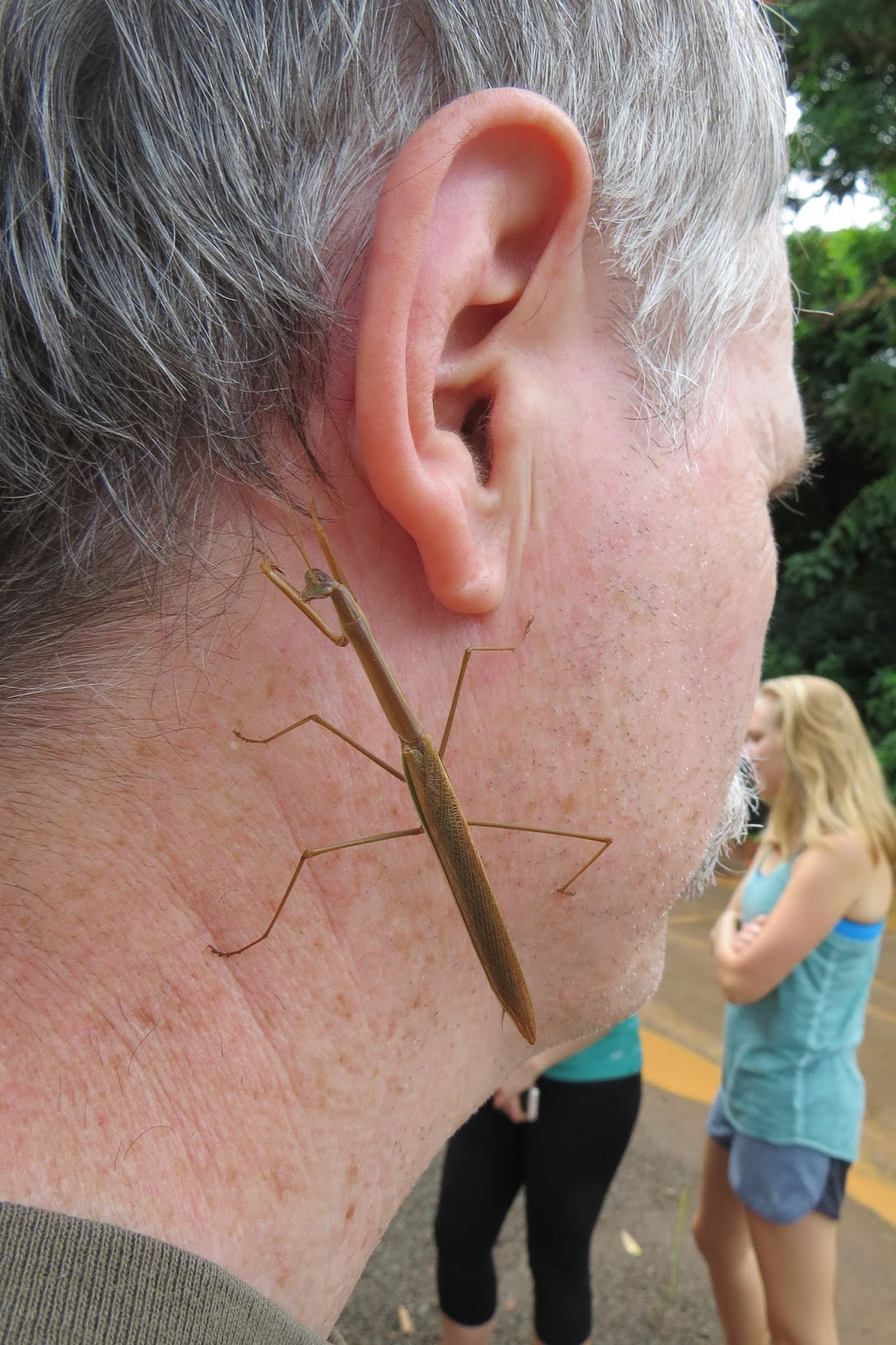
We stopped at roadside farm stands for eggs, tangerines picked off the branch for a quarter each, bags of lettuce, papayas, smoothies, grapefruits, and avocados the size of melons. The juice bar was open for business, and a friendly praying mantis wished us happy holidays. When the North Coast’s notorious deluge let up, we stopped at Kealia Beach for a picnic lunch.

Juice and smoothie bar.

The praying mantis climbed up Dad's neck, then turned to face the camera. (Who knew they had swivelly necks?!)

Kealia Beach.


Day Two: Kiluea National Wildlife Refuge and Lighthouse.


This park has a short paved trail with views of a red-footed booby colony, a flock of nenes (endemic Hawaiian geese) with the unfortunate habit of charging moving cars, soaring white-tailed tropicbirds, the occasional pair of Laysan albatross, and a great frigatebird waiting to pirate the poor boobies’ catch of fish.

Mom and nene. 

Red-footed booby.

Mom and Lisa and, behind them, Kiluea Lighthouse.

Rain clouds came in fast.

Many male house finches on Kauai have amazing orange and yellow coloration instead of red.

Grazing nene.
 
White-tailed tropicbird.

Day Three: Waimea Canyon and the Kalalau Valley.


The dry west side of Kauai is graced with a magnificent red-dirt canyon, Waimea, that rivals the desert beauty of the Southwest. Lisa and I frolicked on Mars and hiked an hour down the muddy trail to view another deep gouge in the land, Kalalau Valley, coated in ferns and culminating in a remote white-sand beach far below us. Native ohi’a-lehua trees were pollinated by endemic red ‘apapane honeycreepers.

Red dirt.

Seastars.

Alright, we'll stop making goofy faces.

Breath-taking Kalalau Valley.

Fiddlehead fern.

I'm so frond of my family.
Pun credit to Sienna ;)

Day Four: Exploring Hanalei.


“Puff the magic dragon lived by the sea, and frolicked in the autumn mist in a land called Hanalei…” If any town is populated by magic dragons, this one is it. Surf shops, hippies, vegan organic shave ice, waterfowl in estuarine ponds, ancient sea caves exposed by low sea levels, unswimmable surf, traditional taro ponds, and infamous Puka Dogs can be found here.

Taro fields in the Hanalei National Wildlife Refuge.

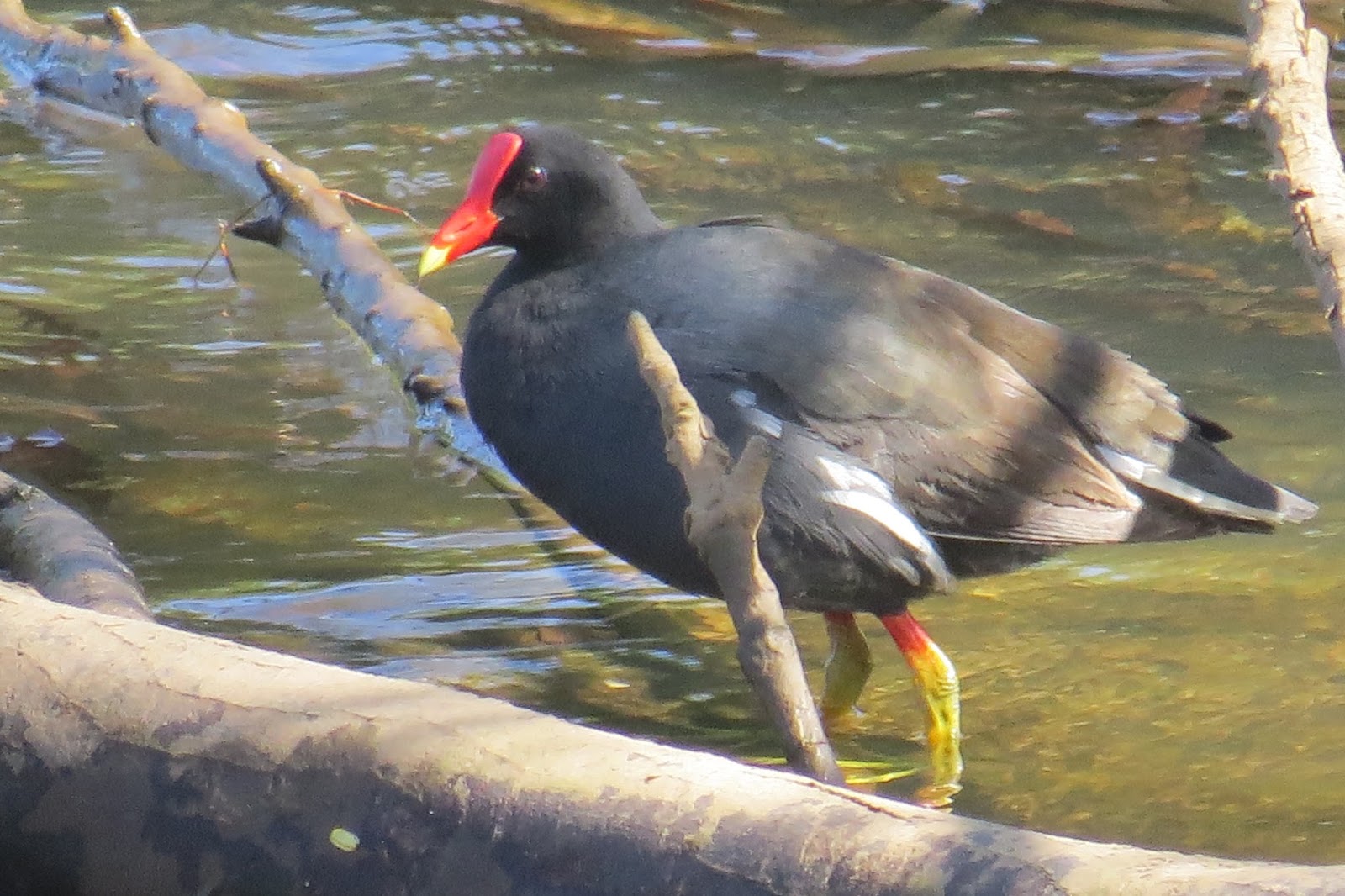
Hawaiian subspecies of common moorhen.

Endemic Hawaiian coot.

Mom and Dad and a big old cliff.

Hanalei Beach.

Koloa, the endemic Hawaiian duck.

Hawaiian race of black-necked stilt in taro.

Day Five: Hiking the Na Pali Coast.


OMG this was the best day ever. Mom, Lisa, and I scrambled along the rocky cliff-side trail for two miles to reach Hanakapi’ai beach. A hand-carved wooden sign implored us not to swim with 83 tick marks and the warning: “Unseen currents have killed 83+ here.” Then we turned inland to climb another two miles of pure mud and reach Hanakapi’ai Falls, where cold jungle rainwater drops over 300 feet of volcanic rock. We crossed Hanakapi’ai River eight times, sometimes hopping across boulders, sometimes wading knee deep, sometimes clinging to a rope. We swam with endemic freshwater gobies (their pelvic fins are modified into suckers that let them climb waterfalls!) in a calm pool and finally reached the beach again. To make the last two miles go quickly, I created an interval game of running to Lisa (who was walking faster ahead), then waiting for Mom (who was walking slower behind), then sprinting back to Lisa, then waiting for Mom, again and again. I ended up running the whole trail in spurts and making friends with all the accommodating hikers I passed many times.

The green misty jagged cliffs of Na Pali.

Fearless hikers!

I couldn't fit Mom and Lisa and the top half of Hanakapi'ai Falls in one frame. 

Tree fern!!!!!

We... made... it... WHEW!

Day Six: Scuba Diving at Koloa Landing.


I was lucky to see dozens of new marine fish and invertebrate species today on a two-tank dive off the South Shore. Spinner dolphins and humpack whales poked up their dorsal fins while I suited up, and a couple lazy green sea turtles grazed underwater. My dive master, Elora, found me a bright purple, silky soft Velvet Star (Leiaster leachi) to admire!

Three spinner dolphins surfacing in synchrony.

Ready!

Day Seven: Stand-Up (and Lie-Down) Paddle Boarding on the Hanalei River.


After five minutes, “stand-up paddle boarding” turned into swimming, pulling Lisa while she laid back and sunbathed, paddling myself along on my belly using my hands, startling red-eared slider turtles, and witnessing a colony of black-crowned night herons angrily clacking at each other. By the end of our float back downriver, I was pulling both Mom and Lisa with our ankle straps connecting us. Nothing beats lazy river exploration at a frog’s-eye level.

White-rumped shama.

Pacific golden plovers winter in Hawaii on their own personal patches of grass. This one had a lovely territory outside our condo. 

This Laysan albatross sat beneath her tree on the Princeville golf course day in and day out. We had to creep very close to even make her turn her head so we knew she wasn't a statue. Maybe she was on a nest!
Share:

The Wildlife of Honolulu International Airport

Christmas Eve traditions made way this year for a new adventure: Hawaii.

We had a layover at Honolulu International Airport on O'ahu where we found a courtyard filled with anoles, geckos, and lots of little birds.

Red-vented bulbul.

Red-crested cardinal.

Spotted dove.

Female house sparrow.

Brown anoles were everywhere!

Impossible to catch but easy to photograph.

I had to poke around in stacks of stepping stones to find the slumbering, nocturnal geckos (my favorite!)

I found about ten mourning geckos, Lepidodactylus lugubris.

I was going to check under this faded traffic cone, but I didn't need to lift it! This little gecko was hiding in the top.

She looks like either a house gecko (Hemidactylus frenatus) or an Indo-Pacific gecko (Hemidactylus garnotii) but I cannot for the life of me figure out which one she is!

Lisa and Gecko made friends.

She changed color from pale white to variegated brown in an instant.

My family members in their natural habitat.

A short island-hop later, we made it to our destination: the oldest, greenest inhabited Hawaiian island, Kauai! This island is divided into four sections.

Photo credit: www.hawaiicity.com

The South Coast is the sunniest region, and the best for swimming in the winter months due to kinder currents. It's where most dive shops and resorts are housed.

The East Coast includes the airport in Lihue, where we landed, as well as the towns of Nawiliwili, Kapa'a, and Wailua.

The North Coast, where we're staying, is known for rain. (We couldn't bear to miss our Seattle weather over winter break! But the showers here come and go in five minutes, and the droplets feel like a warm shower.) The north side is also famous for its lush green jungle (Jurassic Park was filmed here) and its rugged, rocky shoreline called the Na Pali Coast. The town on this side of the island is named Kilauea, and the well-kept-but-outdated-feeling, golf-course-focused tourist hub where we're renting a condo is called Princeville.

The West Coast is the enigma: only a few miles from the end of our road, but due to geological barriers, the road doesn't go through. To reach sites like Waimea Canyon on the west, we'll have to circumnavigate the island, a journey that takes around two hours.

See you tomorrow!
Share:

Popular Posts

Labels